Walk into a poultry house in Kasoa at two o'clock on a March afternoon and you can feel the problem on your own skin: the air is heavy, the roof is radiating heat, and the birds have stopped eating. They stand with wings held away from the body, beaks open, breathing fast — and every one of those panting birds is burning feed to fight the heat instead of turning it into meat or eggs. Temperature and humidity are the two environmental levers that quietly decide whether a Ghanaian flock thrives or merely survives, and most keepers underestimate how narrow the birds' comfort zone really is. This guide sets out the numbers that matter, why our climate pushes flocks past them, and the practical, low-cost ways to keep a house within range.
Written by the Agro Prime Ghana poultry team and reviewed against current references (University of Minnesota Extension, EW Nutrition and University of Georgia poultry-ventilation guidance). Last updated September 2026.
Key takeaways
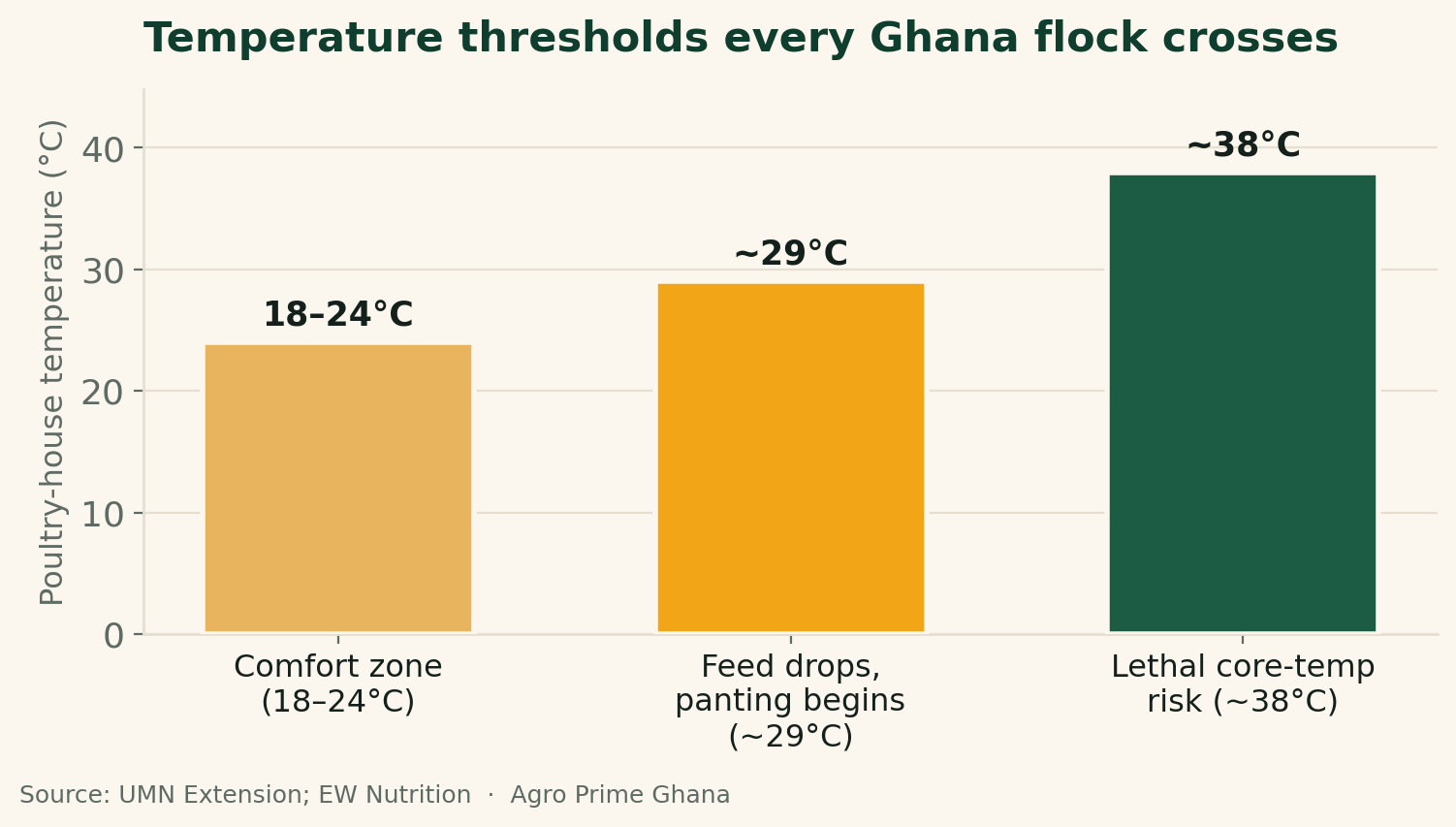
Adult poultry are most comfortable and efficient in a narrow band of about 18–24°C. Birds begin cutting feed intake around 29°C (85°F), and core body temperature reaches lethal levels near 38°C (100°F) of house temperature without relief. A chicken's normal body temperature is around 41°C, and with no sweat glands it loses heat mainly by panting, which humidity blocks. Keep relative humidity between about 50% and 70%: above 70% you get wet litter and rising ammonia, below 50% the house turns dusty. During heat stress birds drink 2–4 times their normal water. The winning strategy in Ghana is airflow at bird level, cool water always available, sensible stocking, roof and ventilation management, and feeding in the cool hours.
The comfort zone is narrower than most keepers think
Poultry are warm-blooded, but unlike us they cannot sweat — a single fact that shapes everything about managing them in a hot climate. A chicken holds its body temperature around 41°C and sheds excess heat mainly through its respiratory tract, by breathing faster and, when pushed, panting, and to a lesser degree by radiating heat from the comb, wattles and unfeathered skin. The range of air temperatures in which a bird can hold its body temperature without spending extra energy is the thermoneutral zone. According to EW Nutrition, the optimum for poultry well-being and performance is roughly 18–22°C, and University of Minnesota Extension places the thermoneutral zone for most poultry at about 60–75°F (roughly 16–24°C). Birds are at their best around 18–24°C — a band a typical uninsulated house in southern Ghana spends much of the day above.
Outside that zone in either direction, the bird pays. When it is too cold, birds burn feed to stay warm and huddle instead of growing; when it is too hot, they cut feed intake and divert energy into panting. Either way, feed that should be building the bird is spent on temperature control — which is why comfort is not a luxury but the difference between a flock that converts feed efficiently and one that eats and disappoints.
Why Ghana's climate pushes flocks over the edge
Two features of our climate make temperature and humidity a year-round job rather than a seasonal worry. The first is straightforward heat. Across the forest and coastal south, daytime temperatures routinely sit in the high twenties to mid-thirties, and inside a metal-roofed house at midday the air can be several degrees hotter still. University of Minnesota Extension notes that at about 85°F (29°C) birds begin reducing feed intake, and that around 100°F (38°C) core body temperatures climb to lethal levels without intervention — not exotic numbers here, since a poorly ventilated house on a still afternoon reaches them regularly.
The second feature is humidity, the one keepers most often overlook. A bird cools itself by evaporating moisture from its airways when it pants; the more humid the air, the less it can shed, so the same temperature is far more dangerous on a muggy day. EW Nutrition puts it plainly: relative humidity "imposes a ceiling on water evaporation and subsequent dissipation of heat." A house at 32°C and low humidity is uncomfortable; the same 32°C at high humidity, common along the coast and through the rains, can tip a flock into serious distress. The harmattan flips the problem: dry air is easier to cool into, but low humidity dries litter to powder and raises dust. Managing a Ghanaian house means managing both dials, and they do not always move together.
Reading temperature: the thresholds that matter
Think of house temperature as a series of thresholds the flock crosses as the day heats up. In the 18–24°C comfort band, birds eat, drink and grow normally and you need only keep air moving. As the house climbs past 29°C, the first thing you lose is appetite — birds ease off feed, and growth and egg output slip before any bird looks obviously sick. Push higher and you see the classic signs of heat stress: wings held out, open-beak panting, birds crowding the coolest spots and drinkers, pale combs and a quiet flock. If house temperature approaches 38°C and birds cannot dump heat fast enough, core temperature rises to a lethal point and you begin losing birds — often the biggest and best first, since they generate the most metabolic heat. The distance between "slightly uncomfortable" and "dying" is only a handful of degrees, which is why afternoon vigilance in the hot season is not optional. Our guide to heat stress in poultry goes deeper into treating an active episode.
Reading humidity: the 50–70% window
Relative humidity is the single most useful indicator of overall air quality in a poultry house, and it has a clear target. University of Georgia poultry-ventilation guidance recommends keeping it between 50% and 70%. Drift above 70% and you invite two linked problems: litter stops drying and turns wet and caked, and ammonia and carbon dioxide climb — the UGA work found that above 70% humidity both tended to rise to potentially harmful levels, breeding footpad burns, coccidiosis and respiratory disease. Drift below 50% — the harmattan scenario — and the house turns dusty, irritating the birds' airways. The table below translates these bands into what you will see and do.
| Reading | What it means | What to do |
|---|---|---|
| Temp 18–24°C | Comfort zone — normal feeding and growth | Keep air moving; nothing more needed |
| Temp ~29°C+ | Feed intake drops, panting begins | Increase airflow, cool water, ease stocking pressure |
| Temp ~35°C+ | Clear heat stress — wings out, heavy panting | Emergency cooling, electrolytes, wet the roof/floor, avoid handling |
| RH below 50% | Dusty air (harmattan), irritated airways | Damp down dust, manage litter, watch respiratory signs |
| RH 50–70% | Ideal — good litter, good air quality | Maintain — this is the target |
| RH above 70% | Wet litter, rising ammonia and CO₂ | Ventilate hard, fix leaks, stir or replace wet litter |
Ventilation: the free tool that does most of the work
The most powerful thing you can do about both heat and humidity costs nothing but design and attention: move air through the house. Ventilation does three jobs at once — it carries heat out, it carries moisture out (keeping humidity in range and litter dry), and airflow across the skin helps birds lose heat directly. University of Minnesota Extension's first recommendation for heat is to prioritise airflow at bird level — the phrase to remember, because air moving high in the roof does little for a bird on the litter. For the open-sided houses common in Ghana, that means orienting the building to catch the prevailing breeze, keeping side openings genuinely open, and adding fans to drive air across the flock on still afternoons. Ventilation is the backbone of temperature and humidity control, so it deserves its own study — see our guide to poultry house ventilation.
Field note: the afternoon walk tells you everything
The reading we trust most is not a gauge but the birds themselves, checked at the hottest part of the day rather than in the cool morning when everything looks fine. A comfortable flock is spread evenly, active and noisy; a flock in trouble is panting with wings lifted, silent, bunched at the drinkers or the coolest wall. A cheap thermometer and a humidity meter at bird height turn that into numbers, but the birds' posture is the alarm that never needs batteries.
Managing the roof and the sun
A large share of a Ghanaian house's heat comes straight through the roof as the sun beats on bare metal and radiates down onto the birds. Affordable countermeasures make a real difference: paint the roof a light, reflective colour; add insulation or a ceiling void where the budget allows; extend the eaves so low sun does not shine onto the birds; and keep shade trees around the house to cut the radiant load without blocking the breeze. On extreme days, wetting the roof with a hose pulls heat away. None of this is high technology; it is the accumulation of small decisions that keep the box the birds live in from turning into an oven.
Stocking density, water and the cool-hour rule
Every bird is a small heater, so how many you pack into a house sets how hot and humid it becomes. Crowding concentrates body heat and moisture, so a house comfortable at sensible density becomes an oven when overstocked; in the hot season it pays to stock a little lighter than the maximum. Water is the other lifeline. During heat stress birds drink two to four times their normal intake, so cool, clean water must be abundant and easy to reach — extra drinkers, topped up through the afternoon, kept out of direct sun. University of Minnesota Extension notes that a potassium-chloride electrolyte solution (around 0.6% for up to three days) can help birds keep drinking through a hot spell.
Finally, use the clock. Digestion generates heat, so a bird eating a big meal at midday fights the sun and its own metabolism at once. A well-tested tactic is to withdraw feed for a few hours before the afternoon peak and feed in the cool of early morning and evening instead. Feed timing pairs naturally with the litter and ventilation practices in our litter management guide.
Field note: humidity is a litter problem in disguise
When keepers ask how to control humidity, the honest answer is usually "look at your litter and your drinkers." Most of the moisture that pushes a house above 70% comes from inside — droppings, leaking water, and poor airflow that lets it hang in the air. We treat a leaking drinker as an urgent job, because a small leak becomes caked litter, which becomes ammonia you smell at the door and footpad sores on the birds. Keeping litter dry and fixing leaks the day you find them does more for humidity than any gadget, and it is free.
Chicks are a different climate altogether
Everything above concerns growing and adult birds, whose enemy is heat. Day-old chicks are the opposite problem: they cannot regulate their own temperature and need a warm brooder, starting around 32–35°C under the heat source and stepped down a few degrees each week until they are feathered. This creates a useful contradiction — the same house kept cool for adults must be kept warm for chicks, and the harmattan that relieves adults can chill a brood overnight. Reading chick behaviour (huddling means cold, spreading to the edges means too hot) is a skill in itself; our brooder temperature chart lays out the week-by-week targets. The principle uniting both stages is the same: watch the birds, measure the air, and keep them in the band where feed builds the bird instead of fighting the weather.
The bottom line on temperature and humidity
Temperature and humidity are the quiet arithmetic behind every flock's performance. Birds do their best in a narrow band around 18–24°C with humidity between 50% and 70%; push much past those and, because a chicken cannot sweat and can only pant, feed that should make meat and eggs is spent staying alive. Ghana's heat and, along the coast and in the rains, its humidity sit close to or above those thresholds for much of the year, while the harmattan swings the house the other way into dry, dusty air. The tools are mostly cheap and mostly about attention: move air at bird level, keep the sun off the flock, do not overcrowd, give abundant cool water, feed in the cool hours, and fix the leaks that drive humidity up. Do that consistently and you keep birds in the zone where they convert feed efficiently — which is the whole point of raising them.
Frequently asked questions
What is the ideal temperature for a poultry house?
What relative humidity should I aim for?
How do I know if my chickens are heat-stressed?
Why is humidity so important, not just temperature?
How much extra water do birds need in the heat?
What is the cheapest way to cool an open poultry house in Ghana?
Does the harmattan cause its own problems?
How does stocking density affect temperature and humidity?
Sources & further reading
- University of Minnesota Extension — Preventing heat stress in poultry (thermoneutral zone, 85°F and 100°F thresholds, 2–4× water intake, airflow at bird level, electrolytes).
- EW Nutrition — Heat stress in poultry (optimum temperature ~18–22°C, role of relative humidity in limiting heat loss).
- University of Georgia poultry-ventilation guidance — Relative humidity as a measure of poultry-house air quality (50–70% target; ammonia and CO₂ above 70%).
- Agro Prime Ghana guides: poultry house ventilation, heat stress in poultry, brooder temperature chart and litter management.
About Agro Prime Ghana
Agro Prime Ghana Limited runs a poultry hatchery and mixed agribusiness in Kasoa, supplying day-old chicks and working alongside poultry keepers across the country. These guides draw on that hands-on hatchery and farm experience, checked against current technical references. This article is general educational information, not a substitute for advice from a qualified veterinary or extension officer for your specific flock and housing. Need chicks, feed advice or farm support? Book a visit or message us on WhatsApp (+233 24 915 1503).