In Ghana's heat, a poultry house should be built with its long axis running east–west, so the sun only ever strikes the two short end walls and never beats down the length of the open sides. That single free decision — made before you lay a block — keeps the low, fierce morning and evening sun off your birds, lets the prevailing breeze blow straight through the house, and can be the difference between a flock that pants and stops eating by midday and one that stays cool and keeps growing. Orientation costs nothing and cannot be changed once the house is up, yet it is one of the most powerful heat-stress defences you have in a country where the daytime average already sits above the temperature at which birds start to suffer. This guide explains how to orient a poultry house in Ghana, and why it matters so much.
Written by the Agro Prime Ghana hatchery team and reviewed against current industry and extension references (FAO small-scale poultry guidance and university poultry-housing literature). Last updated September 2026.
Key takeaways
Build the house with its long axis east–west so direct sun hits only the short end walls — the FAO confirms this "helps to minimize exposure to direct sunlight" in the tropics. Turn the open long sides to face the prevailing wind (along the coast, the south-west sea breeze most of the year) so air blows across the birds. Keep the house narrow (about 8 m, 12 m at most) so the breeze reaches every bird. Give the roof a wide overhang of at least a metre (3.5 ft) to shade the walls and keep rain out, a steep pitch (around 42–45°) for air space and storm resistance, and a white or reflective top surface that FAO says can reflect up to 70% of the sun's heat. This matters because Ghana's daytime average of about 29–30°C already exceeds the roughly 26–27°C at which heat stress begins, so every degree you keep out of the house counts.
Why orientation matters so much in Ghana's climate
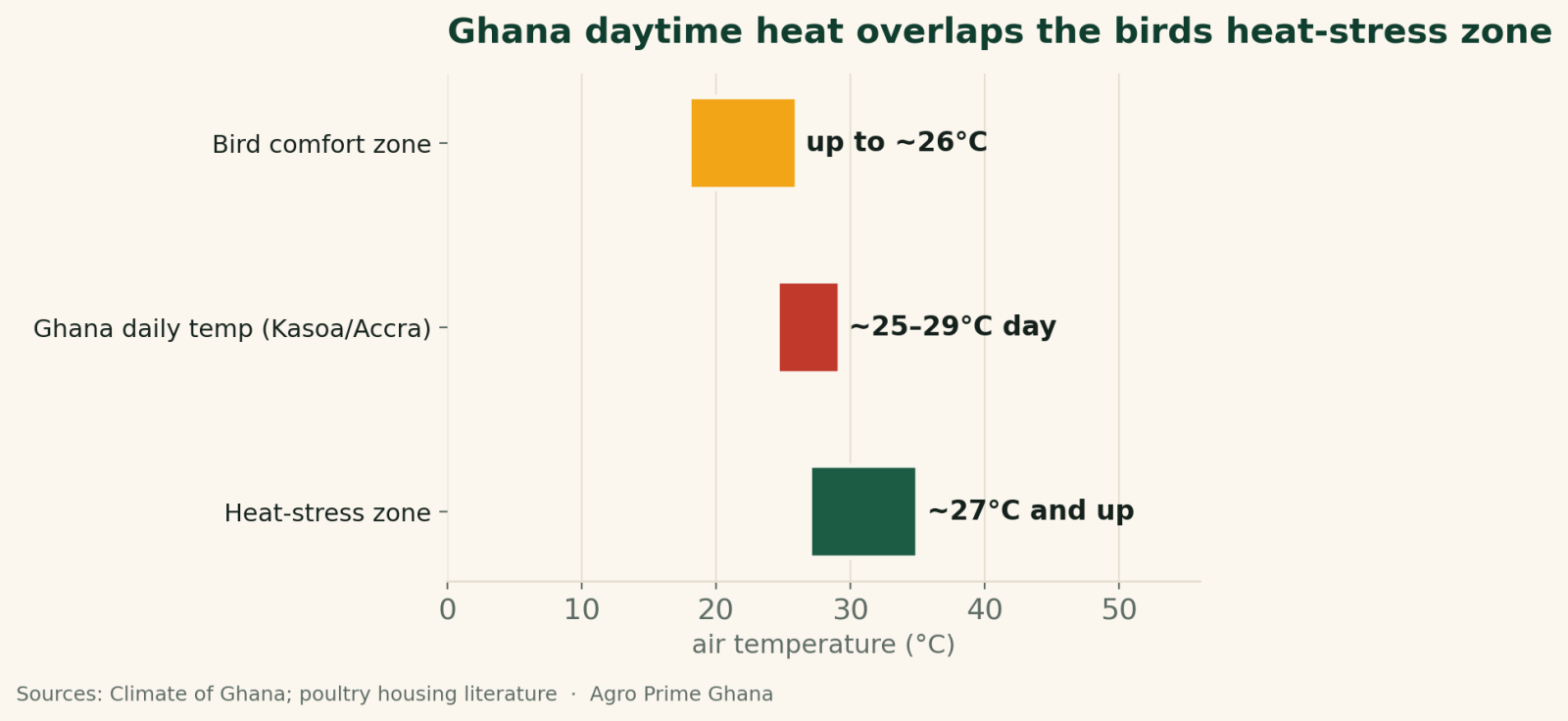
Orientation matters because Ghana is hot enough, for enough of the year, that birds are already close to their heat-stress limit before you add any sun at all. Around Kasoa and Accra the daytime temperature averages roughly 29–30°C, dropping to about 24–25°C at night, with relative humidity often between 77% and 85% — warm, muggy air that makes it hard for a bird to shed heat. Poultry-housing literature puts the point at which chickens begin to suffer heat stress at around 26–27°C, which means a typical Ghanaian afternoon is already over the line for the flock. High humidity makes it worse, because birds cool themselves largely by panting, and panting works poorly when the air is already saturated. Now add direct sun pouring onto a badly-oriented house through the long open sides, and a roof radiating heat downward, and you have birds that stop eating, drink frantically, spread their wings, pant — and, in the worst cases, die in the hottest part of the afternoon. Orientation is your first, free line of defence in this fight, working alongside good ventilation and active heat-stress management.
The east–west rule: why the long axis faces the sun's short ends
The core rule is simple: run the length of the house east–west, so the sun travels along the roof from one short end to the other and never shines directly down the long open sides. Because the sun rises in the east and sets in the west, a house whose long axis points east–west presents only its two narrow end walls to the low, punishing morning and evening sun — the times of day when sunlight comes in at a flat angle and can reach deep inside a building. The long sides, where your birds sit and where the open mesh or curtains are, face north and south and stay shaded by the roof for most of the day. Turn the house the other way — long axis north–south — and every afternoon the western long side takes the full, low, blazing sun straight onto the birds. The FAO's small-scale poultry guidance states plainly that in warm climates "an east–west orientation of the length of the building helps to minimize exposure to direct sunlight," the opposite of the advice for cold countries where you deliberately let the sun in. This is why the east–west long axis is close to universal in tropical poultry design, and why getting it wrong is such an expensive, permanent error.
Working with the wind, not just the sun
Orientation is a balancing act between blocking the sun and catching the wind, and in Ghana you usually get to do both. While the long axis wants to run east–west for shade, the open long sides also need to face the prevailing wind so that natural ventilation can carry heat, moisture and ammonia out of the house. Fortunately, along the southern coast the dominant airflow for much of the year is the moist south-west breeze off the sea, so a house oriented east–west naturally presents a long side toward that south-westerly flow — sun control and wind capture line up rather than fight each other. From about December to March the dry, dusty harmattan blows from the north-east instead, bringing cooler nights but fine dust that irritates birds' airways; a house open on both long sides can be managed with curtains to take the cooling breeze while shielding birds from the worst of the dust. The practical rule is: fix the east–west long axis first for sun control, then orient and open the long sides to catch the prevailing breeze, and use curtains or adjustable sidewalls to fine-tune airflow through the seasons.
| Design feature | Recommended in Ghana | What it does |
|---|---|---|
| Long axis | East–west | Keeps direct sun on the short end walls, off the birds |
| Open long sides | Face prevailing wind (south-west breeze on the coast) | Let the breeze blow across the flock for natural cooling |
| House width | ~8 m (12 m maximum) | Lets wind reach every bird; avoids a stagnant middle zone |
| Roof overhang | At least 1 m (3.5 ft) | Shades the walls from sun and keeps driving rain out |
| Roof pitch | ~42–45° | Adds air space above birds; sheds storm rain; resists wind |
| Roof top surface | White / reflective (aluminium or white paint) | Reflects up to ~70% of the sun's heat away from the house |
| Spacing to next house | Generous — not blocking the wind | Keeps every house in fresh, moving air |
The roof: overhang, pitch and colour
Once the house is turned the right way, the roof is your next-biggest lever on heat, and its overhang, pitch and colour all pull in the same direction. A generous overhang — extension guidance recommends the eaves project at least 1 metre (about 3.5 feet) beyond the walls — throws shade onto the sidewalls so the sun does not strike them directly, and it stops driving rain from blowing in through the open sides during storms. A steep pitch, around 42–45°, does two jobs: it creates a tall pocket of air above the birds so heat rises well clear of them, and it sheds the heavy rains of the wet season while standing up to storm winds. And the colour and material of the top surface matter enormously: the FAO notes that a white or aluminium-painted roof can reflect "up to 70 percent of incident solar heat radiation," so a light, reflective roof stays far cooler than a bare dark one and radiates far less heat down onto the flock. A dark or rusted roof, by contrast, absorbs the sun and becomes a heater above your birds all afternoon. Between orientation and a good reflective roof, you can keep an enormous amount of the sun's energy out of the house before you spend a cedi on fans or foggers.
Field note: check the house at 3 p.m., not 9 a.m.
A house can look perfectly cool and comfortable when you walk it in the morning and be an oven by mid-afternoon — and the afternoon is when heat kills. When we assess orientation on a farm, we look at where the sun falls at around 2–4 p.m.: is it landing on the birds through an open side, or only on an end wall? Are the birds along one side panting and crowding away from a sunlit wall? Watch the flock itself — birds spreading their wings, panting with open beaks, going off feed and crowding to the coolest end are telling you the house is taking too much heat. If a house is already built facing the wrong way, you cannot rotate it, but you can fight back with shade cloth on the sunny side, a reflective roof coat, extra ventilation and more space per bird. Orientation done right just means you rarely have to.
Spacing, width and letting the breeze through
Good orientation only pays off if the wind can actually reach the house and pass through it, which brings in width and spacing. A house that is too wide defeats natural ventilation no matter how well it is turned, because the breeze stalls before it crosses the building and a stagnant, hot, humid core forms down the middle — this is why FAO advises naturally-ventilated houses stay under about 8 m wide, and other guidance caps it around 12 m. Just as important is spacing: if the next house upwind sits too close, it blocks and staleness the air before it ever reaches yours, so houses must be well separated, laid out so none stands in another's wind shadow. This is where orientation ties directly into overall poultry house construction and site planning — the house has to be narrow enough, spaced far enough, and turned correctly, all three together, for the breeze to do its cooling work. Getting the axis right but building the house too wide, or jammed against the last one, wastes the advantage.
Beat the heat from the ground up — get your housing and stock right
Orientation, roof and ventilation decide how hard your birds have to work against the heat, and the stock you start with decides how well they cope. Agro Prime Ghana advises poultry keepers on housing and farm setup — orientation, roofing and airflow for our climate — and we supply strong, vaccinated day-old chicks (broiler and layer), point-of-lay pullets and quality feed to give your flock the best start in a hot country. Planning a new house or struggling with heat in an existing one? Book a setup consultation and we'll help you get the design and the birds right. Message us on WhatsApp (+233 24 915 1503) or book a visit.
What to do if your house already faces the wrong way
If your house is already built with the wrong orientation, you cannot turn it, but you can blunt the worst of the heat with a series of retrofits. Hang shade cloth or woven mats on the sun-struck side to intercept direct sunlight before it reaches the birds. Coat the roof with white reflective paint or fit a reflective layer to cut the heat radiating down. Add an extended overhang or verandah on the sunny side to push the sun-line away from the wall. Improve airflow with more open sidewall area, adjustable curtains, and fans or foggers if you can power them. Crucially, reduce stocking density so each bird has more room to shed heat, provide cool, clean water in abundance (birds drink far more in heat), and shift heavy feeding to the cooler early morning and evening. None of these fully replace correct orientation, but together they can pull a badly-turned house back from dangerous to manageable. And when you build the next house, get the axis right from the first block — it is the one heat defence you never have to pay for again.
The bottom line on poultry house orientation in Ghana
In Ghana's hot, humid climate, orientation is the cheapest and most permanent heat-stress defence you have. Build every house with its long axis east–west so the sun only touches the short end walls; open and face the long sides to the prevailing south-west breeze so the wind blows across the flock; keep the house narrow and well spaced from its neighbours so that breeze actually gets through; and top it with a steep, wide-overhanging, white reflective roof that throws most of the sun's heat straight back at the sky. Because the daytime average already sits above the temperature where heat stress begins, every one of these free or cheap decisions keeps birds eating, growing and alive through the hottest afternoons. Make them on paper, before you build — orientation is the one thing you truly cannot fix later.
Frequently asked questions
Which direction should a poultry house face in Ghana?
Why is east–west orientation better than north–south in the tropics?
How does orientation reduce heat stress?
How much should a poultry house roof overhang the walls?
Does roof colour really affect house temperature?
Which way does the prevailing wind blow in southern Ghana?
Can I fix a poultry house that faces the wrong way?
How wide should a naturally-ventilated house be for good airflow?
Sources & further reading
- FAO — Small-scale poultry production: housing and management (east–west orientation, house width, roof overhang and pitch, reflective roofing).
- TNAU Agritech Portal — Poultry House Construction (long-axis orientation, roof overhang, house dimensions).
- Wikipedia — Climate of Ghana (temperature, humidity, rainy season and harmattan).
- Agro Prime Ghana guides: poultry house ventilation, heat stress in poultry, building a low-cost poultry house, and layer house design.
About Agro Prime Ghana
Agro Prime Ghana Limited runs a poultry hatchery and mixed agribusiness in Kasoa, helping poultry keepers across the country build and stock farms suited to our climate. We supply healthy day-old chicks (broilers and layers), point-of-lay pullets, quality feed and hands-on farm support, including advice on house design, orientation and heat management. This article is general educational information, not a substitute for professional advice for your specific site. Building or fixing a house for the heat? Book a visit or message us on WhatsApp (+233 24 915 1503) to order chicks, feed or a setup consultation.