A SWOT analysis for a Ghanaian poultry business is a one-page audit of four things: your Strengths and Weaknesses (which are inside your farm and within your control) and the Opportunities and Threats (which are out in the market and mostly beyond it). Done honestly, it turns a vague feeling that "poultry is hard right now" into a clear map of where you have an edge, where you are exposed, what to chase, and what to defend against — before those forces cost you money. For poultry in Ghana this framework is unusually powerful, because the sector's realities are stark and well documented: a huge, growing appetite for chicken on one side, and cheap imported frozen chicken plus punishing feed costs on the other. This guide gives you the framework and a full worked example you can adapt to your own farm today.
Written by the Agro Prime Ghana poultry team and reviewed against current industry references (USDA/FAS Ghana Poultry reports and peer-reviewed research on Ghana's poultry sector). Last updated September 2026.
Key takeaways
SWOT sorts your poultry business into Strengths and Weaknesses (internal, controllable) and Opportunities and Threats (external, market-driven). In Ghana the biggest opportunity is a market where consumption has grown to about 13 kg per person and roughly 79% of chicken is still imported — vast unmet demand for local birds and eggs. The biggest threats are cheap frozen imports (priced at under half of local chicken) and feed costs running near 70% of production cost. Common internal weaknesses are small scale, weak biosecurity and ~10% mortality in our climate; common strengths are freshness, festival demand and closeness to customers. The point of SWOT is action: play your strengths into the opportunities, and fix or hedge the weaknesses the threats can exploit.
What a SWOT analysis is and why it fits poultry
SWOT is a simple strategic tool that maps four factors — Strengths, Weaknesses, Opportunities and Threats — onto a two-by-two grid, so you can see your competitive position at a glance. The crucial discipline is the split between internal and external. Strengths and weaknesses live inside your farm: your flock health, your feed strategy, your management skill, your capital, your customer relationships — things you can change. Opportunities and threats live in the wider market: consumer demand, import competition, feed prices, disease pressure, policy — things you must respond to rather than control. Confusing the two is the most common mistake; "high feed prices" is a threat (external), while "we have no plan to manage feed cost" is a weakness (internal), and the fixes are completely different.
Poultry suits SWOT well because the external forces acting on a Ghanaian farm are large, well understood and largely shared across the industry — which means your fate is decided mostly by how well your internal position is set up to meet those forces. A farm with the same feed prices and the same imports as its neighbour can be profitable while the neighbour fails, purely on internal strengths. SWOT is how you find and press that advantage. It pairs naturally with a feasibility study and a business plan: feasibility asks "should we do this?", SWOT asks "where do we stand and what should we do about it?", and the plan turns the answers into action.
Why the external picture matters so much in Ghana
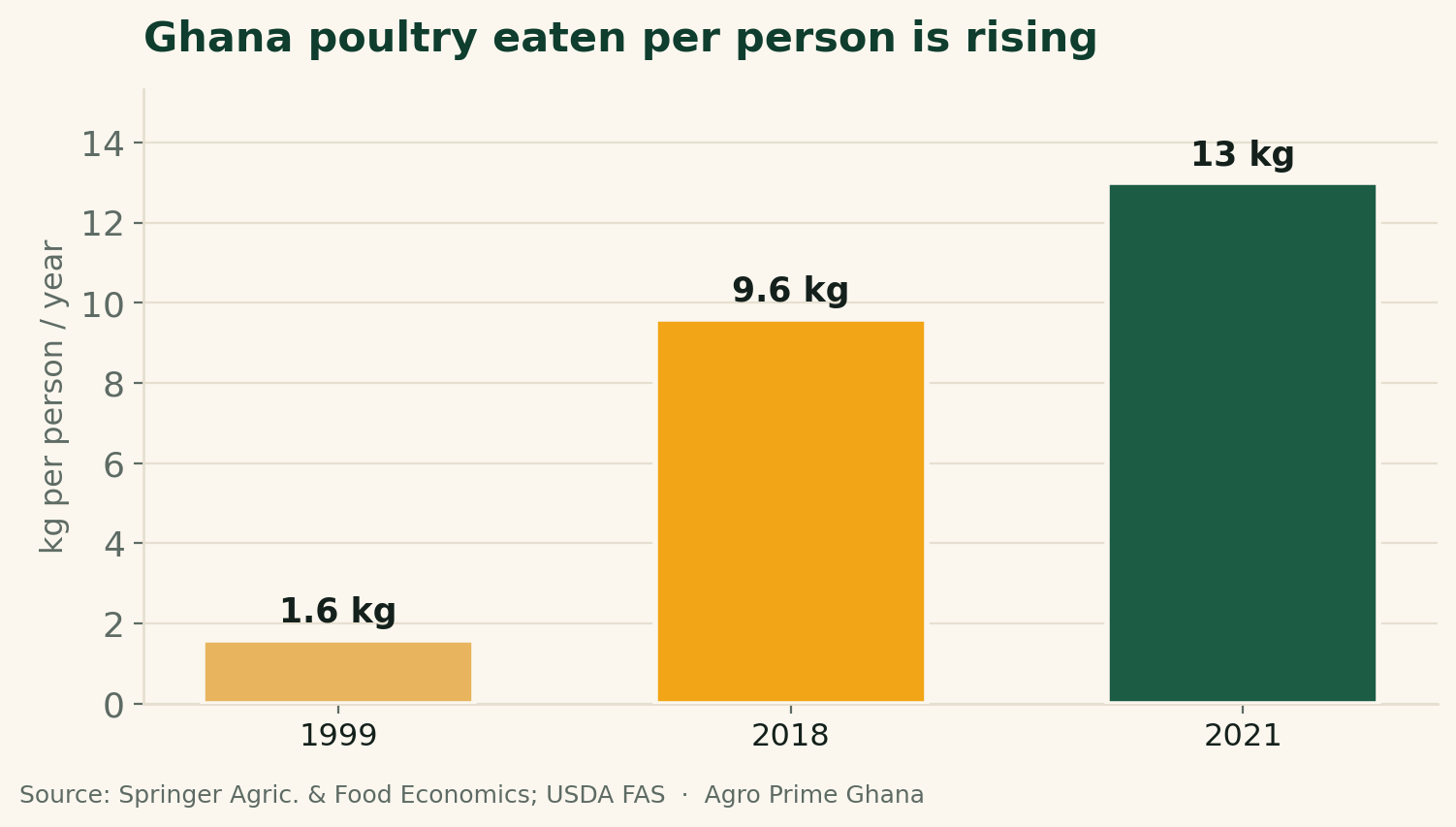
Before the worked example, it helps to be clear-eyed about the external forces, because they define most farms' opportunities and threats. The demand side is genuinely encouraging. Ghanaian per-capita poultry consumption rose from roughly 1.6 kg in 1999 to about 9.6 kg by 2018, reaching around 13 kg by 2021, according to research in Agricultural and Food Economics and the USDA Foreign Agricultural Service. Urbanisation, population growth and rising incomes are pushing that number up. That is a powerful, durable opportunity.
The threat side is equally real. Most of that growing demand is met by imports, which supply about 79% of the chicken meat Ghanaians eat, and local broiler self-sufficiency sits near 5%. Imported frozen cuts sell for less than half the price of local chicken, so competing on price is a losing game. And the cost side bites hard: feed is roughly 70% of production cost per Ghanaian profitability research in Scientific African, driven by maize and soybean prices you cannot control. Overlay the climate — commercial mortality reported near 10%, more than double temperate-country rates — and you have the shared external reality every Ghanaian poultry farm faces. Your SWOT's job is to position your farm to win inside it.
A worked SWOT example: a small Kasoa-area layer and broiler farm
Let us make this concrete with a realistic example: a small farmer near Kasoa running a few hundred layers and a rotating batch of broilers, selling eggs to local shops and live birds around festivals. The point is not that your farm is identical — it is to show how each quadrant is filled with honest, specific entries rather than vague ones. A weak SWOT says "good quality." A useful SWOT says "fresh eggs delivered same-day to twelve nearby shops, a service imports cannot match." Specificity is what makes it actionable.
| Internal — Strengths | Internal — Weaknesses |
|---|---|
| Fresh, local birds and eggs — a real edge over frozen imports; same-day delivery to nearby shops and chop bars | Small scale (a few hundred birds) means higher per-bird cost and little bargaining power on feed |
| Close to Accra/Kasoa markets and festival demand; strong personal customer relationships | No buffer against feed price spikes; feed bought bag-by-bag at retail prices |
| Owner does daily husbandry — quick to spot sick birds and act | Biosecurity gaps and hot, still housing pushing mortality toward or above 10% |
| Flexible product mix (eggs for steady cash, broilers for festival peaks) | Thin working capital; risk of running short of feed before birds are sold |
| External — Opportunities | External — Threats |
|---|---|
| Large, growing demand (~13 kg/person) that local farms supply only a fraction of | Cheap imported frozen chicken at under half the local price |
| Consumer preference for fresh local chicken, especially at Christmas, Easter and festivals | Volatile maize and soybean prices driving feed cost (~70% of total cost) |
| Premium buyers — hotels, restaurants, egg wholesalers — wanting reliable local supply | Disease pressure (Newcastle, Gumboro, coccidiosis) and climate-driven mortality |
| Value-add options: dressed/branded chicken, direct sales, out-grower schemes | Exchange-rate and input-cost swings; unreliable power and water in places |
How to read your Strengths — and turn them into money
Strengths are the internal advantages that let you compete despite the threats, and the most valuable ones are those imports and big frozen suppliers cannot copy. Freshness is the classic example: a frozen thigh shipped from Europe cannot match a live or freshly dressed bird sold the same day, and Ghanaian consumers reward that, particularly at festivals. Proximity is another — same-day delivery to a cluster of nearby shops and chop bars is a service, not just a product. So is a hands-on owner who walks the flock daily and catches disease early, and personal relationships that turn one-off buyers into standing orders. When you list a strength, ask the killer question: does it give me an edge a frozen import or a distant farm cannot? If yes, it belongs at the centre of your strategy — and your marketing.
Field note: your best strength is usually a relationship, not a bird
Over years of working alongside small keepers, the ones who stay profitable are rarely those with the fanciest houses — they are the ones who own their customers. A farmer who has ten shopkeepers, a hotel kitchen and a few caterers on WhatsApp, taking eggs or birds every week and paying on time, has something no importer can undercut: trust and convenience. Frozen chicken competes on price; it cannot deliver twelve trays of fresh eggs to your regular shops by 8 a.m. When you do your SWOT, list every customer relationship as the asset it is, protect it fiercely, and grow it before you grow the flock. Demand you have already secured is worth more than birds you hope to sell.
How to read your Weaknesses — the part it is tempting to skip
Weaknesses are the internal gaps that the external threats can exploit, and an honest list here is the most valuable part of the whole exercise — precisely because it is uncomfortable. The most common weaknesses on Ghanaian small farms are structural: small scale (higher per-bird cost, no bargaining power on feed), no strategy for feed price swings, biosecurity gaps that let disease in, hot poorly ventilated housing that lifts mortality, and thin working capital. Notice how each weakness lines up against a specific threat: small scale versus feed-price volatility; weak biosecurity versus disease pressure; poor housing versus the climate; thin cash versus long feeding periods. That pairing is the whole point — a weakness only matters because a threat can walk through it.
The good news is that weaknesses are internal, so you can act on them. You cannot lower the world price of maize, but you can reduce your feed cost per bird through better feed conversion, bulk buying or on-farm mixing — see reducing poultry feed cost. You cannot stop disease existing, but you can tighten biosecurity and buy strong, vaccinated chicks. Every weakness you close narrows a door the market's threats were counting on.
How to read Opportunities without kidding yourself
Opportunities are favourable external trends you can position to capture — but only if a matching strength lets you reach them. The headline opportunity in Ghana is the sheer size of unmet demand: with about 79% of chicken imported and consumption still climbing, local producers who can deliver quality and reliability have a wide-open field. Within that, the sharpest, most reliable opportunity for small farms is the festive market — Christmas, Easter and other celebrations, when consumers actively prefer and will pay more for fresh local chicken. Timing broiler batches to hit those peaks is one of the clearest ways a small farm converts a national trend into cash; our guide on selling live birds at festivals covers the mechanics. Other real opportunities include premium institutional buyers (hotels, restaurants, wholesalers) wanting dependable local supply, and value-add moves like branded dressed chicken or out-grower arrangements.
The discipline here is to only claim an opportunity you can actually serve. "Huge national demand" is not your opportunity unless you have a strength — proximity, freshness, a relationship, spare capacity — that lets you supply some slice of it profitably. Opportunities matched to strengths are strategy; opportunities you cannot reach are just daydreams.
How to read Threats — and hedge the ones that can sink you
Threats are external forces that can damage your business, and in poultry two dominate. The first is import competition: frozen chicken at under half the local price means you can almost never win on price, so a farm whose only pitch is "cheaper" is exposed. The strategic response is not to fight on price but to compete where imports are weak — freshness, festivals, live birds, relationships, speed of delivery. The second is feed cost: with feed at around 70% of production cost and maize and soybean prices volatile, a feed spike can wipe out a thin margin overnight. The response is to hedge — improve feed conversion, buy well, keep a feed reserve, and stress-test your economics against a 20% feed rise so a bad month does not become a closed farm.
Field note: the threat that quietly closes farms is a feed spike met with no reserve
Of all the threats on the grid, the one we have watched end the most small farms is not a dramatic disease outbreak — it is a feed price jump that arrives when the keeper has no buffer. Maize climbs after a poor harvest or a weak cedi, the margin was already thin, and there is no cash reserve and no cheaper feed plan to fall back on. The farms that survive those months are the ones whose SWOT flagged "no feed-price hedge" as a weakness in advance and did something about it: a modest feed reserve, a bulk-buying arrangement, better feed conversion, or a mixing option. Name that exposure before the price moves, because after it moves your options are gone.
Disease and climate round out the list: Newcastle, Gumboro and coccidiosis remain constant pressures, and the heat that pushes mortality toward 10% is always there. These threats are hedged with biosecurity, vaccination, good ventilation and strong chicks — internal actions against external dangers. The value of naming threats explicitly is that it moves them from vague background worry into a checklist of specific defences you can put in place before, not after, they cost you a flock.
Turn your SWOT into your stocking plan — with the right chicks
A SWOT is only useful if it changes what you do next. If your analysis says your edge is freshness and festival demand (strengths and opportunity) but your exposure is mortality and feed cost (weaknesses and threats), the practical move is to stock strong, healthy, well-vaccinated chicks on a batch schedule timed to your market. That is exactly what we help with at Agro Prime Ghana — day-old broilers and layers and point-of-lay pullets bred and raised for local conditions, plus advice on timing batches to festival peaks and feeding them efficiently. Want to translate your SWOT into a concrete stocking and feeding plan? Message us on WhatsApp +233 24 915 1503 or book a visit.
From grid to action: making SWOT actually change your farm
A SWOT that sits in a drawer is worthless; the value comes from the four moves it points to. First, match strengths to opportunities — this is your growth engine (fresh local eggs into a market hungry for them; broilers timed to festivals you are close to). Second, use strengths to defend against threats — freshness and relationships to blunt import competition. Third, fix or shore up weaknesses before threats exploit them — tighten biosecurity ahead of disease season, build a feed buffer ahead of price spikes, ring-fence working capital before the next batch. Fourth, be honest about weaknesses that meet threats head-on — where you are both exposed and under external pressure, either fix it fast or avoid that ground entirely (for example, do not try to compete head-to-head with imports on price if your scale gives you no cost advantage).
Redo the exercise at least once a year, and whenever something big shifts — a feed price surge, a new competitor, a disease outbreak nearby, a chance to supply a hotel. A SWOT is a snapshot; the market moves, and so should your reading of it. Pair it with good record keeping so your entries are grounded in your own numbers rather than impressions, and it becomes one of the sharpest, cheapest management tools you own.
The bottom line on SWOT for Ghanaian poultry
A SWOT analysis converts the messy reality of running poultry in Ghana into four clear lists and, from them, a plan. The external picture is fixed and shared: strong, growing demand around 13 kg per head, but roughly 79% of it captured by cheap imports, feed at some 70% of cost, and a climate that pushes mortality toward 10%. Within that, your farm's fortune turns on internal factors you control — freshness, proximity, relationships and management on the strength side; scale, feed strategy, biosecurity and working capital on the weakness side. Fill each quadrant with specific, honest entries; then play your strengths into the opportunities, defend with them against the threats, and close the weaknesses the threats are waiting to exploit. That is how a small Ghanaian poultry farm wins on a field it did not design.
Frequently asked questions
What is a SWOT analysis for a poultry business?
What are the main strengths of a Ghanaian poultry farm?
What are the biggest threats to poultry farming in Ghana?
What is the difference between a weakness and a threat?
What is the biggest opportunity for poultry farmers in Ghana?
How do I turn a SWOT analysis into action?
How often should I do a SWOT analysis?
Is a SWOT analysis the same as a business plan?
Sources & further reading
- Agricultural and Food Economics (Springer) — Aligning policy for success: evidence from the poultry sector of Ghana (consumption trends, import dependency, mortality, production structure).
- USDA Foreign Agricultural Service — Ghana Poultry Voluntary Update 2024 (production vs imports, per-capita consumption, broiler self-sufficiency, feed prices).
- Scientific African — Profitability and choice of feed among poultry producers in Ghana (feed at ~70% of production cost).
- The Poultry Site — Overview of Ghana's struggling poultry sector.
- Agro Prime Ghana guides: poultry feasibility study, business plan, broiler vs layer profit, selling live birds at festivals, and reducing feed cost.
About Agro Prime Ghana
Agro Prime Ghana Limited runs a poultry hatchery and mixed agribusiness in Kasoa, working alongside poultry keepers across the country. We supply healthy day-old chicks (broilers & layers), point-of-lay pullets, quality feed and hands-on farm support, and we help farmers turn a plan on paper into a flock that pays. This article is general educational information, not a substitute for professional business advice tailored to your farm. Ready to start or expand? Book a visit or message us on WhatsApp (+233 24 915 1503) to order chicks, feed or advice.


