Poultry farming can be profitable in Ghana, but it does not guarantee a return. Profit on a broiler batch depends on the price of day-old chicks, the cost of feed, how many birds die, how well disease is controlled and the price you receive when the birds are sold. Each of these can move sharply within a single cycle of about six to seven weeks. The demand case is real: Ghana imports most of the poultry it eats, which gives local producers a large market to serve. The risk is equally real, so the useful question for an investor is not "is poultry profitable?" but "under what conditions does this particular operation make money, and what happens when those conditions change?"
Written by the Agro Prime Ghana team and reviewed against current market references (Bank of Ghana; Ghana Statistical Service figures as reported). Last updated October 2026. General information, not financial advice.
Key takeaways
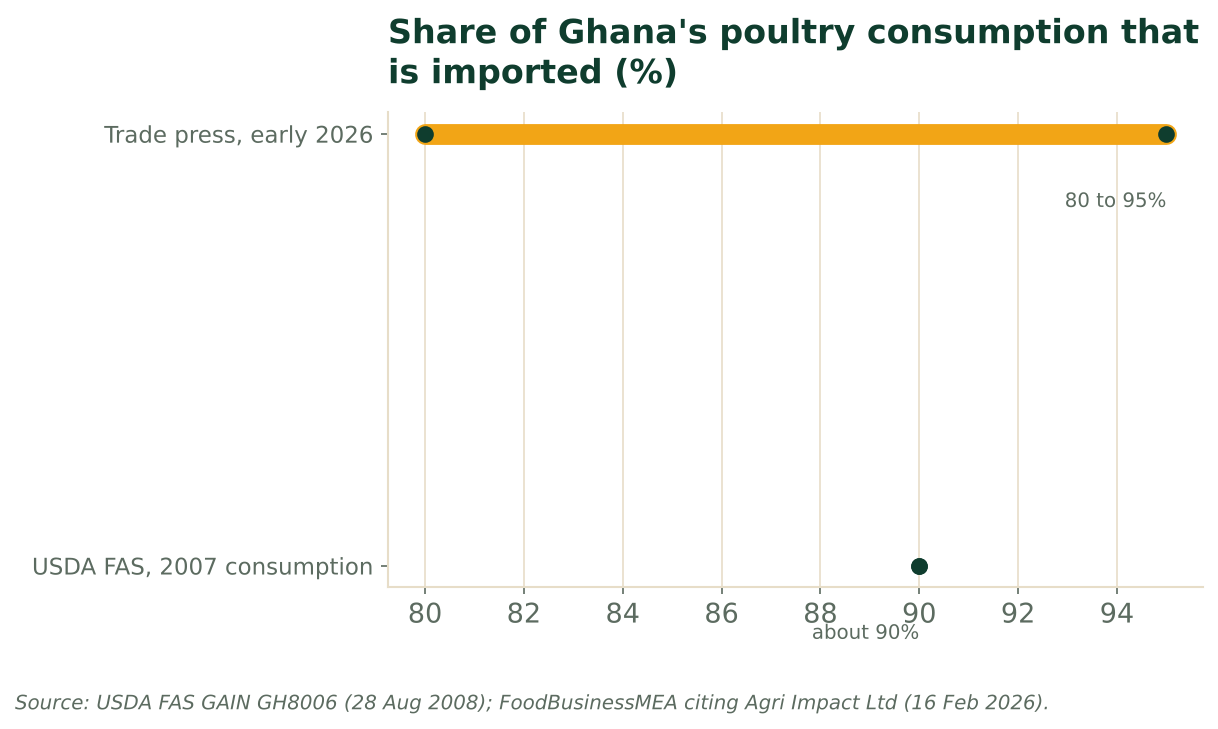
Ghana imports most of its poultry: nearly 90% of 2007 consumption per USDA FAS, and 80 to 95% per trade-press reporting in February 2026. Maize makes up 50 to 55% of poultry feed and soybean about 30%, per the Association of Feed Millers of Ghana (reported February 2025). A 2022 Cobb 500 supplement gives a day-42 target of about 3.28 kg live weight, a target and not a promise. As a benchmark, the 91-day Treasury bill yielded 4.62% in the auction reported on 18 October 2026, and the 364-day yielded 9.71%.
What "profitable" should mean to an investor
A batch is not yet a business. A broiler batch is profitable only if the money from selling birds is larger than every cost of raising them. Those costs include the chicks, feed, medicines and vaccines, litter, electricity, water, transport to market, labour, and an allowance for birds that die before sale. First-time calculations often leave out one or two of these, usually on the cost side.
An investor also needs to look beyond the batch. A farm rarely fills its sheds for fifty-two weeks a year, because each house must be cleaned, disinfected and rested between batches. A good margin on each batch can still produce a modest return on the capital tied up in buildings and equipment if only a few batches run each year. Ask for both the margin per batch and the batches per year, and ask what comparable batches actually made.
The demand case: Ghana imports most of its chicken
The demand argument rests on a simple gap between what Ghanaians eat and what local farms produce. The USDA Foreign Agricultural Service reported in 2008 that poultry meat imports supplied nearly 90% of Ghana's 2007 consumption, with domestic commercial and backyard production supplying about 11%. Its 2017 report forecast imports of about 158,000 tons against local broiler meat production of about 35,000 tons, and said domestic output was supplying less than a quarter of demand. Those 2017 figures were forecasts, not measured outturns, and should be read as such.
More recent reporting points the same way. In February 2026, FoodBusinessMEA reported that poultry imports remain between 80 and 95% of total consumption, citing analysts at Agri Impact Limited, and that the government wants to expand domestic production to ten times current levels. That is secondary reporting rather than a primary government statistic, so treat the exact share as indicative. The direction is consistent across sources and years, and it is the reason local producers can find buyers.
The gap is also a warning. Imported frozen chicken sets a price benchmark that local birds must meet, and that price follows global supply and the exchange rate. A large market is not the same as a profitable one.
| Option | Horizon | Liquidity | Main risk | Dated reference |
|---|---|---|---|---|
| 91-day Treasury bill | 13 weeks | High; repaid at maturity | Yield changes at each auction; may trail inflation | 4.62%, reported 18 Oct 2026 |
| 364-day Treasury bill | 1 year | Lower before maturity | Yield changes; may trail inflation | 9.71%, reported 18 Oct 2026 |
| Broiler batch via a profit-share partnership | About 6 to 7 weeks of grow-out, plus setup and cleaning | Low until the batch is sold and settled | Disease, mortality, feed and sale price; operator performance | Terms set in writing; no guaranteed return |
| Own small broiler farm | Set by build time and cycle length | Low; capital sits in birds, buildings and equipment | All of the above, plus your own management and labour | Build and running costs must be quoted locally |
| Listed equities on the GSE | Flexible | Moderate; depends on the stock | Price swings; the GSE-CI rose 71.9% year to date to August 2026, but past gains do not predict future ones | Via licensed brokers |
Where the money is made and lost
Feed is usually the largest running cost, and its price is the biggest source of uncertainty. The Association of Feed Millers of Ghana said maize makes up 50 to 55% of poultry feed and soybean about 30%, so the two ingredients together account for most of the formula. Reporting in early 2025 linked sharp feed price rises to drought in northern Ghana, which cut maize output and pushed up the cost of a 50-kilogram bag.
Feed conversion matters more than most first-time investors expect. The 2022 Cobb 500 performance supplement lists a mixed-sex day-42 target of about 3.28 kg live weight, with cumulative feed intake of about 5.10 kg and a cumulative feed conversion of 1.555. Feed conversion is the kilograms of feed needed per kilogram of live weight gained. If real birds convert feed less efficiently, the feed bill rises even when the birds look healthy. Each extra 0.1 in feed conversion at a 3.28 kg target means about 0.33 kg more feed per bird sold.
Mortality is the other large lever. A bird that dies still eats feed up to the point of death, and the cost of the chick is lost. Disease control, vaccination, biosecurity and house management are therefore not side issues. They determine how many birds reach the scale.
| Driver | Why it matters | Question to ask the operator |
|---|---|---|
| Feed price and supply | Often the largest running cost; maize and soybean prices feed through to the formula | How is feed bought, stored and priced across the batch, and what happens if prices rise mid-cycle? |
| Feed conversion | Each point of conversion drives feed tonnage and cost | What conversion has been achieved on recent batches, not just the target? |
| Mortality | Dead birds consume feed and erase the chick cost | What mortality has been recorded per batch, and how was it counted? |
| Sale price | Prices can fall when many producers sell at the same time | Who buys the birds, at what price basis, and is there a contract? |
| Chick quality | Weak or poorly vaccinated chicks raise mortality and reduce growth | What vaccination and hatchery records come with each batch? |
A worked illustration (an example, not a forecast)
The arithmetic below uses assumptions you must check. It is a way of seeing how the numbers interact, not an estimate of what any farm will earn. The formula is simple: gross sales equal birds sold, multiplied by average live weight, multiplied by the price per kilogram you actually receive. Profit is gross sales minus every cost in the batch budget.
Assume 1,000 chicks are placed, mortality is 5% (so 950 birds are sold), and the average live weight at sale is 3.0 kg, slightly below the 3.28 kg target to reflect real farms. Multiply 950 by 3.0 kg to get 2,850 kg of live birds sold. At your own quoted price per kilogram, gross sales follow directly. You then subtract the chick cost, the feed bill (the feed tonnage multiplied by the delivered price per tonne), medicines, vaccines, labour, transport and running costs. What is left is the batch margin before any share of overheads.
The useful part is the sensitivity, which does not depend on any local price. The table below shows how single changes move the result.
| Change from the example | Effect on gross sales | Effect on feed cost | Why it hurts the margin |
|---|---|---|---|
| Sale price 10% lower | Down 10% | No change | Revenue falls while every cost stays |
| Mortality rises from 5% to 10% | Down about 5.3% (900 birds instead of 950) | Roughly unchanged, since dead birds have already eaten | Lost birds carry their full feed and chick cost |
| Feed conversion rises from 1.555 to 1.655 | No change | Up about 6.4% for the same weight gain | More feed per kilogram sold |
| Feed price 10% higher | No change | Up 10% | Feed is a large share of running cost |
In a bad season these changes can combine, hitting one batch from several directions at once. That is why you should test the downside case, not only the central one, before money changes hands.
Why returns disappoint
Most disappointing batches have ordinary causes. Biosecurity is loose, so disease spreads. Feed is changed mid-cycle without a plan, so birds grow slowly. Birds are sold into a weak market nobody checked. Records are too thin to show whether the chicks, feed, house or timing caused the loss, and investors learn of it only from the final account.
The fix is clear records per batch, a clear split between fixed and variable costs, and a cash reserve so that one bad cycle does not force a sale at the bottom of the market.
How poultry compares with a Treasury bill
A Treasury bill pays a known yield for a known term. The 91-day bill yielded 4.62% in the auction reported on 18 October 2026, and the 364-day bill yielded 9.71%. Those rates move at every auction, and the figures above are a snapshot, not a promise. They are useful because they set a floor against which any higher-risk opportunity must be judged. Headline inflation was 5.2% in September 2026, so the 91-day bill yielded slightly less than inflation, while the 364-day bill offered a margin above it.
A poultry batch has no such certainty, and its return can be negative. Ask whether the upside compensates for that risk and for the lack of liquidity. If the answer depends on optimistic assumptions about sale price and mortality, the opportunity is not yet well understood.
Where Agro Prime fits
Agro Prime Ghana runs a poultry hatchery and mixed agribusiness in Kasoa. Its partner page invites people to back its farming production, and its example is a share in the next 1,000-bird batch on a profit-share basis. Whether a particular batch is right for you is a question for the written terms, not the headline. Before paying anything, ask for the full terms in writing, including what you put in, how profit is calculated, what happens if the batch makes a loss, what records you will receive and whether your capital can be lost.
Next step
If you want to see the mechanics before deciding, read how partnering with Agro Prime works, or message us on WhatsApp (+233 24 915 1503) to ask for current chick and feed prices and a sample of the batch records. You can also book a visit to the Kasoa site and see the operation for yourself.
The bottom line
Poultry farming in Ghana has a real market, a short production cycle and a tangible asset you can visit. It also has disease risk, feed-price risk, mortality, market price swings and management risk, any of which can wipe out a batch. Treat it as a higher-risk option than a Treasury bill, model the downside before the upside, and do not invest money you cannot afford to lose. If you cannot get clear answers to the questions in this guide, that is a reason to wait.
Investor note: a profitable batch is not a profitable year
One good batch can look excellent, but returns on a poultry operation depend on how many batches the facility runs, how long the cleaning gaps are, and what the operation earns after overheads. Ask for the annual picture, not a single cycle.
Investor note: ask for the loss scenario first
Before you look at projected profit, ask what happens to your capital if the batch loses money, if mortality doubles or if the sale price falls by a fifth. The answer tells you more about the risk than any optimistic forecast.
Related reading: break-even analysis, cash flow and the broiler feeding guide.
Frequently asked questions
Is poultry farming profitable in Ghana in 2026?
It can be, but profit is not guaranteed. Demand is strong because Ghana imports most of its poultry, but margins depend on feed prices, mortality, disease control, feed conversion and the sale price. Treat any single batch result as one data point, not a forecast.
How long does a broiler take to reach market weight?
The 2022 Cobb 500 supplement sets a day-42 target of about 3.28 kg live weight for mixed-sex birds, roughly six weeks. Real results depend on chicks, feed, housing and health, so ask for recent batch records.
What is the biggest cost in poultry farming?
Feed is usually the largest running cost. The Association of Feed Millers of Ghana said maize makes up 50 to 55% of poultry feed and soybean about 30%, so the two main ingredients drive most of the feed price risk.
Is poultry safer than a Treasury bill?
No. A Treasury bill pays a stated yield for a stated term, and the government is the borrower. A poultry batch depends on biology, weather, markets and management, and it can lose money. It is a higher-risk option.
Can I lose my money in a poultry partnership?
Yes. Under a profit-share arrangement, a loss on the batch can reduce or eliminate what you receive, and depending on the written terms it may affect your capital. Read the loss provisions before you pay anything.
What does profit-share mean in practice?
It means you receive a portion of the profit from an agreed production batch, under terms set out in writing. The exact calculation, the costs deducted before profit, and how losses are shared should all be stated. Ask for a worked example that includes a loss.
Where can I find current feed and chick prices?
Prices change often, so check them directly. You can message Agro Prime on WhatsApp (+233 24 915 1503) for current quotes, or compare with local feed millers and hatcheries before deciding.
Does the Bank of Ghana policy rate affect poultry farming?
Indirectly. The policy rate was held at 14% on 25 September 2026. It shapes borrowing costs and Treasury bill yields, which set the benchmark a poultry investment must beat.
Sources & further reading
- USDA FAS GAIN, "Poultry and Products" annual report GH8006 (Ghana), 28 August 2008
- USDA FAS, Ghana: 2017 Ghana Poultry Report Annual (forecasts)
- FoodBusinessMEA, "Ghana plans tenfold increase in poultry production to cut import reliance", 16 February 2026
- FoodBusinessMEA, "Ghana's poultry sector struggles as high feed costs pressure farmers", 4 February 2025
- Cobb-Vantress, 2022 Cobb 500 Broiler Performance and Nutrition Supplement
- MyJoyOnline, Treasury bill auction report, 18 October 2026
- Ghana News Agency, Bank of Ghana holds policy rate at 14%, 25 September 2026
- Modern Ghana, headline inflation for September 2026 (Ghana Statistical Service), 7 October 2026
- Ghanaian Times, GSE year-to-date performance to August 2026, 7 September 2026
- Bank of Ghana, bill rates
About Agro Prime Ghana & a note on risk
Agro Prime Ghana Limited runs a poultry hatchery and mixed agribusiness in Kasoa and invites partners to invest in its farming production through a profit-share on a production batch. This is general educational information, not financial advice, and investing carries risk including loss of capital. Rates and figures quoted are dated and change; always do your own research or consult a licensed adviser. Explore it: see how it works, book a visit, or message WhatsApp (+233 24 915 1503).