To increase egg size in laying hens in Ghana, get your pullets to the right body weight before you switch the lights on, then push a few specific nutrients — dietary protein and the amino acids methionine and cystine, plus about 1.5 grams of linoleic acid per hen per day from an oil like soybean — while managing age at first egg with your lighting programme. Egg size is set by three big levers: how old and how heavy a hen is when she starts laying, and what is in her feed. A market woman in Kasoa will pay noticeably more for a crate of large eggs than for pullet-sized ones, so moving a flock from "medium" to "large" is one of the cleanest ways to lift income without adding a single extra bird. The frustrating part is that most keepers try to fix small eggs after the flock is already in lay, when the biggest decisions — body weight and age at first egg — have already been made. This guide explains what controls egg size, and exactly which levers you can still pull, in the order that matters.
Written by the Agro Prime Ghana poultry team and reviewed against current industry references (Hy-Line and Hendrix Genetics layer management guidance and peer-reviewed nutrition studies). Last updated September 2026.
Key takeaways
Egg size is driven mainly by hen age (eggs get bigger as a flock ages), body weight at first egg (heavier pullets lay larger eggs), and nutrition. The most efficient controllable lever during rearing is reaching target body weight before light stimulation — for Hy-Line Brown that means light-stimulating at about 1.40 kg for larger eggs versus 1.30 kg for smaller. On the feed side, the strongest nutritional levers are the methionine + cystine to lysine ratio (raise it above ~90% for larger eggs), a 10–15% higher digestible amino acid intake than baseline, and ~1.5 g linoleic acid per bird per day from soybean or flax oil rather than palm oil. Delaying maturity with a slower step-down lighting programme also increases egg size. Combined management can shift average egg weight by 4 grams or more. Heat above ~27°C works against you, so cooling matters in Ghana.
What actually determines egg size?
Egg size is determined chiefly by the hen's age, her body weight when she comes into lay, and specific nutrients in her feed — genetics and breed set the ceiling, but management decides how close you get to it. As a hen ages, her eggs naturally get bigger: a flock that starts on small, pullet-sized eggs will drift up through medium and large over the laying year, and by the end of a long cycle the eggs are often at the top of the size range. That means part of "small eggs" is simply a young flock, and patience is part of the answer. But the levers you control — how heavy and how old a pullet is at first egg, and what you feed — decide where in that natural range your flock sits. According to Hy-Line's technical guidance on optimising egg size, "heavier hens tend to lay more eggs throughout the production period" and give you far more flexibility to shape the egg-size profile, which is why body weight during rearing is the single most efficient tool you have.
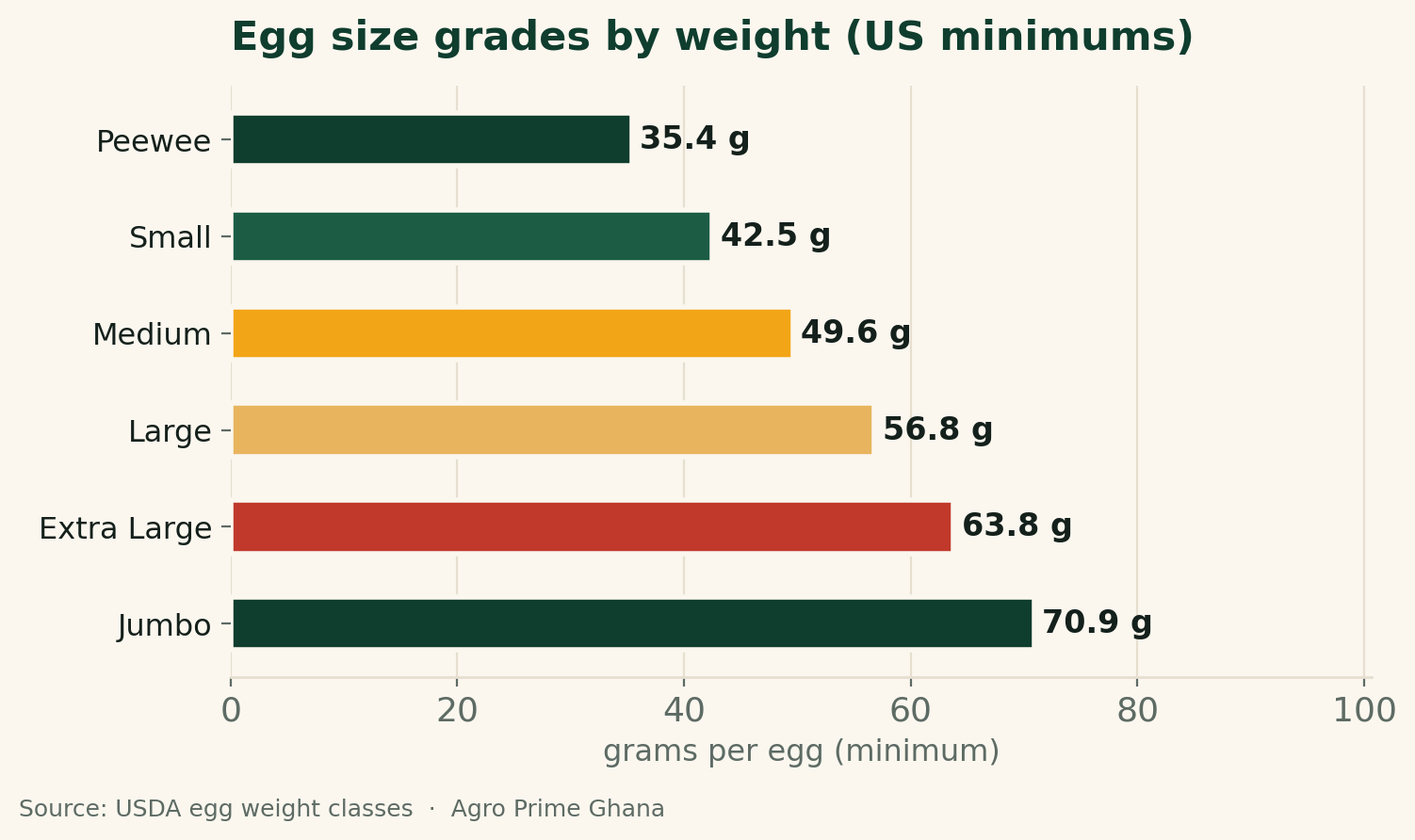
To make this concrete, it helps to know the weight bands. In the EU grading system a medium egg is 53–63 g, large is 63–73 g, and extra-large is 73 g and above; the US uses similar minimums — large starts at about 56.8 g and extra-large at 63.8 g, per the standard egg size classifications. Ghana does not enforce these grades rigidly, but the market clearly rewards a bigger, heavier egg, and these numbers give you a target to aim at when you weigh a sample of eggs from your own flock.
Why egg size matters so much for a Ghanaian layer farm
Egg size matters because it directly changes the price you get, and because chasing it wrongly can quietly wreck your flock. In markets around Kasoa and Accra, buyers sort by size and pay a premium for large and extra-large crates, so a flock stuck laying medium eggs is leaving money on the table every single day. Multiply a small per-crate premium across thousands of eggs over a laying year and the gap is substantial — often larger than what you would gain from squeezing out a few more eggs. This is why "how do I get bigger eggs?" is one of the most common questions we hear from layer keepers, and why it deserves a proper answer rather than a bag of "egg booster."
The catch is that the most aggressive way to get big eggs early — starving a flock of energy or delaying lay heavily — can hurt shell quality and hen health. Egg size and shell strength pull against each other: bigger eggs stretch the same amount of shell material over a larger surface, so the shell gets thinner. Pushing egg size too hard, too early, on a young flock is a classic cause of cracked eggs and prolapse. The goal is not the biggest possible egg; it is the biggest egg the flock can lay reliably and safely, matched to what your market will pay for. For the broader picture on keeping a flock productive, see our guide on how to increase egg production.
Body weight and age: the two levers you set before lay
The two most powerful egg-size levers — body weight at maturity and age at first egg — are locked in during rearing, before the flock lays a single egg. Heavier pullets at the onset of lay produce larger eggs than lighter ones, and later-maturing hens lay larger eggs than early-maturing ones. Hy-Line's guidance quantifies this: to steer a Hy-Line Brown flock toward larger eggs, you light-stimulate at about 1.40 kg body weight, whereas stimulating at a lighter 1.30 kg gives smaller eggs; for the white-egg W-80 the corresponding targets are roughly 1.25 kg for larger versus 1.17 kg for smaller. The mechanism is simple — a bigger, better-developed pullet has the body reserves and frame to produce a bigger egg from the start.
Age works alongside weight through your lighting programme. Hendrix Genetics' layer specialists note that "early light stimulation on lighter pullets will lead to smaller egg size while late light stimulation on heavier pullets will lead to larger egg size." A slower step-down/step-up lighting programme — spreading the light changes over about 12 weeks rather than rushing them in 7 — delays sexual maturity, lets the pullet grow more, and produces larger eggs. This is exactly why uniform, well-grown pullets matter so much: you cannot make a good egg-size decision on a flock that is all different weights. Weigh a sample regularly during rearing (see weighing poultry for uniformity) and feed pullets properly through the grower phase, as covered in our grower and pullet feeding guide, so the flock hits target weight together.
Field note: decide your egg-size strategy before the pullets reach point of lay
The mistake we see most often is a keeper who only starts worrying about egg size once the eggs are already coming out small — by then the body weight and maturity decisions are behind them, and the feed levers alone can only do so much. On our own side, the honest advice is to decide early: if your market pays best for large eggs, plan for heavier pullets and a slower, later light stimulation from the rearing stage. If you buy point-of-lay pullets rather than rearing your own, ask the supplier what weight and lighting the birds were reared on — it tells you a great deal about the eggs you are about to get.
Which feed changes actually increase egg size?
On the nutrition side, the levers that genuinely move egg size are amino acids, total protein, dietary fat and specifically linoleic acid — not vague "boosters." The single strongest dietary influence is the sulphur amino acids methionine and cystine relative to lysine. Hy-Line's technical update recommends a minimum methionine-to-lysine ratio of 47:100 to support maximum egg mass, and for deliberately larger eggs, raising the methionine + cystine to lysine ratio above 90% and running roughly 10–15% higher digestible amino acid intake than baseline recommendations. In practice this means a genuinely well-formulated layer feed with enough good protein and supplemental methionine — not just more of a cheap, low-protein ration. Our guide to amino acids in poultry feed explains why methionine is usually the first limiting amino acid in Ghanaian maize-soya diets.
Dietary fat and linoleic acid are the other proven lever. Linoleic acid is an essential fatty acid the hen must get from feed, and it feeds directly into egg (yolk) size. Hy-Line's guidance is that larger eggs need about 1.5 g of linoleic acid per bird per day, best supplied from soybean oil or flaxseed, while holding it down near 0.9 g/day with a low-linoleic source like palm oil keeps eggs smaller. Hendrix Genetics adds that higher crude fat at the start of lay — with linoleic acid pushed toward 2–3% of the diet versus the standard ~1% requirement — promotes larger eggs, and that combined management can shift average egg weight "up to 4 g and beyond." Total dietary energy matters too: both too little and too much energy depress egg weight, so the ration has to be balanced, not just rich. This is exactly the kind of formulation work our layer feeding guide walks through.
Field note: weigh a sample of eggs before you decide anything
Egg size is easy to misjudge by eye, and we have seen keepers spend money "fixing" a size that was actually fine, or ignore a real problem because a few big eggs caught their attention. The cheap fix is a small kitchen scale: once a week, weigh a random sample of 20–30 eggs and note the average in grams. That tells you exactly where the flock sits against the size bands — medium, large, extra-large — and whether your feed and management changes are actually moving the needle. Numbers beat impressions every time, and the scale costs less than one bag of "egg booster."
| Lever | To get LARGER eggs | To keep eggs SMALLER | Source |
|---|---|---|---|
| Body weight at light stimulation (Hy-Line Brown) | ~1.40 kg (heavier) | ~1.30 kg (lighter) | Hy-Line |
| Age at maturity / lighting | Later stimulation, slow ~12-week step-down | Earlier stimulation, fast ~7-week programme | Hy-Line / Hendrix |
| Methionine + cystine : lysine ratio | Above ~90% | Below ~84% | Hy-Line |
| Digestible amino acid intake | 10–15% above baseline | At or below baseline | Hy-Line |
| Linoleic acid per hen per day | ~1.5 g (soybean/flax oil) | ~0.9 g (palm oil) | Hy-Line |
| House temperature | Keep below ~27°C | Heat above 27°C shrinks eggs | Hendrix |
The role of lighting in egg size
Lighting shapes egg size mainly through when it triggers sexual maturity: switch the lights up later and more slowly, and the flock matures later, heavier, and lays larger eggs. A flock started on stimulatory light too early — before it has reached target body weight — matures young and small, and those birds tend to lay small eggs for a long time. Conversely, a well-managed step-down programme through rearing that delays the day-length increase gives the pullet extra growing time. The practical Ghanaian point is that natural daylight near the equator is fairly constant at roughly 12 hours, so if you are not using artificial light control at all, you are leaving this lever untouched. Even a simple, consistent lighting schedule in a controlled house lets you manage maturity deliberately. Our poultry lighting program guide covers how to set this up under local conditions.
Why your eggs may be small even when you do everything right
If a flock lays small eggs despite good feed, the usual reasons are a young flock, hot weather, low feed intake, or pullets that were simply too light at maturity. Heat is a big one in Ghana: Hendrix Genetics notes a significant reduction in egg size once house temperature climbs above about 27°C, even when the number of eggs laid holds steady. When it is hot, hens eat less, and lower feed intake means less protein, less linoleic acid and less energy reaching the ovary — all of which shrink the egg. So heat hits egg size twice: directly, and by cutting intake. Practical cooling — good ventilation, cool clean water, shade, feeding during the cooler parts of the day — protects egg size as well as bird welfare. Our guide on heat stress in poultry details the measures that work here.
Low feed intake for any reason — poorly palatable feed, dirty or scarce water, feeder overcrowding, or disease — has the same effect. Before adding expensive fat or amino acids, make sure the hens are actually eating their full ration; a flock under-consuming a good feed will lay smaller eggs than a flock eating a modest feed properly.
Get point-of-lay pullets reared for the eggs you want to sell
Because body weight and maturity are set before the first egg, the fastest way to get the egg size you want is to start with well-reared, uniform point-of-lay pullets and the right layer feed. Agro Prime Ghana supplies strong point-of-lay layer pullets and can advise on a layer ration built for your market — whether that is early large-egg production or steady, shell-safe sizing. Tell us what your buyers pay for, and we will help you match the bird, the feed and the lighting to it. Message us on WhatsApp (+233 24 915 1503) or book a visit to the hatchery.
A practical order of operations to increase egg size
The efficient way to increase egg size is to work the levers in the order they take effect — rearing first, then feed, then environment. In practice:
- During rearing: feed pullets to hit or slightly exceed target body weight, keep the flock uniform, and use a slower, later light stimulation if larger eggs are your goal. This is where most of the outcome is decided.
- At point of lay: put the flock on a properly formulated layer feed with adequate protein, a methionine + cystine to lysine ratio pushed toward 90%+, and enough dietary fat/linoleic acid (aim near 1.5 g/bird/day from soybean oil).
- Through lay: protect feed intake — cool the house below 27°C where you can, keep water clean and cold, avoid feeder overcrowding, and control disease and parasites so birds eat their full ration.
- Be patient with a young flock: eggs get bigger with age. Some "small egg" complaints simply need six to ten more weeks.
- Don't overshoot: once eggs reach your target size, hold the ration steady — chasing ever-bigger eggs thins shells and raises cracks and prolapse risk.
The bottom line on increasing egg size
Bigger eggs come from bigger, later-maturing hens fed the right nutrients — not from a miracle additive. The decisive moves happen before the flock lays: grow pullets to target body weight, keep them uniform, and time light stimulation to mature them later and heavier when large eggs are the goal. Then support that with a genuinely well-formulated layer feed — adequate protein, a high methionine + cystine to lysine ratio, and around 1.5 g of linoleic acid per bird per day from soybean or flax oil — while protecting feed intake against heat above 27°C. Be patient with young flocks, since eggs grow with age, and stop pushing once you hit your market's target size, because ever-bigger eggs mean thinner shells. Get the rearing and feed right and the large-egg premium follows on its own.
Frequently asked questions
How can I increase egg size in my laying hens in Ghana?
Does body weight really affect egg size?
What nutrients make eggs bigger?
Why are my hens laying small eggs?
Does linoleic acid increase egg size?
How does lighting affect egg size?
Should I chase bigger eggs or more eggs?
Can pushing for big eggs cause problems?
Sources & further reading
- Hy-Line International — Optimizing Egg Size in Commercial Layers (Technical Update) (body weight targets, methionine:lysine ratios, linoleic acid, lighting).
- Hendrix Genetics / Laying Hens — Adjusting egg size to market needs via management (body weight, light stimulation, fat and linoleic acid, temperature).
- Wikipedia — Chicken egg sizes (US and EU egg weight classifications in grams).
- Agro Prime Ghana guides: layer feeding guide, amino acids in poultry feed, and poultry lighting program.
About Agro Prime Ghana
Agro Prime Ghana Limited runs a poultry hatchery and mixed agribusiness in Kasoa, supplying day-old chicks, point-of-lay pullets and farm support to keepers across the country. These guides combine hands-on hatchery and farm experience with current industry and veterinary references. This article is general educational information, not a substitute for professional veterinary or nutrition advice tailored to your flock. Want bigger eggs and a stronger layer flock? Book a visit or message us on WhatsApp (+233 24 915 1503) to order pullets, feed or advice.