
Hubbard is a French-origin broiler breeder whose birds are prized for one quality above all — robustness. Hubbard itself describes the breed's "robustness and adaptability" as "evident under any temperature and feed conditions" and calls it "an ideal product for temperate as well as tropical areas," which is exactly the claim a Ghanaian farmer wants to test. In its conventional fast line (Hubbard Efficiency Plus) the bird reaches about 2.95 kg at 42 days on a competitive feed conversion, while Hubbard's separate Premium range (the JA, Redbro and colour-feather birds) offers slower-growing, hardy, coloured chickens for free-range and premium markets. This guide explains the Hubbard broiler's performance, its reputation for toughness, and where it fits Ghana's climate and markets.
Written by the Agro Prime Ghana hatchery team and reviewed against current industry references (Hubbard Efficiency Plus performance objectives and Hubbard broiler and Premium management guides). Last updated September 2026.
Key takeaways
Hubbard is a major global broiler breeder offering two very different families. The conventional fast broilers (e.g. Hubbard Efficiency Plus, Flex, Classic) hit commercial targets — roughly 1 kg at 21 days, 1.6 kg at 28 days and 2.95 kg at 42 days — and are selected hard for feed conversion, robustness and liveability. The Premium range (JA57, JA87, Redbro and other coloured lines) is slower-growing, hardy and rustic, bred for free-range, Label Rouge and welfare-focused markets rather than maximum speed. Hubbard's reputation is built on tough, uniform birds that hold up well under stress and variable feed — a genuine advantage in Ghana's heat. As with any broiler, brooding, feed quality and heat management decide the outcome.
What is a Hubbard broiler?
Hubbard is one of the three big broiler-breeding companies that supply the world's meat chickens (alongside Aviagen's Ross/Arbor Acres and Cobb-Vantress). It is a long-established French breeder, and its distinguishing strategy is breadth: rather than a single flagship strain, Hubbard offers a wide catalogue tuned to different markets, from the fastest, most feed-efficient white birds to slow-growing coloured chickens for premium and free-range production. On the conventional side sit lines such as Hubbard Efficiency Plus, Hubbard Flex (marketed for excellent feed conversion and meat quality at 1.8–3.0 kg slaughter weights) and Hubbard Classic (strong early growth). On the premium side sits the Hubbard Premium range — the JA and Redbro lines — bred for robustness, good conformation and colour differentiation. The thread running through the whole catalogue, and the reason many farmers in hot and variable climates favour Hubbard, is a deliberate selection emphasis on hardiness and liveability, not just top-end growth speed.
Hubbard broiler performance: weight and FCR by age
For the conventional Hubbard broiler, the published performance objectives give a growth curve squarely in the modern commercial range. The figures below are as-hatched (straight-run) targets for the Hubbard Efficiency Plus and, like all breeder standards, assume good brooding, correct nutrition and low stress — use them as a target to manage towards and a yardstick to judge your batch against.
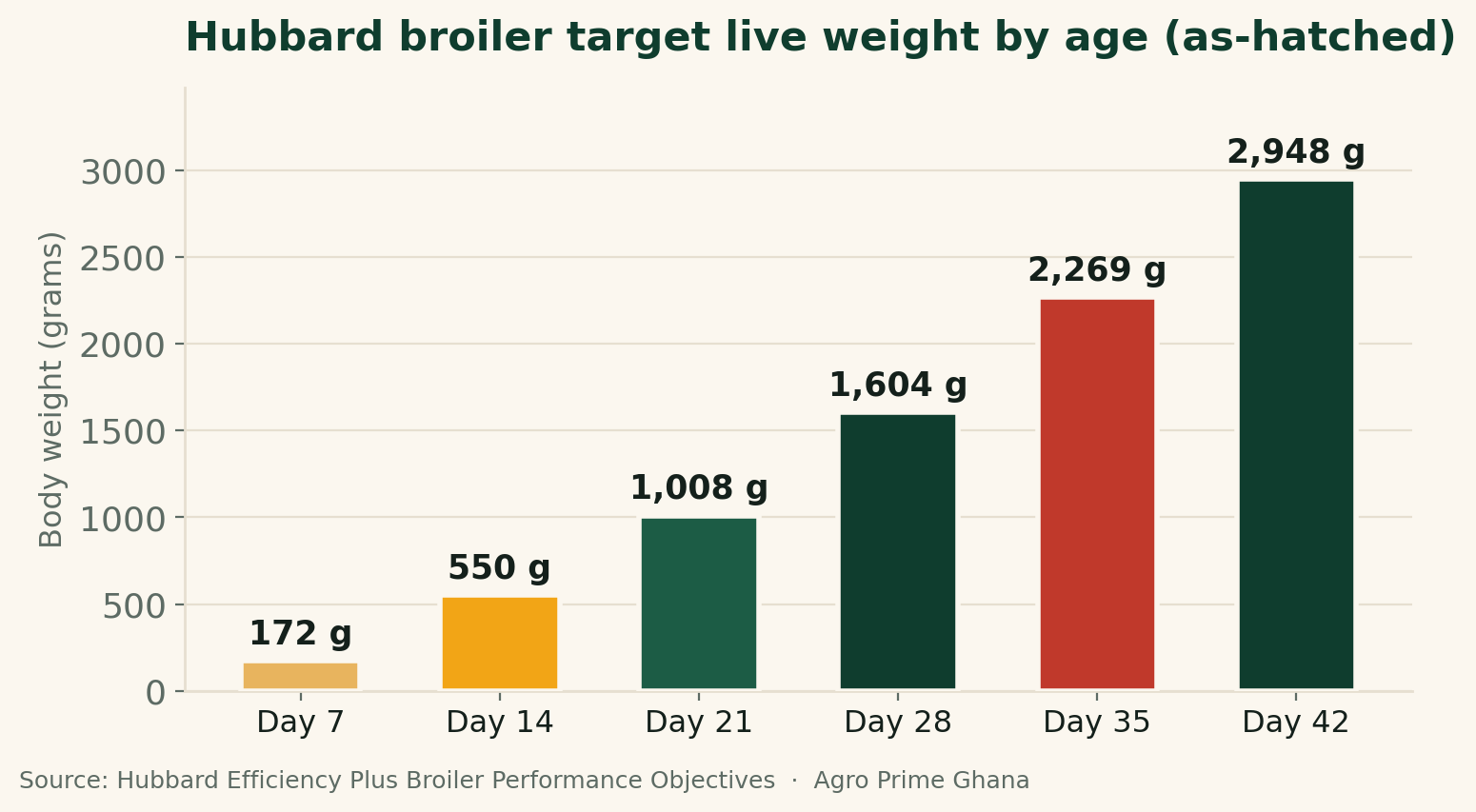
A Hubbard broiler roughly quadruples its hatch weight in the first week, passes 1 kg at three weeks, and reaches about 2.95 kg by 42 days, with cumulative feed conversion finishing in the low 1.6s — competitive with the other fast strains, and Hubbard's Flex line is marketed specifically on best-in-class FCR. The table below places the conventional Hubbard beside the strains Ghanaian farmers know, and shows where the slower Premium birds sit.
| Hubbard type | Growth & target weight | Best-fit market |
|---|---|---|
| Efficiency Plus / Flex / Classic (fast, white) | ~2.95 kg at 42 days; FCR ~1.6 | Standard commercial broiler meat — same league as Cobb/Ross/Arbor Acres |
| Premium — JA57 / JA87 (slower, coloured) | Slower growth; grown to older ages (often ~56–81 days free-range) | Free-range, Label Rouge, premium/rustic markets |
| Premium — Redbro (slower, coloured) | Intermediate/slow; "ECC"-type welfare balance | Higher-welfare and premium retail programmes |
Sources: Hubbard Efficiency Plus performance objectives; Hubbard Premium product literature. Premium lines are deliberately slower — that is their purpose, not a weakness.
How does Hubbard compare to Cobb, Ross and Arbor Acres?
On the conventional fast side, the Hubbard broiler competes directly with Cobb 500, Ross 308 and Arbor Acres Plus, and the published targets are close: all four reach roughly 2.9–3.3 kg by six weeks on a feed conversion in the mid-1.5s to low-1.6s. Hubbard's Efficiency Plus finishes at about 2,948 g at 42 days, within a whisker of the Arbor Acres (2,981 g) and Ross 308 (2,998 g); Cobb 500 tends to publish the heaviest weight targets. Where Hubbard has built its name is not on winning the raw-weight race by a wide margin but on robustness and liveability — the bird's reputation for coping with heat, variable feed and less-than-perfect conditions. That reputation is exactly why Hubbard appeals in tropical and developing markets. Alongside these fast birds, Hubbard is unusual in also offering a full slow-growing Premium range, something the pure fast-broiler competitors do not emphasise — giving farmers a genuine second option for niche, free-range or premium markets. Our Cobb 500 guide, Ross 308 guide and Arbor Acres guide cover the fast alternatives in detail.
Field note: "robust" is a management advantage, not a licence to relax
Farmers sometimes hear "Hubbard is a hardy, robust bird" and assume it forgives poor brooding or cheap feed. It does not. What robustness really means in practice is a slightly wider safety margin — the bird tends to hold up better when a hot afternoon, a rough feed batch or a small management slip would knock a more delicate strain sideways. That margin is worth real money over a year of batches, but it is bought on top of good management, not instead of it. We treat a robust strain as insurance against the bad days, while still doing everything right on the good ones.
Why Hubbard's robustness matters in Ghana
Ghana's poultry conditions are exactly the ones that expose a fragile bird: high ambient heat much of the year, humidity, harmattan dust in the dry season, and feed quality that varies from bag to bag because maize and groundnut are weather- and storage-dependent. A strain selected for robustness and liveability has a real edge here, because the losses that quietly erode broiler profit in Ghana are rarely dramatic disease outbreaks — they are the steady drip of birds that fail to thrive, uneven growth, and mortality on the hottest days. Hubbard's own claim that the bird is suited to "tropical areas" and performs "under any temperature and feed conditions" is a marketing statement, but it reflects a genuine breeding emphasis that plays to Ghanaian realities. The practical translation: a Hubbard broiler is a sensible choice where conditions are tougher or less controllable — open-sided houses, hotter regions, home-mixed feed of variable quality — precisely the situations many Ghanaian farmers operate in. It still needs the fundamentals, but it tends to give you a little more room for the inevitable imperfect day.
The Hubbard Premium range: slower-growing, hardy, coloured birds
Hubbard's Premium family deserves separate attention because it answers a different question entirely. Where the fast broiler asks "how much white meat, how cheaply, how fast," the Premium birds — the JA57, JA87, Redbro and related coloured lines — are bred for slower growth, robustness, rusticity and good conformation, and are typically grown to older ages (commonly in the region of 56 to 81 days in free-range systems). They are the genetics behind France's famous Label Rouge free-range chicken and similar higher-welfare, premium programmes worldwide. Hubbard describes these females as "very prolific" birds that "can be kept to an older age," and positions the newer Redbro line as offering "the best balance in terms of animal welfare, environment, and economics." For Ghana, the relevance is growing: there is a real and expanding market for firmer-fleshed, slower-grown, hardy chickens that suit traditional cooking and premium buyers — a niche closer to the local and improved dual-purpose birds many consumers prefer than to the soft-textured fast broiler. If you are eyeing that market rather than the standard live-weight trade, a slower coloured strain is worth understanding; our overview of Noiler and Kuroiler dual-purpose birds and best chicken breeds for Ghana sit alongside this thinking.
Match your broiler strain and chicks to your market with Agro Prime
Whether you want a fast bird for the standard live-weight trade or you are exploring hardier, slower-growing chickens for a premium or free-range market, the first decision is which day-old chick to start with. Agro Prime Ghana supplies healthy broiler day-old chicks across proven strains and can talk you honestly through the trade-offs — growth speed, feed cost, robustness and the buyers you are aiming at — so your batch matches your market rather than fighting it. Tell us your plan and we will help you choose. Message us on WhatsApp (+233 24 915 1503) or book a visit to order chicks or plan your production.
Brooding and feeding Hubbard broilers in Ghana
Robust or not, a Hubbard broiler is still a modern meat chicken, and the first week still decides the batch. Start chicks warm — a brooding temperature around 32–34°C at chick level on day one, stepped down gradually as the birds feather — and read the birds rather than only the thermometer: evenly-spread, active chicks are comfortable; huddling means cold; panting at the edges means too hot. Hubbard's management guide makes the point that early weight is decisive, noting that a chick's body weight increases four-to-five times over the first week and that even a small extra weight at day seven translates into a meaningfully heavier bird at day 40. Get water in before feed, spread starter on chick paper so no bird has to hunt for its first meal, and keep litter dry from the start. Our brooder temperature chart and brooding guide give the week-by-week detail. On feed, the fast Hubbard lines want the standard phased broiler programme — starter, grower, finisher — set out in our broiler feeding guide; the slower Premium birds are fed less intensively and grown longer. Whichever you run, guard against aflatoxin in maize and groundnut, which quietly undermines even the most robust strain — see aflatoxin in poultry feed.
Managing heat and health
Even a robust bird has limits, and heat is still the main one in Ghana. Big broilers in the final weeks generate a great deal of body heat, so shade, generous ventilation or fans, cool clean water and avoiding midday disturbance remain essential — Hubbard's toughness widens the safety margin but does not remove the ceiling. Our guide to heat stress in poultry covers the defences. On health, the Hubbard broiler needs the same disciplined routine as any strain: dry litter to keep coccidiosis and footpad problems at bay, a sound Newcastle and Gumboro vaccination programme, and solid biosecurity to keep disease off the farm in the first place. The robustness reputation is real, but it is best thought of as making good management a little more forgiving — not as a substitute for it.
The bottom line on Hubbard broilers
Hubbard is a strong, credible choice for Ghanaian broiler farmers, and it offers something the pure fast-broiler brands do not: two genuinely different families under one name. The conventional fast lines match Cobb, Ross and Arbor Acres closely on the numbers — about 2.95 kg at six weeks on a competitive feed conversion — while carrying a well-earned reputation for robustness and liveability that suits Ghana's heat, humidity and variable feed. The Premium JA and Redbro lines open a separate door onto the growing market for hardy, slower-grown, coloured chickens. Neither family escapes the basic laws of broiler farming — good chicks, good brooding, good feed, and heat management still decide profit — but if you value a bird with a little more margin for the tough days, or you want a slow-growing option for a premium market, Hubbard deserves a place on your shortlist.
Frequently asked questions
What weight does a Hubbard broiler reach?
Is the Hubbard broiler good for Ghana's climate?
What is the difference between Hubbard fast and Hubbard Premium birds?
How does Hubbard compare to Cobb 500 and Ross 308?
Are Hubbard slow-growing broilers suitable for Ghana?
What FCR does a Hubbard broiler achieve?
Does a robust strain mean I can use cheaper feed or skip good brooding?
Where can I buy Hubbard or other broiler chicks in Ghana?
Sources & further reading
- Hubbard — broiler performance objectives and management guides (Efficiency Plus and other lines; body weight and FCR by age).
- Hubbard — Premium range (JA, Redbro and coloured lines) for free-range and Label Rouge markets.
- Hubbard — Efficiency Plus broiler guide and nutrient specifications (early growth and management).
- Agro Prime Ghana guides: Cobb 500 guide, Ross 308 guide, Arbor Acres guide, broiler feeding guide and heat stress in poultry.
About Agro Prime Ghana
Agro Prime Ghana Limited runs a poultry hatchery and mixed agribusiness in Kasoa, supplying day-old chicks and working alongside poultry keepers across the country. We supply healthy broiler day-old chicks in several proven strains, plus point-of-lay pullets, quality feed and hands-on farm support nationwide. This article is general educational information, not a substitute for professional veterinary or agronomic advice for your specific flock. Ready to start or expand? Book a visit or message us on WhatsApp (+233 24 915 1503) to order chicks, feed or advice.