
The Arbor Acres Plus is a fast-growing white broiler from Aviagen that, under good management, reaches roughly 2.98 kg by 42 days on a cumulative feed conversion of about 1.55 — putting it in the same top tier as the Ross 308 and Cobb 500, the two strains most Ghanaian farmers already know. Its calling cards are strong early growth, robustness and reliable liveability, which matter a great deal in our heat. This guide sets out the Arbor Acres Plus performance figures age by age, how to manage the bird under Ghanaian conditions, and honestly how it stacks up against Cobb and Ross so you can decide whether it belongs in your next batch.
Written by the Agro Prime Ghana hatchery team and reviewed against current industry references (Aviagen Arbor Acres Plus and Ross 308 performance objectives, and the Arbor Acres Broiler Management Handbook). Last updated September 2026.
Key takeaways
The Arbor Acres Plus is Aviagen's conventional fast broiler, bred as a sibling programme to the Ross 308 and managed almost identically. As-hatched targets are about 1 kg at 21 days, 1.6 kg at 28 days, 2.29 kg at 35 days and 2.98 kg at 42 days, with cumulative FCR climbing from roughly 1.16 at 3 weeks to 1.55 at 6 weeks. It is known for good chick quality, uniformity and liveability, which suits the many Ghanaian farmers selling live birds at 4–6 weeks (about 1.6–2.5 kg). It needs the same fundamentals as any modern broiler: 32–34°C brooding, clean water, phase feeding and ventilation to beat the heat. Get those right and it performs at Cobb/Ross level; get them wrong and no strain will save the batch.
What is the Arbor Acres Plus broiler?
The Arbor Acres Plus is a commercial fast-growing meat chicken produced by Aviagen, the same breeding company that owns the Ross line. It is a four-way cross — a hybrid bred over decades for rapid, efficient muscle growth — and it is one of a small handful of "white broiler" strains that supply the great majority of chicken meat worldwide. In practice the Arbor Acres and Ross programmes share so much genetic background and are selected to such similar targets that Aviagen publishes near-identical management advice for both; a farmer who can run Ross 308 well can run Arbor Acres Plus well, and vice versa. The bird is white-feathered, yellow-skinned, broad-breasted and grows fast: it converts feed to meat with an efficiency no local or dual-purpose bird can match, which is exactly why commercial farmers reach for it. What it is not is a hardy scavenger — like all modern broilers it is a high-input, high-output animal that repays good brooding, good feed and good ventilation and punishes neglect quickly.
Arbor Acres Plus performance: weight and FCR by age
Under the conditions Aviagen assumes — good brooding, correct nutrition and low stress — the Arbor Acres Plus follows a well-defined growth curve. The figures below are the 2022 "as-hatched" (straight-run, cockerels and pullets mixed) objectives from the Arbor Acres Plus Broiler Performance Objectives. Read them as a target and a diagnostic tool, not a promise: if your birds track close to these weights you are managing well; if they fall well short, something — heat, feed quality, disease or water — is holding them back.
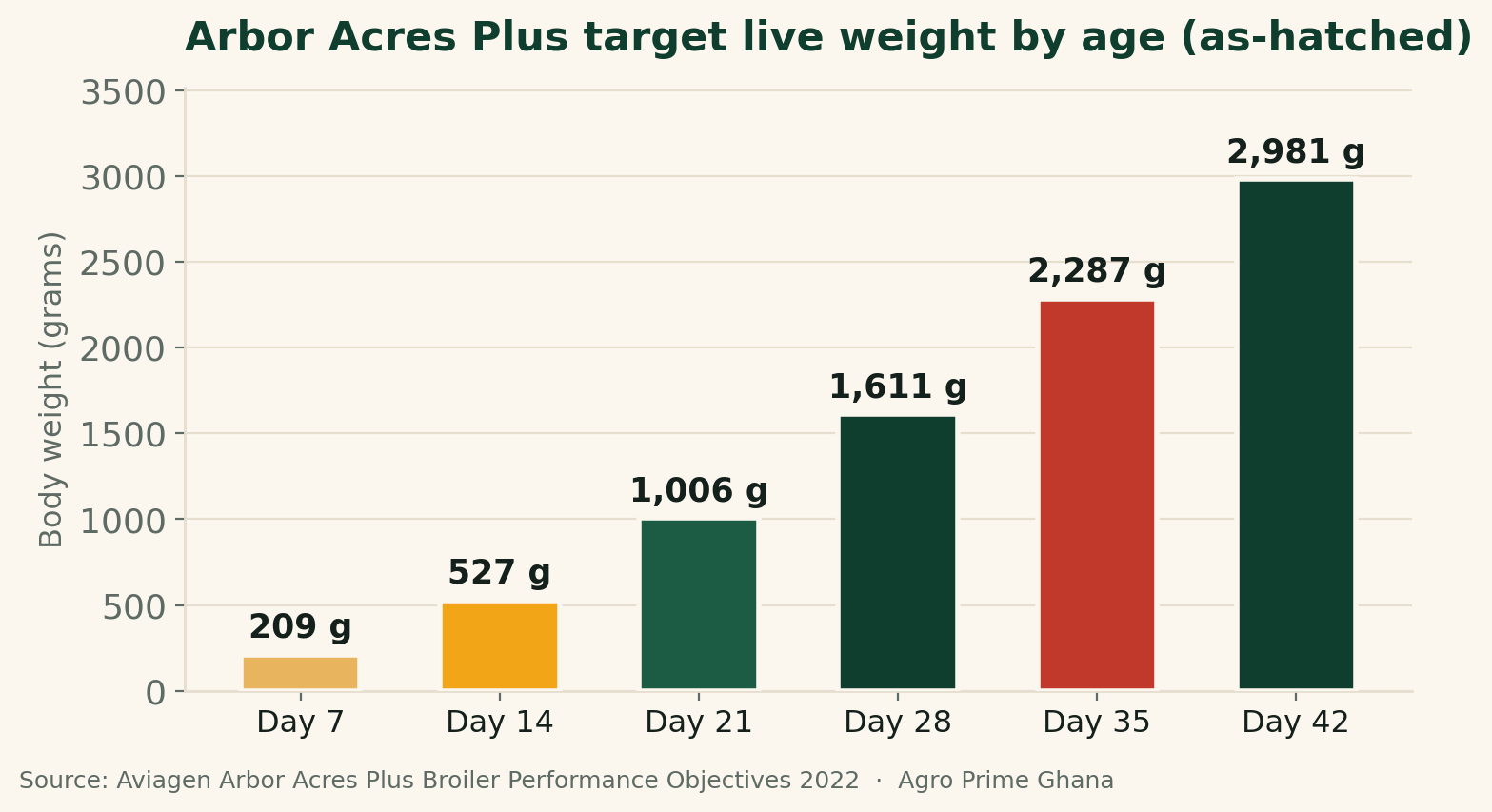
Notice two things. First, the growth is front-loaded in relative terms: a chick roughly quadruples its hatch weight in the first week (44 g to about 209 g), which is why the brooding period sets the ceiling on the whole batch. Second, feed conversion worsens steadily with age — it costs far more feed to add the last kilogram than the first — which is the single most important economic fact in broiler farming. The table sets the Arbor Acres Plus curve beside the other strains Ghanaian farmers buy, so you can see how close they run.
| Strain (as-hatched) | 35-day weight / FCR | 42-day weight / FCR | Notes |
|---|---|---|---|
| Arbor Acres Plus | 2,287 g / 1.42 | 2,981 g / 1.55 | Aviagen; balanced growth, robustness & liveability |
| Ross 308 | 2,296 g / 1.40 | 2,998 g / 1.53 | Aviagen sibling; virtually the same targets |
| Cobb 500 | 2,521 g / 1.44 | 3,278 g / 1.56 | Cobb-Vantress; often shows the highest weight targets |
| Hubbard (Efficiency Plus) | 2,269 g / n.a. | 2,948 g / ~1.62 | Known for robustness in tough conditions |
Sources: Aviagen Arbor Acres Plus and Ross 308 Broiler Performance Objectives 2022; Cobb 500 2022 performance supplement; Hubbard Efficiency Plus performance objectives. Compare like with like — all figures are "as-hatched"; cockerels alone weigh more, pullets less.
How does Arbor Acres compare to Cobb 500 and Ross 308?
The honest answer is that at the level of the published objectives, the three fast white strains are remarkably close — the differences between Arbor Acres Plus, Ross 308 and Cobb 500 at 42 days are smaller than the differences a single farm will see between a well-managed batch and a poorly-managed one. All three will reach roughly 2 kg somewhere around 32–35 days and 2.9–3.3 kg by six weeks on a feed conversion in the low-to-mid 1.5s. Because Arbor Acres and Ross come from the same company and are bred to almost the same specification, they behave almost interchangeably; Cobb 500 tends to publish slightly heavier weight targets but a broadly similar FCR. For a Ghanaian farmer the practical decision is rarely "which strain is genetically best" — it is which quality, well-vaccinated day-old chick you can reliably get from a trusted source. A first-rate Arbor Acres chick will always beat a stressed, poorly-brooded Ross or Cobb chick. Our detailed Cobb 500 guide and Ross 308 guide go deeper on each; treat all three as members of the same high-performance family rather than rivals in different leagues.
Field note: the strain on the sack matters less than the chick in the box
We have watched farmers agonise over Arbor Acres versus Ross versus Cobb while ignoring the things that actually decide the batch. In our experience the order of importance is: chick quality and health first, then brooding, then feed, then ventilation — and only then, a distant fifth, the exact strain. A uniform box of bright, active, well-hatched chicks of any of these strains, brooded properly from hour one, will outperform a "better" strain that arrived chilled, dehydrated or from a poorly-managed hatchery. Buy the chick, not the label.
Brooding and managing Arbor Acres Plus in Ghana
The first week decides the batch, and nowhere more so than in our climate. Aviagen's management guidance for the Arbor Acres calls for chicks to be started warm — a brooding temperature around 32–34°C at chick level on day one, stepped down gradually by roughly 2–3°C a week as the birds feather and learn to regulate their own heat. Getting this right is not guesswork: watch the birds. Chicks spread evenly and feeding are comfortable; chicks huddled under the heat source are cold; chicks pushed to the edges, panting with wings held out, are too hot — a constant risk in a Ghanaian afternoon. Our brooder temperature chart and guide to brooding day-old chicks lay out the week-by-week targets, and the common, costly errors are collected in brooding mistakes that kill chicks. Beyond temperature, the non-negotiables are simple and the same for every modern broiler:
- Water before feed, always. Chicks arrive mildly dehydrated after the hatch and transport. Clean, cool, freely-available water is the first thing they need; check that every chick has found a drinker in the first hours.
- Feed on paper early. Put starter crumb on chick paper as well as in feeders for the first days so no chick has to hunt for its first meal — early feed intake drives that critical first-week weight.
- Space and ventilation. Overcrowding concentrates heat, damp and ammonia — all of which slow growth and invite disease. Give the birds room and move air. See our notes on poultry house ventilation.
- Dry, friable litter. Damp litter breeds coccidiosis and footpad problems. Fix leaking drinkers the day you see them.
Feeding the Arbor Acres Plus for its growth curve
A fast broiler only hits its numbers on a feed that matches its changing needs, which is why commercial broiler feeding is split into phases: a high-protein starter for roughly the first 10–14 days to build frame and feather, a grower through the middle weeks, and a lower-protein, higher-energy finisher in the final stretch to lay down weight economically. Feeding a cheap layer or all-purpose mash to a broiler wastes its genetics entirely. Because feed is comfortably the largest cost in any broiler enterprise — usually well over half — the quality of that feed decides your margin as much as the strain does. Watch two things especially under Ghanaian conditions: aflatoxin in maize and groundnut, which silently wrecks growth and immunity (see our guide to aflatoxin in poultry feed), and simple feed freshness in the heat and humidity. Our full broiler feeding guide sets out the phases, protein levels and practical rationing.
Order strong Arbor Acres and other broiler chicks from Agro Prime
Agro Prime Ghana supplies healthy, well-hatched broiler day-old chicks in several proven strains — Arbor Acres, Cobb and Ross — so you can match the bird to your market and your management. Every chick leaves with the right start: good hatch quality, appropriate vaccination, and honest advice on brooding, feeding and the best age to sell for your target weight. Not sure which strain or how many to start with? Tell us your market and we will help you choose. Message us on WhatsApp (+233 24 915 1503) or book a visit to place an order or plan your next batch.
Is the Arbor Acres Plus suitable for Ghana's conditions?
Yes — with the same caveat that applies to every fast broiler: it is suited to Ghana's markets but stressed by Ghana's heat, so success depends on management. On the market side the fit is excellent. The Arbor Acres Plus reaches the live weights Ghanaian buyers want — roughly 1.6 kg by 4 weeks, 2.3 kg by 5 weeks and about 3 kg by 6 weeks — which lines up neatly with how live birds are sold here, and its good liveability and uniformity mean more sellable birds per batch. On the climate side, heat is the enemy: broilers generate a lot of metabolic heat as they grow, and a big Arbor Acres bird in the last two weeks of a hot, still afternoon is genuinely at risk. That risk is manageable with shade, generous ventilation or fans, cool clean water, avoiding midday disturbance, and sometimes finishing birds a little earlier in the hottest months. Our guide to heat stress in poultry covers the practical defences. Handle the heat and the Arbor Acres Plus is as suitable for Ghana as any strain on the market.
Field note: pick your slaughter age for your market, not the maximum weight
The performance table tempts farmers to push every batch to 42 days for the biggest bird, but that is not always the best money. Feed conversion worsens sharply in the last two weeks, heat stress and leg problems climb with body weight, and many Ghanaian buyers actually prefer a bird around 1.8–2.2 kg. We plan the sell date backwards from what the customer wants and what feed costs, not forwards to the heaviest possible carcass. A 35-day bird sold whole into a ready market often beats a 45-day giant that ate two extra weeks of expensive finisher. See broiler vs layer profit for how the sums work.
Common problems and how to avoid them
Fast growth carries its own risks, and knowing them lets you head them off. The main ones with Arbor Acres and every other fast broiler are leg and skeletal problems in heavy birds (minimised by not overheating the brooder, avoiding excessive early weight and keeping litter dry and non-slippery), heat stress in the final weeks, ascites (fluid in the abdomen from the heart and lungs struggling to supply a fast-growing body, worse where ventilation is poor), and gut diseases such as coccidiosis that thrive on damp litter — covered in our coccidiosis guide. None is a reason to avoid the strain; they are the price of high performance, all reduced by the same disciplined management plus a sound Newcastle and Gumboro vaccination and biosecurity routine.
The bottom line on Arbor Acres Plus
The Arbor Acres Plus is a genuine top-tier fast broiler — a close sibling of the Ross 308, managed the same way, reaching about 3 kg at six weeks on a feed conversion around 1.55 — and it is well suited to Ghanaian farming provided you give it what a modern broiler needs. For most farmers the choice between Arbor Acres, Cobb and Ross should come down to which quality chick you can reliably source rather than small gaps on a spec sheet, because management, not genetics, is what usually separates a profitable batch from a disappointing one. Start with a strong chick, brood it properly, feed it in phases, beat the heat, and sell at the weight your market actually wants. Do that, and the Arbor Acres Plus will reward you as well as any broiler on the Ghanaian market.
Frequently asked questions
What weight does an Arbor Acres broiler reach at 6 weeks?
Is Arbor Acres better than Ross 308 or Cobb 500?
What is the FCR of Arbor Acres broilers?
Is the Arbor Acres suitable for Ghana's hot climate?
At what age should I sell Arbor Acres broilers in Ghana?
What feed does an Arbor Acres broiler need?
Are Arbor Acres chicks available in Ghana?
Do Arbor Acres broilers have leg or heart problems?
Sources & further reading
- Aviagen — Arbor Acres Plus Broiler Performance Objectives 2022 (as-hatched body weight and FCR by age).
- Aviagen — Ross 308 Broiler Performance Objectives 2022 (sibling-strain comparison figures).
- Aviagen — Arbor Acres Broiler Management Handbook (brooding temperatures and management).
- Agro Prime Ghana guides: Cobb 500 broiler guide, Ross 308 broiler guide, broiler feeding guide and heat stress in poultry.
About Agro Prime Ghana
Agro Prime Ghana Limited runs a poultry hatchery and mixed agribusiness in Kasoa, supplying day-old chicks and working alongside poultry keepers across the country. We supply healthy broiler day-old chicks in several proven strains, plus point-of-lay pullets, quality feed and hands-on farm support nationwide. This article is general educational information, not a substitute for professional veterinary or agronomic advice for your specific flock. Ready to start or expand your broiler batch? Book a visit or message us on WhatsApp (+233 24 915 1503) to order chicks, feed or advice.