A hatchery partnership — or out-grower model — is an arrangement where a farmer raises birds under an agreement with a hatchery or larger operator who supplies the day-old chicks (and often feed, medication and technical advice) and, in return, buys back the grown birds or eggs on agreed terms. For a Ghanaian farmer, the appeal is simple: you get reliable, quality chicks and a guaranteed buyer, while the hatchery gets dependable production without owning every farm. Done well, it lowers the two biggest risks a small poultry farmer faces — bad chicks and no market. Done badly, it can trap a grower in one-sided terms. This guide explains how these partnerships work in Ghana, the honest advantages and pitfalls, and how to structure one that is fair to both sides.
Written by the Agro Prime Ghana hatchery team and reviewed against current industry references (FAO contract-farming guidance and peer-reviewed studies of Ghanaian broiler production). Last updated September 2026.
Key takeaways
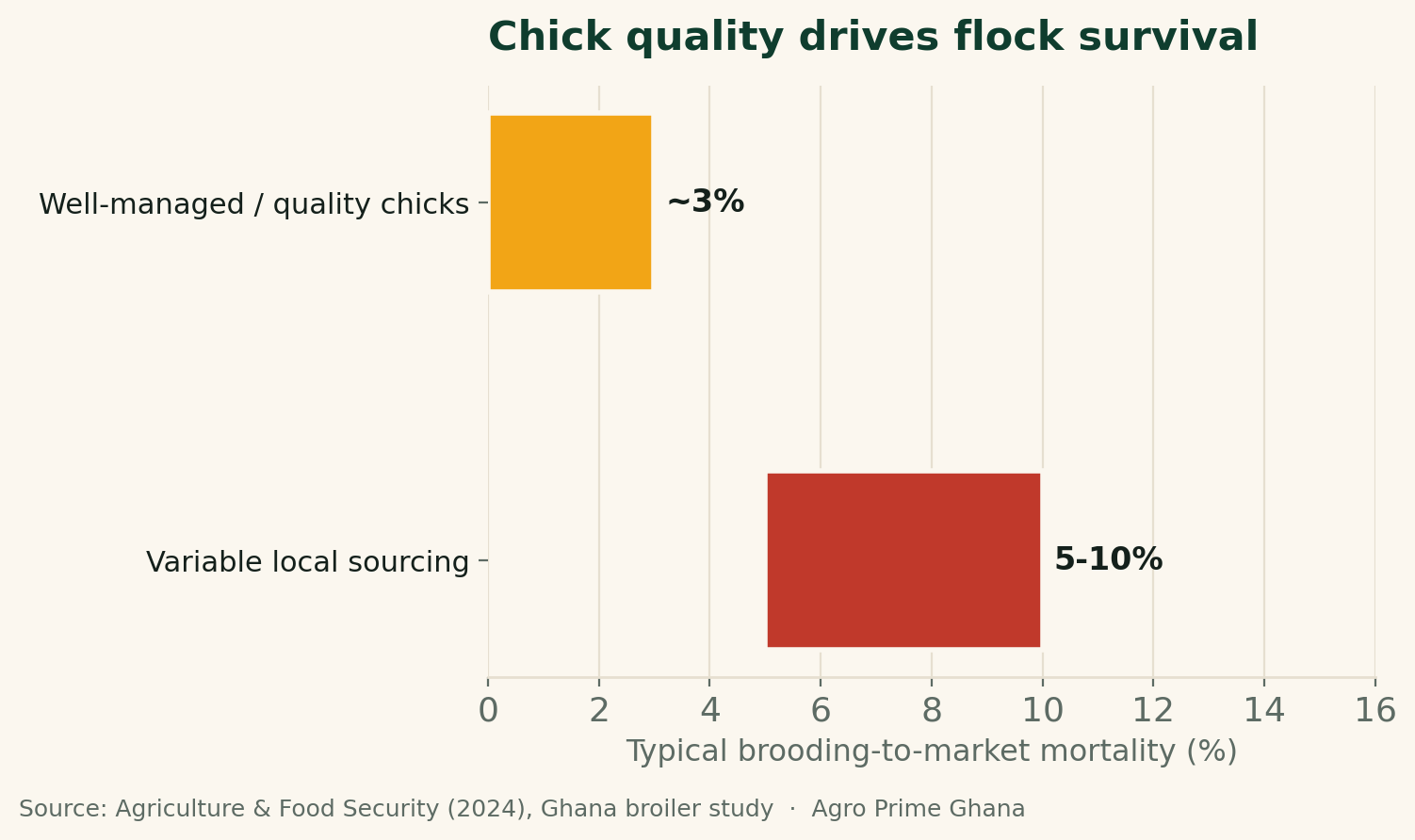
In a hatchery partnership, the grower supplies land, housing and daily labour while the hatchery supplies quality day-old chicks and usually feed, medication and technical support, with a buy-back agreement for the finished birds or eggs. The FAO notes contract farming gives smallholders guaranteed markets, input supply, credit access and new skills — but warns of real risks: sponsors reducing quotas, manipulating quality standards or paying late, and growers side-selling or diverting inputs. Chick quality is central: well-sourced, well-managed chicks lose around 3% to market, while poor local sourcing pushes mortality to 5–10%. With feed at 48–59% of broiler cost and Ghana importing roughly 270,000 tonnes of chicken against 70,000 tonnes produced locally, a fair partnership that secures inputs and market can turn a fragile smallholder into a viable producer — if the contract is clear and honest on both sides.
What is a hatchery partnership or out-grower model?
A hatchery partnership is a form of contract farming in which a farmer agrees, in advance, to raise a hatchery's birds under set conditions in exchange for inputs and a market. Instead of buying chicks on the open market, raising them alone and hunting for buyers at the end, the grower enters an agreement — ideally written — that ties the two sides together across the whole cycle. The FAO describes contract farming as an arrangement between farmers and buyers made ahead of production, typically specifying price, quantity, quality and the inputs the sponsor will provide. In poultry, the models on the ground in Ghana usually take one of a few shapes:
- Chick-supply plus off-take. The hatchery supplies quality day-old chicks and agrees to buy the finished broilers (or table eggs) back at an agreed price or formula. The grower funds feed and rearing.
- Full-package contract rearing. The hatchery or integrator supplies chicks, feed and medication and pays the grower a rearing fee per bird raised to target weight — the grower is paid for the service of growing, and the birds effectively remain the sponsor's.
- Chick supply with technical support. A lighter partnership where the hatchery supplies vaccinated chicks and ongoing advice (brooding, feeding, biosecurity) and the grower sells independently but reliably comes back for chicks. This is the most common starting point in Ghana.
The heart of every version is the same: the farmer stops carrying the two heaviest risks alone — will the chicks be good? and can I sell what I raise?
Why these models matter in Ghana's poultry market
Partnership models matter in Ghana because the market is huge but individual farmers are fragile. The country imports the vast majority of its chicken meat — around 270,000 tonnes of imports against roughly 70,000 tonnes of domestic production in 2024, per the USDA FAS — so there is enormous room for local birds. Yet the typical smallholder struggles with exactly the things a partnership fixes: unreliable chick quality, expensive feed that must be bought before the birds earn, thin technical knowledge, and no dependable buyer. A 2024 study in Agriculture & Food Security found that Ghanaian broiler farms using well-managed, quality chicks kept mortality near 3%, while those relying on variable local sourcing saw 5–10% — and with feed at 48–59% of production cost, a grower who loses birds or overpays for inputs has almost no margin left. By pooling the hatchery's chick quality, buying power and know-how with the farmer's land and labour, a partnership addresses several of these weaknesses at once. That is why aggregation and out-grower arrangements keep appearing in efforts to close Ghana's poultry deficit.
The honest advantages for the grower
For the farmer, a good partnership converts several make-or-break gambles into managed, shared risks. Drawing on the FAO's summary of contract-farming benefits and how they play out in Ghanaian poultry:
- A guaranteed market. The single biggest relief for a small grower is knowing the birds will be bought. The FAO notes sponsors normally undertake to purchase the produce, which opens markets a small farmer could not reach alone and removes the end-of-cycle panic of unsold, still-eating birds.
- Reliable, quality inputs. Chicks — and often feed and medication — come from a source with a reputation to protect, cutting the risk of weak or unvaccinated stock. For chicks specifically, this is decisive, because chick quality sets the ceiling on everything that follows.
- Access to credit and inputs on terms. Where the hatchery supplies inputs against the finished crop, the grower effectively gets working capital they might never obtain from a bank — the FAO notes contracts can even serve as a form of collateral.
- Skills and technical support. Partnerships transfer real know-how — brooding, feeding, biosecurity, record keeping — that raises the grower's performance permanently, not just for one batch.
For a farmer still learning the ropes, this support can be the difference between an expensive hobby and a business. If you are at that stage, pair a partnership with the fundamentals in our guide to starting a poultry farm in Ghana.
The honest risks — and who carries them
A partnership is only as good as its terms, and the FAO is candid that contract farming can go wrong for both sides. Pretending otherwise does no farmer any favours. The real risks:
- Quota and quality manipulation. The FAO warns sponsors may reduce agreed quantities when the market softens, or tighten quality standards to reject birds and buy less. A grower who has already spent on feed is exposed.
- Late payment or unreliable sponsors. If the buyer pays slowly or fails, the grower — who has carried the feed cost — can be pushed into debt. The FAO explicitly flags farmer indebtedness from production problems and unreliable sponsors.
- One-sided pricing. Where the hatchery is the only buyer, it can hold pricing power. A fair formula, agreed up front, is the grower's protection.
- Grower-side breaches too. The risks run both ways: the FAO notes growers may side-sell to a higher bidder outside the contract, or divert subsidised feed and inputs to other uses — behaviour that makes sponsors wary and terms stricter for everyone.
None of this means partnerships are a trap; it means the contract must be clear, written, and fair, and both sides must keep their word. The models that endure in Ghana are the ones where neither party can quietly win at the other's expense.
| Model | Hatchery/sponsor provides | Grower provides | Grower's main risk |
|---|---|---|---|
| Chick supply + off-take | Quality chicks; buy-back of finished birds/eggs at agreed terms | Housing, feed, labour, day-to-day management | Feed-price swings; buyer reducing quota or price |
| Full-package contract rearing | Chicks, feed, medication, technical supervision; pays rearing fee | Housing, labour, biosecurity, meeting target weight | Low fee; strict rejection of underweight birds |
| Chick supply + technical support | Vaccinated chicks and ongoing advice | Everything else; sells independently | Own marketing; no guaranteed buyer |
Common poultry partnership structures in Ghana. Exact terms vary — always agree them in writing.
Field note: what makes a partnership actually work
The arrangements we see succeed are not the ones with the fanciest contracts — they are the ones built on a track record of both sides keeping small promises. A hatchery that consistently delivers healthy, vaccinated chicks on the agreed date earns a grower who does not side-sell; a grower who keeps clean records and hits target weights earns first call on the next batch and better terms. Trust here is not sentiment, it is economics: it lowers everyone's risk. We always tell growers to start small with a new partner, watch how disputes are handled (not whether they happen — they will), and only scale the relationship once both sides have proven reliable through a full cycle or two.
How to structure a fair partnership agreement
A fair poultry partnership is written down and spells out, before any chick is delivered, exactly who supplies what, how price and quality are judged, and what happens when things go wrong. A handshake works until the first bad batch or market dip — then only clear terms protect both sides. At minimum, agree on:
- Inputs and timing. Chick numbers, breed, vaccination status and delivery dates; whether feed and medication are included and at what cost or deduction.
- Price or fee, and how it is set. A fixed price, a formula linked to market rates, or a per-bird rearing fee — written, not verbal. Vague pricing is where most disputes start.
- Quality standards and how they are measured. Target weight, age, acceptable mortality, and who assesses the birds — so "quality" cannot be redefined at collection time.
- Payment terms. When and how the grower is paid after delivery. Late payment is one of the FAO's top-listed grower risks; pin it down.
- Responsibilities and risk-sharing. Who bears the loss if a disease break or a bad chick batch causes mortality — this is the clause growers most often overlook and most need.
- Records. Both sides benefit from honest, shared records of chick numbers, feed, mortality and weights — the backbone of trust and of any dispute resolution. See our guide to poultry record keeping.
If you are considering broiler-specific arrangements, our guide to broiler out-grower schemes in Ghana goes deeper into the numbers of contract broiler rearing.
Field note: agree the "what if it dies" clause first
The clause growers most often skip is the one they most need: what happens if a batch suffers heavy mortality from a disease break or a genuinely weak chick delivery. It is uncomfortable to raise before anything has gone wrong, which is exactly why so many verbal arrangements have no answer for it — and why the argument, when losses come, gets bitter. We always encourage both sides to decide this openly at the start: if mortality stays within a normal band the grower carries it, but if it spikes because of a chick-quality problem the hatchery shares the cost. Naming that line in advance is not distrust; it is what lets a partnership survive its first bad batch, and every partnership eventually has one.
Partner with a hatchery that keeps its side of the deal
Agro Prime Ghana works with growers across the country as a chick-supply and technical partner — reliable, vaccinated day-old broiler and layer chicks and point-of-lay pullets delivered on schedule, plus hands-on advice on brooding, feeding, biosecurity and record keeping so your birds hit their targets. We would rather build long-term relationships with growers who succeed than sell a batch and disappear. Want to discuss a chick-supply or out-grower arrangement that is fair to both sides? Message us on WhatsApp (+233 24 915 1503) or book a visit to talk through volumes, schedules and terms.
Is a partnership right for your farm?
A partnership suits you if your biggest constraints are chick quality, input finance or market access — and less so if you already have those solved and simply want independence. Ask yourself honestly: Do you struggle to source good chicks, or to sell your birds at a fair price? Do you lack the working capital to buy feed up front? Are you still building technical skill? If yes, a partnership can carry you over exactly those gaps while you strengthen. If instead you already have reliable chick sources, cash flow and buyers, you may prefer to stay independent and simply buy quality chicks batch by batch — the lighter "chick supply plus support" model then fits better than a binding contract. There is no single right answer; there is only the arrangement that reduces your particular risks. Whatever you choose, the fundamentals underneath — biosecurity, feeding, records and a plan to finance the operation — remain yours to get right.
The bottom line on hatchery partnerships
Hatchery partnerships and out-grower models exist to solve the two problems that sink most Ghanaian smallholders — unreliable chicks and no guaranteed market — by pairing the hatchery's chick quality, inputs and know-how with the farmer's land and labour. The upside is real: guaranteed off-take, quality inputs, working capital and skills, all in a market where local birds displace imports. But the FAO's warnings are just as real: quota and quality manipulation, late payment, one-sided pricing, and grower-side breaches like side-selling. The difference between a partnership that lifts a farm and one that traps it comes down to a clear, written, fair agreement, an honest track record on both sides, and shared records that keep everyone accountable. Start small, prove reliability through a cycle or two, and scale the relationship only once trust — and the numbers — have earned it.
Frequently asked questions
What is a hatchery partnership or out-grower model in poultry?
What are the main benefits for the farmer?
What are the risks of poultry contract farming?
Why does chick quality matter so much in a partnership?
What should a poultry partnership agreement include?
What is the difference between contract rearing and a chick-supply deal?
Are hatchery partnerships common in Ghana?
How do I avoid being exploited in a partnership?
Sources & further reading
- FAO — Advantages and problems of contract farming (benefits and risks for growers and sponsors) and Contract farming FAQ.
- USDA Foreign Agricultural Service — Ghana Poultry Voluntary Update 2024 (imports vs domestic production).
- Agriculture & Food Security (2024) — Improving broiler farm competitiveness in Ghana and Senegal (chick sourcing, mortality, feed cost share).
- Agro Prime Ghana guides: broiler out-grower schemes, starting a poultry farm, record keeping, and poultry farm financing.
About Agro Prime Ghana
Agro Prime Ghana Limited runs a poultry hatchery and mixed agribusiness in Kasoa, supplying day-old chicks and working alongside poultry keepers across the country as a chick-supply and technical partner. We supply healthy day-old chicks (broilers & layers), point-of-lay pullets, quality feed and hands-on farm support. This article is general educational information, not a substitute for professional business or veterinary advice. Interested in an out-grower or chick-supply partnership? Book a visit or message us on WhatsApp (+233 24 915 1503) to discuss volumes, schedules and fair terms.