To package and freeze chicken for sale in Ghana safely, you must chill the dressed bird quickly, pack it in clean, food-grade, moisture-proof material, freeze it hard to -18°C (0°F) at the centre of the meat, and hold it at that temperature all the way to the customer — while carrying a label that names the product, your business, the weight, the packing and best-before dates, and storage instructions. Get any link in that cold chain wrong and you are not selling frozen chicken; you are selling a food-safety problem. This is one of the most practical ways a Ghanaian broiler farmer can escape the live-bird price squeeze and sell dressed, frozen, value-added birds directly to households, chop bars, hotels and cold stores. But the same freezer that protects your product can quietly hide spoilage, freezer burn and bacteria that survived a sloppy process. This guide walks through the cold chain, the packing materials, the labelling the FDA expects, and the real shelf life you can promise.
Written by the Agro Prime Ghana poultry team and reviewed against current food-safety references (USDA Food Safety and Inspection Service, the Codex code of practice for quick frozen foods, and Ghana's food labelling rules). Last updated September 2026.
Key takeaways
Freezing stops bacteria multiplying but does not kill them, so the bird must be clean and well-chilled before it goes in the freezer. Freeze to and store at -18°C (0°F) or colder at every point — freezer, transport and display — as the Codex quick-frozen code requires. Keep chicken out of the 4–60°C (40–140°F) "danger zone", where bacteria such as Salmonella and Campylobacter multiply fast. Pack in clean, food-grade, moisture-proof material to prevent freezer burn. At a steady -18°C, whole chicken keeps about 12 months and cut parts about 9 months for best quality (USDA). Ghana's labelling rules (L.I. 1541) require the product name, your name and address, net weight, packing and best-before dates, storage instructions and a batch number. Cook to 74°C (165°F). In a market flooded with imports, a reliable local cold chain is your edge.
Why freeze and pack chicken at all in Ghana?
Freezing and packing dressed chicken lets a Ghanaian farmer sell a finished product at a better margin than a live bird, and reach customers who want convenience, portioning and food safety rather than a flapping cockerel. The economics are compelling. Ghana consumes on the order of 460,000 metric tonnes of poultry meat a year, yet the domestic broiler industry meets only a small fraction of that demand — the rest arrives as cheap, imported, already-frozen chicken. That import flood is exactly why a local farmer who can dress, pack, freeze and label birds to a proper standard has an opening: you can offer genuinely fresh-frozen, traceable, locally raised chicken with a cold chain the customer can trust, instead of anonymous parts that have crossed an ocean. Dressed-and-frozen also smooths your cash flow — you are no longer forced to sell every bird the week it hits market weight (a trap we cover in broiler versus layer profit), and you can build stock for the festive rush described in selling live birds at festive season. But the moment you take on freezing, you take on responsibility for a cold chain, and that is not optional.
What the cold chain actually means for your birds
The cold chain is the unbroken run of low temperature from the moment a bird is slaughtered to the moment your customer cooks it, and every gap in it costs you safety, quality or both. It rests on a few hard numbers. Freezing itself must reach -18°C (0°F): the USDA notes that at 0°F, food is effectively frozen solid and bacteria, yeasts and moulds become dormant — inactive but not destroyed. That last point is the one most sellers miss: freezing is a pause button, not a kill switch. Any Salmonella or Campylobacter already on a carelessly dressed bird will still be there, alive, when it thaws in a customer's kitchen. The Codex code of practice for quick frozen foods sets the professional standard: quick-freeze the product so it passes rapidly through the -1°C to -5°C range of maximum ice-crystal formation, reach -18°C at the thermal centre (the warmest, deepest point of the meat), and then keep it at -18°C or colder through storage, transport and retail display. Fast freezing matters because slow freezing grows large ice crystals that rupture the muscle, so the meat drips and goes soft when it thaws.
The other number to burn into memory is the danger zone: 4–60°C (40–140°F). The USDA warns that bacteria multiply rapidly in that band. Every stage where your chicken sits in that range — a warm dressing shed, a slow chiller, a market table without ice, a customer's boot on a hot Kasoa afternoon — is a stage where the count of bacteria climbs. Your job is to move birds through that zone as fast as possible: chill promptly after slaughter, freeze hard, and never let the product warm back into it until the customer is ready to cook.
How long does frozen chicken really keep?
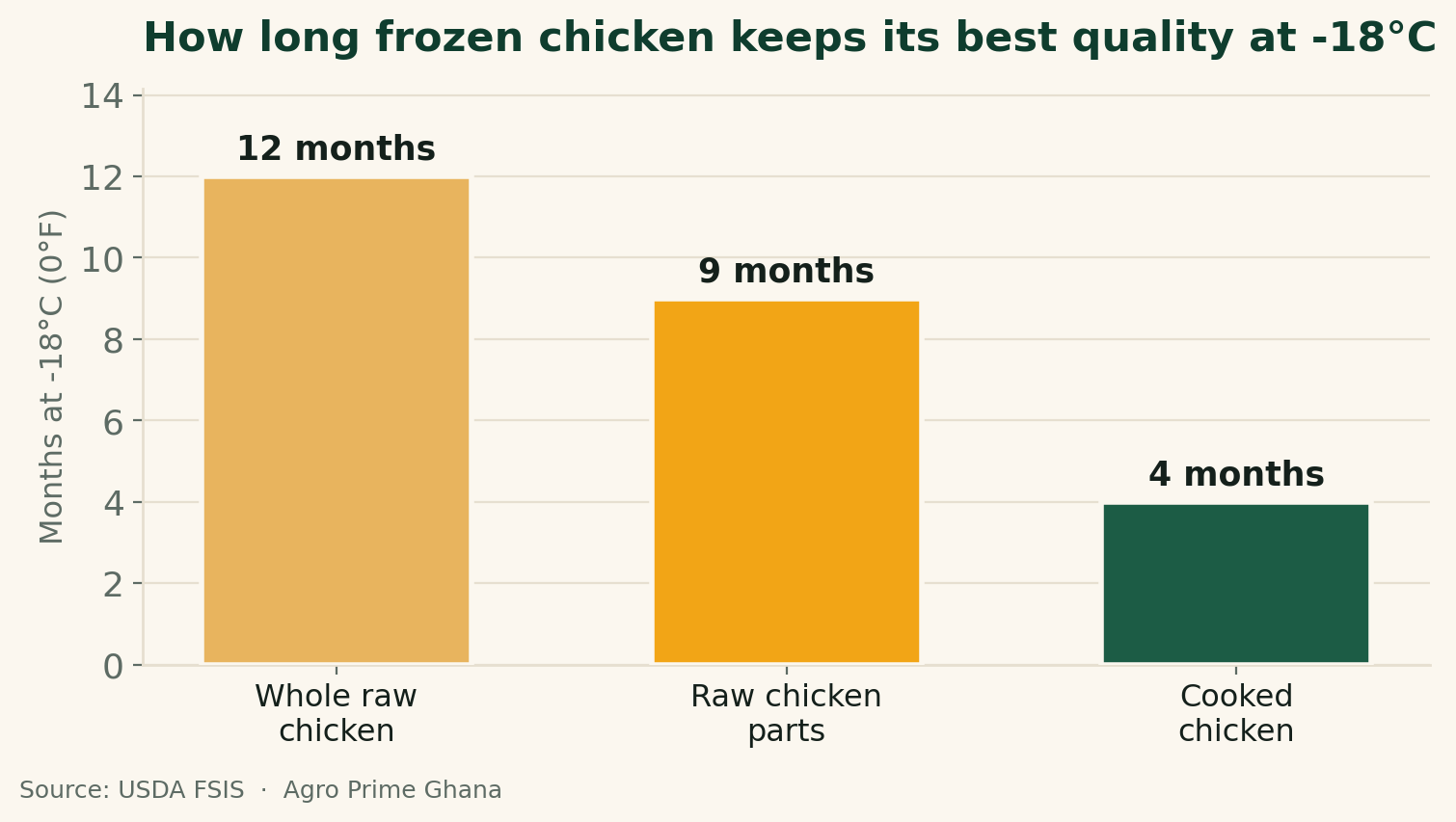
At a steady -18°C, frozen raw chicken stays safe almost indefinitely but only keeps its best eating quality for a limited window — and that window is what you should base your best-before date on. The USDA's Food Safety and Inspection Service gives clear guidance for quality (not safety, which continues as long as it stays frozen): whole raw chicken keeps about 12 months, raw parts about 9 months, and cooked chicken about 4 months. The table below turns the key temperatures and times into a working reference for a Ghanaian packing operation.
| Stage / product | Target temperature | Time limit (quality & safety) |
|---|---|---|
| Fresh raw chicken in the fridge | 4°C (40°F) or below | 1–2 days only |
| Whole raw chicken, frozen | -18°C (0°F) or colder | ~12 months for best quality |
| Raw chicken parts, frozen | -18°C (0°F) or colder | ~9 months for best quality |
| Cooked chicken, frozen | -18°C (0°F) or colder | ~4 months for best quality |
| The "danger zone" | 4–60°C (40–140°F) | Minimise — bacteria multiply fast |
| Safe cooked internal temp | 74°C (165°F) | Kills vegetative bacteria |
Two cautions. First, these times assume the temperature never wavers; a freezer that thaws and refreezes with each ECG power cut shortens quality dramatically, because every partial thaw grows more damaging ice crystals and edges the surface toward the danger zone. Second, "safe" and "good" are different things — a bird frozen for 18 months may still be safe if it never warmed up, but it will likely be dry, tough and freezer-burnt, and a disappointed customer does not come back.
Chilling and packing: getting the bird ready to freeze
Good frozen chicken is made before the freezer, not in it. After slaughter, evisceration and washing, the carcass should be chilled quickly — ideally in iced water or a cold room down toward 4°C — so it spends as little time as possible in the danger zone. Only then should it be packed. Packing dry, cold and clean is what separates a professional pack from a market-table one:
- Use food-grade, moisture-proof material. The enemy of frozen chicken is moisture loss — freezer burn is simply the surface drying out and oxidising into grey, leathery patches. Wrap birds snugly in food-grade polythene or vacuum-pack them so there is little air against the meat. Squeeze out air, seal tightly, and avoid thin, recycled or non-food-grade plastics that can taint the meat or split at freezer temperatures.
- Portion before you freeze. Decide whether you are selling whole birds, halves, or parts (thighs, wings, gizzards) and pack in the units your customer buys, because refreezing a thawed bird to break it up later is exactly what you must avoid.
- Pack in freeze-friendly sizes. Flatter, smaller packs freeze faster to the centre than a dense pile, which means less time in the ice-crystal zone and better texture.
- Label before it goes in. Weigh and label each pack while you can still handle it easily (covered in the labelling section below).
Field note: the chiller does the hard work, not the freezer
A mistake we see again and again is a farmer who buys a big chest freezer and thinks the job is done — then loads warm, freshly dressed birds straight into it. A chest freezer is built to hold things frozen, not to pull heat out of a warm carcass fast. Loading warm birds in bulk lets them sit for hours in the danger zone in the middle of the pile while the outside crusts over, and it warms everything else in the box. The habit that pays off is a proper chill first — iced water or a cold room to bring carcasses down near 4°C — and then freezing in modest batches with space around each pack so cold air can circulate. Freeze fast, stack tight only once solid.
What packaging materials should you use?
The right packaging is food-grade, moisture- and vapour-proof, and strong enough not to tear at -18°C, because its whole purpose is to keep water in the meat and contamination out. For most small and medium Ghanaian operations the practical choices are food-grade polythene bags (heat-sealed or tightly tied with air pressed out) or, for a premium product, vacuum packing, which removes almost all the air and gives the longest freezer life and the cleanest look on a shelf. Whatever you choose, it must be intended for food contact — thin market "rubbers" and reused sacks are false economy that lead to freezer burn, leaks and cross-contamination. An outer carton or crate protects the packs from crushing and makes cold-room stacking and transport tidy. If you print your own bags or add a label, that surface is also your branding and your legal label, so it earns its keep twice.
What does the FDA require on the label?
A packaged frozen chicken sold in Ghana must carry a label that truthfully identifies the product and its handling, and Ghana's General Labelling Rules (L.I. 1541), enforced by the Food and Drugs Authority, set out what that means. In practice, aim to show all of the following clearly and in indelible, legible print:
- The name of the product — e.g. "Frozen Whole Chicken" or "Frozen Chicken Thighs".
- Net weight in metric units (grams or kilograms), reflecting the frozen contents.
- Name and address of the producer/packer — your business, so the product is traceable to you.
- Date of packing and a best-before/use-by date, based on the realistic frozen-quality window above.
- Storage instructions — "Keep frozen at -18°C or below. Do not refreeze after thawing."
- A batch or lot number, so a specific run can be traced or recalled.
- Country of origin (Product of Ghana), which is also a selling point against imports.
Beyond the label itself, selling packaged meat brings food-business obligations: registering the product and premises with the FDA, and handling and storing to hygienic standards. Treat the label as a promise you can keep — never post-date, never print a best-before you cannot honour with your actual freezer, and never relabel old stock. The whole value of "local and trustworthy" collapses the first time a customer finds a spoiled bird behind an honest-looking label. Solid records make this manageable; see record keeping on the poultry farm.
Sell dressed, frozen birds — start with strong broilers
A frozen-chicken line is only as good as the bird that goes into it, and a clean, fast-growing, well-finished broiler dresses out into an attractive, meaty pack that a cold store or hotel will pay for. Agro Prime Ghana supplies healthy day-old broiler chicks and the feeding and management support to raise them to an even market weight with good conformation — the raw material for a premium frozen product. If you are planning a dressed-and-frozen line and want advice on breed choice (see our Cobb 500 guide), stocking numbers or a processing routine, message us on WhatsApp +233 24 915 1503 or book a visit to the hatchery.
Keeping the cold chain intact to the customer
The cold chain does not end at your freezer door — it must hold through transport and display, or everything upstream is wasted. During delivery, move frozen birds in an insulated box or cold van and keep them at -18°C; the Codex code is explicit that transport and retail display should both maintain -18°C. Short, well-planned delivery runs, ice packs, and an insulated container make this achievable even without a refrigerated truck for a small operation. At the point of sale, product should go straight into a customer's own freezer or be cooked soon; advise customers plainly on the label and in person. Two rules protect you and them:
- Never refreeze thawed chicken. Once a bird has fully thawed, refreezing it is unsafe and destroys quality — bacteria that woke up during the thaw have been multiplying. If power fails and product partially thaws but still holds ice crystals and stays cold (below ~4°C), it can be refrozen with some quality loss, but a bird that reached room temperature should be discarded.
- Thaw safely. Teach customers to thaw in the fridge, in cold water (changed every 30 minutes) or in the microwave — never on the counter, where the surface climbs into the danger zone while the middle is still frozen.
Frequent, unmanaged power cuts are the real Ghanaian challenge here, so build for them: a full freezer holds cold longer than a half-empty one, keep the lid shut during outages, and consider a temperature log or a cheap fridge thermometer so you actually know whether -18°C is being held rather than hoping it is.
Field note: freezer burn is a quality warning you can read
When we open a customer's returned pack and see grey, dry, papery patches on the meat, we can usually reconstruct what went wrong without being told: loose or torn packaging, air trapped against the meat, a freezer that isn't holding a steady -18°C, or a bird stored far too long. Freezer burn is not dangerous to eat once cooked, but it makes the meat dry and tasteless, and no customer accepts it. The fix is boringly reliable — pack tight with the air pressed out or vacuum-sealed, hold a steady temperature, and rotate stock first-in-first-out so nothing lingers past its quality window. If your packs are burning, the message is about your packing and your freezer, not the chicken.
Common mistakes that ruin a frozen-chicken business
Most failures in small frozen-chicken ventures trace back to a short list of avoidable errors, and knowing them is half the defence. Loading warm birds into a chest freezer and expecting it to chill them; using thin, non-food-grade plastic that tears and lets in air; letting birds sit on a market table in the danger zone before or after freezing; a freezer that rides warmer than -18°C because it is overloaded, iced up, or off during long power cuts; refreezing thawed stock to save it; and dating packs on hope rather than on a real quality window. Each one is cheap to fix and expensive to ignore. The businesses that last treat temperature as a number they measure, packaging as food-safety equipment rather than a wrapper, and their label as a promise — and in a market where imported frozen chicken competes mainly on price, that discipline is exactly what lets a local seller compete on trust. For more on reaching buyers, see poultry marketing in Ghana.
The bottom line on freezing and packing chicken
Selling frozen, packaged chicken is one of the best ways for a Ghanaian broiler farmer to add value and sidestep the live-bird price war — but only if you respect the cold chain end to end. Start with a clean, quickly chilled bird; pack it in food-grade, moisture-proof material with the air pressed out; freeze it fast to -18°C at the centre; hold that temperature through storage, transport and display; and label it honestly with the product, your name, the weight, the dates and clear storage advice. Promise a realistic shelf life — around a year for whole birds, nine months for parts — and never post-date or refreeze. Do all that and your freezer stops being a place where quality quietly dies and becomes what it should be: the tool that lets locally raised, traceable, safe Ghanaian chicken beat the anonymous imports on the thing customers actually care about — trust.
Frequently asked questions
At what temperature should chicken be frozen and stored for sale?
How long can I keep frozen chicken before selling it?
Does freezing kill bacteria like Salmonella on chicken?
What packaging is best for freezing chicken?
What must a frozen chicken label show in Ghana?
Can I refreeze chicken that has thawed?
How do I keep chicken frozen during Ghana's power cuts?
Is locally frozen chicken competitive against imports in Ghana?
Sources & further reading
- USDA Food Safety and Inspection Service — Freezing and Food Safety (0°F freezing, dormant bacteria, storage times, thawing, refreezing).
- USDA FSIS — Chicken from Farm to Table (danger zone 40–140°F, fridge/freezer temperatures, cooking to 165°F, storage durations).
- FAO / Codex Alimentarius — Code of Practice for the Processing and Handling of Quick Frozen Foods (-18°C standard, thermal centre, cold-chain transport and display).
- The Poultry Site — Overview of Ghana's poultry sector (consumption, imports, local production share).
- Agro Prime Ghana guides: poultry marketing, broiler vs layer profit, and record keeping.
About Agro Prime Ghana
Agro Prime Ghana Limited runs a poultry hatchery and mixed agribusiness in Kasoa, supplying day-old chicks and supporting poultry keepers across the country. We supply healthy day-old chicks (broilers & layers), point-of-lay pullets, quality feed and hands-on farm support — the foundation of a profitable dressed-and-frozen chicken line. This article is general educational information, not a substitute for professional food-safety or veterinary advice; register your food business and premises with the FDA before selling packaged meat. Ready to start or expand? Book a visit or message us on WhatsApp (+233 24 915 1503) to order chicks, feed or advice.