To find customers for poultry products in Ghana, go where chicken and eggs are already bought in volume every day: open markets and market queens, chop bars and restaurants, hotels and caterers, cold stores and frozen-chicken sellers, and institutions like schools and canteens — then lock those buyers in with reliability, word of mouth and, where you can, standing contracts. The demand is enormous and mostly met by imports, which is both the challenge and the opening for a local farm. Consider the common trap: a farmer raises a good batch of broilers, then panics in the last two weeks trying to sell them, dumps them cheaply to a middleman, and swears poultry "doesn't pay." The problem was never the birds — it was starting to look for customers after the birds were ready instead of before the chicks arrived. Finding buyers is a skill you build deliberately, and this guide lays out exactly where Ghana's poultry customers are and how to win and keep them.
Written by the Agro Prime Ghana poultry team and reviewed against current industry references (USDA Foreign Agricultural Service and Ghanaian market research). Last updated September 2026.
Key takeaways
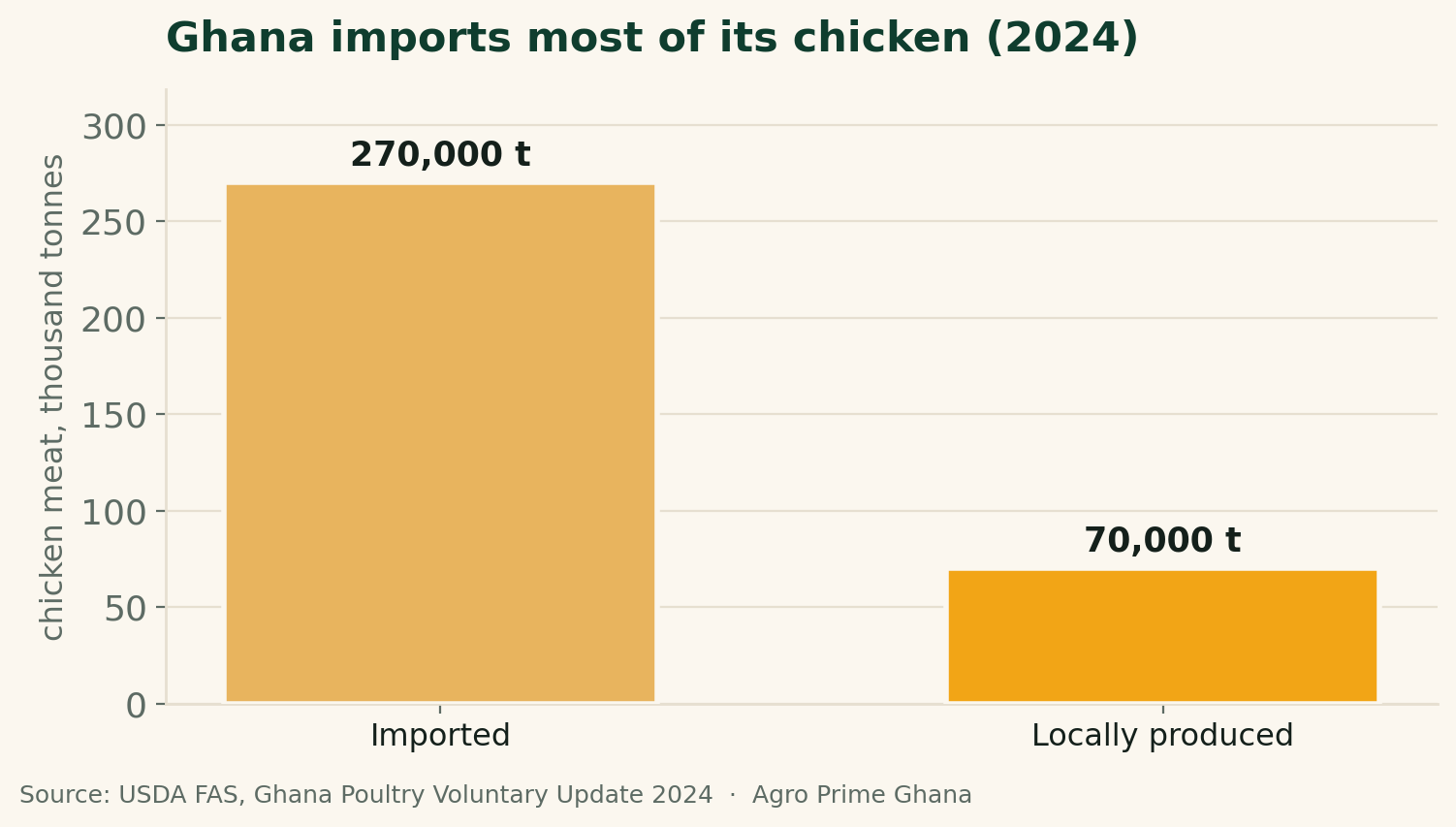
Ghana eats far more chicken than it produces: total chicken meat consumption is around 340,000 tonnes a year, of which roughly 270,000 tonnes (about 79%) is imported and only about 70,000 tonnes produced locally, per the USDA's 2024 Ghana poultry update. Local broilers are under 5% of chicken meat consumed, and most domestic chicken is sold as live birds, with demand and prices peaking at Christmas. Your best customers are open markets, chop bars and restaurants, hotels, cold stores, and institutions — plus households direct. Eggs are traded by the crate of 30, mostly through retailers and wholesalers. Win customers with reliability, consistent quality and fair pricing; keep them with word of mouth and standing contracts. Line up buyers before the birds are ready, never after.
Why finding customers is the make-or-break skill in Ghanaian poultry
In Ghana, the farms that fail rarely fail at raising birds — they fail at selling them, usually because they had no buyers lined up when the flock was ready. The market context makes this clearer. According to the USDA Foreign Agricultural Service, Ghana consumes on the order of 340,000 tonnes of chicken meat a year but produces only about 70,000 tonnes domestically, importing the rest — roughly 270,000 tonnes, near 79% of supply. Domestically produced broilers are under 5% of all chicken meat eaten, and most local chicken reaches the table as live birds sold in the market, with a strong spike in demand at Christmas. What this means for you is twofold: demand is huge and nowhere near satisfied by local farms, so there is plenty of room — but you are competing against cheap frozen imports on price, which forces you to compete on freshness, trust, and relationship instead. That is exactly where a local farmer who knows their buyers personally wins. Finding and holding the right customers is therefore not a task you do at the end; it is the core skill of the whole business.
Who actually buys poultry in Ghana?
Poultry in Ghana is bought by a clear set of customer types, and each wants something slightly different — knowing which you are selling to shapes everything from your bird size to your pricing. Households buy small quantities frequently, valuing freshness and trust. Open-market traders and market queens buy in bulk to resell. Chop bars, restaurants and fast-food outlets buy steadily and value reliable supply and consistent size. Hotels and caterers want quality and dependable delivery, often on account. Cold stores and frozen-chicken sellers buy volume and compete hard on price against imports. Institutions — schools, hospitals, company canteens — buy in large, predictable quantities, sometimes on contract. On the egg side, the picture is similar: research on egg marketing in Ghana found the main channels are retailers and wholesalers, with direct-to-consumer sales least common, and eggs moving by the crate of 30 (Scientific African, 2023). The table below maps these customers so you can choose where to focus.
| Customer type | What they buy | How to win them | Watch out for |
|---|---|---|---|
| Open-market traders / market queens | Live birds and eggs in bulk to resell | Reliability, volume, a fair standing price | They set the price; margins get squeezed |
| Chop bars & restaurants | Regular birds/parts, consistent size | Dependable weekly supply, uniform birds | They compare hard on price vs imports |
| Hotels & caterers | Quality dressed birds, sometimes on account | Quality, clean processing, reliable delivery | Credit terms; higher standards; paperwork |
| Cold stores / frozen sellers | Volume, often dressed and frozen | Consistent volume and competitive price | Direct price war with cheap imports |
| Institutions (schools, canteens) | Large, predictable orders | Contracts, capacity, invoicing | Slow payment; must guarantee supply |
| Households (direct) | Small, frequent buys of eggs/birds | Freshness, trust, WhatsApp convenience | Many small orders to manage |
Open markets and market queens
Open markets are the backbone of poultry selling in Ghana, and building a relationship with the market traders who buy in bulk is often the fastest route to moving a whole batch. In markets from Kasoa to Kaneshie to Kumasi, live birds and eggs pass through traders — frequently the well-organised market queens who control much of the wholesale flow — and selling to them means you can clear volume in one transaction rather than chasing dozens of small buyers. The trade-off is price: because they buy to resell, they push for the lowest rate, and a farm that depends entirely on them stays a price-taker. The way to win here is to become a reliable, known supplier — consistent bird size, dependable quantities on agreed days, honest dealing — so that a queen prefers your birds and will hold a standing arrangement. Use the market for what it is good at (moving volume, especially at festive peaks) while you also build higher-margin direct customers so you are never wholly at the mercy of the market price. For selling into peak seasons in particular, see our guide to selling live birds for the festive season.
Chop bars, restaurants and fast food
Chop bars and restaurants are among the best customers a poultry farm can have, because they buy regularly, plan ahead, and value a supplier who never lets them down. A busy chop bar or waakye joint gets through birds and eggs every week without fail, so winning even a handful of them creates a dependable base of orders you can build the farm around. What they want is consistency: birds of a reliable size, delivered on the day promised, at a stable price they can build into their own costing. To win them, approach directly and professionally — bring a sample, quote clearly, and start with a small standing order you can absolutely fulfil, then grow it as trust builds. Because they weigh you against cheap imported chicken, compete on what imports cannot offer: freshness, the ability to supply exactly the size and quantity they need, and a real person who answers the phone. Dressed and portioned birds often suit restaurants better than live ones, so being able to supply chicken parts and process cleanly can open doors a live-bird seller cannot.
Hotels, caterers and event cooks
Hotels, professional caterers and event cooks are higher-value customers who pay for quality and reliability, and who stay loyal to a supplier that meets their standards. They handle weddings, funerals, conferences and daily service, so orders can be large and, for events, highly predictable once booked. The bar is higher: they expect well-dressed, clean, uniform birds, professional handling, dependable delivery, and often payment on account rather than cash. Win them by presenting the farm well, talking honestly about your hygiene and processing, and proving reliability on a first small order before asking for their main business. Caterers plan around funerals and events booked weeks ahead, which lets you schedule production to match — a real advantage over scrambling to sell a finished batch. The credit terms and quality expectations mean this segment rewards the more organised farm, so grow into it as your operation matures rather than starting there.
Field note: sell the batch before you set the eggs, not after
The hardest lesson in poultry selling is also the simplest: line up your buyers before the birds exist, not when they are eating you out of profit at market weight. Our practice is to know roughly who a batch is for before it is even started — this many for a couple of chop bars, this many promised to regular market traders, a share held for festive or direct household orders — so the flock is largely spoken for as it finishes. Feed does not stop while you hunt for buyers; every extra day a finished bird waits is money lost and margin gone. Plan production around orders you have cultivated, stagger batches so you always have birds ready when customers want them, and you turn selling from a last-minute panic into a routine hand-over.
Cold stores and frozen-chicken sellers
Cold stores are where most imported chicken reaches Ghanaian consumers, which makes them both a big potential customer and your competitor's home turf. They move serious volume, so a farm that can supply consistently dressed and, ideally, frozen birds can find a real outlet. The catch is price: cold stores exist largely to sell cheap imported frozen chicken, so selling into them means competing closest to the import price, where local production is least advantaged. Approach realistically — this is a volume, low-margin channel best suited to farms that have got their costs down and can guarantee steady supply. Where you can, position your birds as a fresh or premium local alternative rather than undercutting imports on price alone, and pair supply with good packaging and cold handling. For many small and medium farms, cold stores are a supplementary outlet for surplus rather than the main customer, with better margins found among chop bars, caterers and direct buyers who value freshness.
Institutions, schools and corporate buyers
Institutions — boarding schools, hospitals, hostels, company and factory canteens, and government caterers — are among the most valuable poultry customers because they buy in large, predictable quantities on a regular schedule. A single school feeding hundreds of students, or a canteen serving a workforce daily, is steady, plannable demand you can organise production around. Winning them usually means capacity and paperwork: proving you can supply the quantity reliably, often submitting a quotation or tender, and being ready to invoice and wait for payment rather than collect cash. That suits farms with enough scale and organisation to guarantee supply and absorb slower payment — but the reward is a large, stable order to build a production calendar around. Approach directly with a clear written offer, start where you can meet the volume comfortably, and treat on-time delivery as the thing that renews the relationship. This is also where a formal contract genuinely protects both sides.
Have the customers but not the steady supply to serve them?
Winning chop bars, caterers or an institution is only half the job — you then have to deliver birds of consistent size, on time, batch after batch. That reliability starts with good chicks and a planned production calendar. Agro Prime Ghana supplies strong day-old broiler and layer chicks, point-of-lay pullets, quality feed and practical help with staggering batches so you always have birds ready when a customer orders, instead of gaps and gluts. If you have found demand and now need dependable supply behind it, that is exactly what we help farms build. Message us on WhatsApp (+233 24 915 1503) or book a visit to the Kasoa farm to plan your production around the customers you are winning.
Word of mouth and repeat customers: the real growth engine
In Ghana's poultry trade, word of mouth is the most powerful and cheapest marketing there is, and turning every satisfied buyer into a repeat customer and a referrer is how farms grow steadily. A chop-bar owner who trusts your supply tells another; a household that got fresh, clean birds tells the family WhatsApp group; a market trader who finds you reliable brings you into her network. This only works if you earn it, so treat reliability and fair dealing as marketing: deliver the promised size and quantity on the promised day, price fairly and consistently, fix any problem quickly, and stay reachable — most Ghanaian buyers now expect to reach a supplier on WhatsApp and pay by mobile money. Ask happy customers to recommend you, and keep every buyer's contact, using a WhatsApp broadcast list to announce when stock is ready. Repeat business is where poultry becomes profitable — a hundred loyal buyers who reorder are worth far more than a constant scramble for new ones, a theme we develop in our guide to poultry marketing in Ghana.
Contracts and out-grower arrangements
For farmers who want guaranteed buyers, contracts and out-grower schemes remove the single biggest risk in poultry — not knowing who will buy the finished birds. A supply contract with an institution, processor, large caterer or aggregator commits a buyer to take an agreed quantity at an agreed price, letting you plan production and financing with real confidence instead of hoping the market absorbs your batch. Out-grower or contract-farming arrangements go further: a larger company or hatchery may supply chicks, feed and technical support and agree to buy back the grown birds, sharing risk and locking in your market. These trade some independence and margin for security — often a good deal for a newer farm that cannot yet afford an unsold batch. Read the terms carefully — pricing, quality standards, payment timing and what happens if either side falls short — and start with a scale you can honour. Our guides to contract broiler farming and the broiler out-grower model walk through how these work here and what to check before you sign.
Field note: your reputation is your best salesperson — protect it
Over time the farms that never struggle to sell are the ones whose name means "reliable." We have learned to guard that harder than any single sale: it is better to turn down an order we cannot fill well than to deliver undersized birds late and damage a relationship that would have bought from us for years. One disappointed chop bar tells others; one delighted one does too. So we say no when we must, we make problems right quickly and without argument, and we keep our word on size, day and price. That steadiness is quietly the most effective customer-finding tool there is — because the customers you already have become the people who bring you the next ones.
The bottom line on finding poultry customers in Ghana
Ghana's poultry demand is enormous and largely unmet by local farms — the country imports close to 80% of the chicken meat it eats — so the customers are unquestionably there; the skill is in reaching and holding them. Go where poultry is already bought in volume: open markets and their traders, chop bars and restaurants, hotels and caterers, cold stores, institutions, and households direct. Match your product to each buyer, compete on the freshness, trust and reliability that imports cannot offer, and treat consistent, fair, on-time supply as your real marketing. Then compound it: turn satisfied buyers into repeat customers and referrers through word of mouth and WhatsApp, and lock in demand with standing arrangements and contracts where you can. Above all, find your customers before the birds are ready, not after — plan production around orders you have cultivated, and selling stops being the crisis at the end of every batch and becomes the steady heartbeat of a profitable farm.
Frequently asked questions
Who are the main buyers of poultry products in Ghana?
How do I sell my broilers before they get too big and eat my profit?
Why is it hard to compete with imported chicken in Ghana?
Are chop bars and restaurants good customers for a poultry farm?
How can word of mouth help me find poultry customers?
Should I use contracts or out-grower schemes to secure buyers?
How do institutions like schools buy poultry, and how do I reach them?
How do I find customers for eggs specifically?
Sources & further reading
- USDA Foreign Agricultural Service — Ghana Poultry Voluntary Update 2024 (consumption, imports vs domestic production, live-bird marketing, festive demand).
- Scientific African (2023) — Organization and performance of chicken egg marketing in Ghana (egg marketing channels, crate trade, constraints).
- Agro Prime Ghana guides: poultry marketing in Ghana, selling live birds for the festive season, contract broiler farming, and the broiler out-grower model.
About Agro Prime Ghana
Agro Prime Ghana Limited runs a poultry hatchery and mixed agribusiness in Kasoa, supplying day-old chicks, point-of-lay pullets, feed and hands-on farm support to keepers across the country. These guides combine practical hatchery and farm experience with current industry references. This article is general business information, not financial or legal advice — market conditions and prices change, so verify current figures before you commit. Ready to build supply behind the customers you are finding? Book a visit or message us on WhatsApp (+233 24 915 1503) to order chicks, pullets, feed or advice.