One medium-to-large egg gives you roughly 6 grams of complete, high-quality protein for about 70 calories, plus choline, vitamin B12, vitamin D, vitamin A, selenium, riboflavin and the eye-protecting pigments lutein and zeaxanthin — making it one of the most nutrient-dense, best-value protein foods a Ghanaian family can put on the table. For the price of a single egg you get a package of nutrients that is hard to match, gram for gram or cedi for cedi, in fish, meat or milk. Yet many people still hesitate over eggs because of an old worry about cholesterol that the science has now largely put to rest. This guide lays out exactly what is in an egg, why those nutrients matter, where the cholesterol story really stands today, and why eggs remain smart, affordable nutrition for households across Ghana.
Written by the Agro Prime Ghana poultry team and reviewed against current nutrition references (USDA FoodData Central, the 2020 and 2025 Dietary Guidelines for Americans, and Harvard's Nutrition Source). Last updated September 2026.
Key takeaways
A single large egg (about 50g) supplies roughly 6.3g of complete protein and about 72 calories, with all nine essential amino acids. It is one of the few natural food sources rich in choline (about 147mg — around a quarter of a day's needs), and it delivers meaningful vitamin B12, vitamin D, vitamin A, riboflavin, folate, selenium and the antioxidants lutein and zeaxanthin. On the old cholesterol worry: the 2015–2020 Dietary Guidelines dropped the 300mg/day cholesterol limit, and the 2025 Guidelines do not mention dietary cholesterol at all — for most healthy people, up to about one egg a day is not linked to higher heart-disease risk. For Ghanaian families, that makes eggs an affordable, shelf-stable, everyday source of first-class protein and micronutrients.
What is actually inside an egg?
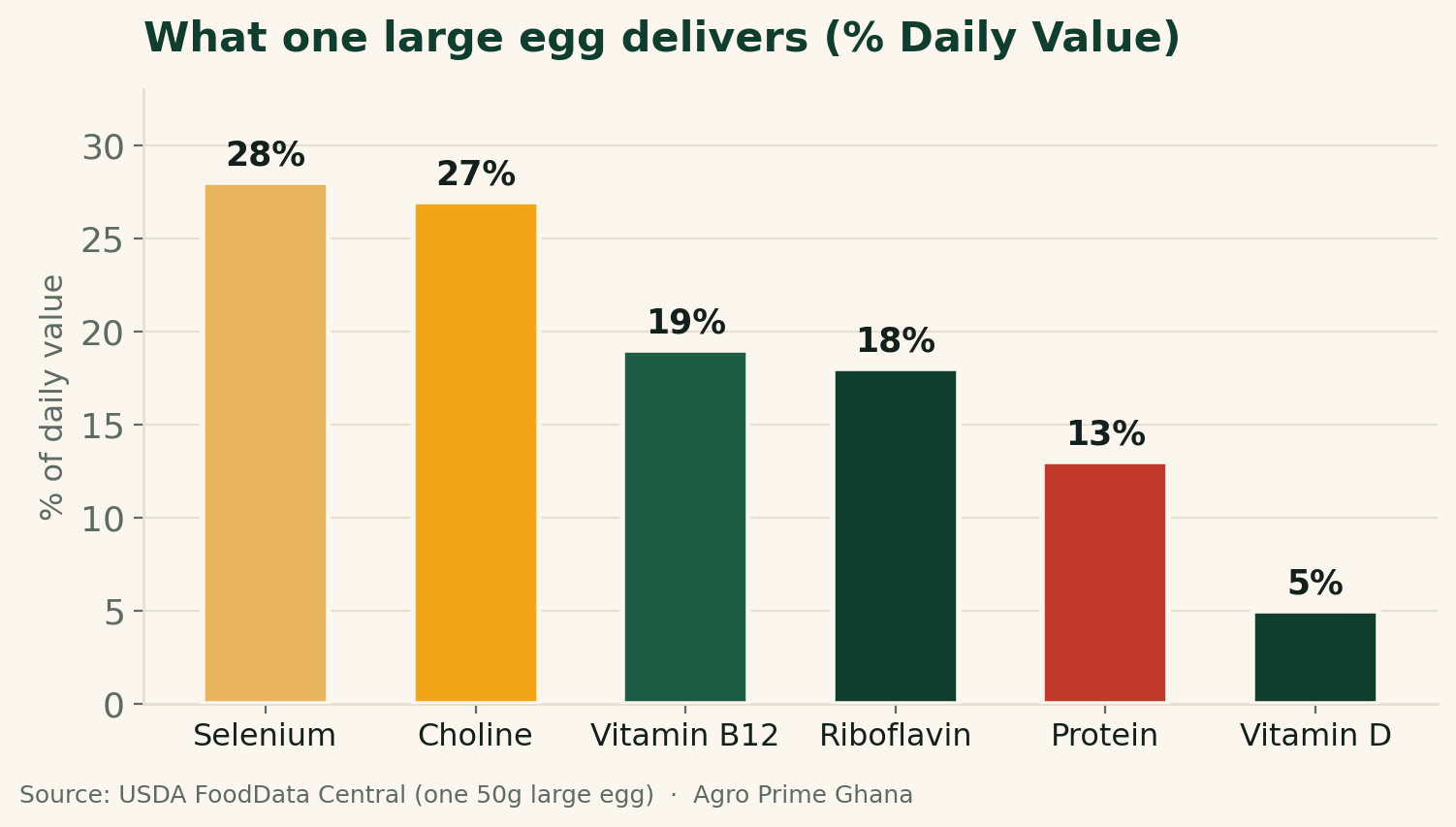
An egg is one of nature's most complete single foods, because it contains everything needed to build a whole chick. According to USDA FoodData Central, one large egg of about 50 grams provides roughly 72 calories, 6.3g of protein, 4.8g of fat, 147mg of choline, 80 micrograms of vitamin A, 0.45 micrograms of vitamin B12, about 1 microgram (41 IU) of vitamin D, 15.4 micrograms of selenium, 0.23mg of riboflavin, 24 micrograms of folate, and around 126 micrograms of lutein plus zeaxanthin. That is a remarkable amount of nutrition in a food you can hold in one hand. The protein is spread across both the white and the yolk, while most of the vitamins, minerals, choline and the beneficial pigments are concentrated in the yolk — which is why eating whole eggs, not just whites, is what makes them so valuable. The egg white is essentially high-grade protein and water; the yolk is where the micronutrient wealth sits.
Why egg protein is "complete" and high quality
Egg protein is considered a gold standard because it contains all nine essential amino acids — the building blocks the human body cannot make for itself — in close to the ideal ratio, and in a form the body absorbs very efficiently. Nutritionists have historically used egg as the reference protein against which other foods are scored, which tells you how good it is. The 2025 Dietary Guidelines for Americans single eggs out as a high-quality protein to prioritise at meals across the lifespan. For a growing child, a pregnant or breastfeeding mother, a hard-working farmer or an older person trying to hold on to muscle, that quality matters: the roughly six grams of protein in one egg go a long way, and they arrive alongside the vitamins and minerals that help the body actually use them. Few affordable foods deliver protein of this calibre.
The nutrients that make eggs special
Beyond protein, the standout nutrients in an egg are the ones that are genuinely hard to get elsewhere. Here is what the yolk in particular brings, and why each one matters for a Ghanaian household.
| Nutrient (per large egg) | Roughly how much | Why it matters |
|---|---|---|
| Protein | ~6.3g (complete) | Builds and repairs muscle, supports growth, immunity and recovery; all nine essential amino acids |
| Choline | ~147mg (~a quarter of daily needs) | Vital for brain development, memory and liver function; eggs are one of the richest common sources — important in pregnancy and childhood |
| Vitamin B12 | ~0.45 mcg | Needed for healthy nerves and red blood cells; naturally found only in animal foods |
| Vitamin D | ~1 mcg (41 IU) | Helps absorb calcium for strong bones; eggs are one of very few natural food sources |
| Vitamin A | ~80 mcg | Supports vision, skin and immune defences |
| Selenium | ~15.4 mcg (~a quarter of daily needs) | An antioxidant mineral that protects cells and supports the thyroid and immune system |
| Riboflavin (B2) | ~0.23mg | Helps turn food into energy |
| Lutein & zeaxanthin | ~126 mcg | Antioxidant pigments that concentrate in the eye and are linked to long-term eye health |
Two of these deserve special mention. Choline is a nutrient most people have never heard of, yet many diets fall short of it — and eggs are among the best natural sources, supplying roughly a quarter of an adult's daily needs in one egg. It is critical for brain development in the womb and in early childhood, which is why eggs are such valuable food for pregnant and nursing mothers and for young children. Vitamin D is the other: it is genuinely scarce in the natural diet, and the egg yolk is one of the few foods that contains it at all. Together with the vitamin A, selenium and B-vitamins, this is why an egg is far more than "just protein."
The cholesterol myth: what changed
For decades, eggs carried a bad reputation because the yolk contains cholesterol — about 186mg in a large egg, most of it in the yolk. The old advice told people to limit dietary cholesterol to 300mg a day, which made a two-egg breakfast look risky. That advice has been overturned by the evidence. As Harvard's Nutrition Source explains, the cholesterol you eat has a much smaller effect on blood cholesterol than the mix of fats in your diet — saturated and trans fats matter far more. Reflecting this, the United States' 2015–2020 Dietary Guidelines removed the long-standing 300mg daily cap on dietary cholesterol, and the newest 2025 Dietary Guidelines do not mention dietary cholesterol as a concern at all, while actively recommending eggs as a high-quality protein.
The practical bottom line for a healthy person: research finds that up to about one egg a day is not associated with an increased risk of heart disease. There are sensible exceptions — people living with diabetes or existing heart disease should follow their doctor's or dietitian's advice, as the picture can differ for them, and how you cook the egg matters too (frying eggs in a lot of oil, or pairing them daily with fatty processed meat, changes the equation). But the blanket fear that "eggs are bad for your heart" no longer reflects the science. For the average Ghanaian household, an egg a day is a reasonable, nourishing habit rather than a health risk.
Field note: whole egg, cooked simply, is the win
The nutrition lives in the whole egg, so throwing away yolks to "avoid cholesterol" throws away the choline, vitamins A and D, the pigments and much of the value. What we suggest to families is simple: eat the whole egg, and cook it simply — boiled, poached, or fried in a little oil rather than swimming in it. A boiled egg needs no oil at all, travels well, keeps children full, and is one of the cheapest complete-protein snacks you can pack. How you treat the egg after cooking matters for food safety too — see our guide to egg storage and handling.
Why eggs are such good value protein in Ghana
Protein is the most expensive part of most family food budgets, and this is exactly where eggs earn their place. Compare the ways a Ghanaian family typically buys protein — fish, chicken, beef, tinned foods — and the egg stands out on three counts. First, cost per gram of high-quality protein: an egg delivers around six grams of top-tier protein for the price of a single egg, which is usually cheaper per gram than meat or most fish, and far cheaper than tinned protein. Second, no waste and no cold chain needed: an egg is a sealed, single-portion package that keeps for weeks in a cool, dry place without a fridge, so nothing spoils and nothing is thrown away — a real advantage where refrigeration is not guaranteed. Third, versatility and convenience: eggs need no cutting, cleaning or de-boning, cook in minutes, suit any meal, and are easy for a child or an elderly person to eat and digest.
Put together, that is why nutritionists so often recommend eggs as an affordable everyday protein for families on a budget, and why school-feeding and child-nutrition programmes around the world lean on them. In a country working to close protein and micronutrient gaps — particularly for children, where choline and quality protein support brain development — the humble egg is one of the most cost-effective tools available. Buying a crate of thirty at a time from a local producer usually brings the per-egg cost down further still.
Want a steady, affordable egg supply — or to produce them yourself?
Whether you want fresh table eggs for your household or shop, or you are thinking of keeping layers to feed your family and sell the surplus, Agro Prime Ghana can help. We supply healthy point-of-lay (POL) pullets ready to start laying, along with balanced layer feed and practical advice on getting good, consistent egg numbers. If you are weighing up a small laying flock, read our guide on how many layers you need for an egg business, then message us on WhatsApp (+233 24 915 1503) or book a visit to talk through pullets, feed and setup for your situation.
Do brown eggs beat white eggs — and does yolk colour mean more nutrition?
A common belief is that brown eggs, or eggs with deep orange yolks, are more nutritious. The truth is more down-to-earth. Shell colour is simply the breed of the hen — brown-egg layers like Lohmann Brown and ISA Brown lay brown eggs, white-egg breeds lay white — and it has essentially no bearing on what is inside. A brown egg and a white egg of the same size carry practically the same protein, vitamins and minerals. Yolk colour is a little different: a deeper orange yolk usually reflects more of the plant pigments (like those from maize, green feed or added marigold) in the hen's diet, which can mean somewhat more lutein and zeaxanthin, but it is a signal of the hen's feed, not proof of a dramatically "healthier" egg. What genuinely affects an egg's nutrition is the hen's diet and health — well-fed hens on a balanced layer ration lay consistently nutritious eggs, whatever the shell colour. If you are choosing birds, our guide to the best layer breeds in Ghana covers the practical differences.
Getting the most from eggs — safety and storage
To turn good eggs into good nutrition safely, a few basics matter, especially in Ghana's heat. Buy eggs clean, uncracked and fresh, and store them in a cool, dry place away from strong-smelling foods; a shaded, ventilated spot or a fridge both work, and eggs keep for weeks when kept cool. Cook eggs thoroughly — until the white is set and the yolk is firming — particularly for young children, pregnant women, the elderly and anyone unwell, to be safe from salmonella; runny, undercooked eggs carry a small risk that proper cooking removes. Wash your hands and any surfaces after handling raw egg. And do not rely on eggs alone: an egg is an outstanding contribution to a meal, but a balanced plate still needs vegetables, a carbohydrate and other foods. Used sensibly, though, eggs are one of the easiest wins in family nutrition — cheap, complete and convenient. Our egg storage and handling guide goes into the practical detail.
The bottom line on egg nutrition
An egg is a small package of first-class nutrition: about six grams of complete protein, a rare rich source of choline, and a spread of vitamins A, D, B12, riboflavin, folate, selenium and eye-protecting antioxidants — all for roughly 70 calories and the price of a single egg. The decades-old fear about dietary cholesterol has been walked back by the guidelines themselves; for most healthy people, an egg a day fits comfortably into a healthy diet. Eat the whole egg, cook it simply and store it safely, and you have one of the most affordable, convenient and nutrient-dense foods available to a Ghanaian family. Few things you can buy give back so much nutrition for so little.
Frequently asked questions
How much protein is in one egg?
Are eggs bad for cholesterol and the heart?
What nutrients do eggs provide besides protein?
How many eggs a day is safe to eat?
Are brown eggs more nutritious than white eggs?
Is it better to eat the whole egg or just the white?
Why are eggs recommended as affordable protein for families?
Do eggs help children's growth and brain development?
Sources & further reading
- USDA FoodData Central — nutrient data for whole large eggs (protein, choline, vitamins, minerals, lutein and zeaxanthin).
- American Egg Board / Egg Nutrition Center — the 2025 Dietary Guidelines for Americans on eggs, protein and cholesterol.
- Harvard T.H. Chan School of Public Health, The Nutrition Source — Eggs (dietary cholesterol, heart-disease evidence, sensible intake).
- Agro Prime Ghana guides: layer feeding guide, egg storage and handling, and best layer breeds in Ghana.
About Agro Prime Ghana
Agro Prime Ghana Limited runs a poultry hatchery and mixed agribusiness in Kasoa, supplying day-old chicks (broilers & layers), point-of-lay pullets, quality feed and hands-on farm support to poultry keepers across the country. These guides combine practical hatchery and farm experience with current, credible references. This article is general educational information, not personalised medical or dietary advice — anyone with a specific health condition should speak to a doctor or dietitian. Want a reliable supply of fresh eggs, or to start your own layers? Book a visit or message us on WhatsApp (+233 24 915 1503) to order POL pullets, feed or advice.