
The egg-handling equipment a Ghanaian farm actually needs — plastic trays, a candler, a grading scale, storage that keeps eggs cool, and only sometimes a washer — should be bought in that order, because each tool pays off at a different flock size and the cheapest ones deliver the most value first. A stack of clean plastic egg trays and a simple candler cost very little and immediately cut breakages and let you sort out cracked or stale eggs; a grading scale earns its keep the day you start selling by size; a cool store or cold room protects freshness across your whole flock; and an egg washer — the most expensive and most misunderstood item — is often the last thing you need and sometimes one you should skip. Many farmers get this backwards, spending on a washer while eggs still cook in the sun and crack in careless handling. This guide walks through each piece of equipment, what it does, and the flock size at which it starts to pay.
Written by the Agro Prime Ghana poultry team and reviewed against current industry references (FAO egg marketing guidance and small-scale egg-handling extension resources). Last updated September 2026.
Key takeaways
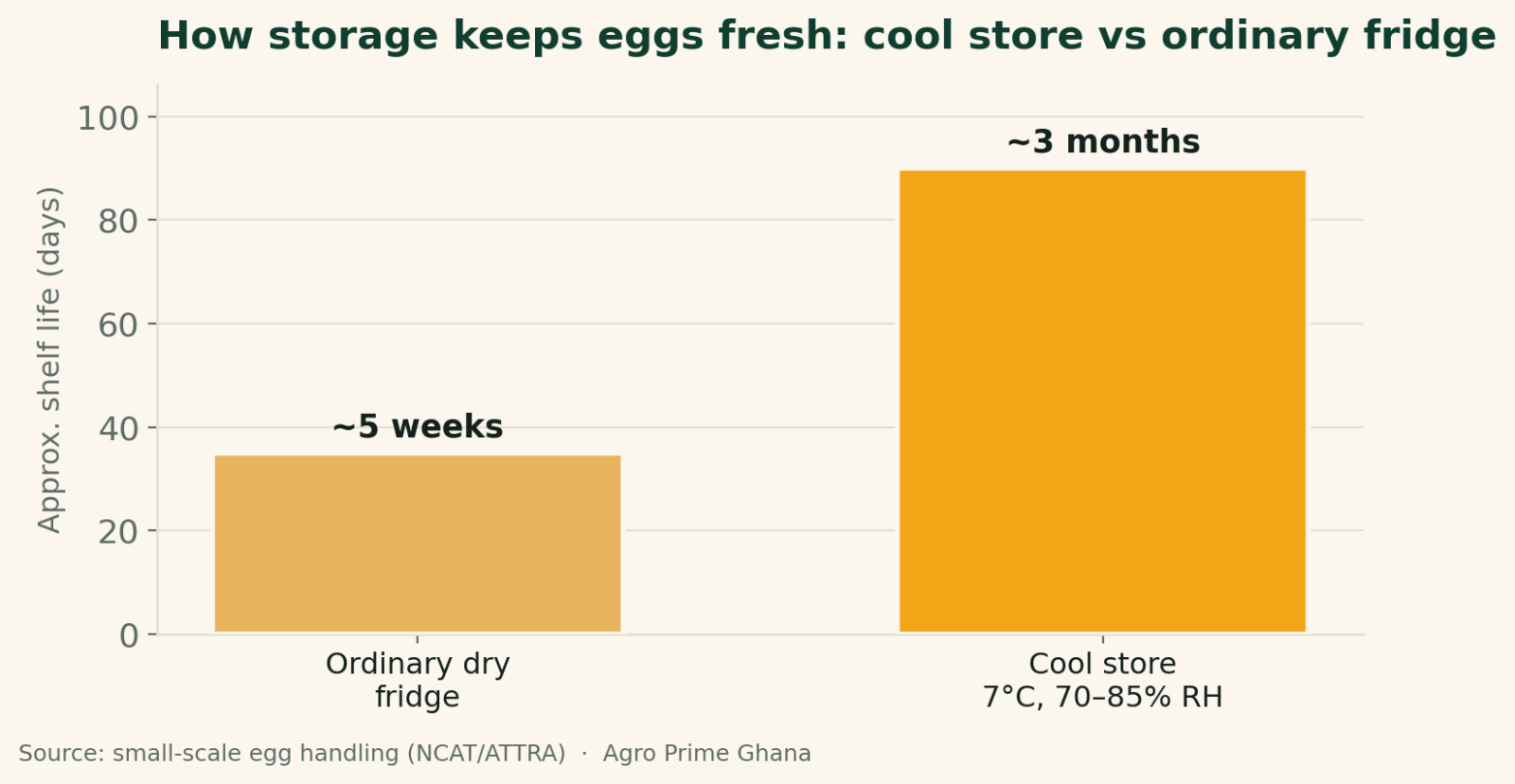
Buy in order of value-per-cedi: trays first, then a candler, then a scale, then cool storage, and a washer last (if at all). Clean plastic trays cut cracks and let air move around eggs. A candler (even a torch and a tube) reveals cracks, blood spots and the air-cell size that signals freshness. A grading scale sorts eggs into size classes (Large ~57 g, XL ~64 g, Jumbo ~71 g by USDA minimums) so you can sell by grade. Cool storage matters most of all: at 45°F (7°C) and 70–85% humidity eggs keep up to ~3 months, versus ~5 weeks in a dry ordinary fridge. Washing is risky — soaking eggs 1–3 minutes lets microbes penetrate the shell, and wash water must be at least 20°F warmer than the egg — so dry cleaning is usually safer. Match every purchase to your flock size and what you sell.
Which egg-handling equipment does a Ghanaian farm actually need?
The core kit is modest: clean egg trays and buckets for collection, a candler for quality checking, a scale for grading, and cool, clean storage — with washing equipment only for specific situations. Everything else is a refinement. The reason to think in this order rather than by catalogue is that egg handling is really about protecting a quality the hen already produced: from the moment of lay, an egg only ever loses quality, and good equipment simply slows that loss and lets you sort the good from the bad. So the tools that prevent breakage and reveal defects (trays, candler) and the tools that preserve freshness (cool storage) do the heavy lifting; the tools that add market polish (grading scale, cartons) come next; and the tools that carry the most risk if used wrongly (washers) come last. A farmer with 200 layers and a farmer with 5,000 need the same categories of equipment but very different scales of it, and matching spend to flock size is how you avoid buying an expensive machine that sits idle. As you read each section, weigh it against your own numbers and your sales channel, because the right answer for a farm selling loose crates at the roadside differs from one supplying a supermarket with graded cartons.
Trays, flats and collection gear: the cheapest wins
Clean plastic egg trays (flats) and gentle collection habits are the highest-return "equipment" on any egg farm, because most egg losses are simple breakages that cost nothing to prevent. Each 30-egg tray holds eggs blunt-end-up and spaced so they neither knock together nor get crushed, and moving eggs on trays rather than in buckets or bowls slashes cracks — and a cracked egg is a lost premium egg and an open door for bacteria. Frequent collection is part of this system: extension guidance recommends gathering eggs several times a day — commonly twice in the morning and once in the afternoon — which reduces the number that get dirty, cracked or eaten by hens and gets them out of the warm nest sooner. Plastic trays beat pulp or wood for a farm because they can be washed and disinfected between uses, breaking the cycle of contamination that dirty flats spread. This gear costs little and pays from the first flock, whatever your size, which is exactly why it should be your first purchase and your most disciplined habit. Handle gently, collect often, move on trays, and you have already prevented the losses that fancier equipment cannot recover.
Candlers: seeing quality you cannot see from outside
A candler lets you look inside an intact egg by shining a bright light through it, revealing the cracks, blood and meat spots, and air-cell size that decide whether an egg belongs in a premium carton. This is the tool that makes grading by quality possible, and it need not be expensive. At its simplest, extension resources describe hand candlers as basic as a torch with a paper tube taped over it, or a can with a small hole and a bulb — the point is a concentrated beam in a darkened room. Held to the light, a good egg shows a small air cell at the blunt end, a barely visible yolk shadow and a clear white; a poor one shows a large air cell (a sign it is old or badly stored), a visible crack, or dark spots. The FAO's egg marketing guidance ties the air cell to grade directly: a top-grade egg has an air cell about 3 mm deep or less, a middle grade up to about 6 mm, and anything larger falls below premium. Because the air cell grows as an egg loses moisture with age and warmth, candling is as much a freshness check as a defect check. For a small farm, a simple hand candler is an early, cheap, high-value buy; larger operations move to bench-top or inline candlers that check many eggs quickly. Either way, candling is what stops a stale or cracked egg reaching a customer under your name.
Grading scales: the tool that lets you sell by size
A grading scale sorts eggs into weight classes, and it pays off the moment you decide to sell branded or graded eggs rather than mixed crates, because a size claim you cannot verify is no claim at all. Eggs sort into recognised classes by minimum weight — roughly Jumbo 71 g, Extra Large 64 g, Large 57 g, Medium 50 g, Small 43 g per egg on the USDA scale — and a scale is simply how you assign each egg to its class reliably. The equipment scales with your operation. A very small producer can use an inexpensive kitchen scale or a simple gravity/balance grader that tips eggs into size bands, which extension sources note can be bought cheaply; a growing farm moves to a dedicated egg-grading scale; and a large one invests in a mechanical grader that weighs, sorts and sometimes candles in one pass. The commercial logic is clear: graded eggs let you fill consistent cartons, charge a premium for the scarce large sizes, and meet the uniformity a supermarket or hotel demands — the foundation of a premium egg brand. Until you sell by grade, a scale is optional; the day you do, it becomes essential.
| Equipment | Roughly when it pays off | What it does for you |
|---|---|---|
| Plastic trays & collection gear | Any flock, from day one | Cuts breakage and contamination; the cheapest, highest return |
| Candler | Small flock, once you sell by quality | Reveals cracks, spots and freshness (air-cell size) |
| Grading scale | When you sell graded/branded eggs | Sorts by size class for consistent, premium cartons |
| Cool store / cold room | As volume & freshness claims grow | Slows quality loss; extends shelf life from weeks to months |
| Egg washer | Rarely — large, dirty-egg operations only | Cleans at volume, but risks driving bacteria into the egg if misused |
Storage and cooling: the equipment that protects everything
Cool, clean, humid storage is the highest-impact investment after basic collection gear, because it protects the freshness of every egg your whole flock lays, not just the ones you sort. An egg loses quality fastest when it is warm, and Ghana is warm, so temperature is the lever that matters most. The numbers make the case starkly: extension guidance shows eggs held at about 45°F (7°C) and 70–85% relative humidity keep for up to three months, while the same eggs in an ordinary dry refrigerator keep only about five weeks, and eggs left at ambient warm-room temperature deteriorate far faster still. The FAO similarly advises keeping eggs below 13°C to slow deterioration, with high humidity to reduce moisture loss through the shell. For most Ghanaian farms the practical ladder runs from a cool, shaded, well-ventilated store room (cheap, and far better than the open sun), up to a dedicated refrigerated cool room as volume and premium claims grow. Humidity matters alongside temperature because eggs lose water through the porous shell; a store that is both cool and humid holds weight and quality longer. If you are making any "fresh" claim, cool storage is not optional equipment — it is what makes the claim true. More on this in egg storage and handling.
Field note: cool the eggs before you spend on anything fancy
If a farmer asks us what one thing to buy to sell better eggs, our answer is almost never a machine — it is somewhere cool to put the eggs. We have seen good, large, clean eggs from healthy hens quietly downgraded because they sat in a hot store for days before sale, air cells ballooning while the farmer saved for a grading scale. Warmth is the thief. A shaded, ventilated room out of direct sun is the free version; a small cold room is the paid version; both beat an expensive washer or grader sitting next to eggs that are already stale. Get the eggs cool and clean first, then add sorting and grading polish once freshness is under control.
Egg washers: the equipment to think hardest about
An egg washer is the most expensive and most easily misused piece of handling equipment, and for many Ghanaian farms the right decision is to not wash at all and instead keep eggs clean and dry-clean the few that need it. Understanding why requires knowing what washing does to the egg. The shell carries a natural cuticle or "bloom" that seals its pores against bacteria; washing — especially wrong washing — strips that protection and can actively drive bacteria inward. Extension guidance is blunt about the hazards: wash water must be at least 20°F warmer than the egg (and no more than about 40°F warmer), because cold or cool water makes the egg contract and suck water — and any surface bacteria — through the shell, while too hot a difference cracks it. Worse, soaking eggs for as little as 1–3 minutes lets microbes penetrate the shell, so immersion done carelessly is a contamination route, not a cleaning one. Proper washing needs warm water (around 90–100°F / 32–38°C), a sanitizer at a controlled concentration (chlorine commonly 50–200 ppm), frequent water changes (every few dozen eggs) and prompt drying — a real process, not a rinse in a bucket. Given all that, dry cleaning (brushing or lightly sanding off the odd dirty patch) is safer for most farms, and the smartest "washing equipment" is actually clean nests, frequent collection and enough trays so eggs rarely get dirty in the first place (see egg shell quality problems). A powered washer only earns its place on a large operation producing many eggs that genuinely need cleaning, run by someone who will manage water temperature and sanitizer properly. For most, it is money better spent on cooling.
Start with hens that lay clean, strong-shelled eggs
The best way to reduce washing, cracking and downgrades is to start with good layers and good nutrition, so eggs come out clean, strong-shelled and uniform in the first place. Agro Prime Ghana supplies healthy layer chicks and point-of-lay pullets of proven brown-egg breeds, plus layer-feeding and calcium advice that keeps shells strong and eggs graded-size — which is what makes candling, grading and cartoning worthwhile. If you are setting up egg handling and want practical help sizing your trays, storage and grading to your flock, message us on WhatsApp +233 24 915 1503 or book a visit to the hatchery.
Field note: buy the machine after the volume, not before it
We often meet farmers who bought a grader or a washer early, hoping the equipment would grow the business into it — and then watched it gather dust beside a flock too small to feed it. Equipment does not create demand; it serves demand you already have. The pattern that works is the reverse: sell every egg your current handling can produce cleanly, let a buyer pull you toward graded cartons or higher volume, and only then buy the tool that removes the bottleneck they created. A hand candler, a cheap scale and a cool store will carry you a long way, and by the time they truly can't keep up, you'll know exactly which machine pays — because a real buyer will be waiting for what it produces.
Matching equipment to your flock size and sales channel
The right equipment set is the one that fits both how many eggs you produce and who you sell them to, so scale each purchase to your reality rather than copying a bigger farm. A small backyard or starter flock selling loose to neighbours and the roadside needs little more than clean trays, frequent collection and a cool, shaded store — a candler and kitchen scale are worthwhile once quality and size start to matter. A growing commercial farm selling to shops, hotels and the occasional supermarket should add a proper hand or bench candler, a grading scale, printed cartons and a genuine cool room, because now you are selling on consistency and freshness and your equipment must guarantee both. A large operation supplying supermarkets and institutions at volume justifies mechanical grading, higher-throughput candling, substantial refrigerated storage and — only if it produces many eggs needing cleaning — a properly managed washer. The through-line at every scale is the same priority order: prevent breakage, preserve freshness, then add grading and market polish, and treat washing as the exception rather than the rule. Buy in that order and each cedi delivers its maximum before you spend the next one.
The bottom line on egg-handling equipment
Egg-handling equipment for a Ghanaian farm should be bought in order of value, not order of price tag: clean plastic trays and disciplined, frequent collection first, because they prevent the breakages nothing else can recover; a simple candler next, to reveal cracks, spots and the air-cell size that signals freshness; cool, humid storage as the highest-impact protector of every egg you produce, turning a five-week shelf life into months; a grading scale once you sell by size and brand; and an egg washer last — or not at all, since careless washing drives bacteria into the egg and dry cleaning is safer for most farms. Match each item to your flock size and your buyers, and resist the temptation to buy an impressive machine while eggs still cook in the sun. Get the cheap, high-value basics right first, and the polish that commands a premium — grading, cartoning, a real freshness claim — becomes worth adding on top.
Frequently asked questions
What egg-handling equipment does a small Ghanaian farm need first?
Do I really need an egg washer?
How does a candler help, and do I need an expensive one?
When is a grading scale worth buying?
What storage temperature keeps eggs fresh longest?
Why are plastic trays better than pulp or wood?
How should I clean eggs if I don't wash them?
How do I match equipment to my flock size?
Sources & further reading
- FAO — Marketing quality eggs (candling, air-cell grades, storage temperature and humidity, quality loss through the shell).
- NCAT / ATTRA and The Poultry Site — Small-Scale Egg Handling (collection frequency, washing water temperature, sanitizer levels, candling and grading equipment, storage life).
- USDA egg sizing via chicken egg size classes (weight classes and minimum weights).
- Agro Prime Ghana guides: egg storage and handling, egg shell quality problems, and building a premium egg brand.
About Agro Prime Ghana
Agro Prime Ghana Limited runs a poultry hatchery and mixed agribusiness in Kasoa, supplying day-old chicks and point-of-lay pullets and supporting poultry keepers across the country. We supply healthy day-old chicks (broilers & layers), point-of-lay pullets, quality feed and hands-on farm support — the foundation of a clean, well-graded egg operation. This article is general educational information, not a substitute for professional agronomic advice. Ready to start or expand your layer enterprise? Book a visit or message us on WhatsApp (+233 24 915 1503) to order pullets, feed or advice.