The most common poultry farming mistakes in Ghana are avoidable management errors, not bad luck: getting the brooder temperature wrong, crowding too many birds into too little space, skipping the Newcastle disease vaccine, letting litter stay damp, and feeding poor or mouldy grain. Almost every "mysterious" loss a small farmer suffers traces back to one of these. Picture a keeper who buys a hundred healthy day-old chicks, does everything with good intentions, and still buries a third of them before point of lay — not because the chicks were weak, but because a handful of small, fixable errors stacked up. This guide walks through the mistakes we see most often on Ghanaian farms, why each one bites hardest under our heat and humidity, and exactly how to avoid it.
Written by the Agro Prime Ghana poultry team and reviewed against current veterinary and industry references (MSD Veterinary Manual, FAO and university extension guidance). Last updated September 2026.
Key takeaways
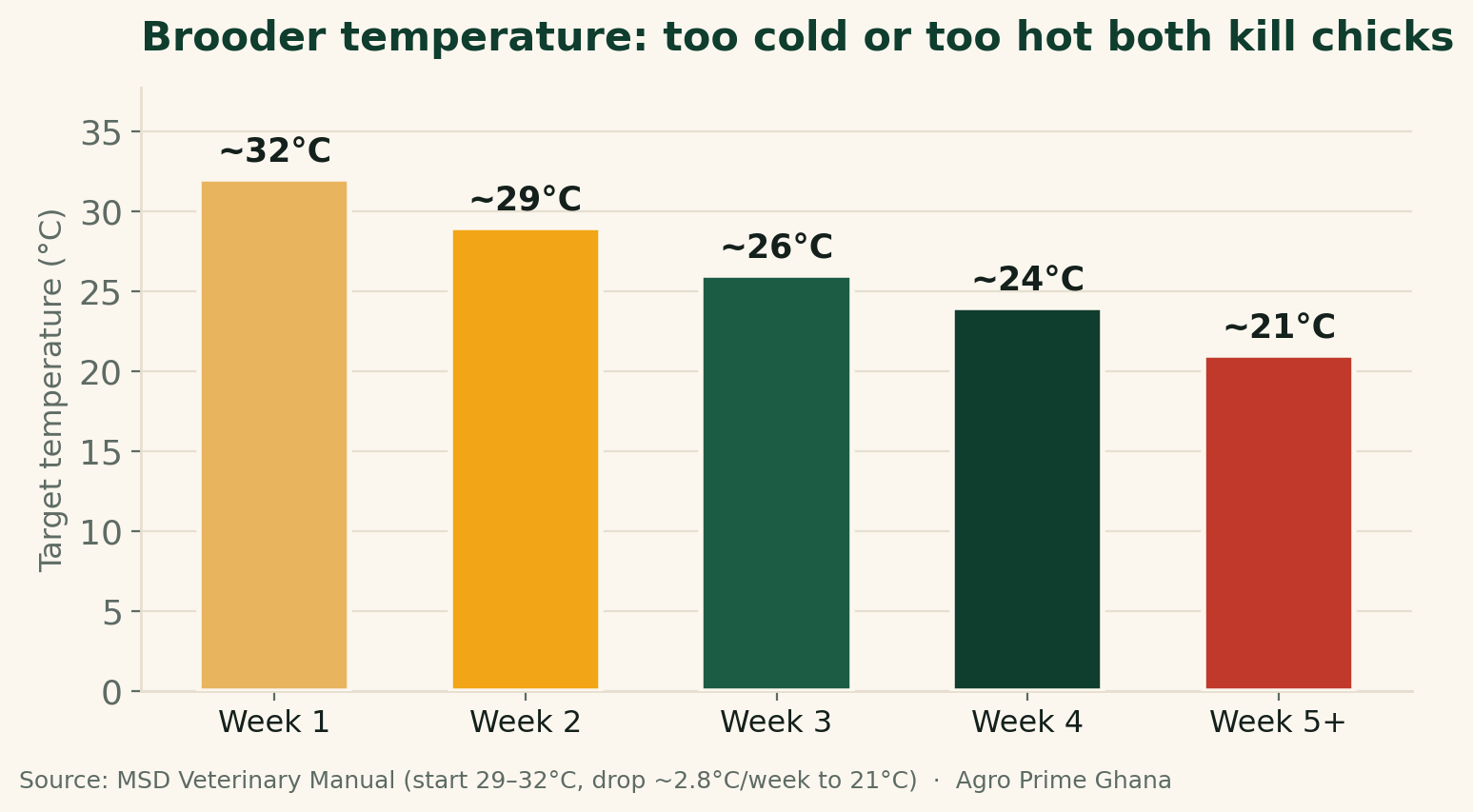
The costliest poultry mistakes in Ghana cluster around five areas. Brooding: chicks need a start temperature of about 29–32°C, dropped roughly 2.8°C each week toward 21°C — too cold or too hot both kill. Crowding: overstocking drives feather pecking (which starts after 2–3 weeks), wet litter and disease. Vaccination: skipping Newcastle vaccine invites outbreaks that can kill up to 80% of unprotected birds. Litter and water: damp litter breeds coccidiosis and raises ammonia above the 25 ppm safe ceiling. Feed: mouldy maize or groundnut carries aflatoxin, dangerous at just 50 ppb. Fix these five and most "unexplained" losses disappear.
What are the most common poultry farming mistakes in Ghana?
The most common mistakes are almost always about management rather than the birds themselves: poor brooding, overcrowding, weak biosecurity and missed vaccinations, damp litter, careless feeding and storage, no clean water discipline, and keeping no records to learn from. What makes them so damaging is that they rarely announce themselves as a single dramatic event. Instead they show up as a flock that grows unevenly, converts feed poorly, responds badly to vaccines and drips away a few birds at a time — losses a keeper writes off as "just how poultry is" when each one is preventable. Farmers tend to blame the hatchery, the breed or bad luck long before they examine the brooder thermometer, the stocking rate or the feed store. The encouraging truth is the opposite: because these problems are man-made, they are within your control, and correcting them costs far less than the birds they save.
Why these mistakes hit harder in Ghana's climate
Ghana's warmth and humidity turn small management slips into serious problems faster than in cooler climates. Poultry are comfortable in a narrow band — roughly 15–24°C for adult birds — and once house temperatures climb toward 29°C they cut back feed intake, while sustained heat near 38°C becomes life-threatening, according to University of Minnesota Extension. Our humidity also means any wet patch of litter stays wet, and warm damp litter is precisely what lets coccidiosis oocysts and moulds thrive — while the same heat in the feed store lets Aspergillus generate aflatoxin on maize and groundnut. And because much of the country's poultry goes unvaccinated, Newcastle disease circulates freely and can wipe out most of an unprotected flock in days, as the FAO documents. The Ghanaian environment is unforgiving of the very mistakes farmers most often make.
The five costliest mistakes, at a glance
Here is a quick map of the mistakes that cause the most damage on Ghanaian farms, what they look like, and the single most important fix for each, drawn from the references cited throughout this article.
| Mistake | What it looks like | The key fix |
|---|---|---|
| Wrong brooder temperature | Chicks huddling under the lamp (cold) or spread panting at the edges (hot); early deaths | Start ~29–32°C, drop ~2.8°C/week to ~21°C; let chick behaviour guide you |
| Overcrowding | Feather pecking, wet litter, uneven growth, smothering | Give correct floor, feeder and drinker space; split flocks rather than cram |
| Skipping vaccination | Sudden mass deaths (Newcastle, Gumboro), poor response to disease | Follow a proper vaccination schedule from day-old |
| Damp, neglected litter | Caked wet litter, ammonia smell, coccidiosis, dirty birds | Keep litter dry and friable; fix leaking drinkers; ventilate |
| Poor feed and storage | Slow growth despite eating, vaccine failure, mouldy grain | Buy clean grain, store dry and cool, never feed mouldy feed |
Mistake 1: Getting the brooder wrong
The single most decisive week in a bird's life is its first, and brooding is where most beginners lose birds. Newly hatched chicks cannot regulate their own body temperature, so they depend entirely on the heat you provide. The MSD Veterinary Manual recommends a starting brooding temperature of about 29.4–32.2°C, lowered by roughly 2.8°C each week until it reaches about 21°C. The classic errors are running the brooder too cold (chicks pile and smother under the lamp), too hot (they pant, move to the edges and dehydrate), or letting the temperature swing overnight when the harmattan cold or a power cut hits. Two more mistakes compound it: too little floor litter — the MSD Manual advises at least 7.5 cm — and a cold, hard, draughty floor on arrival. The birds themselves are the best thermometer you own: evenly spread, feeding chicks are comfortable; a tight huddle means cold; birds pressed to the walls with beaks open mean too hot. Our brooder temperature chart and guide to brooding mistakes that kill chicks cover this in full.
Field note: read the chicks, not just the thermometer
On our hatchery floor we treat the thermometer as a starting point and the chicks' behaviour as the final word. A reliable habit is to stand quietly at the brooder for two minutes on every visit and watch: contented chicks murmur softly and scatter across the whole guard; cold chicks go quiet, then start a sharp, distressed cheeping and bunch under the heat; too-hot chicks drift to the edges and open their beaks. We also check last thing at night, because a brooder fine at noon can go cold when the evening drops — and a single cold night in week one costs birds you never fully recover.
Mistake 2: Overcrowding the birds
Overcrowding is a false economy that quietly wrecks flocks. Cramming in more birds feels like getting more from your space, but it concentrates droppings (so litter goes wet and coccidiosis and ammonia climb), makes feeder and drinker competition fierce, raises the heat load, and triggers behavioural vices. The MSD Veterinary Manual notes that cannibalism and feather pecking typically begin in birds older than 2–3 weeks, and lists the main controls as decreasing light intensity, decreasing bird density, increasing the number of feeders and providing enrichment. Reducing density appears twice in that list — it is that central. Overcrowding also makes every other mistake worse: wet litter spreads faster, disease jumps between birds more easily, and heat stress arrives sooner. The fix is discipline about space: give birds the correct floor area for their age and type, provide enough feeder and drinker points that no bird has to fight to eat or drink, and if you have more chicks than your house can hold, split them rather than squeezing them in.
Mistake 3: Skipping or mishandling vaccination
Failing to vaccinate — especially against Newcastle disease — is one of the most catastrophic mistakes a Ghanaian keeper can make. Newcastle is an acute viral disease that, according to the FAO, can kill up to 80% of unprotected rural poultry, with mortality exceeding 50% in naive flocks and death often within 2–3 days of signs appearing. There is no treatment once it strikes; the only defence is vaccination before exposure. Many farmers skip it because their birds "look healthy," or believe local breeds are immune — a dangerous myth, since indigenous village chickens are exactly the ones Newcastle devastates. Others vaccinate but undo the effort through poor handling: leaving vaccine in the sun, mixing it in chlorinated water, or giving it to already-sick birds. A vaccine is a living, fragile product; break the cold chain and you may be injecting water. Follow a proper schedule from day-old, keep vaccines cold until use, and read our full guide to Newcastle disease in Ghana. Vaccination is cheap insurance against a disease that can empty a house in under a week.
Order strong, well-started chicks — and a vaccination plan to match
Many "flock disasters" are really weak starts: chicks from an unknown source, no clear vaccination schedule, and no one to call when something looks wrong. Agro Prime Ghana supplies healthy day-old broilers and layers and point-of-lay pullets, and we send every buyer away with a simple written brooding and vaccination plan suited to their setup — not just birds in a box. Planning a new batch? Message us on WhatsApp (+233 24 915 1503) or book a visit, and we will match the right chicks, feed and schedule to your housing.
Mistake 4: Letting litter go damp and dirty
Damp litter is the quiet engine behind a surprising share of poultry losses, and neglecting it is a mistake almost every struggling farm makes. Warm, moist litter is the perfect nursery for coccidiosis: the MSD Veterinary Manual explains that the parasite's oocysts sporulate into their infective form within 1–2 days under warm, damp conditions of about 21–32°C — a description of a Ghanaian poultry house most of the year. Wet litter also drives up ammonia: research summarised by the USDA Agricultural Research Service shows ammonia release rises sharply as litter gets wetter, and the recommended ceiling is about 25 ppm — above that, birds' airways are damaged and they become far more prone to respiratory disease. The usual causes are leaking drinkers, poor ventilation and overcrowding. The fixes are cheap or free: fix leaking drinkers at once, set drinker height so birds cannot splash, remove caked wet patches, ventilate to carry moisture out, and never overstock. Our guide to poultry litter management lays out a full routine.
Mistake 5: Careless feeding and feed storage
Feed is the biggest cost in poultry and a place where mistakes are common and expensive. The first error is feeding the wrong ration for the bird's age and type — starter, grower, finisher and layer feeds exist for good reasons. The second, more insidious, is mouldy or aflatoxin-contaminated feed. Aflatoxin is a poison produced by Aspergillus moulds on maize and groundnut, and the MSD Veterinary Manual puts the tolerable level at only about 50 ppb for young poultry and 100 ppb for adults — tiny amounts that damage the liver, suppress immunity (so vaccines fail), and slow growth. Crucially, feed can carry dangerous aflatoxin even when it looks acceptable, and our heat and humidity make the feed store a prime breeding ground for the mould. Other feeding mistakes include running out of feed between purchases and storing bulk feed warm and damp for months. Buy clean grain, store feed dry, cool, off the floor and pest-free, use it in good time, and never feed anything visibly mouldy. For cutting cost without cutting corners, see reducing poultry feed cost.
Mistake 6: Weak biosecurity and no clean water discipline
Many farms are, in effect, an open door to disease: visitors walk straight into the birds, new stock is mixed in with no isolation, the same boots and crates move between houses, and rodents, wild birds and flies come and go freely — every one a route for Newcastle, Gumboro and coccidiosis. Good biosecurity is unglamorous but decisive: limit who enters the birds' area, disinfect footwear and equipment, keep an all-in/all-out flow where you can, control pests, and quarantine new birds before mixing them. Water discipline sits alongside it — dirty drinkers spread disease and undo vaccination. Clean drinkers daily, use a clean source, and remember that in heat stress birds drink two to four times their normal intake, so water must never run out. Our guide to poultry biosecurity in Ghana gives a practical, low-cost framework.
Field note: the mistake behind the mistakes — no records
The error we most wish more farmers would fix is invisible: keeping no records. A farm that does not write down placement dates, deaths, feed used and vaccinations cannot see its own mistakes, so it repeats them batch after batch. The farms that steadily improve are almost always the ones with a simple exercise book by the door. When something goes wrong, those few lines usually reveal exactly which mistake caused it — a cold night, a missed vaccine, a bad feed batch.
The bottom line on avoiding poultry mistakes
Poultry farming in Ghana rewards attention to a short list of basics far more than it rewards luck, expensive inputs or special breeds. The mistakes that empty houses are nearly always the same: a brooder run too cold or too hot, too many birds in too little space, a skipped or mishandled vaccine, litter left damp, feed that is wrong or spoiled, an open door to disease, and no records to learn from. None of these fixes is costly, and most are free. Get the first week right, give birds room, vaccinate properly, keep litter dry and feed clean, guard the gate, keep simple records, and diagnose before you treat — and the "unexplained" losses that discourage so many keepers simply stop happening.
Frequently asked questions
What is the biggest mistake new poultry farmers make in Ghana?
Why do my chickens keep dying even though they look healthy?
Do local Ghanaian chickens need vaccination?
How much space do poultry need to avoid overcrowding?
Why is damp litter such a serious problem?
Can mouldy feed really harm my birds if they eat it anyway?
Should I give my birds antibiotics to prevent disease?
How do I know if my brooder is the right temperature?
Sources & further reading
- MSD Veterinary Manual — Management of Growing Chickens (brooding temperature schedule, litter depth) and Common Management-Related Problems in Backyard Poultry (cannibalism, feather pecking, density).
- FAO — Controlling Newcastle Disease in Village Chickens (mortality up to 80% in unprotected rural poultry, disease course).
- University of Minnesota Extension — Preventing heat stress in poultry (comfort range, water intake in heat).
- USDA Agricultural Research Service — Poultry Litter Moisture Management to Reduce Ammonia (25 ppm ceiling, moisture and ammonia).
- Agro Prime Ghana guides: brooder temperature chart, Newcastle disease, litter management, biosecurity, and reducing feed cost.
About Agro Prime Ghana
Agro Prime Ghana Limited runs a poultry hatchery and mixed agribusiness in Kasoa, supplying day-old chicks and working alongside poultry keepers across the country. These guides draw on that hands-on hatchery and farm experience, checked against current veterinary and industry references. This article is general educational information, not a substitute for diagnosis by a qualified veterinary or extension officer — if your flock is sick, get it seen. We supply healthy day-old chicks (broilers and layers), point-of-lay pullets, quality feed and hands-on farm support across Ghana. Ready to start or expand? Book a visit or message us on WhatsApp (+233 24 915 1503) to order chicks, feed or advice.