There is no single best agribusiness to invest in Ghana, because the right choice depends on how long you can leave your money alone, how much loss you can absorb, and whether you want a stake you can visit or a return set by someone else's market. What you can do is judge every option on the same five tests: how it earns money, how long your cash is tied up, how it can fail, how easily you can get out, and how much you depend on people you cannot supervise every day. On those tests, poultry production stands out for one reason that matters in Ghana right now: the country still imports a large share of the chicken it eats. It also carries risks that a government bill does not, and this guide sets out both sides.
If you have saved some money, you have probably been pitched several things at once. A fixed deposit at your bank, a treasury bill, a few shares on the Ghana Stock Exchange, a stake in a relative's shop, a plot of land, or a share in a farm. Each one promises something different, and each one hides a different kind of risk. The easiest way to lose money is to compare them by the headline rate and ignore how each one actually makes its money. This article gives you a framework for that comparison, shows the dated figures we used, and explains where poultry fits and where it does not.
Written by the Agro Prime Ghana team and reviewed against current market references (Bank of Ghana, Ghana Statistical Service, USDA Foreign Agricultural Service data). Last updated October 2026. General information, not financial advice.
Key takeaways
No option is best for everyone. Judge each one on how it earns, how long money is locked, how it can fail, how liquid it is, and who you depend on. As of 18 October 2026, the 91-day treasury bill yielded 4.62 percent and the 364-day bill 9.71 percent, with the Bank of Ghana policy rate at 14 percent and August 2026 inflation at 5.0 percent. The Ghana Stock Exchange Composite Index closed September 2026 at 14,141.56, up 61.24 percent for the year but well below its March peak. Poultry is compelling because local supply covers only a fraction of demand, but it is higher risk than a treasury bill, and no return is guaranteed.
Why agribusiness is on the list at all
Agribusiness means investing in the businesses that grow, process, store or sell food and farm inputs. Its appeal in Ghana is simple to state. People eat every day, so demand for food does not disappear when the economy slows. Farming also produces something you can point to, which a share certificate or a bank balance does not. And some of the gap between what Ghana eats and what it grows is still open, which is the strongest argument for investing in local production rather than in imports.
The numbers that matter right now
These are the most recent figures we could verify at the time of writing. Rates change often, so check the latest auction before you act.
| Option | Latest dated figure | Typical horizon | How it can lose you money | How easily you can exit |
|---|---|---|---|---|
| 91-day treasury bill | 4.62% yield (reported 18 Oct 2026) | 3 months | Low default risk on government paper; returns fall if rates keep dropping, and reinvesting at a lower rate is the real risk | Held to maturity, or sold through the secondary market |
| 364-day treasury bill | 9.71% yield (reported 18 Oct 2026) | 12 months | Same sovereign risk; the yield you lock in can look low if inflation rises again | Harder to exit early than a 91-day bill |
| Ghana Stock Exchange shares | GSE Composite Index 14,141.56 at end-September 2026, up 61.24% year to date | Multi-year | Prices can swing sharply; the index hit 15,185.49 on 10 March 2026 and has since fallen back | Depends on how liquid each share is; many trade thinly |
| Poultry production stake | Depends on the batch; no guaranteed figure | One production cycle, about six to seven weeks for broilers, plus setup time | Disease, mortality, feed price spikes, selling-price swings, and dependence on the operator | Usually fixed to the batch; exit terms must be agreed in writing before you pay |
A framework for judging any agribusiness option
Ask the same five questions of any business. A good opportunity answers all five clearly.
- How does the money come back? Is it a fixed interest rate, a share of profit, a share of sales, or the hope that the asset rises in value? Write the mechanism in one sentence. If you cannot, stop there.
- When do you get paid, and what is the cycle? A broiler batch runs a few weeks; a tree crop may take years. Match the cycle to the time you can genuinely leave the money alone.
- What is the worst realistic outcome? Not the best case. Ask what happens to your capital if disease hits, prices fall, or the operator runs out of cash.
- Can you verify what you own? Can you see the farm, the birds, the feed records and the sales? If you cannot, you are trusting a story.
- Who controls the money in the middle? If your money passes through someone else's account, what written agreement protects you, and what happens if that person is unreachable?
These questions also protect you from the more common problem in Ghana: schemes that promise high returns with no visible business behind them. The Securities and Exchange Commission named 23 unlicensed online investment schemes on 22 July 2026 and urged the public to verify the licence of any company offering investment products before committing funds. Use the same test on every option in this article, including ours.
Why poultry keeps coming up in Ghana
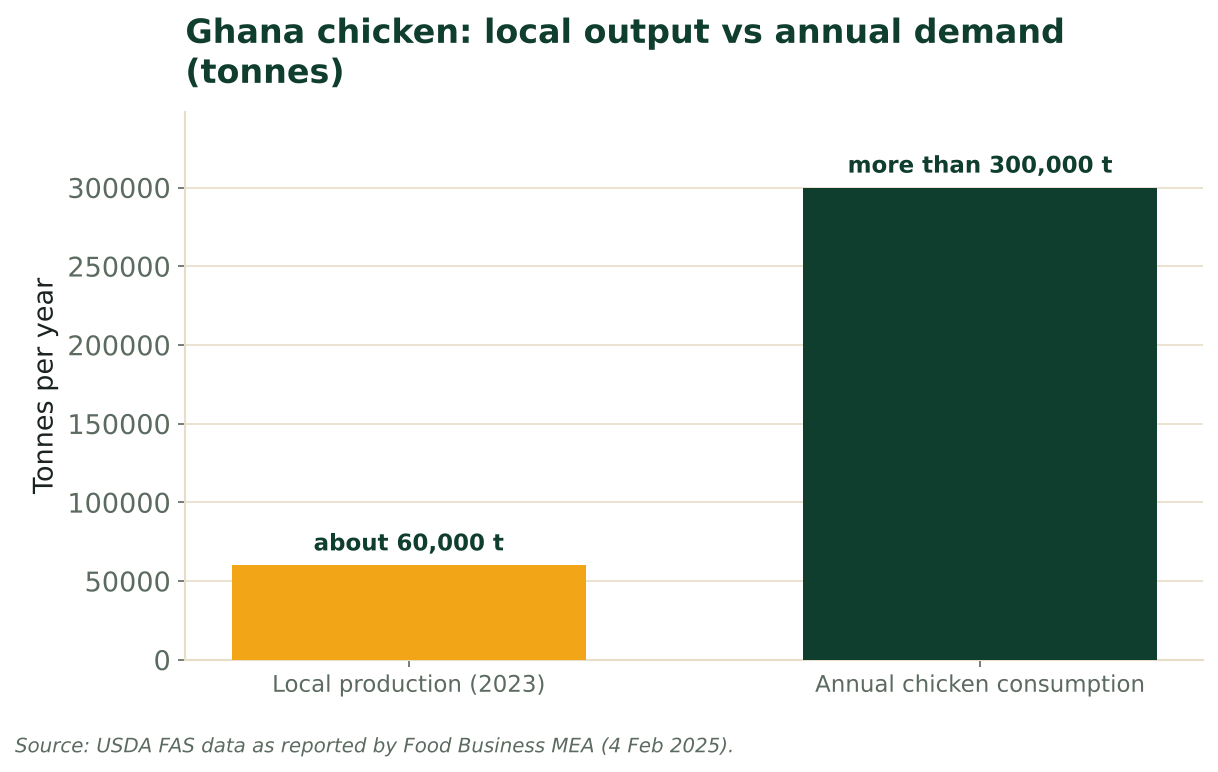
Poultry is the agribusiness case most often made in Ghana, and it is worth understanding why. A February 2025 Food Business MEA report, citing USDA Foreign Agricultural Service figures, puts Ghana's annual chicken consumption above 300,000 metric tonnes, with local production of about 60,000 tonnes in 2023, covering roughly 18 percent of demand. The same report says imports make up more than 80 percent of chicken supply, a figure it does not attribute to a named source. Read together, those numbers imply a gap of around 240,000 tonnes a year, and that gap is the reason local producers can find buyers. The primary USDA report was not retrievable when we checked, so confirm the latest USDA figures before you rely on them.
Demand is steady, too. Chicken is affordable, familiar and eaten across income groups, which means a well-run farm is not waiting for a fashion to change. Poultry also has a short production cycle. A broiler flock is typically ready in about six to seven weeks, so you see the outcome of each batch quickly and can learn from it. That speed is one of the main reasons agribusiness investors in Ghana look at poultry first, and it is also why the risks show up fast.
The strongest honest argument for poultry is that it is tangible and short-cycle, and that Ghana is still short of local supply. The strongest honest counter-argument is that a high-demand market is not the same as a profitable farm. Feed is the biggest cost, and it moves with imported and local inputs. The same Food Business MEA report quotes the feed millers' association saying a 50-kilogram bag of maize rose from US$16 in January to US$29, in a price spike it links to a drought in northern Ghana. A farm that cannot manage feed cost, disease and the timing of sales can lose money even when demand is strong.
Investor note: what a high-demand market does not guarantee
Ghana's chicken gap tells you there is room for local producers. It does not tell you that any single farm will be profitable. Two farms in the same town can get very different results from the same market, because one controls feed, vaccination and mortality better than the other. When you assess a poultry opportunity, the operator's record and controls matter more than the national statistic.
The risks you should price in before you invest
Every investment carries risk, and agribusiness has its own list. Treat this as the checklist to work through before any money moves.
- Disease and mortality. A flock can be hit by disease despite vaccination. Ask how mortality is recorded, what happens to the batch when it strikes, and whether losses are shared transparently.
- Feed prices. Feed is the largest running cost. Ask how the operator buys feed, whether prices are fixed for the cycle, and how a price spike changes the economics.
- Selling prices. Live birds and processed chicken are sold into a market that can fall as well as rise. A good operator has more than one buyer.
- Currency. The cedi fell 7.9 percent against the US dollar in the first half of 2026, according to the Bank of Ghana's Monetary Policy Report as reported by the Ghana News Agency. Imported feed and vaccines can cost more when the cedi weakens, which pushes up the price of the whole batch.
- Operator risk. The people running the farm are the largest single risk in most small agribusiness deals. Ask for written terms, a clear reporting schedule, and what happens if the operator cannot continue.
- Liquidity. A stake in one batch is hard to sell mid-cycle. Assume your money is locked until the cycle closes unless a written exit route says otherwise.
None of these is a reason to avoid agribusiness automatically. They are reasons to ask better questions and to size your stake so a bad batch cannot damage the rest of your finances.
Where a poultry stake fits, and where it does not
A poultry stake works best as one part of a spread that includes lower-risk holdings. Money you need within a few months belongs in a bank account or a short-dated treasury bill. Money you can leave alone for longer, and can afford to see a batch disappoint, may suit a small, verified stake. Never borrow to invest in a farm, and never invest money you will need for rent, school fees or medical costs.
Poultry is less suitable if you want a predictable, fixed return, if you cannot visit or verify the operation, or if you need to exit at short notice. It is more suitable if you value a physical asset, can follow the production cycle, and are willing to read the agreement in full before paying. For many Ghanaian savers, the best use of agribusiness is a measured one: a single batch or a small stake, learned from, rather than a large bet placed on a headline.
Ready to talk it through?
If a poultry production partnership sounds like a fit, you can read how it works on our partnership page, which explains the profit-share model and what it does and does not promise. You can also send us your questions on WhatsApp (+233 24 915 1503). If you would rather see the farm first, book a visit. Take your time, compare options, and do not commit money you cannot afford to lose.
How to run your own due diligence
Before you decide on any agribusiness, including ours, work through a short checklist. Put the answers in writing where you can, and keep copies.
- Get the terms in writing. What do you own or share in? How much do you pay, when, and to whom? What is paid back, when, and on what basis?
- Ask for records. For a poultry batch, ask for the source of the chicks, the vaccination schedule, feed purchases, mortality records and past sales. Compare what you are told with what you can check.
- Visit or verify. If you cannot visit, ask for a video call and a live walk-through of the house. Verify that the business is registered and that the people you are paying are who they say they are.
- Check the regulator. If the offer involves shares or pooled investment, check whether the company is licensed by the Securities and Exchange Commission. The SEC publishes lists of entities operating without a licence.
- Get independent advice. For a large sum, speak to a licensed financial adviser or an accountant who understands Ghanaian tax and contract law.
Investor note: a rate is not a promise
When you see a yield, a percentage or a projected profit, ask three questions: is it guaranteed, is it paid from a verified source, and what happens if the business misses it? For government bills the answer to the first question is closer to yes, though rates still move. For a farm, the honest answer is almost always that it is not guaranteed, and a credible offer will say so plainly.
The bottom line
The best agribusiness to invest in Ghana is the one whose risks you understand, whose money you can afford to leave in place, and whose operator you can verify. Poultry production has a strong argument behind it: local supply covers a fraction of demand, the product is everyday food, and the asset is visible. It also has real risks, including disease, feed costs, currency pressure and operator dependence, and it is higher risk than a treasury bill. Use the framework in this article, check the latest figures, and treat any offer that promises certainty with suspicion.
Frequently asked questions
What is the best agribusiness to invest in Ghana?
No single option is best for everyone. Compare options on how they earn money, how long your cash is tied up, how they can fail, how easily you can exit, and who you depend on. Poultry production is one strong candidate because Ghana imports a large share of its chicken, but it carries higher risk than a government treasury bill.
Is agribusiness a safe investment in Ghana?
No investment is safe in the sense of having no risk of loss. Agribusiness is riskier than government bills because it depends on weather, disease, feed prices and the operator. It can offer a tangible asset and a shorter cycle than some alternatives, but you should expect to lose some or all of the money invested in a bad batch.
What are treasury bill rates in Ghana right now?
In the latest auction reported on 18 October 2026, the 91-day bill yielded 4.62 percent, the 182-day bill 6.31 percent and the 364-day bill 9.71 percent. These figures change with every auction, so check the Bank of Ghana or a current news report before you act.
What is the Bank of Ghana policy rate?
The Bank of Ghana cut its policy rate to 14 percent in March 2026, and its Monetary Policy Committee kept it at 14 percent at the decision reported on 24 September 2026. The rate can change at any committee meeting, so check the latest decision before relying on it.
How has inflation moved in Ghana in 2026?
Headline inflation was 3.3 percent in February 2026 and 3.2 percent in March, rose to 3.7 percent in May, to 5.3 percent in June, eased to 4.6 percent in July and reached 5.0 percent in August, according to reported Ghana Statistical Service data. Non-food inflation drove the recent rise.
Is the Ghana Stock Exchange a good place to invest?
The GSE Composite Index rose strongly in early 2026, crossing 15,000 for the first time on 10 March, and closed September 2026 at 14,141.56, up 61.24 percent for the year. Gains have been concentrated in some financial stocks, and prices can fall as well as rise. Research individual companies and their liquidity before investing.
Can I invest in a poultry farm with no guaranteed return?
Yes, but any honest offer will say the return is not guaranteed. A profit-share partnership pays only if the batch makes money, and it can pay nothing or lose capital. Ask what happens in a bad cycle, how losses are shared, and how records are provided before you pay.
Where can I learn more about starting a poultry business in Ghana?
Our guides cover the economics and planning in more detail. Read whether poultry farming is profitable in Ghana, how to write a poultry business plan, and how cash flow works on a poultry farm. You can also see how a partnership works on our partner page.
Sources & further reading
- Graphic Online: BoG cuts policy rate to 14% amid easing inflation (March 2026)
- MyJoyOnline: MPC maintains policy rate at 14% for third consecutive meeting (reported 24 September 2026)
- MyJoyOnline: T-bills auction, government records marginal oversubscription (published 18 October 2026)
- Citi Newsroom: Treasury bill auction oversubscribed by 30.3% (27 July 2026)
- Ghanaian Times: Investors trade GH¢5.34bn in shares in nine months (12 October 2026)
- African Markets: GSE Composite Index crosses 15,000 (March 2026)
- Ghana Stock Exchange: May 2026 Market Summary Report
- USDA Foreign Agricultural Service: Ghana regional page
- Food Business MEA: Ghana's poultry sector struggles as high feed costs pressure farmers (4 February 2025), citing USDA figures
- Ghana News Agency: Cedi records 7.9% depreciation against US dollar in first half of 2026 (30 August 2026)
- Citi Newsroom: SEC names 23 unlicensed online investment schemes (22 July 2026)
- Securities and Exchange Commission Ghana: Public notice, list of entities operating without a licence
About Agro Prime Ghana & a note on risk
Agro Prime Ghana Limited runs a poultry hatchery and mixed agribusiness in Kasoa and invites partners to invest in its farming production through a profit-share on a production batch. This is general educational information, not financial advice, and investing carries risk including loss of capital — always do your own research or consult a licensed adviser. Explore it: see how it works, book a visit, or message WhatsApp (+233 24 915 1503).