You walk into the layer house in the morning and find one hen with a small ring of red, glistening tissue pushed out below her tail — and, too often, the rest of the flock already pecking at it. This is vent prolapse, sometimes called a "blowout," and it is one of those problems that goes from minor to fatal in a single day. The tissue is the lower reproductive tract turned briefly inside out; on its own it might slip back, but once penmates start pecking it becomes an open wound, then cannibalism, then a dead hen. The good news is that prolapse is largely a management disease: get pullet rearing, body weight, lighting and feeding right and you can push it to the margins. This guide explains why prolapse happens in Ghanaian layer flocks, how to act fast when you spot it, and — most importantly — how to stop it before it starts.
Written by the Agro Prime Ghana poultry team and reviewed against current veterinary and industry references (VAL-CO layer management guidance and MSD Veterinary Manual). Last updated September 2026.
Key takeaways
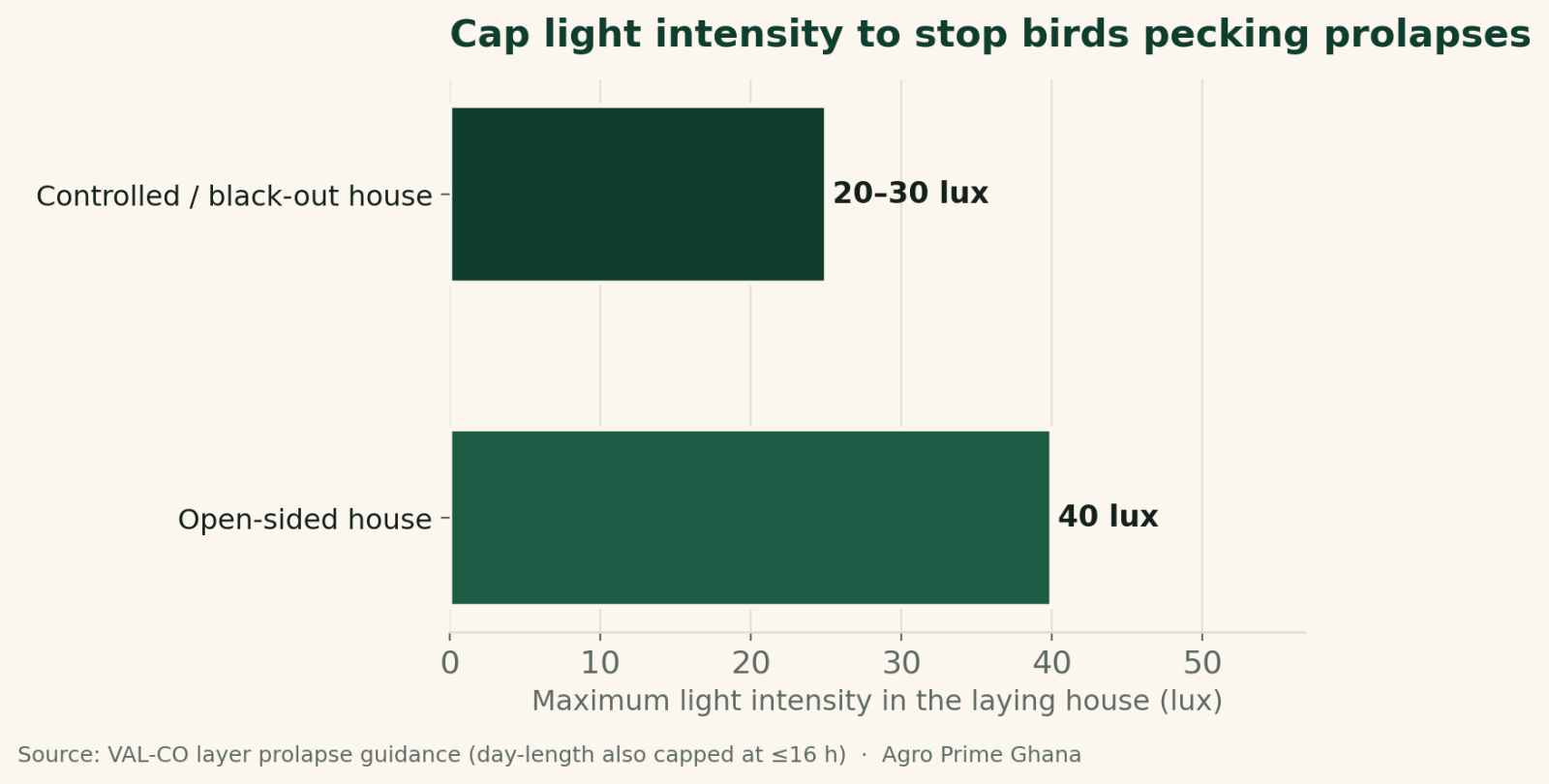
Vent prolapse is when the lower reproductive tract is pushed out through the vent during laying and fails to draw back in. It is most common in hens that come into lay too young, underweight or over-fat, in birds laying oversized or double-yolk eggs, and where calcium is short (weak straining muscles and thin shells). Once tissue is exposed, other birds are drawn to the "moist, glistening" surface and peck it — turning prolapse into cannibalism, haemorrhage, shock and death. There is no reliable cure once cannibalism sets in, so prevention is everything: correct body weight and uniformity into lay, sensible light (keep intensity down — around 20–30 lux in a controlled house, no more than ~40 lux open-sided — and day-length capped at about 16 hours), phase feeding with the right calcium, and dark, tidy nest boxes. Act within minutes: isolate the bird, clean and reduce the prolapse, and keep her out of sight of the flock.
What vent prolapse actually is
Every time a hen lays, the last part of her oviduct briefly everts — turns partly inside out — to deliver the egg at the vent, then draws back inside. Vent prolapse is simply that normal eversion failing to reverse: the tissue stays out. VAL-CO's layer guidance describes prolapse as the lower reproductive tract being temporarily turned inside out and then not retracting after the egg is laid. In a mild case the exposed tissue is small and pink and may slip back by itself. The danger is what happens next: exposed, moist tissue is irresistible to other hens, and the moment one bird pecks it, pecking causes bleeding, bleeding attracts more birds, and within hours you can have a full cannibalism event and a dying hen. That is why prolapse is an emergency, not a wait-and-see problem.
Why it matters so much in Ghanaian layer flocks
Prolapse earns its place among the problems layer keepers must understand because of how quickly and cheaply it can be prevented — and how expensively it plays out when it is not. A cluster of cases almost always points back to how pullets were reared and how the laying house is run, not to bad luck. It concentrates when young hens first come into lay, and it is made far worse by bright light, which turns a single exposed vent into a flock-wide pecking problem. In the warm, open-sided houses common across Ghana — where light intensity is hard to control — those two ingredients come together easily, and because pecked prolapses lead to cannibalism, one untreated case can teach a whole pen to peck at vents. As VAL-CO bluntly notes, there is no effective treatment once things have gone far — affected hens lay less afterwards and are highly likely to prolapse again — which is why the entire strategy sits on prevention.
Who is most at risk
Prolapse is not random; it favours particular birds and particular management. Drawing on VAL-CO's guidance, the highest-risk situations are:
| Risk factor | Why it causes prolapse |
|---|---|
| Coming into lay too young / underdeveloped | A tract and pelvis not yet mature enough for laying strains and prolapses more easily — even if production-phase body weight looks fine, poor skeletal development during rearing raises the risk |
| Over-fat hens | Abdominal fat narrows the egg passage and weakens muscle tone, forcing harder straining; fat hens also tend to lay larger eggs |
| Oversized & double-yolk eggs | Large eggs physically stretch and strain the vent; double-yolkers, common in young flocks, are a classic trigger |
| Soft-shell / thin-shell eggs | A poorly formed egg gives the muscles nothing firm to work against, so the hen strains longer and harder |
| Calcium deficiency | Weakens the muscle tone that should draw the tract back in, and produces the weak shells that increase straining |
| Bright light & peak lay | High light intensity draws other birds to peck exposed tissue; peak production simply means more eggs and more chances to prolapse |
Notice how many of these trace back to a single root: bringing pullets into lay before their bodies are ready. A pullet photostimulated while still underweight or immature is being asked to push eggs through a tract that has not finished developing — the commonest recipe for prolapse there is.
Spotting it early — and telling it apart from a normal lay
The whole game with prolapse is speed, so you need to recognise it fast. Walk the flock, especially around the nest boxes and in the first hours after most eggs are laid, and look for a hen with red or pink tissue protruding below the vent. Early, it may be a small moist ring that the hen can still retract; advanced, it is a larger mass, often dirtied, sometimes already pecked and bleeding. Warning signs on the bird include a soiled or blood-stained rear, a hen sitting apart or straining, and — the giveaway — other birds crowding and pecking at her back end. Do not confuse a brief, normal eversion during laying (which disappears within moments) with a true prolapse that stays out. If tissue is still visible a while after the hen has finished laying, or if there is any blood or pecking, treat it as prolapse and act immediately.
Field note: the flock tells you before you see the tissue
On the farm, the first sign of a prolapse is often behavioural, not visual. A knot of hens gathered tightly around one bird, all facing inwards and pecking, usually means one of them has an exposed vent — and by the time you push through to look, there may already be blood. We treat any such huddle at the back of a laying flock as a prolapse until proven otherwise, and we get the bird out immediately. The longer she stays in view of the others, the worse the damage and the more likely the rest of the pen learns to peck at vents, which is a habit that is very hard to unteach.
What to do when you find a prolapse
If you catch it early, a single hen can often be saved. Move calmly and quickly:
- Isolate her at once. The first priority is to get the bird away from the flock and out of sight, both to stop the pecking and to give the tissue a chance to recover. A quiet, dim pen is ideal.
- Clean the tissue gently. Rinse away dirt and droppings with clean, lukewarm water so you can see what you are dealing with and reduce infection risk.
- Reduce the swelling and ease it back. Something to shrink the tissue (a cool compress; keepers commonly use a little sugar to draw out fluid) makes it easier to gently push the prolapse back in with a clean, gloved, lubricated finger. Work slowly and do not force it.
- Keep her dark and quiet. Low light discourages laying for a day or two (resting the tract) and keeps her calm; apply an antiseptic to guard against infection.
- Watch, and be realistic. A mild case caught early may hold and heal, but be honest about the odds: VAL-CO notes there is no effective treatment for a serious prolapse, recovered hens lay less, and re-prolapse is very likely. Where tissue is badly damaged, heavily pecked or repeatedly prolapsing, humane culling is the kinder decision.
Prevention 1: rear pullets so they enter lay ready
The single most powerful thing you can do about prolapse happens weeks before the first egg. Rear replacement pullets to breed-standard body weight and good uniformity, and do not switch on the "lay" signal until they are physically ready. Photostimulation — increasing day-length — and the move to layer feed tell the body to start producing; do it too early, to underweight or uneven birds, and you invite prolapse. VAL-CO's guidance is explicit that prolapse occurs more when birds are too young and underdeveloped to be laying, and that poor skeletal development in rearing raises the risk even if later body-weight targets are met. Their practical rule is to delay photostimulation when flock uniformity is below about 70% — in other words, wait until enough of the flock has reached target before you press "go." This is where prolapse is truly won or lost.
Field note: don't let the calendar rush your pullets into lay
The temptation is always to start eggs as soon as possible, because eggs are income. But a flock pushed into lay a week or two early — before body weight and frame are there — pays it back in prolapse, small first eggs and a shaky peak. We would rather hold a flock a little longer, weigh a sample of birds to check they are on target and even, and only then extend the lighting. A steady, well-timed start gives fewer blowouts, better shell quality and a stronger, longer laying life.
Prevention 2: get light right
Light is the lever that decides whether one prolapse becomes a flock disaster, because bright light draws birds to peck exposed tissue. Two things matter. First, intensity: keep the laying house dim enough that a bit of red tissue is not a beacon. VAL-CO's guidance points to roughly 20–30 lux in controlled-environment houses and no more than about 40 lux in open houses — bright enough for hens to feed and find nests, dim enough to discourage pecking. Second, day-length: cap it at a maximum of about 16 hours (many managers prefer 15), and never lengthen the day before pullets are ready. In Ghana's open-sided houses this is harder — you cannot dim the sun — but you can avoid adding bright artificial light, use shading and orientation to cut glare, and keep nest boxes genuinely dark. Where pecking is already a problem, reducing light intensity is one of the fastest interventions available.
Prevention 3: feed and egg size
Feeding controls two prolapse drivers at once — body condition and egg quality. Keep hens in the right condition (not over-fat, since abdominal fat narrows the passage and fat hens lay larger eggs), and get calcium right, because calcium underpins both firm shells and the muscle tone that draws the tract back in. Weak, soft or oversized eggs all make a hen strain harder and longer, which is exactly what causes the tract to stay out. Phase feeding — matching the diet to the flock's stage — is the tool here; our layer feeding guide for Ghana covers calcium levels and particle size in detail. Managing egg size matters too: very large and double-yolk eggs, most common in flocks brought into lay young, are direct mechanical triggers, which loops back to the same lesson — a correctly timed, well-fed start prevents the oversized early eggs that tear at an immature vent.
How prolapse links to other layer problems
Prolapse rarely travels alone. A pecked vent is an open door for bacteria, and the E. coli that colonises such wounds is the leading cause of reproductive-tract infection and death in layers — which is why prolapse in late lay feeds directly into egg peritonitis and colibacillosis. Cannibalism, once learned around a prolapse, can spread to other targets and become a flock vice. And a flock producing many oversized or shell-weak eggs, or coming into lay unevenly, often shows prolapse, poor persistency and a disappointing peak together — all symptoms of the same rearing and feeding gaps. If prolapse keeps appearing alongside a fall in production, read it as a whole-flock message; our guides to why hens stop laying and increasing egg production tie the levers together.
The economics: cheap to prevent, expensive to ignore
The arithmetic of prolapse is stark. Prevention costs essentially nothing beyond rearing, lighting and feeding properly — things that also give you better shells, a stronger peak and a longer laying life. Ignoring it costs whole birds: the price of the hen, the pullet-rearing invested in her and the eggs she would have laid, multiplied by every case, plus every bird lost to the cannibalism a single untreated prolapse can trigger. Because there is no reliable cure and re-prolapse is likely, each case that reaches cannibalism is effectively a total loss. Set the near-zero cost of correct timing and dim light against a flock that has learned to peck vents, and prolapse is one of the clearest "prevention pays" cases in layer management.
The bottom line on vent prolapse
Vent prolapse is a fast, ugly, largely preventable problem: the laying tract stays out, other birds peck it, and cannibalism kills the hen. It clusters where pullets are brought into lay too young or over-fat, where eggs are oversized or shell-weak, where calcium is short, and where light is too bright. There is no dependable cure once tissue is badly pecked, so the winning approach is entirely about prevention — rear to target weight and uniformity and delay lay until birds are ready, keep the house dim and the day no longer than about 16 hours, feed for good condition and firm shells, and keep nest boxes dark. When a case does appear, treat it as an emergency: isolate, clean and reduce the prolapse within minutes, before the flock turns a minor eversion into a fatal wound. Get the rearing and lighting right and blowouts stop being a regular feature of your laying house.
Frequently asked questions
What is vent prolapse in chickens?
What causes a hen to prolapse?
Can a prolapsed vent heal on its own?
How do I treat a prolapse at home?
How do I stop the other hens pecking a prolapse?
Does calcium prevent prolapse?
At what age are hens most at risk of prolapse?
Will a hen lay again after prolapsing?
Sources & further reading
- VAL-CO — Prolapse in Laying Hens: Causes, Treatment, Prevention (risk factors, body weight and uniformity, light intensity and day-length, no effective treatment, re-prolapse risk).
- MSD Veterinary Manual — Disorders of the Reproductive System in Poultry (how vent damage and prolapse connect to reproductive-tract infection and egg peritonitis).
- The Poultry Site — Colibacillosis in Layers (vent-origin E. coli infection in late lay following vent trauma and prolapse).
- Agro Prime Ghana guides: layer feeding guide, why hens stop laying, and how to increase egg production.
About Agro Prime Ghana
Agro Prime Ghana Limited runs a poultry hatchery and mixed agribusiness in Kasoa, supplying day-old chicks and point-of-lay pullets and supporting layer keepers across the country. These guides combine hands-on hatchery and farm experience with current veterinary and industry references. This article is general educational information, not a substitute for advice from a qualified veterinary or extension officer — if prolapse or cannibalism is spreading in your flock, get help quickly. Need pullets, feed advice or farm support? Book a visit or message us on WhatsApp (+233 24 915 1503).