
To move day-old chicks a long distance safely, get them there quickly — ideally within the first 48–72 hours after hatch, while they still live off their yolk reserves — and keep the box air at about 32–35°C with 50–60% humidity, steady fresh ventilation, and no direct sun or cold draughts. The chicks' own body temperature should sit around 40–40.5°C, and your job on the road is to hold that: not so cold that they pile and huddle, not so hot that they pant. In Ghana that means beating the midday heat, choosing the right box and vehicle, and watching the birds, not just the clock. This guide walks through timing, temperature, ventilation, boxes and the warning signs that decide whether a batch of chicks arrives strong or half-dead after a long trip from the hatchery to the farm.
Written by the Agro Prime Ghana hatchery team and reviewed against current industry references (The Poultry Site chick-handling guidance and hatchery best practice). Last updated September 2026.
Key takeaways
Day-old chicks can survive roughly 48–72 hours after hatch on their yolk reserves without feed or water, which is what makes transport possible — but every hour counts, so place them fast. Keep chick-box air at about 32–35°C and the vehicle at 22–28°C, with relative humidity around 50–60% and CO₂ ideally near 500–600 ppm. A healthy chick's body temperature is about 40.0–40.5°C — hold that. Chilled chicks huddle and pile (deadly by suffocation); overheated chicks pant with open beaks and spread their wings; chicks short of air gasp and push their heads out of the box. In Ghana's heat, travel in the cool of early morning or evening, never in a sealed hot boot, keep boxes spaced for airflow, and get chicks into a pre-warmed brooder as soon as you arrive.
How long can day-old chicks safely travel?
Day-old chicks can safely travel for a limited window because a newly hatched chick carries its own packed lunch. Just before hatching, the chick draws the remaining yolk into its body, and that yolk sac supplies proteins, fats, vitamins and fluid that sustain it for its first days without any feed or water. This is why hatcheries can ship chicks at all: the reserve lasts roughly 48–72 hours after hatch, so a chick placed within that window arrives with enough left over to get going in the brooder. Good practice is to move chicks as early as possible — many hatcheries dispatch within 24 hours of hatch — so the journey eats into as little of the reserve as possible.
The 48–72 hour figure is a survival ceiling, not a target. Every hour in a box is an hour of yolk spent on staying alive rather than on early growth, and a chick that arrives late, dehydrated and with an exhausted reserve is a poor starter that never quite catches up. For long journeys within Ghana, plan the trip so chicks are in a warm brooder, drinking, well before that window closes, with a comfortable margin for breakdowns and traffic. If a journey genuinely cannot be completed inside the safe window, source the chicks closer instead.
Why temperature is the thing that kills chicks on the road
Temperature is the single biggest cause of transport losses, because a day-old chick cannot yet regulate its own body heat and depends on its surroundings to stay in a narrow safe band. A healthy chick's body temperature runs about 40.0 to 40.5°C, and the whole aim of transport is to hold it there. According to The Poultry Site, the air inside the box should be around 32 to 35°C, while the vehicle and handling area sit cooler at 22 to 28°C, with relative humidity of about 50 to 60% throughout. Too far below and chicks chill; too far above and they overheat. Both are killers, and in Ghana the far more common danger is heat.
Chilling and overheating each have a signature. Chilled chicks conserve warmth by huddling and piling on top of one another — and piling is lethal, because the chicks underneath suffocate or are crushed. Overheated chicks do the opposite: they open their beaks and pant, spread their wings, and grow progressively noisier. Because a chick's small body loses and gains heat fast, conditions can swing within minutes — a vehicle parked in the sun at a roadside stop can cook a box of chicks quickly — so temperature has to be watched actively, not set and forgotten.
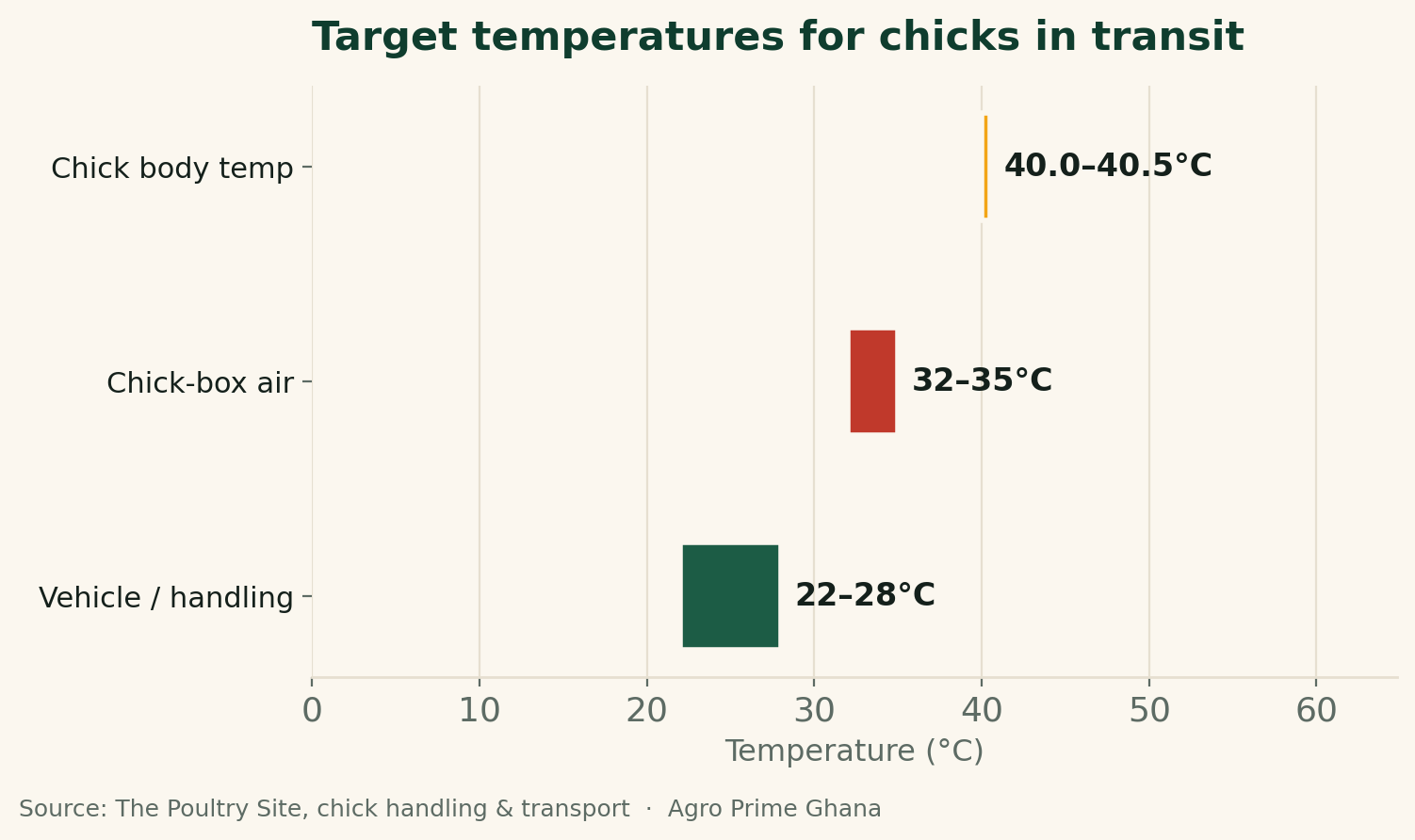
The target conditions at a glance
Getting the numbers right is easier when they are in one place. The table below summarises the target environment for day-old chicks in transit, drawn from The Poultry Site's chick-handling guidance. Treat the chick-box air figure as the one that matters most; the vehicle figures are how you achieve it.
| What you're measuring | Target | Why it matters |
|---|---|---|
| Chick body temperature | 40.0–40.5°C | The outcome you're protecting; measured at the vent if checking |
| Chick-box air temperature | ~32–35°C | The air the chicks actually breathe — the key number |
| Vehicle / handling temperature | 22–28°C | How you keep box air in range without overheating |
| Relative humidity | 50–60% | Too dry dehydrates chicks; too damp stops heat loss |
| Carbon dioxide (CO₂) | ~500–600 ppm | Rising CO₂ means poor ventilation; chicks start gasping |
| Placement window | Within 48–72 hrs of hatch | How long yolk reserves last; aim well inside it |
Ventilation: the danger you can't see
Fresh air is as important as the right temperature, because a box full of living chicks steadily uses up oxygen and gives off carbon dioxide and moisture, and stale air can kill even when the temperature looks fine. The Poultry Site guidance puts the target CO₂ around 500–600 ppm; when ventilation is poor and CO₂ climbs, chicks show it clearly — they gasp for air and try to push their heads out of the boxes. That is an emergency signal that the air has gone bad, distinct from heat panting, and it means the boxes need more fresh air immediately.
The challenge is that the two needs pull against each other: you want steady airflow to refresh the air, but not a cold draught blowing directly onto the chicks. The answer is gentle, even ventilation. Space the boxes so air can move between them — leave at least around 30 cm between rows where you can — rather than stacking them in a solid, airtight block, and never seal chicks in a closed car boot, which becomes both an oven and a CO₂ trap. In a pickup or van, arrange the boxes so the ventilation holes are not blocked, and keep some air moving through the load. Good ventilation on the road is the same principle as in the house — covered in our guide to poultry house ventilation — just at box scale.
Field note: watch the birds, not just the thermometer
A thermometer tells you the air; the chicks tell you the truth. On dispatch mornings we look at and listen to every box before it leaves and again whenever we can on a long run. Chicks spread evenly and murmuring softly are comfortable. Chicks bunched into a pile are cold — and a pile is an emergency, because the ones underneath smother. Chicks panting and getting loud are too hot. Chicks with their heads pushed up through the vent holes, gasping, are short of air. You learn to read a box in a few seconds, and that beats any single temperature number.
Choosing the right box and vehicle
The container and vehicle are the tools that let you hold those conditions. A proper chick box is rigid enough not to crush, with ventilation holes on the sides, internal divisions so chicks cannot slide into a heap when the vehicle brakes, and a soft, non-slip floor lining. Do not overcrowd — chicks need room to spread out and lose heat, and an over-packed box concentrates warmth and CO₂ — but a box too empty lets chicks slide together and chill. Purpose-made boxes handle this; improvised cartons rarely do, and a smooth floor invites splayed legs, covered in our note on spraddle leg in chicks.
For the vehicle, the priorities are a covered, ventilated load space, shade, and a smooth ride. An air-conditioned van is ideal for long distances because it holds the 22–28°C target through the heat of the day, but a well-shaded, well-ventilated pickup or car can work if you travel in the cool hours and manage airflow. Whatever the vehicle, secure the boxes so they cannot tip or slide under braking, keep them out of direct sun, and never put chicks in a sealed boot with no way to see them. If you cannot see and hear the chicks, you cannot respond when they signal distress — and on a long trip, that response is the whole game.
Let us get the chicks to you — or get you started right
Long-distance chick transport is where good batches are quietly lost, so it's worth getting right. When you order day-old chicks from our Kasoa hatchery, we pack them in proper, ventilated chick boxes and can advise on moving them to your area — timing the trip for the cool hours and having your brooder ready before they arrive. If you're far from Kasoa, talk to us before you travel. Message us on WhatsApp at +233 24 915 1503 or book a visit to arrange your chicks and a transport plan that gets them to your farm strong.
Timing your journey around the Ghanaian climate
In Ghana, when you travel matters as much as how — because midday heat is the enemy, the single most effective free measure is to move chicks in the cool of early morning or evening. A journey that would overheat a box under a 34°C midday sun is far safer at dawn, when the air is closer to the vehicle target. Plan long trips to start early, and where a route crosses the hottest hours, prefer an air-conditioned vehicle or reschedule. During the harmattan, remember the opposite risk at night — cold, dry, dusty air that can chill and dehydrate chicks — so a trip is not automatically "safe because it's not hot"; it's safe when the box air stays in range, whatever the season.
Plan the practical details too. Map the route and its likely delays, and build a time margin so you stay well inside the yolk-reserve window even if the trip runs long. Have the destination ready before you leave — getting the brooder right is covered in our brooder temperature chart for Ghana. Minimise stops, keep the boxes shaded and ventilated at every pause, and never leave chicks in a parked vehicle in the sun even for a few minutes.
The first hour after arrival
How you handle arrival decides whether the journey's stress fades or turns into losses. Move the boxes straight into the pre-warmed brooder, out of sun and draught, and get the chicks onto clean, fresh water quickly — travelled chicks are mildly dehydrated and their first priority is fluid; dipping a few beaks shows the rest where the water is, and lukewarm water is kinder than cold to a chilled traveller. Watch how the flock spreads under the heat source: chicks huddled directly under it are cold, chicks pushed to the edges are too hot, and chicks spread evenly are just right.
Give the birds a calm start. Keep the brooder quiet, avoid unnecessary handling, and let them rest, drink and find their feet. A batch that travelled well and is placed into a warm, ready brooder usually recovers within hours and starts strongly; a batch tipped into a cold, unprepared pen after a hard trip carries that stress for days. If chicks arrive clearly chilled, piled or gasping, act on what you see — restore warmth and airflow, get fluids into them — rather than assuming they will recover on their own. Everything you did on the road is only banked if the arrival is handled with the same care.
Field note: warm the brooder before you leave, not after you arrive
The mistake we see most often on long-distance orders is not on the road at all — it's at the far end, where a tired farmer arrives and only then starts lighting the brooder. Those chicks sit in a cold pen losing the very heat you protected all journey. We tell customers to switch the brooder on hours before the chicks are due, so it is already at placement temperature with water waiting. The journey and the arrival are one job; getting the chicks there safely counts for little if they land in a cold house.
The bottom line on transporting chicks long distance
Transporting day-old chicks a long way in Ghana comes down to speed, temperature and air. Move them fast — well inside the 48–72 hour window their yolk reserves allow — hold the box air near 32–35°C with 50–60% humidity and steady fresh ventilation, and keep the chicks' body temperature in its safe band around 40°C. Beat the heat by travelling in the cool hours, use proper ventilated boxes and a shaded vehicle, and never seal chicks in a hot boot where you cannot see them. Above all, read the birds: spread and quiet means comfortable, piled means cold, panting means hot, heads-out and gasping means starved of air. Get them into a pre-warmed brooder onto fresh water the moment you arrive, and a long journey need not cost you a single chick.
Frequently asked questions
How long can day-old chicks survive without food or water during transport?
What temperature should day-old chicks be kept at during transport?
How do I know if chicks are too hot or too cold in the box?
Can I transport chicks in the boot of my car?
What is the best time of day to transport chicks in Ghana?
How many chicks should go in one transport box?
What should I do the moment the chicks arrive?
Is it worth transporting chicks over very long distances at all?
Sources & further reading
- The Poultry Site — Maintaining the Ideal Climate for Chick Handling and Transport (body temperature 40.0–40.5°C, box air 32–35°C, vehicle 22–28°C, humidity 50–60%, CO₂ 500–600 ppm, chilling/overheating/gasping signs).
- Freedom Ranger Hatchery — How Long Can Baby Chicks Go Without Food or Water During Shipping? (48–72 hour yolk-reserve survival window, shipping within 24 hours of hatch).
- Agro Prime Ghana guides: brooder temperature chart, poultry house ventilation, spraddle leg in chicks.
About Agro Prime Ghana
Agro Prime Ghana Limited runs a poultry hatchery and mixed agribusiness in Kasoa, supplying day-old chicks and working alongside poultry keepers across the country. We pack chicks in proper ventilated boxes, supply healthy day-old chicks (broilers & layers), point-of-lay pullets, quality feed and hands-on farm support, and we'll help you plan a safe journey to your farm. This article is general educational information, not a substitute for professional veterinary advice. Ready to order or plan a delivery? Book a visit or message us on WhatsApp (+233 24 915 1503).