Tomato is one of the most eaten and most demanded vegetables in Ghana — the base of nearly every stew, soup and jollof — yet the country spends heavily importing tomatoes and tomato paste, and local farmers routinely watch harvests rot for lack of a buyer or a price. That paradox is the whole story of tomato farming here: enormous demand, real money to be made, but a crop that punishes poor timing, poor disease control and poor market planning. Grown with the right variety, disciplined disease and pest management, and — above all — a plan for when and where to sell, tomato is a high-value crop. This guide covers how to grow tomato successfully in Ghana and, just as importantly, how to sell it profitably.
Key takeaways
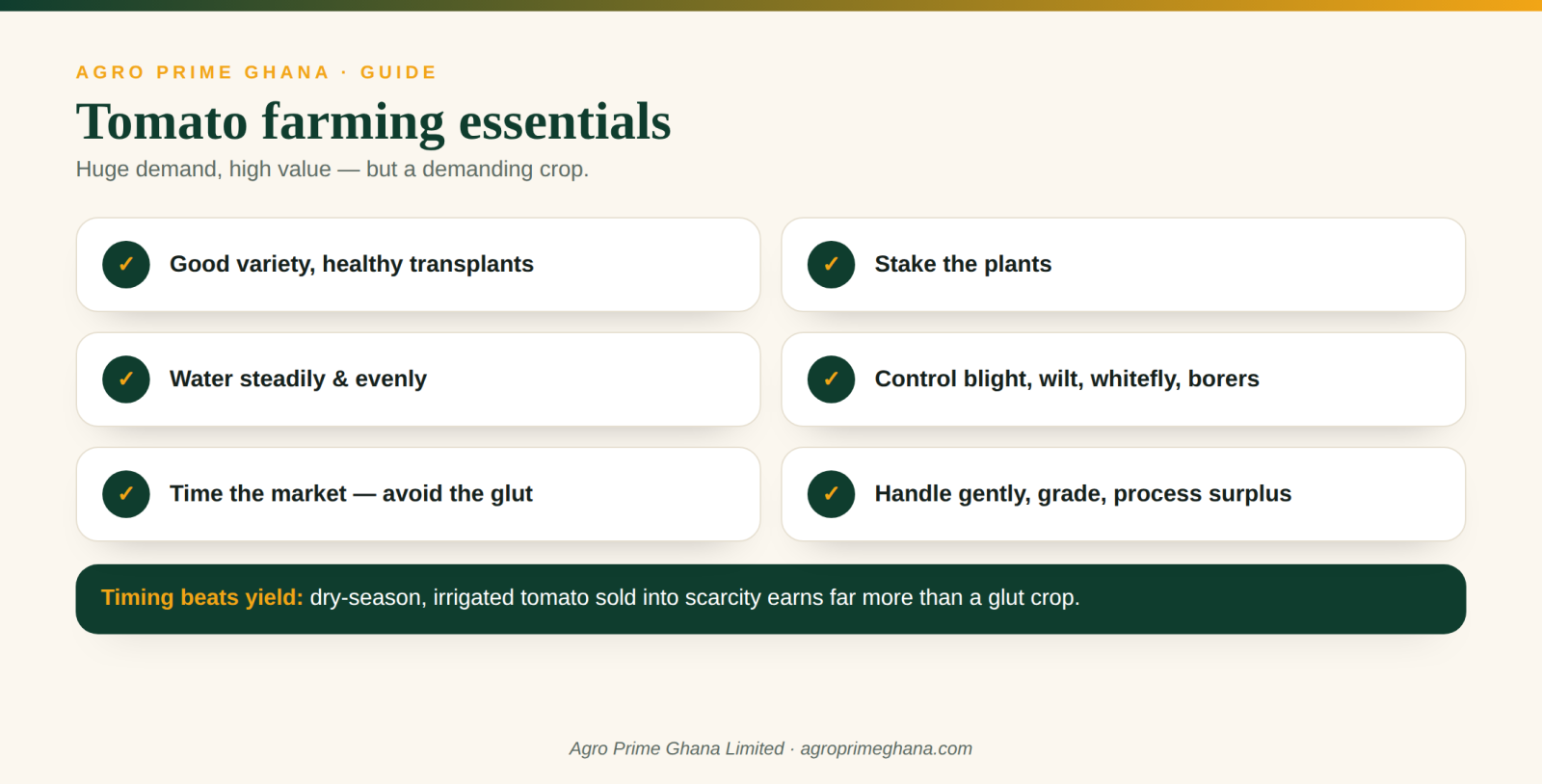
Tomato has huge, constant demand in Ghana but is a demanding crop. Success rests on three things: a good variety and healthy nursery-raised transplants; disciplined disease and pest control (blight, bacterial wilt, whitefly, fruit borers); and — the make-or-break factor — market timing. Growing in the dry season under irrigation to sell when local supply is scarce earns far more than glutting the market at peak harvest. Stake the crop, water steadily, and plan your sale before you plant.
Why tomato is a high-value crop
Tomato demand in Ghana is deep and unrelenting: it is a staple ingredient in stews, soups, jollof and countless dishes, bought daily by households, chop bars, restaurants and processors. That constant demand, plus the country's heavy reliance on imported fresh tomatoes and tomato paste, means a well-timed local crop can sell very well. The catch is that tomato is not an easy crop — it is vulnerable to several diseases and pests, sensitive to weather, and prone to gluts and price crashes when everyone harvests at once. This combination of high value and high difficulty is exactly why it rewards the farmers who do it properly: strong demand pays well for a good crop sold at the right time, while careless growing or poor market timing loses money on a crop that needed real skill. Tomato is a crop to respect and plan for, not to plant casually.
Varieties and the nursery
Tomato farming starts before the field, with variety choice and a good nursery. Choose a variety suited to your purpose and conditions — some are bred for fresh market, some for processing into paste, some for better disease tolerance, longer shelf life or heat tolerance for dry-season growing — using quality seed from a reliable source. Most tomato is raised first in a nursery (a seedbed or trays) and then transplanted, because starting seedlings in a protected, well-managed nursery gives stronger, more uniform plants and lets you cull weak ones. Raise the seedlings on clean, well-prepared soil or media, protect them from pests and harsh sun, water carefully, and transplant healthy seedlings at the right age into a well-prepared field at proper spacing. Getting strong, healthy, disease-free transplants into the ground is the foundation of the crop; weak or already-infected seedlings never recover into a good crop.
Staking, watering and feeding
Once transplanted, tomato needs active management to yield well:
- Stake the plants. Supporting tomato plants on stakes or strings keeps fruit off the ground, reduces disease and rot, makes spraying and harvesting easier, and improves fruit quality — staked tomato generally outperforms sprawling, unstaked crops.
- Water steadily and evenly. Tomato needs consistent moisture; erratic watering causes problems like fruit cracking and blossom-end rot. In the dry season, reliable irrigation is essential — and is exactly what lets you grow for the high-price window.
- Feed for fruiting. Tomato is a hungry crop that responds to good soil and balanced feeding for strong growth and heavy fruit set; follow sound fertility practice for your soil.
- Weed and keep the field clean, which also reduces pest and disease pressure.
The real battle: diseases and pests
Here is where most tomato crops are won or lost. Tomato is vulnerable to serious diseases and pests, and controlling them is central to success. The major threats include fungal and bacterial diseases — such as blights (leaf and fruit blight), bacterial wilt (which can wipe out plants), and various leaf spots and wilts — and insect pests like whitefly (which also spreads virus diseases), aphids, and fruit-boring caterpillars that ruin the fruit. Left unmanaged, these can destroy much of a crop. Control rests on an integrated approach: start with clean, healthy transplants and resistant varieties where available; keep the field and crop clean; rotate tomato with unrelated crops rather than growing it on the same land repeatedly (which builds up soil diseases like bacterial wilt); scout the crop regularly; and apply appropriate fungicides and insecticides correctly and safely at the right time, ideally with extension or agro-dealer guidance. Prevention and early action beat trying to rescue a crop already overwhelmed. The farmers who master tomato are the ones who manage its diseases and pests proactively.
The decisive factor: market timing
This is the single most important business lesson in tomato farming: when you sell matters as much as how you grow. Tomato is notorious for gluts — when the main rain-fed crop comes in, everyone harvests at once, the market floods, prices crash, and farmers watch fruit rot or sell at a loss. The farmers who profit are those who sell when supply is scarce and prices are high — typically by growing in the dry season under irrigation, when field production is low and prices are strong, or otherwise timing their crop to hit a gap in supply. This is why irrigation is such a powerful advantage in tomato: it lets you grow off-season for the high-price window rather than competing in the glut. Plan your market before you plant: know when you will harvest, what prices that window typically brings, and who will buy — fresh-market traders, a processor, an institutional buyer. A perfectly grown tomato crop sold into a glut can lose money; a decent crop sold when tomatoes are scarce can be very profitable. Sell smart, not just grow well.
Harvest, handling and processing
Tomato is perishable and easily damaged, so careful harvesting and handling protect your income. Harvest at the right maturity for your market — fully ripe for immediate local sale, or slightly firmer/turning for fruit that must travel or wait — and pick regularly as fruit ripens. Handle gently to avoid bruising, and use suitable crates rather than overfilled sacks that crush the fruit, because bruised, crushed tomato spoils fast and sells for less. Get the crop to market quickly, since fresh tomato does not keep long. Because so much tomato is lost to spoilage and gluts, processing is a valuable option and opportunity: surplus or lower-grade tomato can be turned into paste, purée, sauce or dried tomato, adding value, extending shelf life and capturing some of the demand now met by imports. Even simple, careful handling and grading — selling clean, unbruised, well-sorted fruit — earns a better price than dumping mixed, damaged tomato.
The economics of tomato
Tomato can be highly profitable but carries real cost and risk. Your main costs are seed and nursery, land preparation, staking, water and irrigation (especially for dry-season crops), fertiliser, and — significantly — disease and pest control, which is not optional on this crop. Against that, a good crop sold into a strong-price window earns very well given tomato's high value and demand. The big risks are disease or pest failure (losing much of the crop) and market gluts (selling into a price crash), both of which are managed by the disciplines above: proactive disease control and deliberate market timing. Because of the glut risk, the difference between profit and loss on tomato often lies less in yield than in timing the sale. Know your costs, plan your harvest window and buyer before planting, and treat disease control as a core cost rather than something to skip. Managed this way, tomato is one of the higher-earning crops available to a Ghanaian farmer; grown carelessly or sold into a glut, it is one of the most disappointing.
Common mistakes to avoid
- No market plan, harvesting into a glut and crashing prices — plan your selling window before planting.
- Weak disease control, losing the crop to blight or bacterial wilt.
- Poor or infected transplants, which never make a good crop.
- Not staking, leaving fruit on the ground to rot and disease.
- Erratic watering, causing cracking and blossom-end rot.
- Rough handling, bruising perishable fruit that then spoils and sells cheap.
Frequently asked questions
Is tomato farming profitable in Ghana?
Why is market timing so important for tomato?
What diseases and pests attack tomato?
Should I grow tomato in the dry season?
Why should I stake tomato plants?
Do I need a nursery for tomato?
What can I do with surplus or unsold tomato?
How should I handle tomato after harvest?
The bottom line on tomato farming
Tomato sits at the heart of Ghanaian cooking and Ghanaian food demand, and that makes it a genuinely high-value crop — but a demanding one that rewards skill and planning and punishes carelessness. Success rests on three disciplines. Start with a good variety and strong, healthy nursery-raised transplants. Then manage the crop actively — stake it, water it steadily, feed it, and above all control its diseases and pests, which are the main technical challenge. And finally, treat market timing as seriously as growing: plan your harvest window and buyer before you plant, and aim to sell when supply is scarce and prices are high — which, in practice, usually means dry-season, irrigated production rather than glutting the market at peak. Add careful handling, grading and even processing of surplus, and tomato becomes one of the most profitable crops a Ghanaian farmer can grow, helping to close the gap the country now fills with imports.
Grow a high-value crop the smart way
Agro Prime Ghana Limited runs a hatchery and agribusiness in Kasoa. Tomato and other vegetables can strongly diversify farm income when grown and timed well. Talk to us about building a resilient, profitable farm: book a visit or message WhatsApp (+233 24 915 1503).