Banana is a crop of steady, year-round rewards. Unlike seasonal fruits, a well-managed banana field produces bunches continuously through the year, meeting constant demand for a sweet, convenient, popular fruit at home and — for the right varieties grown to standard — in export markets. Grown from suckers or clean tissue-culture plants, banana establishes and yields relatively quickly for a perennial. But it lives under the shadow of two serious diseases that shape how it must be grown, and it rewards good management of its plants and bunches. This guide covers how to grow banana successfully in Ghana, how it differs from plantain, and how to manage the diseases and practices that decide the crop.
Key takeaways
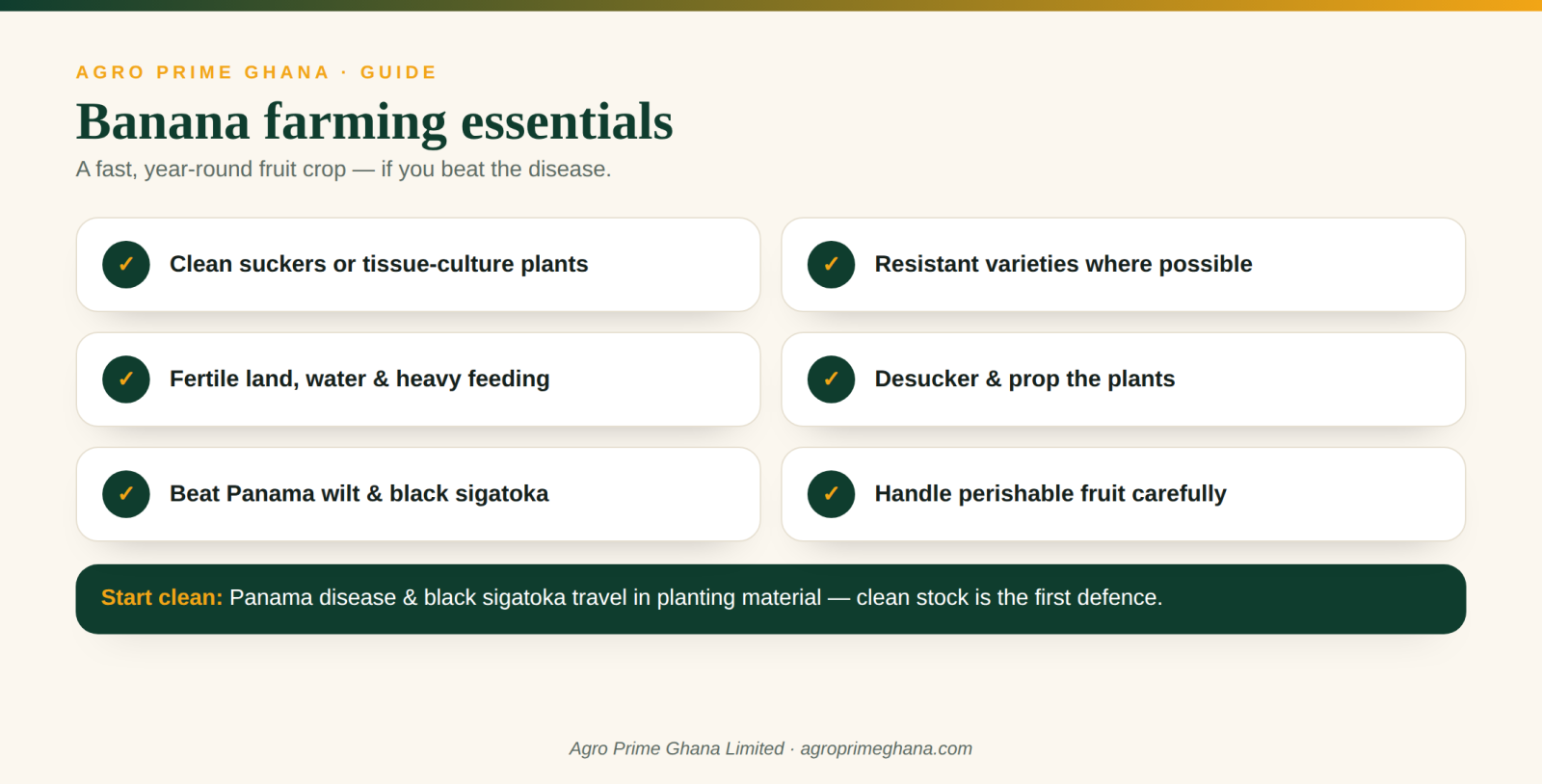
Banana is a fast-establishing perennial that fruits year-round, meeting constant local (and potential export) demand for sweet dessert bananas. Plant clean, healthy suckers or tissue-culture plants, establish on fertile, well-drained land with steady water and feeding, and manage the plants (desuckering, propping, bunch care). The defining threats are Panama disease (Fusarium wilt) and black sigatoka — manage them with clean planting material, resistant varieties and good practice. Steady, continuous production makes banana a reliable earner.
Why banana is a rewarding crop
Banana's great strength is steady, continuous production. Unlike seasonal tree fruits, a well-managed banana field yields year-round: as one plant fruits, its followers (suckers) grow on to fruit after it, so the field keeps producing bunches continuously, giving a steady, recurring stream of income rather than a single seasonal payday. Demand is constant and broad: sweet dessert bananas are a popular, convenient, everyday fruit eaten fresh by households, sold by vendors and markets, and — for the right varieties grown to standard — traded in export markets, where banana is one of the world's major fruits. Banana establishes and yields relatively quickly for a perennial, coming into production faster than tree crops, and once established a plantation can produce for years. It suits the warmer, higher-rainfall southern zones with good moisture. The trade-offs are that banana needs good moisture and management and, importantly, lives under the threat of serious diseases that must be respected. But for a farmer wanting a fruit crop that pays steadily and continuously, with strong demand and relatively quick returns, banana is a genuinely rewarding option — provided its disease risks are managed.
Banana and plantain: the difference
It helps to be clear how banana differs from its close relative plantain, since both are grown in Ghana. Both are large herbaceous plants (not true trees) of the same family, grown similarly from suckers, and both produce bunches of fruit. The main difference is in the fruit and its use: dessert banana is the sweet fruit eaten raw and fresh, soft and sweet when ripe, and is the focus of this guide, whereas plantain is a starchier cooking type, usually cooked (fried, boiled, roasted) rather than eaten raw sweet. This distinction matters for the market — dessert banana serves the fresh-fruit and export markets for sweet bananas, while plantain serves the cooking-staple market — and can matter for variety choice and handling. Much of the growing, however, is broadly similar between the two. This guide focuses on the sweet dessert banana; a farmer choosing between them should match the crop to the market they are targeting (sweet fresh fruit versus cooking staple), while recognising that both are managed in comparable ways and both benefit from clean planting material and good disease management.
Planting material: suckers and tissue culture
Banana is grown from vegetative planting material, and its quality — especially its freedom from disease — is critical. The traditional material is suckers (young shoots taken from existing plants), which are cheap and available but carry a real risk: they can carry diseases and pests (including the soil diseases and nematodes that plague banana) from the parent plant into the new field, spreading problems. The improved alternative is tissue-culture plantlets — young plants raised in the laboratory that are clean, disease-free, uniform and vigorous — which give a healthier, more uniform, higher-yielding start and, crucially, avoid introducing disease, making them especially valuable for establishing a clean plantation. So use clean, healthy planting material: carefully selected, treated suckers from healthy plants, or, better, clean tissue-culture plantlets, particularly given the disease threats discussed below. Plant into fertile, well-drained land at the proper spacing. Because banana's serious diseases are often carried in planting material and soil, starting with clean material is one of the most important things a farmer can do — it is the first line of defence for the whole plantation.
Establishing and managing the crop
Banana is a fast-growing, hungry, thirsty crop that rewards attentive management:
- Fertile land, water and feeding. Banana needs fertile, well-drained soil, plenty of moisture (steady water, with irrigation in dry periods), and good feeding — it is a heavy feeder — for strong plants and good bunches.
- Desucker the plants. Each mat produces several suckers; managing them (keeping the right number of followers per mat and removing excess) channels the plant's energy into good bunches and orderly, continuous production.
- Support/prop the plants. A heavy bunch can topple a plant, especially in wind, so propping or supporting fruiting plants protects the bunch.
- Keep the field clean and manage the plants, removing old leaves and maintaining the mat for health and productivity.
This active management — feeding, watering, desuckering, propping and general care — is what keeps a banana field healthy and continuously productive. Banana rewards good husbandry with steady bunches, and neglect shows up quickly in poor plants and small bunches.
The defining threats: Panama disease and black sigatoka
Any serious guide to banana must center on its two most important diseases, which shape how the crop is grown worldwide and in Ghana. Panama disease (Fusarium wilt) is a devastating soil-borne fungal disease that wilts and kills banana plants; it persists in the soil for years, is spread through infected planting material and soil movement, and cannot be cured in an infected plant — making prevention essential. Black sigatoka (black leaf streak) is a serious fungal leaf disease that destroys the leaves, sharply reducing the plant's ability to fill its bunches and cutting yield and fruit quality, and it is a major, ongoing challenge in banana. Together these diseases are the defining challenge of the crop. Managing them relies on prevention and good practice: use clean, disease-free planting material (a key reason tissue culture is so valuable) and avoid moving disease in on suckers or soil; grow resistant or tolerant varieties where available (an important defence, especially against Panama disease, for which resistant types are central); practise good field hygiene and sanitation, including managing infected plants and, for black sigatoka, removing affected leaves and maintaining airflow; follow recommended control measures (for black sigatoka, well-timed fungicide programmes are used in commercial production); and rotate or avoid replanting into known-infected soil for Panama disease. The practical lessons for the farmer are clear: start clean, choose resistant varieties, keep the field healthy, and act on disease promptly. Banana is a rewarding crop — but only when Panama disease and black sigatoka are respected and managed as the central risks they are.
Harvest, handling and the economics
Banana is harvested by cutting the bunch at the right maturity for its market — firmer and less ripe for fruit that must travel or be sold over time (and for export), riper for immediate local sale — and because the field fruits continuously, harvesting is a regular, ongoing task. The fruit is perishable and easily bruised, so careful handling — cutting, dehanding and packing gently, avoiding damage — protects quality and value, especially for fruit destined for more demanding or distant markets. On economics, banana's great advantage is steady, year-round production: against the costs of establishment (ideally clean tissue-culture material), land, water, feeding (banana is a heavy feeder), management and disease control, the field produces continuously, giving a reliable, recurring income rather than a seasonal lump. Demand for fresh dessert banana is constant, and for the right varieties grown to standard there is export potential in a major global fruit market. The key risks are the diseases (Panama and black sigatoka), managed by clean material, resistant varieties and good practice, and perishability, managed by careful handling and prompt marketing. So the keys to banana economics are: establish clean and healthy (favouring tissue culture and resistant varieties), manage the crop and its diseases well, and market the continuous, perishable harvest promptly and carefully. As a fast-establishing, continuously producing, strongly demanded fruit crop, banana is a reliable, steady earner for the southern-zone farmer who manages its central disease risks.
Common mistakes to avoid
- Planting infected suckers, carrying Panama disease, nematodes and other problems into the field — prefer clean or tissue-culture material.
- Ignoring Panama disease and black sigatoka, the crop's defining threats.
- Skipping resistant varieties, a key defence, especially against Panama disease.
- Underfeeding or under-watering, starving a hungry, thirsty crop of what it needs.
- Not desuckering or propping, giving disorderly production and toppled, bunch-lost plants.
- Rough handling of perishable, easily bruised fruit.
Frequently asked questions
Is banana farming profitable in Ghana?
What is the difference between banana and plantain?
Should I use tissue-culture banana plants?
What is Panama disease?
What is black sigatoka?
Does banana produce all year round?
What does banana need to grow well?
How should I handle banana after harvest?
The bottom line on banana farming
Banana is a fruit crop that pays steadily and continuously — a fast-establishing perennial whose well-managed field produces bunches year-round, meeting constant demand for a sweet, popular, convenient fruit and, for the right varieties grown to standard, reaching export markets. Growing it well starts with clean, healthy planting material — ideally disease-free tissue-culture plantlets, or carefully selected suckers — because banana's most serious diseases travel in planting material and soil. From there it rewards attentive management of a hungry, thirsty crop: fertile land, steady water and feeding, desuckering, propping and plant care. And it depends, above all, on respecting and managing its two defining threats — Panama disease (Fusarium wilt) and black sigatoka — through clean material, resistant varieties and good practice. Start clean, manage the crop and its diseases well, and handle the continuous, perishable harvest with care, and banana rewards the southern-zone farmer with one of the most reliable, steadily producing fruit crops available — income that comes not once a season, but all year round.
Grow a steady, year-round fruit crop
Agro Prime Ghana Limited runs a hatchery and agribusiness in Kasoa. Continuously producing crops like banana give reliable, recurring income. Talk to us about building a resilient, productive farm: book a visit or message WhatsApp (+233 24 915 1503).