
You walk your maize field a few weeks after emergence and something is wrong. The young plants are ragged, the newest leaves have a row of neat "shot holes" or torn windows, and deep in the funnel of the whorl there is a mess of moist, sawdust-like droppings. Part a whorl with your fingers and you find the culprit: a fat, greyish-brown caterpillar with a pale upside-down "Y" on its head and four dark spots in a square on its back end. That is fall armyworm, the pest that has redrawn maize farming in Ghana since it arrived in 2016. This guide explains how to identify it, how much damage it really does, how to scout properly, and how to build a control programme that works under Ghanaian conditions without pouring money down the drain on the wrong sprays.
Written by the Agro Prime Ghana agronomy team and reviewed against current references (CABI, FAO and peer-reviewed studies on fall armyworm in Ghana). Last updated September 2026.
Key takeaways
Fall armyworm (Spodoptera frugiperda) was first detected in Africa in 2016 and caused a general outbreak in Ghana from the 2017 season. It feeds on more than 80 plant species but maize is its favourite host. A 2018 survey put average maize yield losses in Ghana at about 26.6% per affected farmer, with the lost value of the national maize crop estimated at roughly US$177 million a year. The moth lays around 1,500 eggs in her life, flies hundreds of kilometres, and completes a generation in about 30 days in our heat — so it multiplies fast. The winning approach is not spraying on a fixed calendar but weekly scouting from emergence, catching the pest while larvae are small, and combining hand-picking, good agronomy, natural enemies and — only when needed — a correctly chosen insecticide rotated to avoid resistance.
What fall armyworm is and where it came from
Fall armyworm is the caterpillar (larva) of a night-flying moth native to the Americas. It is not a worm at all but a member of the Lepidoptera, in the same broad family as the cutworms and the African armyworm that Ghanaian farmers already knew. What made it a continental emergency is its combination of appetite, mobility and breeding speed. It was first reported in West and Central Africa in 2016, and by September 2018 the Centre for Agriculture and Bioscience International (CABI) recorded it in 44 African countries — essentially everywhere on the continent suitable for it. In Ghana, scattered reports in 2016 gave way to a full-blown outbreak at the start of the 2017 cropping season, and it has been part of the maize calendar ever since.
The pest matters here for one simple reason: it eats what Ghana eats. Maize is the country's most important cereal, grown by the great majority of farming households and the base of everything from banku and kenkey to poultry and livestock feed — which is why sound agronomy from land preparation onward, as covered in our guide to maize farming in Ghana, is your first line of defence. A pest that specialises in maize therefore threatens food on the table, income in the pocket, and the cost of the eggs and chicken the rest of the food system depends on. Research on the African invasion published in Frontiers in Agronomy notes that maize is the most widely reported host and that in survey after survey it is the crop farmers say is hit hardest.
How much damage it really does
The honest answer is: a lot, but it varies enormously with how early you catch it. When Ghanaian scientists surveyed farmers and inspected fields for the study published in the Journal of Integrated Pest Management, confirmed infestation ran at about 73.7% of inspected farms in 2017, falling to around 20.9% in 2018 as farmers learned to respond. National maize losses attributed to the pest were estimated at roughly 132,000 tonnes in 2016, 180,000 tonnes in 2017 and 36,000 tonnes in 2018 — the sharp drop showing that management works. A separate 2018 multi-country assessment reported by CABI put the average yield loss at about 26.6% per affected farmer in Ghana, translating to an estimated US$177 million in lost value from the annual maize crop. Across the wider region, documented losses in maize have ranged from around 22% to 67% in West Africa depending on season, variety and response.
Two points sit behind these figures. The damage is heaviest where farmers do nothing or react late; fields scouted and treated early lose far less. And the numbers are less a fixed disaster than a measure of how much is at stake — and therefore how much a good routine can save. The same pressure that can cost you a quarter of your harvest can be pushed down to a manageable nuisance with the right habits.
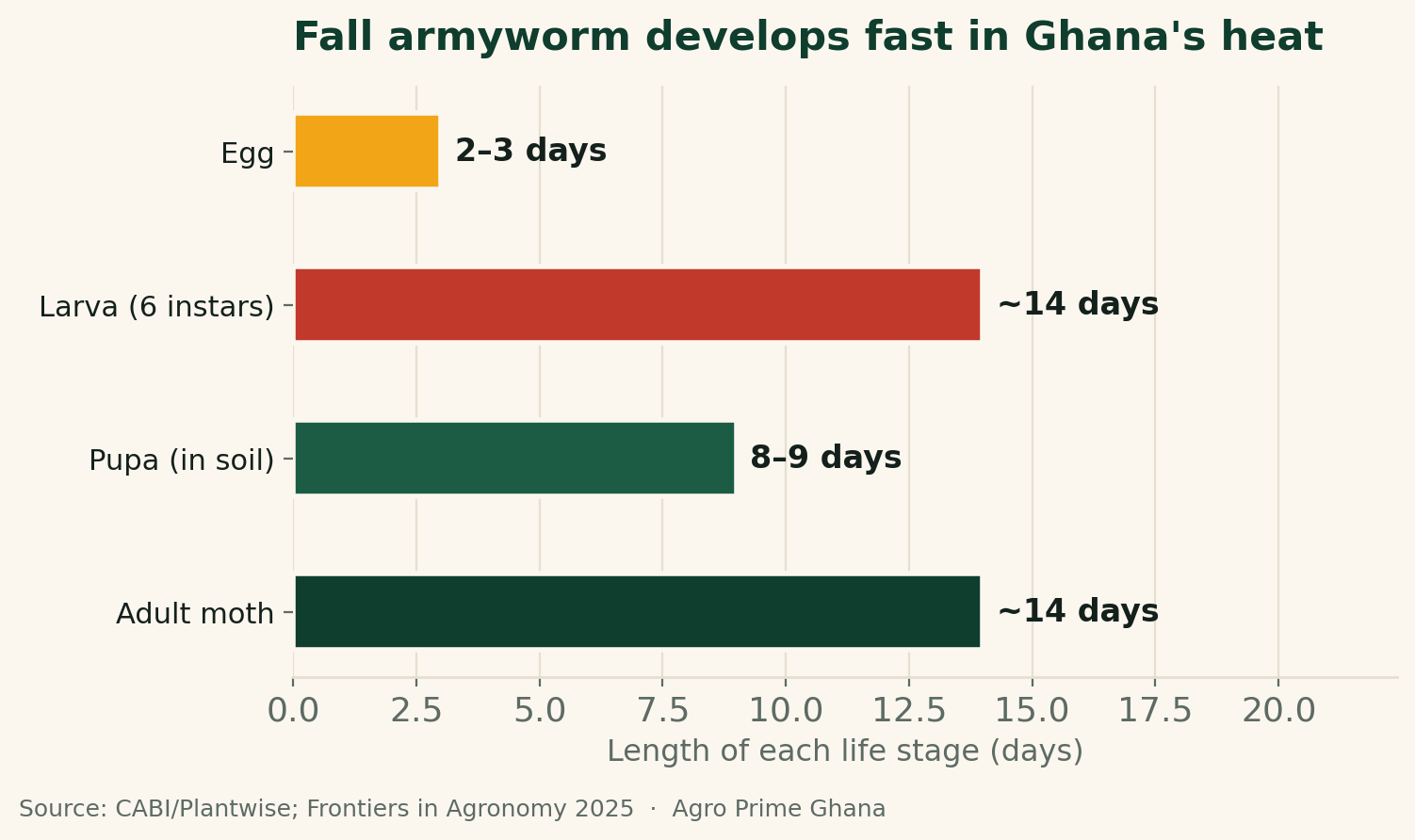
| Life stage | Roughly how long (warm conditions) | What it means for you |
|---|---|---|
| Egg mass | 2-3 days | Furry, greyish masses on leaves; a short window before hatching |
| Larva (6 instars) | ~14 days | The damaging stage; small larvae are easy to kill, big ones are not |
| Pupa | 8-9 days | Hidden in the soil; ploughing can expose and destroy pupae |
| Adult moth | ~14 days | Lays ~1,500 eggs, flies 500+ km at night; re-invades treated fields |
How to identify fall armyworm with confidence
Correct identification saves money, because several caterpillars attack maize and the wrong diagnosis leads to the wrong or unnecessary spray. Fall armyworm has a few reliable "signatures." On the head capsule of a medium or large larva there is a pale, inverted Y-shape. On the second-to-last body segment (near the tail) there are four dark spots arranged in a square. The body is smooth, ranges from green through brown to nearly black, and carries lengthwise stripes. Younger larvae are pale green with a dark head and are much harder to tell apart, which is exactly why the damage pattern matters as much as the caterpillar.
The damage tells its own story. Very small larvae "window" the leaf, scraping one surface and leaving a thin, papery, semi-transparent patch. As they grow they chew ragged holes and, because they feed hidden inside the funnel, the expanding leaves unfurl to reveal rows of holes across the blade — a tell-tale sign. The clincher is what sits in the whorl: moist, chunky frass (droppings) that looks like wet sawdust, often in surprising quantity. Later, larvae can bore into tassels and, most damaging of all for yield, into the developing cob, where they hide under the husk and are almost impossible to reach with a spray.
Field note: read the frass, not just the caterpillar
On our own plots the fastest way to judge a field is to look at the whorls, not to hunt for the insect. Fresh, wet, coarse frass deep in the funnel means an active, feeding larva is inside right now and worth treating; dry, old, crumbly frass with no fresh damage often means the caterpillar has already pupated or been eaten, and a spray would be wasted. We also part the whorl gently rather than yanking it — a startled large larva drops to the base of the plant and you miss it. Checking early morning or late afternoon, when larvae feed more openly, gives a truer picture than the heat of midday.
Why it spreads and rebounds so quickly
Understanding the biology explains why calendar spraying alone fails. A single female moth lays on the order of 1,500 eggs over her roughly two-week adult life, deposited in furry masses on leaves — so one moth you never saw can seed a whole patch of field. The eggs hatch in two to three days. The larva then passes through six growth stages (instars) over about 14 days in warm weather, doing almost all its damage in the last few. It drops to the soil and pupates for eight or nine days, and a new moth emerges. In Ghana's heat the whole cycle can turn over in about a month, and reviews describe the potential for many generations across a year where maize is available. On top of that, the adults are strong night fliers capable of moving hundreds of kilometres — over 500 km before laying, by some accounts — which is why a field you cleared can be re-infested from elsewhere within days. Fast breeding plus long-distance flight is also why the pest develops resistance to insecticides quickly and why no single tool holds it down for long.
Scouting: the habit that decides your season
If you take one thing from this guide, make it this: walk your field every week from emergence, and act on what you see rather than on the calendar. The most vulnerable, most rewarding window is the first six weeks, while the plant is in its vegetative and whorl stages and the larvae are still small and exposed. A workable routine is to inspect at least 5 spots spread across the field, checking around 10 consecutive plants at each spot, and to look specifically for fresh windowing, rows of holes, and wet frass in the whorl. Note what share of plants show fresh damage with a live larva present.
Formal economic thresholds validated for African conditions are still being worked out — researchers note that firm decision thresholds have not been finalised for the continent — so use a sensible, widely taught rule of thumb instead: treat when roughly a fifth of plants in the whorl stage show fresh damage with live small larvae, and be quicker to act the younger the crop. The point of scouting is timing. Small larvae in the first three instars are far easier to kill and have done little harm; large larvae are tougher, hide in the cob, and have already eaten most of what they will eat. Money spent scouting is money saved on sprays that would otherwise be mistimed.
Integrated control: stacking cheap defences before expensive ones
The pest is here to stay, so the goal is not eradication but keeping it below the level that costs you yield — using the cheapest effective tools first and reserving chemicals for when they are truly needed. Build your programme in layers.
- Good agronomy and clean fields. Vigorous, well-fertilised maize outgrows moderate damage; a stressed, patchy crop does not. Early, uniform planting so the whole area passes through the vulnerable whorl stage together, and prompt ploughing after harvest to expose pupae to the sun and predators, both reduce pressure. Destroying volunteer maize and grassy weeds removes off-season hosts.
- Hand-picking and cultural tricks. On smaller plots this is genuinely effective. In the Ghana study, 57% of farmers hand-killed larvae, and squashing egg masses and larvae during your weekly walk removes many pests before they mature. Some farmers drop a pinch of dry sand, wood ash or fine soil directly into the whorl, which abrades and smothers larvae — a low-cost measure worth trying.
- Protect and use natural enemies. Africa already hosts around 20 parasitoid species and numerous predators (ants, earwigs, ladybirds, birds) that attack fall armyworm, and biological products based on the fungi Metarhizium and Beauveria, or on Bacillus thuringiensis (Bt), can be effective. Broad, routine spraying of harsh insecticides kills these allies and makes the next generation worse, so spraying less and smarter is itself a control strategy.
- Botanicals. Neem (Azadirachta indica) extracts and neem-based products are widely used against young larvae and are gentler on beneficial insects; they work best applied early and directed into the whorl.
Field note: aim for the whorl, spray at the right time of day
The commonest reason a spray "fails" is not the product but the placement. The larva sits deep in the funnel of the plant, so a fine mist drifting over the top of the canopy barely touches it. Whatever you apply — biological, botanical or chemical — direct it down into the whorl so it pools where the caterpillar feeds, and use enough water to carry it there. Spray in the cooler, calmer hours of early morning or late afternoon when larvae are active near the whorl mouth and the product will not evaporate or drift; never spray in the heat of the day or when rain is imminent. And rotate between different chemical groups from one application to the next so the pest cannot build resistance.
When and how to use insecticides responsibly
Insecticides have a place — in the Ghana survey 89% of farmers used them — but they are the layer most often misused. Overuse is expensive, kills the natural enemies that would otherwise help, drives resistance, and puts residues on a food crop. Use chemicals as a targeted response to what scouting tells you, not as a weekly ritual. A study on spray frequency in northern Ghana found that maize does not need blanket, repeated spraying to be protected; well-timed applications aimed at the vulnerable early stages do the job with far fewer sprays than many farmers assume.
Practical discipline matters more than brand. Choose a product registered for fall armyworm on maize and follow the label rate exactly — under-dosing breeds resistance and over-dosing wastes money and endangers health. Rotate active ingredients between chemical groups across the season rather than hammering the same one. Wear the protective gear the label specifies, keep to the pre-harvest interval so the maize you sell is safe to eat, and never spray a crop already carrying large larvae inside the cobs, where the insecticide cannot reach them and the money is simply lost. If you are unsure what to buy or how to time it, your district MoFA agricultural extension officer is the right first call.
The economics: why early beats heavy
Fall armyworm is ultimately a maths problem. Left unmanaged it can take a quarter of your harvest or more; managed reactively with heavy spraying it quietly eats your margin in chemical bills, labour and re-treatment. The farms that come out ahead spend a little, early, in the right places: a weekly walk that costs nothing but time, hand-picking and ash while larvae are small, a protected population of natural enemies, and one or two well-aimed applications only when the threshold is crossed. That is exactly why national losses in Ghana fell so sharply between 2017 and 2018 — not because the pest weakened, but because farmers stopped fighting it blind. Treat control as a routine built around scouting rather than a panic response to visible destruction, and the pest moves from a threat to your food security to a line item you have under control.
Frequently asked questions
How do I know it is fall armyworm and not another caterpillar?
When did fall armyworm arrive in Ghana?
How much yield can fall armyworm cost me?
What is the best time to control fall armyworm?
Do I need to spray insecticide every week?
Do neem, ash or sand actually work?
Why does the pest keep coming back after I spray?
Where can I get help identifying or managing it?
Sources & further reading
- Koffi et al. — Assessment of impacts of fall armyworm on maize production in Ghana, Journal of Integrated Pest Management (infestation rates, farmer control practices, national losses).
- CABI — Fall armyworm programme and FAW Evidence Note (2018) (spread to 44 countries, 26.6% yield loss and US$177m estimate for Ghana).
- Fall armyworm in Africa: biology, ecology and management, Frontiers in Agronomy (2025) (life cycle, egg numbers, flight distance, natural enemies, yield-loss ranges).
- Agro Prime Ghana guide: maize farming in Ghana.
About Agro Prime Ghana
Agro Prime Ghana Limited runs a poultry hatchery and mixed agribusiness in Kasoa, and works with maize and vegetable growers whose crops feed both people and our own poultry feed. These guides combine hands-on farm experience with current agronomic references. This article is general educational information, not a substitute for advice from a qualified agronomist or your MoFA extension officer — for product choices and correct timing, get local advice. Need farm support, quality chicks or feed guidance? Book a visit or message us on WhatsApp (+233 24 915 1503).