A poultry farm starter kit is the full checklist for starting a flock of a set size: the floor space by age, the brooder, feeders and drinkers, the first chicks, feed, bedding, a health plan and the records you will keep. Plan the kit around a flock size you can manage, then buy or build to match it. Agro Prime Ghana supplies the chicks, the feed and the advice from our hatchery in Kasoa, and arranges delivery across Ghana, while the housing and most equipment are sourced locally.
Starting a farm usually goes wrong in one of two ways. The farmer buys birds before the house is ready, or builds a house before checking how much room the birds need as they grow. This kit works backwards from the flock size, so that the space, equipment and feed all match the number of birds you plan to keep from the first day to the last. It is a planning checklist, not a bundle with a single price.
From the Agro Prime Ghana team — a working hatchery in Kasoa supplying day-old chicks, point-of-lay pullets and feed across Ghana. Last updated October 2026.
Quick answer
A starter kit has four layers: floor space that grows with the birds, brooding equipment for the first weeks, feeding and watering equipment, and a health and records plan. As a planning figure from a widely used guide, a flock of 1,000 meat birds needs about 5 m² of heated brooder floor on day one, about 100 m² of floor from week 1, and about 200 m² from week 8. Agro Prime supplies the chicks, feed and advice and arranges delivery. You source housing and most equipment locally. For a kit sized to your flock and a current quote, message WhatsApp (+233 24 915 1503), or book a visit.
Start with the flock size, then the space
Everything in the kit depends on how many birds you will keep at one time. Decide the flock size first, then work out the floor. The space a bird needs is small on day one and grows quickly, so a house that is right for the first week can be far too small by week eight. The Merck Veterinary Manual's minimum space figures for meat-strain birds make this clear. They give a heated brooder area of 0.5 m² per 100 chicks from day one, 0.1 m² per bird from week one, and 0.2 m² per bird from week eight.
The table below scales those figures to a flock of 100 birds and a flock of 1,000 birds. The equipment counts use the Mississippi State University ratio of at least two waterers and two feeders per 100 chicks. Scaling by a simple ratio is a planning shortcut, not a guarantee. Confirm the final numbers with your supplier and your vet.
| Kit item | 100 birds | 1,000 birds | Basis |
|---|---|---|---|
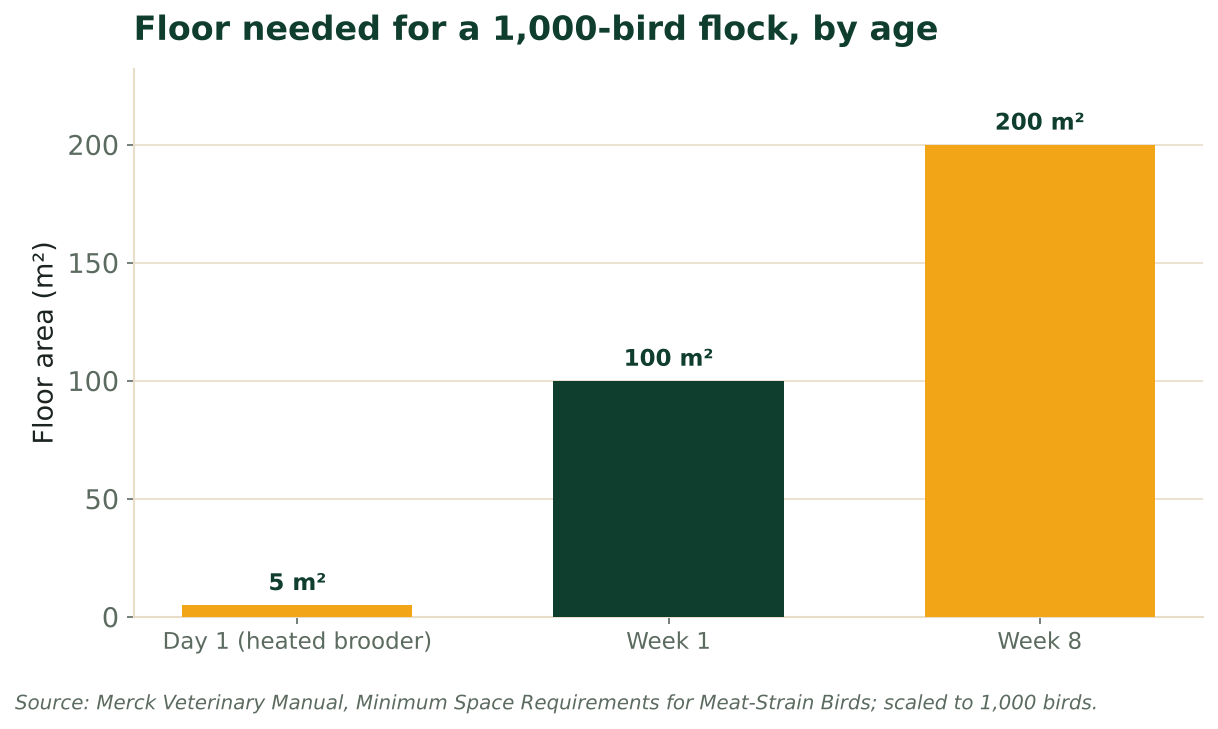
| Heated brooder floor, day one | About 0.5 m² | About 5 m² | 0.5 m² per 100 chicks (Merck) |
| House floor from week 1 | About 10 m² | About 100 m² | 0.1 m² per bird (Merck) |
| House floor from week 8 | About 20 m² | About 200 m² | 0.2 m² per bird (Merck) |
| Waterers | At least 2 (1-gallon) | At least 20 | 2 per 100 chicks (MSU), scaled |
| Chick feeders | At least 2 (12 to 18 inch) | At least 20 | 2 per 100 chicks (MSU), scaled |
| Starter feed | Ask us for the quantity | Ask us for the quantity | Depends on breed and stage |
| Bedding | Dry litter over the whole floor | Dry litter over the whole floor | Material and depth depend on your house |
| Vaccination plan | Agreed with a vet | Agreed with a vet | Set for your flock and area |
The most important number in the table is the week-eight floor. A house built for the brooding stage will not hold a flock that has grown into it. Plan the rearing house for the size the birds will reach, and use the day-one brooder as one part of it, not the whole building. The chart below shows how the floor need grows for a 1,000-bird flock.
The housing and brooder: what to build or buy
The brooder is the part of the kit that makes the first weeks possible. Place it near the centre of the house, so warmth reaches the chicks evenly and the house edges stay clear. Leave about 5 to 6 inches between the heat source and the chicks' backs, as the Mississippi State guide advises, and adjust the height as the birds grow. Light the brooder at least a day before the chicks arrive, and check it works. If you use a gas brooder, plan for regular checks of the burner, the pilot light and the gas line pressure, because a fault in the first days is hard to catch in time.
Surround each brooder with a guard, about 18 inches high, to stop chicks crowding under the edge of the heat. Place it about 3 to 4 feet from the brooder edge and widen it as the flock grows. The guide suggests removing it after about one to two weeks. Hardware cloth can replace a solid guard in hot weather. For the brooding routine itself, see our guide on how to brood day-old chicks in Ghana.
Feeding and watering equipment for the kit
Feeder and drinker space is easy to underestimate. The Merck figures give a feeder space of about 5 cm per bird from week one, rising to about 10 cm per bird from week eight. Drinking-trough space is about 2.5 cm per bird at all ages. When you measure a trough, count both sides. In hot weather, the guide doubles the trough space for adult birds, so plan for the hottest months, not the average day.
The two guides use different units, one in cups and gallon waterers and the other in centimetres of trough, so do not mix them. Choose the equipment type first, then count the space or number that type needs for the flock. Start the first days with feed on egg flats or feeder lids, as the Mississippi State guide advises, so the chicks learn to eat before the feeders take over. Our broiler feeding guide covers the feed stages that follow.
The first chicks, feed and bedding
Agro Prime supplies the day-old chicks and the starter feed, and we arrange delivery across Ghana. Give us your flock size, breed type (broiler or layer) and delivery date, and we will confirm the chicks and feed available for that date. Ask us for the feed stages you will need for your birds, and the quantities at each stage, so you can plan the storage before the chicks arrive.
Use dry, clean bedding over the whole floor and replace wet patches quickly. Keep feed in a dry, cool place, off the floor, and use the older bags first. Water must be clean and available at all times, so plan the water supply for the flock size before delivery day, not after the birds arrive.
Ready to size your kit?
Send us your flock size, the type of birds and your site and delivery area. We will confirm the chicks and feed for your date, and help you check the space and equipment against your plan. Message us on WhatsApp (+233 24 915 1503), or book a visit to walk the site with our team.
Health, records and labour
A starter kit is not complete without a health and records plan. Ask a qualified vet to set the vaccination schedule for your flock and area, and keep a record of each vaccine, its date and its batch. Keep visitors out of the house, use clean footwear at the door, and clean equipment before you move it between houses. When a bird looks unwell, separate it and call the vet early.
Keep simple daily records of mortality, feed used, water and any changes in behaviour. These numbers tell you whether the flock is performing as planned, and they are the basis of any business plan for the next cycle. Our poultry business plan guide shows how to turn those records into a plan for the next flock. Also plan who will look after the birds each day, because labour is part of the kit even when it is not an item you buy.
What the kit costs to start
We cannot give you a reliable total for a starter kit on this page. The cost depends on whether you build or buy the housing, the local price of materials, the flock size and how far your site is from Kasoa. Use the table above as a shopping list, and get quotes from local suppliers for each item. For chicks, feed and delivery, message us on WhatsApp and we will send you a current quote for your flock size and location.
Bottom line
A starter kit is a plan that works from the flock size back to the floor, the equipment, the feed and the records. Size the house for week eight, not only for the day the chicks arrive. Buy or build the brooder before delivery day, and agree the vaccination plan with a vet. Agro Prime supplies the chicks, feed and advice, and arranges delivery across Ghana. If you are planning a larger project, our partner and invest page explains how we work with farms of different sizes.
Plan your farm with Agro Prime
Tell us your flock size, the type of birds you plan to keep and where you are building. We will confirm chick and feed supply for your date, and talk through the space and equipment you need. Message us on WhatsApp (+233 24 915 1503) for a current quote, or book a visit to plan in person.
Frequently asked questions
What is a poultry farm starter kit?
It is a planning checklist for starting a flock of a set size. It covers the floor space by age, the brooder, feeders and drinkers, the first chicks and feed, bedding, a vaccination plan and the records you will keep. It is not a single product with one price.
How much floor space do 1,000 broilers need in Ghana?
The Merck Veterinary Manual's figures give about 5 m² of heated brooder floor on day one, about 100 m² of floor from week one, and about 200 m² from week eight. The week-eight figure is the one to plan for, because the house must hold the birds as they grow.
Does Agro Prime supply the whole starter kit?
Agro Prime supplies the day-old chicks, the starter feed and advice, and arranges delivery across Ghana. The housing, brooder, feeders, drinkers and most equipment are sourced locally or built on the farm. Message us if you want to know whether we can source a particular item for your order.
How many waterers and feeders do I need?
The Mississippi State University guide recommends at least two 1-gallon waterers and two 12 to 18 inch chick feeders for every 100 chicks. For 1,000 chicks, that scales to at least 20 of each. Add more if the birds crowd round them.
How much does it cost to start a poultry farm in Ghana?
We do not publish a starter-kit total, because the cost depends on the housing, the local price of materials, the flock size and the delivery distance. Use the checklist to get local quotes, and message us on WhatsApp for a current quote on chicks, feed and delivery.
Should I start with broilers or layers?
That depends on your market, your space, your skills and how you plan to sell. Broilers are reared for meat over a short cycle, and layers are reared for eggs over a longer one. Tell us your plan and we will help you think through the choice, and our guide on the best chicken breeds in Ghana covers the options.
Can I build the house myself?
Yes, many farmers build their own houses, but the house must meet the space figures for the flock size at each age, keep dry and draught-free, and allow enough ventilation. Check the plan with an experienced farmer or a qualified adviser before you build.
Do you deliver chicks and feed to a new farm site?
Yes, we arrange delivery across Ghana. Cost and timing depend on your location, the number of chicks and the feed you order, and we confirm both on WhatsApp (+233 24 915 1503) before you commit.
Sources
- Merck Veterinary Manual, Minimum Space Requirements for Meat-Strain Birds, for the floor, feeder, drinker and trough space figures, scaled to flock size in the table and chart.
- Mississippi State University Extension, Brooding Chickens and Quail, for the waterer and feeder ratios per 100 chicks, brooder placement, the brooder guard and the advice to light brooders a day ahead.
Order from Agro Prime Ghana
Agro Prime Ghana Limited runs a poultry hatchery in Kasoa and supplies healthy day-old chicks (broilers and layers), point-of-lay pullets, quality feed and hands-on advice to farmers across Ghana, with delivery arranged to your area. Message us on WhatsApp (+233 24 915 1503) for a current quote and to order, or book a visit.