Chicken sausage making in Ghana is the art of turning trimmings, boneless meat and spice into a uniform, packaged, value-added product — and it can be a serious agribusiness rather than a kitchen hobby. The essentials are simple to name and hard to master: keep the meat cold through grinding and mixing, choose the right casing, cook or cure correctly, and follow Ghana's food regulations. For fresh chicken sausage, the one temperature that matters most is the finish: poultry sausage must be cooked to a safe internal 165°F (74°C). Around that sits a chain of hygiene, cold control and paperwork. This guide covers the equipment, casings, food safety and FDA Ghana regulation, costing and the market for chicken sausage in Ghana.
Written by the Agro Prime Ghana poultry team and reviewed against current food-safety references (USDA Food Safety and Inspection Service and the Ghana Food and Drugs Authority). Last updated September 2026.
Key takeaways
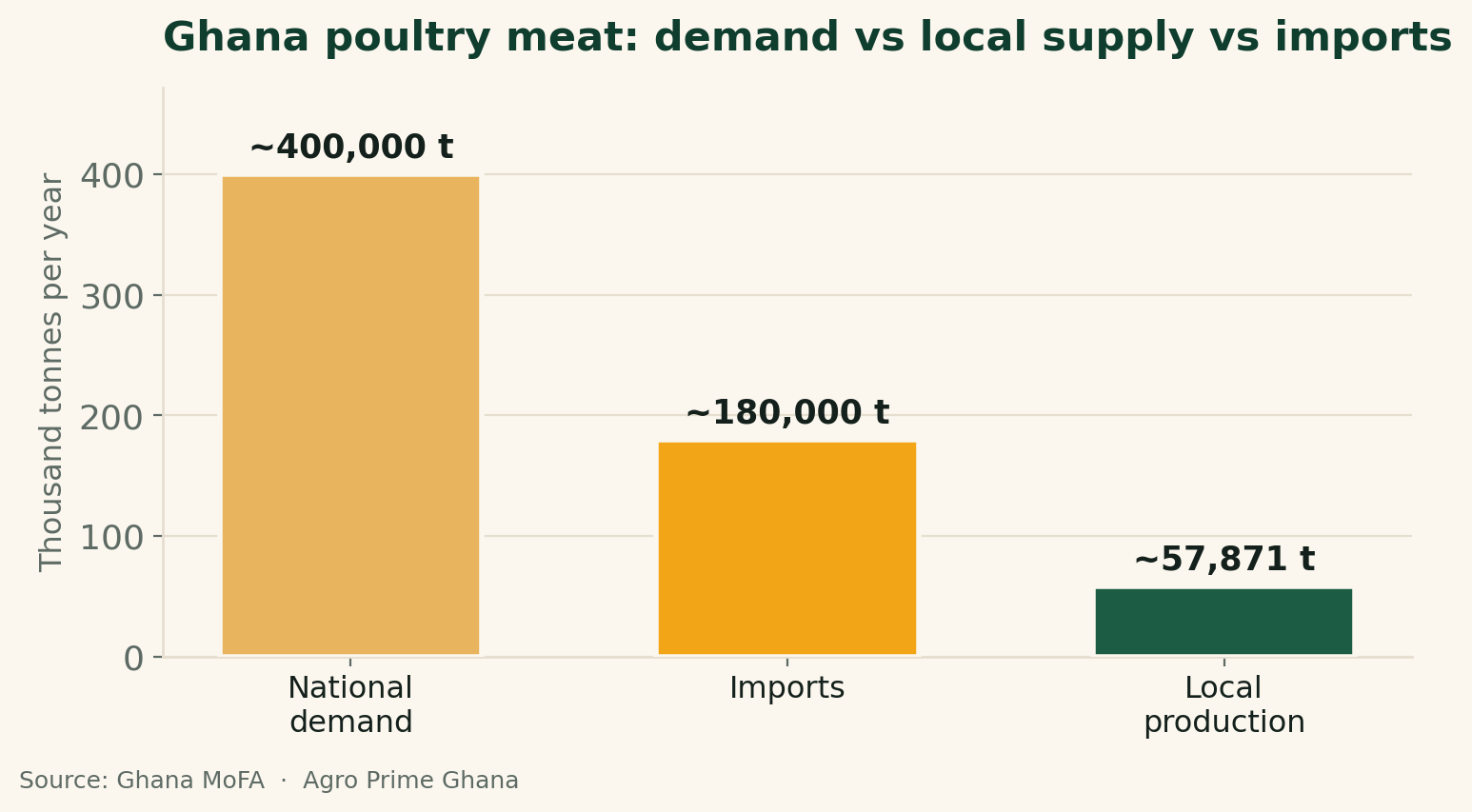
Chicken sausage is a value-added product made by grinding chicken with fat, salt and spices, stuffing it into casings and either selling it fresh (raw) or fully cooking/smoking it. Keep meat and equipment cold (below the 40–140°F danger zone) throughout processing, because grinding warms the meat and warm meat spoils. Cook poultry sausage to a safe internal 165°F (74°C). Casings can be natural, collagen (edible) or cellulose/fibrous (peeled off). If you make cured or smoked sausage, curing salt (nitrite) must be measured precisely and used only at approved rates. In Ghana, a processed food like sausage must be registered with the FDA, and your premises needs a manufacturing-facility licence with food-handler medical certificates and an EPA permit. The market is real: Ghana's poultry-meat demand (~400,000 t) far outstrips local supply (~58,000 t).
What chicken sausage making involves
Sausage making is a defined process, and the steps tell you what equipment and controls you need. You start with chicken meat and fat — often thigh meat and trimmings — which you grind to a chosen texture. You mix in salt, spices, a little water or ice, and sometimes a binder until it holds together, then stuff it into casings and link it. From there it goes one of two ways: fresh sausage stays raw, chilled or frozen, and the customer cooks it to 165°F; or it is fully cooked, smoked or cured so it is ready to eat or keeps longer. Chicken sausage is attractive because chicken is Ghana's most-consumed meat, it uses lower-value cuts profitably, and a consistent recipe builds a brand — but it is genuine food processing, so hygiene, cold control and regulation are not optional extras.
Why there is a real market for it in Ghana
Ghana eats far more chicken than it produces, and processed convenience products are a growing slice of that appetite. The Ministry of Food and Agriculture puts national poultry-meat demand at around 400,000 tonnes against local production of roughly 57,871 tonnes, with imports supplying about 180,000 tonnes (MoFA, Revamping the Poultry Sector in Ghana). Much of the packaged sausage on Ghanaian shelves is imported or made from imported meat, which leaves clear room for a locally made, well-branded, safe chicken sausage sold to supermarkets, hotels, restaurants, schools and households wanting a convenient protein. Sausage also turns trimmings into a premium product, improving the return on every bird. That combination of deep demand, import substitution and better use of the whole carcass is why chicken sausage is one of the more interesting value-addition routes in the sector, alongside those in our guide to poultry marketing in Ghana.
The equipment you actually need
You can start small and scale, but certain tools are non-negotiable. The core kit is a meat grinder (mincer) with plates in a couple of hole sizes, a sausage stuffer (a dedicated stuffer beats a grinder's stuffing tube), accurate scales (weighing salt, spices and any cure precisely is a food-safety issue, not just quality), and reliable refrigeration and freezing. A food thermometer is essential to verify cooked sausage reaches 165°F. Beyond the basics you may add a mixer, a smoker or cooking vat, vacuum-packing equipment, and stainless-steel tables that clean easily. Whatever the scale, design the workspace for hygiene: smooth cleanable surfaces, hand-washing, clear separation of raw handling and packing, and pest control. The FDA will expect this, and so should you — sausage mixes many surfaces and a lot of handling into one product, which is exactly how contamination spreads if the setup is dirty.
Casings: natural, collagen or cellulose
The casing is the skin of the sausage, and your choice affects cost, appearance, bite and whether it is eaten. The three practical options are compared below.
| Casing type | What it is | Eaten? | Best for |
|---|---|---|---|
| Natural | Cleaned animal intestine (hog, sheep) | Yes | Traditional snap and appearance; fresh and cooked sausage |
| Collagen | Edible casing made from processed collagen | Yes | Uniform size, easy to use, consistent; good for scaling up |
| Cellulose / fibrous | Plant-fibre or fibrous casing | No — peeled off | Skinless sausage, large cooked/smoked products |
Natural and collagen casings are edible; cellulose/fibrous casings are removed before or after cooking.
For a start-up in Ghana, collagen casings are often the easiest entry point — consistent, uniform in size, well-storing, and free of the sourcing and cleaning hassle of natural casings — while natural casings give the traditional snap some markets prefer. Whatever you use, buy food-grade casings from a reliable supplier, because a poor or contaminated casing undoes good meat.
Food safety through the whole process
Sausage is a high-handling product, so food safety runs from the meat you receive to the pack you sell, and the overriding rule during processing is keep it cold. Grinding and mixing generate heat, and warm meat both spoils faster and smears rather than binds — so work with well-chilled meat, add ice rather than water where the recipe allows, keep meat out of the danger zone of 40–140°F (4–60°C), and return product to refrigeration promptly (USDA FSIS, "Danger Zone"). Practise strict hygiene: clean, sanitised equipment, hand-washing, separation of raw and finished product, and clean food-grade casings. For the finish, poultry sausage must be cooked to a safe internal 165°F (74°C), verified with a thermometer — whether you cook it yourself or the customer cooks a fresh line following your on-pack instructions (USDA FSIS). Fresh raw sausage is as perishable as any raw poultry, so keep it chilled and use or freeze it quickly. Get the cold chain, the hygiene and the 165°F finish right and you control the great majority of the risk.
Field note: cold meat, sharp plates and clean hands
Three habits separate a clean, consistent sausage operation from a risky one, and none is expensive. First, keep everything cold — chill the meat, the grinder parts and even the mixing bowl; cold meat grinds cleanly, binds better and stays safe, while warm meat smears and spoils. Second, keep plates and blades sharp and clean; a dull grinder crushes and heats the meat instead of cutting it. Third, wash hands and sanitise surfaces constantly, and never let raw meat touch finished product. These are the same disciplines the FDA inspects for.
Curing and smoked sausage: handle nitrite with respect
If you move beyond fresh sausage into cured or smoked products, precision becomes a safety matter, not a preference. Cured and many smoked sausages use a curing salt containing nitrite (sold as "pink"/Prague-style curing salt), which develops the characteristic colour and flavour and, critically, helps prevent the growth of Clostridium botulinum (the organism behind botulism) in cured, smoked and low-oxygen products. Nitrite is effective in tiny amounts and harmful in excess, so it must be weighed precisely and used only at approved rates, never estimated by eye and never used as a substitute for cold storage and hygiene. Do not add curing salt "for safety" to a fresh sausage you simply intend to cook and chill — fresh sausage is kept safe by cold and by cooking to 165°F, not by cure. If you plan a cured or smoked line, learn the correct regulated inclusion rates, follow the product-label and FDA guidance exactly, and keep meticulous records.
Field note: start with fresh sausage, master it, then add lines
We always advise new makers to begin with a simple fresh (uncooked) chicken sausage before reaching for smokers and curing salts. Fresh sausage teaches the fundamentals everything else builds on — cold handling, a clean grind, a binding mix, consistent seasoning and cooking to 165°F — without the added safety stakes of nitrite and smoke. Prove your recipe and hygiene on fresh sausage, keep tight records, and only then expand into cooked, smoked or cured lines. Trying to cure and cold-smoke on day one is where small operations get into trouble.
FDA Ghana registration and premises licensing
Sausage is a processed food, so selling it legally in Ghana means going through the Food and Drugs Authority — and doing so is what lets you supply supermarkets, hotels and institutions rather than being stuck at the informal margins. Two things are involved. First, the product must be registered: the FDA requires processed and packaged foods to be registered before sale and advises on labelling, with a Progressive Licensing Scheme aimed at small and cottage industries (FDA Ghana, Food Registration). Second, the premises must be licensed as a food-manufacturing facility. Per the FDA's guidelines, that involves an application (form FDA/FM05/LOC/01), a copy of your business registration, medical/food-handler test certificates for each production-line worker (covering tuberculosis, hepatitis A, typhoid and other communicable diseases), a Site Master File for new applicants and an EPA permit; a local licence is valid for one year, and the process can take up to 30 working days once requirements are met (FDA Ghana). Plan for this from the start — design a cleanable premises, keep worker health certificates current, and keep good production records, as covered in record keeping for poultry businesses. Compliance is not a hurdle; it is the door into the formal market.
Turn more of every bird into profit — start with the right chicken
Sausage rewards a poultry business by turning trimmings and boneless meat into a premium product, but it starts with a steady supply of healthy, well-finished birds. Agro Prime Ghana supplies day-old broiler chicks and can help you plan a grow-out that gives the meat volumes a small sausage line needs. To build a chicken-sausage business on a dependable, traceable meat supply, message us on WhatsApp at +233 24 915 1503 or book a visit to the Kasoa hatchery.
Costing and the economics
The profit in chicken sausage comes from converting relatively cheap meat and trimmings into a branded, higher-value product — but cost it honestly, because processed food carries more overhead than selling dressed birds. On the cost side sit chicken meat and fat, salt, spices, any binder and cure, casings, packaging, energy for chilling, freezing and cooking, cleaning, FDA registration and licensing, worker medical certificates, and labour — sausage is hands-on. On the revenue side, packaged branded sausage sells at a clear premium over raw meat, especially where it substitutes for imported product and a consistent recipe earns repeat custom. The operators who make it work run tight batches with little waste, use the whole carcass efficiently, control the cold chain, and build a brand that supermarkets and institutions re-order. Keep accurate records of inputs, yields and sales per batch: they tell you your true cost per kilo and whether your price leaves a margin once every hidden cost is counted. Reducing feed costs on the farm side, covered in reducing poultry feed cost, feeds through to a more competitive sausage.
The bottom line on chicken sausage in Ghana
Chicken sausage is a credible, scalable value-addition business in a market that eats far more chicken than it produces and imports much of its processed meat. The making is straightforward in principle — grind, mix, stuff, cook or cure — but it is a real food-processing activity, so the disciplines are what matter: keep meat cold and out of the danger zone throughout, work hygienically, cook poultry sausage to 165°F (74°C), handle any curing nitrite with precision, and register both product and premises with the FDA. Choose casings and equipment to match your scale, cost every batch honestly, and use the whole bird to lift your return. Do that consistently and a grinder, a stuffer and a good recipe can grow into a genuine brand — one that turns Ghana's chicken deficit into your opportunity.
Frequently asked questions
What temperature must chicken sausage be cooked to?
Why must the meat be kept cold while making sausage?
Do I need FDA approval to sell chicken sausage in Ghana?
What casing is best for chicken sausage?
What equipment do I need to start making chicken sausage?
Is curing salt (nitrite) necessary for chicken sausage?
How long does fresh chicken sausage last?
Is chicken sausage a profitable business in Ghana?
Sources & further reading
- USDA Food Safety and Inspection Service — "Danger Zone" (40°F–140°F) and Grilling Food Safely (danger zone, 165°F/74°C poultry, cold handling).
- Ghana Food and Drugs Authority — Food Registration and Guidelines for Licensing of Food Manufacturing Facility (product registration, facility licensing requirements, worker health certificates, Progressive Licensing Scheme).
- Ghana Ministry of Food and Agriculture — Revamping the Poultry Sector in Ghana (poultry-meat demand, local production and import figures).
- Agro Prime Ghana guides: poultry marketing in Ghana, reducing poultry feed cost, and record keeping for poultry farms.
About Agro Prime Ghana
Agro Prime Ghana Limited runs a poultry hatchery and mixed agribusiness in Kasoa, supplying day-old chicks and supporting poultry keepers and food entrepreneurs across the country. We supply healthy day-old chicks (broilers and layers), point-of-lay pullets, quality feed and hands-on farm support, and we help people add value to their birds through processing. This article is general educational information, not a substitute for professional food-safety or regulatory advice — follow FDA Ghana and food-safety guidance for any product you make and sell. Ready to start or expand? Book a visit or message us on WhatsApp (+233 24 915 1503) to order chicks, feed or advice.


