Rats and mice are the uninvited flock you never counted and never sold. They arrive quietly, breed at a frightening pace, eat your feed at night, gnaw your wiring and infrastructure, and — most dangerously of all — carry the very diseases you are spending money to keep out. A single rat can eat its way through more than 20 kilograms of feed in a year and cause several times that in damage and contamination, and on a warm Ghanaian farm with feed, water and shelter on tap, a handful of rodents can become a thriving colony within a season. Yet rodents are one of the most controllable threats on a poultry farm, because their behaviour is predictable: they need food, water and a place to hide, and they travel only short, fixed distances. This guide explains how to control rats and mice on a Ghanaian poultry farm using the approach that actually works — take away their harborage, seal them out, and bait what remains, in that order.
Written by the Agro Prime Ghana poultry team and reviewed against current references (The Poultry Site and University of Tennessee Extension). Last updated September 2026.
Key takeaways
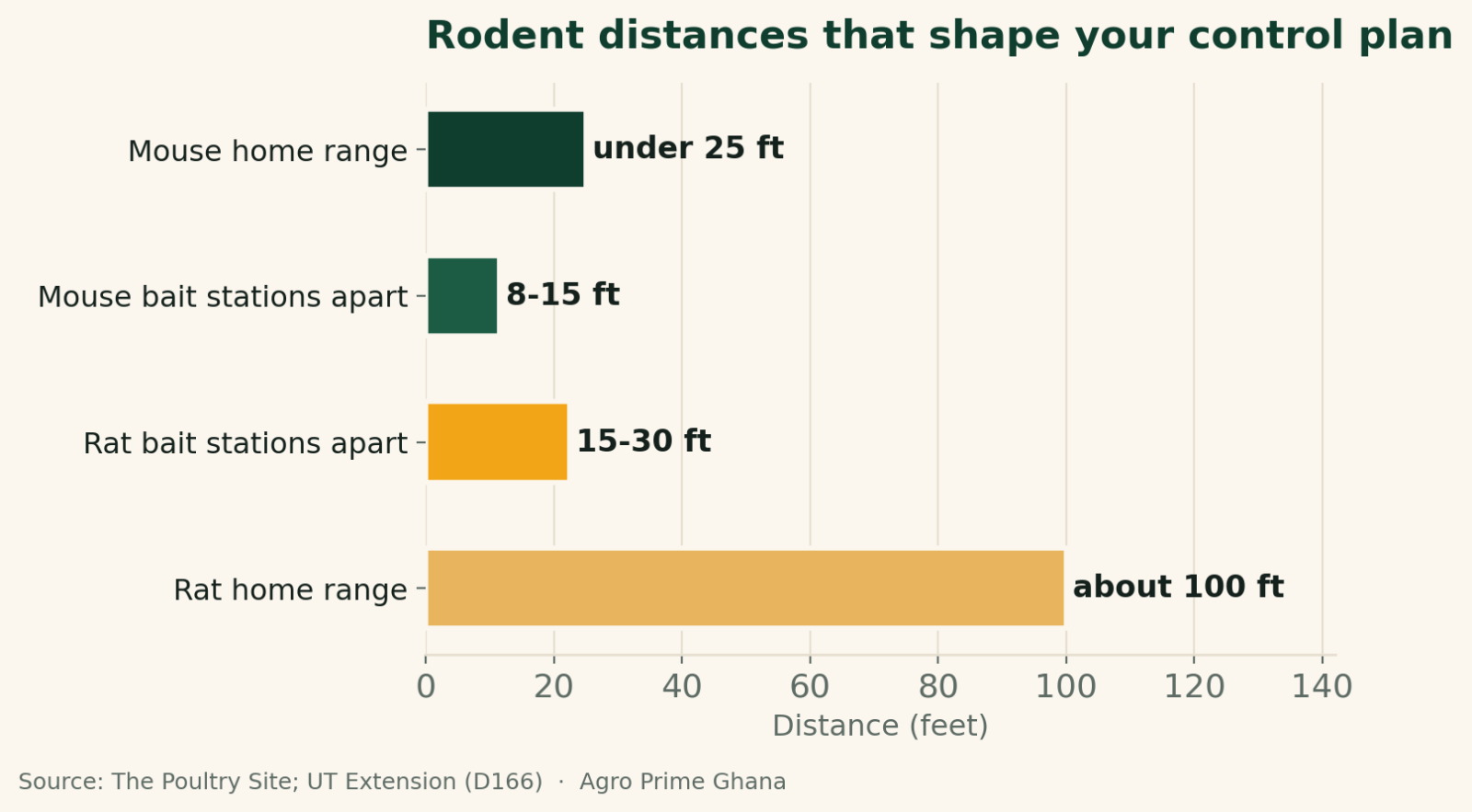
Rodents are a biosecurity threat, not just a feed thief: they carry salmonellosis, colibacillosis, fowl coryza, pasteurellosis, mycoplasmosis and more, and spread them around your farm. They breed explosively — one female rat can produce 60-70 offspring a year that reach breeding age. An adult rat eats about 1-2 ounces (roughly 30-60g) of feed a day; mice much less, but there are usually far more of them. Control is a four-step system: sanitation (remove food and harborage), rodent-proofing (seal gaps — mice get through ¼ inch, rats ½ inch), baiting, and evaluation. Because rats range only about 100 feet and mice under 25 feet, bait stations must be placed close together — roughly 15-30 feet apart for rats and 8-15 feet for mice — along the walls they run.
Why rodents are a disease problem, not just a feed problem
Most keepers think of rats and mice as thieves, and they are — but the bigger cost is disease. Rodents move between the rubbish heap, the drains, the neighbour's farm and your feed store, and they carry poultry pathogens on their feet, in their droppings and urine, and in their bodies. The Poultry Site lists the diseases rodents transmit to poultry as including salmonellosis, colibacillosis, (fowl) coryza, pasteurellosis (fowl cholera), mycoplasmosis, haemorrhagic enteritis and several parasitic infections. In other words, the same infections you vaccinate, disinfect and run all-in/all-out to keep out can be carried straight back in by a rat crossing your feed at night. A farm can do everything else right on biosecurity and still suffer recurring disease because a rodent population is quietly re-seeding it. This is why rodent control belongs at the centre of your biosecurity plan, not at the edge — see our guide to poultry biosecurity in Ghana.
How fast a rodent problem grows
Rodents are dangerous partly because of how quickly a few become many. According to The Poultry Site, rats reach sexual maturity at just 2 to 3 months of age, a female comes into heat about every 5 days, gestation is only 21 to 25 days, and young are weaned by about 3 weeks — so a single female can produce, and see mature, as many as 60 to 70 offspring in a year. That is why a "small rat problem" spotted in the dry season can be an infestation by the time the rains come. It also explains a hard truth about control: killing a few visible rodents achieves little if the food and shelter that support the colony remain, because the survivors simply breed back the losses within weeks. The only durable control is to make the farm unable to support a large population in the first place — which is why sanitation comes before baiting.
What rodents cost you
The feed bill alone is significant. The Poultry Site puts an adult rat's intake at about 1 to 2 ounces of feed a day — on the order of 30-60 grams — which works out to roughly 46 pounds (about 21 kg) of feed per rat per year. Mice eat far less individually, about 0.1 ounce a day, but usually occur in much larger numbers, so their total draw adds up. A population of a couple of hundred rats can consume several tons of feed a year straight out of your margin. And feed eaten is only the visible loss. On top of it sits the feed contaminated with droppings and urine and thrown away, the wiring, feed bags and structures gnawed and damaged, and — the largest and least visible cost — the disease rodents introduce and spread. Once you add contamination and damage, the true cost per rat runs to many times the feed it eats.
Field note: read the signs before you see the rat
By the time you are seeing rats in daylight, the population is already large — rodents are mostly nocturnal, so daytime sightings usually mean numbers have outgrown the available hiding space. We watch for the earlier, quieter signs instead: fresh droppings along walls and behind feed bags, greasy dark smear-marks where they run against surfaces, gnaw marks on bags and timber, burrow holes at the base of walls and under stored equipment, and disturbed or spilled feed in the store. Walking the feed store and the house edges with a torch after dark tells you far more than a daytime glance. Acting on the early signs — while it is still a few animals, not a colony — is the difference between a quick fix and a long campaign.
Step one: sanitation — take away food and shelter
Every rodent programme starts here, because baiting a farm that offers unlimited food and shelter is like bailing a boat without plugging the hole. The Poultry Site frames control as a four-step process — sanitation, rodent-proof construction, population reduction, and evaluation — and sanitation comes first for a reason. Deny rodents the two things that let a colony grow: food and harborage (places to hide and nest). On the food side, store feed in rodent-proof containers or a sealed store, clean up spills promptly, never leave feed in open bags on the floor, and don't let feed sit out overnight in the houses. On the harborage side, keep a clear strip around every building — extension guidance recommends at least a 3-foot (about 1 metre) clear space around the perimeter, free of weeds, rubbish, stacked equipment, timber and idle materials, so rodents have nowhere to shelter or run under cover. Tidy the whole compound: overgrown weeds, rubbish heaps, disused equipment and spilled feed are what turn a farm into rodent habitat. Sound litter and waste handling helps too — our guide to poultry litter management covers keeping the surroundings clean.
Step two: rodent-proofing — seal them out
Rodents get into buildings through astonishingly small gaps, and knowing the sizes tells you what to seal. The Poultry Site notes that a mouse can pass through an opening as small as ¼ inch (about 6mm) and a rat through about ½ inch (about 13mm) — roughly the gap under a poorly fitted door or around a pipe. Rodent-proofing means going round each building and closing these entry points: seal gaps around doors, windows, pipes, cables and eaves; fit door sweeps; screen vents and openings with metal mesh (rodents gnaw through wood, foam and plastic, so use metal or concrete for repairs at ground level); and repair broken blocks, cracked floors and damaged walls. Concrete floors and solid walls are far harder for rodents to burrow into than mud or timber. You will rarely seal a farm perfectly, but every gap you close reduces how easily rodents get to feed and shelter, and makes the baiting step far more effective by funnelling the remaining animals to predictable routes.
Step three: baiting — placed where rodents actually travel
Baiting only works if the bait is where rodents already go, and this is where their short, fixed ranging distances become your most useful tool. Rodents are creatures of habit that run along walls and edges rather than crossing open ground, and they do not travel far: The Poultry Site and extension sources put a rat's home range at about 100 feet and a mouse's at under 25 feet. Because a mouse never ventures far, bait stations must be placed close together to fall within each animal's tiny range. University of Tennessee Extension recommends spacing bait stations roughly 8 to 15 feet apart for mice and 15 to 30 feet apart for rats, positioned along the walls and runways where rodents travel — against the building, behind equipment, at burrow entrances and along fence lines — not out in the open where rodents avoid going.
Use tamper-resistant bait stations to keep rodenticide away from your birds, children, pets and non-target animals, and to keep the bait dry and attractive. Check and refill them regularly; empty or spoiled stations do nothing. One more discipline matters: rotate the type of rodenticide you use over time, because rodents can develop resistance and bait-shyness to a product used continuously. Baiting is powerful, but only as the third step, on a farm you have already made hard to live on — bait alone, on a farm still full of food and harborage, becomes an expensive supplementary feeding programme for a colony that keeps breeding back.
| Control measure | Mice | Rats |
|---|---|---|
| Gap they can pass through | as small as ¼ inch (~6mm) | about ½ inch (~13mm) |
| Home range (how far they travel) | under 25 feet | about 100 feet |
| Bait station spacing | 8-15 feet apart | 15-30 feet apart |
| Feed eaten per animal | ~0.1 oz/day (small, but many) | ~1-2 oz/day (~21 kg/year) |
| Where to place bait | Along walls and runways, at burrows, behind equipment — never open ground | |
Step four: evaluation — keep score and keep going
The fourth step is the one most farms skip, and it is why so many "solve" a rodent problem only to have it return. Rodent control is not a one-off event but an ongoing programme, because the pressure never stops — new rodents keep arriving from surroundings, and any colony breeds back fast if you ease off. Evaluation means monitoring whether your measures are actually working: keep an eye on the signs (droppings, smear marks, gnawing, sightings, bait take), note which stations are being hit and top them up, and adjust — add stations where activity is high, find and seal the entry points feeding the busiest areas, and rotate baits if take drops off. Keep simple records so you can see the trend rather than reacting to the last rat you saw. A farm that treats rodent control as a permanent routine, checked and adjusted, keeps numbers low year-round; a farm that only reacts to visible infestations rides a costly cycle of boom and bust.
Field note: the campaign is won at the perimeter and the feed store
Two places decide whether a farm has a rodent problem: the strip of ground around the houses and the feed store. Weeds, rubbish and idle equipment stacked against the walls give rodents cover to move and nest right next to the birds, so keeping a genuinely clear, swept perimeter does more than any single bait. And because feed is the magnet, a feed store that seals tight — solid door, no gaps, feed off the floor and in closed containers, spills cleaned up the same day — removes the main reason rodents come at all. We treat these two as the foundation; baiting handles what is left. Spend your effort on the perimeter and the store first, and the rest of the programme gets far easier.
Working with your surroundings and neighbours
Rodents do not respect farm boundaries, and in the mixed peri-urban settings common around Kasoa, a farm can be re-invaded from a neighbour's yard, a rubbish dump, a drain or overgrown ground next door. You cannot control your neighbours, but you can make your own farm the least attractive option on the street — well sealed, with no easy feed and no harborage — so rodents have little reason to cross onto it and little to live on if they do. Where possible, coordinate with neighbouring farms, since tackling rodents together across adjoining premises works far better than baiting alone while the colony next door keeps topping up the supply. At minimum, pay extra attention to the boundary facing the highest-risk neighbour: a clear perimeter, sealed buildings and well-placed bait stations along that edge intercept incomers before they reach your feed and your flock.
The bottom line on rodent control
Rats and mice are a bigger threat to a Ghanaian poultry farm than their size suggests: they eat and contaminate feed, damage buildings and equipment, and — most costly of all — carry salmonellosis, colibacillosis, coryza, pasteurellosis and other diseases straight into flocks you are working hard to protect. They breed fast enough that a few become a colony in a season, so the winning approach is systematic and continuous, not reactive. Start with sanitation — deny them feed and harborage, and keep a clear perimeter around every building. Rodent-proof the buildings, remembering that a mouse slips through a quarter-inch gap and a rat through a half-inch. Then bait what remains, placing tamper-resistant stations close together along the walls rodents run — roughly 8-15 feet apart for mice and 15-30 feet for rats — because they never travel far. Finally, keep watching and adjusting, because control is a permanent routine. Get this system running and rodents stop being the hidden flock draining your feed and re-seeding your diseases, and become just another farm risk you keep firmly under control.
Frequently asked questions
Why is rodent control so important on a poultry farm?
How fast do rats multiply?
How much feed do rats and mice eat?
Where should I place rodent bait stations?
What size gaps do I need to seal to keep rodents out?
Why doesn't baiting alone solve a rodent problem?
How do I know if I have a rodent problem before it gets bad?
How do I stop rodents coming from a neighbour's farm or nearby rubbish?
Sources & further reading
- The Poultry Site — Controlling Rodents on the Poultry Farm (diseases carried, breeding rate, feed consumption, home range, ¼/½-inch gaps, four-step control).
- University of Tennessee Extension — Rodent Control on Poultry Farms (D166) (bait station spacing, sanitation, rodent-proofing, baiting and monitoring).
- Agro Prime Ghana guides: poultry biosecurity, poultry litter management, and Newcastle disease in Ghana.
About Agro Prime Ghana
Agro Prime Ghana Limited runs a poultry hatchery and mixed agribusiness in Kasoa, supplying day-old chicks and working alongside poultry keepers across the country. These guides draw on that hands-on hatchery and farm experience, checked against current industry and extension references. This article is general educational information; always follow the label and safety instructions for any rodenticide, and keep baits away from birds, children and pets. Need chicks, feed advice or farm support? Book a visit or message us on WhatsApp (+233 24 915 1503).