A batch of day-old chicks arrives looking fine, but within the first week something is badly wrong. The chicks crowd under the brooder even when it is warm, stand hunched with their eyes closing, go off feed, and start dying — and when you look at the survivors, many have a chalky white paste dried around the vent, sometimes sealing it shut. Deaths climb through the second and third week and the batch never evens up. This is the classic picture of pullorum disease, an old and still-present bacterial killer of young chicks that spreads silently from hen to egg to chick. This guide explains what it is, why it hits so young and so hard, and how to keep it out of your birds under Ghanaian conditions.
Written by the Agro Prime Ghana poultry team and reviewed against current veterinary references (Merck/MSD Veterinary Manual and The Poultry Site disease guide). Last updated September 2026.
Key takeaways
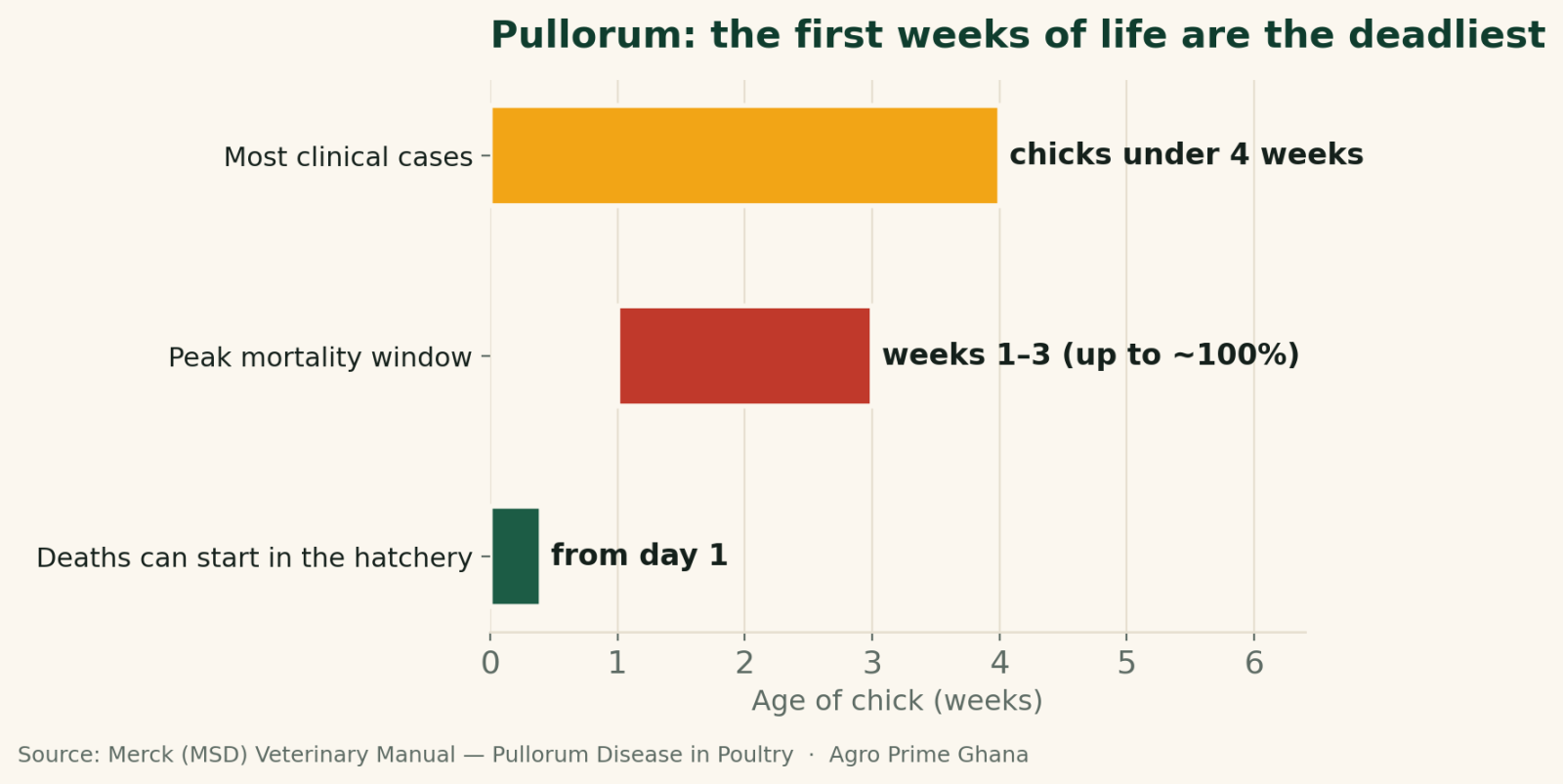
Pullorum disease — historically called bacillary white diarrhoea — is caused by Salmonella Pullorum (Salmonella enterica serotype Gallinarum biovar Pullorum), a bacterium adapted to poultry. It is chiefly a disease of young chicks under 4 weeks old, with mortality that can approach 100% and peaks in the first two to three weeks. The tell-tale sign is chicks huddling near heat with whitish pasting around the vent, going off feed and dying. It passes vertically — from infected hen, through the egg, to the chick — and also spreads horizontally in the hatchery and brooder. Survivors become lifelong carriers with the bacteria hidden in the ovary, seeding the next generation. Treatment is not recommended because it never clears the carrier state; control is built on clean, tested breeding stock, hatchery hygiene and biosecurity.
What pullorum disease actually is
Pullorum disease is a bacterial infection caused by Salmonella Pullorum. According to the Merck (MSD) Veterinary Manual, the organism is Salmonella enterica serotype Gallinarum biovar Pullorum — a gram-negative, non-motile rod that is host-adapted to poultry. That last point is important: unlike the food-poisoning salmonellas that pass through many animals, Pullorum has evolved to live in chickens and turkeys, which is exactly why it is so good at hiding inside a flock and handing itself down the generations. It is a close cousin of the bacterium that causes fowl typhoid (biovar Gallinarum); the two are so similar that they are grouped together, but pullorum is the classic disease of the very young chick, while typhoid tends to strike older birds. The old name "bacillary white diarrhoea" comes straight from what keepers saw a century ago — young chicks with a white, pasty scour — and although the disease has been eradicated from commercial flocks in many rich countries, it remains a live problem in backyard and less strictly controlled poultry across much of the world, including West Africa.
Why it is still a threat in Ghana
Pullorum has been pushed out of commercial poultry in the United States and Europe by decades of compulsory blood-testing and culling of carriers — but that machinery is exactly what is often missing at the small and medium scale here. The disease survives wherever breeding birds are not routinely tested, where hatching eggs come from unknown or mixed sources, and where local and commercial birds mingle. Salmonella organisms are readily detected in Ghanaian poultry and their environment, and the host-adapted Gallinarum/Pullorum group continues to circulate in local and backyard flocks that act as a reservoir. For a keeper buying chicks or hatching eggs, the danger is that the infection is invisible in the parent: a carrier hen looks healthy and lays normal-looking eggs, yet passes the bacterium into the chick before it hatches. The Merck manual notes that deaths can begin in the hatchery shortly after hatching, which tells you the infection was already on board. That is why pullorum is ultimately a disease you fight at the source — in the breeding flock and the hatchery — rather than one you can simply medicate your way out of in the brooder.
How to recognise it: the chick and the carrier
Pullorum wears two very different faces, and you need to know both. In young chicks, the Merck manual lists the signs as huddling near a heat source, anorexia (going off feed), weakness, and whitish faecal pasting around the vent — the "white diarrhoea" of the old name. Affected chicks look chilled and dejected even in a warm brooder, chirp in a distressed way, and die in growing numbers through the first three weeks. In adult survivors and carriers, there is usually nothing to see at all: the manual notes that survivors are "small in size and frequently become subclinically affected carriers with localized infection of the ovary." A carrier hen lays and behaves normally while quietly seeding infected eggs. This split — dramatic disease in chicks, silent carriage in adults — is the whole epidemiology of pullorum in one sentence, and it is why looking only at your visibly sick chicks will never tell you where the problem is coming from. The table below sets the two pictures side by side.
| Young chicks (clinical disease) | Adult carriers (hidden infection) | |
|---|---|---|
| Appearance | Huddling, hunched, chilled, off feed | Normal, healthy-looking, laying |
| Signs | Whitish vent pasting, weakness, chirping, deaths | Usually none; sometimes poorer hatchability |
| Age | Mainly under 4 weeks; peak deaths 1–3 weeks | Birds that survived infection as chicks |
| Where the bacteria sit | Throughout the body (septicaemia) | Localised in the ovary |
| Role in spread | Contaminate the brooder and each other | Pass infection into eggs (vertical spread) |
How pullorum spreads
Pullorum has two routes into your birds, and its genius is using both. The first and most important is vertical (transovarian) transmission: an infected hen passes the bacterium directly into the forming egg, so the chick is infected before it hatches. This is what makes carrier breeding stock so dangerous — a single infected hen can seed a whole tray of infected chicks. The second route is horizontal spread, which the Merck manual describes through direct and indirect contact via contaminated feed, water and litter, and by the respiratory or faecal routes. In practice, once a few infected chicks hatch, they contaminate the hatchery, the chick boxes and the brooder, and healthy chicks pick the infection up from the environment and from each other. Contaminated incubators, egg trays, equipment and even the fluff and dust of the hatchery all move it along. So an outbreak in your brooder is usually the visible tip of an iceberg whose base is a carrier bird somewhere up the supply chain — which is why the questions "where did these chicks come from?" and "was the breeding flock tested?" matter more than anything happening in the brooder itself.
Field note: pasted vents and early deaths mean look upstream
When we see young chicks huddling and dying in the first week or two with white paste around the vent, our first thought is not "what drug do I reach for" but "where did these birds come from." Pullorum, and its cousin fowl typhoid, are diseases carried into a brooder on the chick, not usually created in it. So alongside supportive care we ask hard questions about the source: was this a reputable hatchery, is the breeding flock health-tested, were the eggs or chicks mixed from several places? A brooder that keeps losing chicks batch after batch, always in the same early window, is telling you the problem is in your chick supply, not your brooder management — and that is a problem you solve by changing where you buy, not by medicating harder.
Diagnosis: why you cannot rely on the eye alone
The signs in chicks are suggestive, but several chick killers look alike in the brooder — pullorum, fowl typhoid, other salmonellas, colibacillosis (E. coli) and simple chilling can all produce huddling, pasting and early deaths. The Merck manual is clear that definitive diagnosis is made by isolating and identifying the organism in the laboratory, from freshly dead or sacrificed chicks. For the hidden side of the disease — the carrier adults — the classic tool is serological testing, and the whole-blood or serum plate (rapid) agglutination test is the historic workhorse used worldwide to find and cull carrier birds; it is the same principle behind the national testing schemes that cleared pullorum from commercial flocks abroad. For an ordinary Ghanaian keeper, the practical message is twofold: get a proper laboratory diagnosis when chicks are dying rather than guessing; and understand that finding carriers in a breeding flock is a job for blood-testing, not for watching the birds. If you hatch your own eggs or keep breeders, testing stock is the only reliable way to know your flock is clean.
Treatment: why the manual says "not recommended"
This is the hardest lesson of pullorum, and it is worth stating plainly: the Merck manual states that treatment is not recommended. Antibiotics such as the sulphonamides can reduce chick mortality during an active outbreak, and a keeper facing dying chicks may use them on veterinary advice to save what can be saved. But — exactly as with fowl cholera — medication does not eliminate the infection. Chicks that survive treatment become the very carriers that perpetuate the disease, now carrying it silently into adulthood and, if bred from, into the next generation of eggs. So treatment at best buys survival for a batch while guaranteeing the problem continues; at worst it masks an infected line that should have been removed. This is why, in the countries that beat pullorum, the strategy was never "treat sick chicks" but "test the breeders and cull the carriers." The same logic applies here: do not build your flock on treated survivors of a pullorum outbreak, and do not breed from birds of unknown pullorum status.
Field note: the brooder still has to be right
Because pullorum arrives on the chick, it is easy to forget that brooder conditions still decide how badly a batch suffers. Chilled chicks huddle and stress, which makes any infection worse and also mimics pullorum, so getting the brooder temperature and even heat distribution right removes one big variable and one source of confusion. On the farm we keep the first-week brooder warm, draught-free and evenly heated, with clean feed and water always within reach, and we read how the chicks spread out under the heat as our thermometer. Good brooding will not cure pullorum — nothing in the brooder will — but poor brooding turns a manageable loss into a disaster and hides the real diagnosis. See our brooder temperature chart for the target ranges.
Prevention: winning it at the source
Because pullorum is carried in and cannot be medicated out, control is entirely about keeping it out and starting clean. The measures that actually work:
- Buy chicks and hatching eggs from reputable, health-conscious sources. This is the single most powerful control you have. A hatchery that sources from tested breeding flocks is your best insurance — see our guide to choosing healthy day-old chicks.
- Test breeding stock if you hatch your own. If you keep breeders or run an incubator, blood-testing to find and cull carriers is the proven way to keep a breeding flock free of pullorum. Do not breed from birds of unknown status.
- Practise strict hatchery and brooder hygiene. Clean and disinfect incubators, egg trays, chick boxes and brooders between batches; the bacterium spreads on contaminated equipment and dust.
- Keep young stock separate and secure. Do not mix ages, keep local or unknown-status birds away from your chicks, and control rodents and wild birds, which can carry salmonellas. Our guide to poultry biosecurity lays out the routine.
- Get an early, laboratory-confirmed diagnosis when chicks are dying, so you know whether you are dealing with pullorum, typhoid, another salmonella or something else entirely — and can act correctly.
- Cull, clean and rest after a confirmed outbreak. Removing survivors, thoroughly disinfecting and resting the housing before restocking is the reliable way to stop pullorum recurring, since survivors are carriers.
The bottom line on pullorum disease
Pullorum disease is an old bacterial killer that has been beaten in commercial poultry abroad but still lurks wherever breeding stock is untested and chick sources are unknown. It kills young chicks fast — mortality can approach 100% in the first two to three weeks — with the classic picture of huddling, going off feed and white pasting around the vent. Its real cunning is invisibility in the adult: carrier hens look and lay normally while passing the bacterium through their eggs to the next generation of chicks. There is no medicating your way out, because treatment leaves carriers behind; the disease is won at the source, by starting with clean, tested stock from a reputable hatchery, running tight hatchery and brooder hygiene, and getting a proper laboratory diagnosis when chicks start to die. Get that right and pullorum becomes a disease you read about rather than one that empties your brooder.
Frequently asked questions
What are the signs of pullorum disease in chicks?
What causes pullorum disease?
How does pullorum spread from hen to chick?
Can pullorum disease be treated?
Why do adult carrier hens show no signs?
How do I know if it is pullorum and not something else?
How do I prevent pullorum in my flock?
Is pullorum disease dangerous to people?
Sources & further reading
- Merck / MSD Veterinary Manual — Pullorum Disease in Poultry (causative organism, age and mortality, vertical and horizontal transmission, carrier ovary infection, diagnosis, why treatment is not recommended).
- The Poultry Site — Salmonella Pullorum, Pullorum Disease, "Bacillary White Diarrhoea" (clinical signs, transmission, control).
- Agro Prime Ghana guides: choosing healthy day-old chicks, brooder temperature chart, and poultry biosecurity.
About Agro Prime Ghana
Agro Prime Ghana Limited runs a poultry hatchery and mixed agribusiness in Kasoa, supplying day-old chicks and working alongside poultry keepers across the country. These guides draw on that hands-on hatchery and farm experience, checked against current veterinary references. This article is general educational information, not a substitute for diagnosis by a qualified veterinary or extension officer — if your chicks are dying, get a laboratory diagnosis. Need clean, healthy chicks or farm support? Book a visit or message us on WhatsApp (+233 24 915 1503).