Poultry manure is one of the most valuable organic fertilizers a Ghanaian farmer can get, because it is rich in the three nutrients crops need most — nitrogen, phosphorus and potassium — plus organic matter that rebuilds tired soil. A tonne of broiler litter carries roughly the nutrients of a bag or two of compound fertilizer at a fraction of the cost, and on a mixed farm it is often sitting free in the poultry house. Picture the two farmers most poultry keepers know: one pays for chemical fertilizer for the maize while shovelling the chicken-house waste into a stinking heap behind the pens; the other composts that same waste, spreads it on the maize, cuts the fertilizer bill, grows a heavier crop, and sells the surplus to neighbours. The difference is not luck — it is knowing how to handle the manure. This guide explains what poultry manure is worth, how to compost and apply it safely in Ghana, the real cautions around pathogens and ammonia, and how to turn a waste problem into a second income.
Written by the Agro Prime Ghana team and reviewed against current agronomy and extension references (US university extension nutrient-management guidance). Last updated September 2026.
Key takeaways
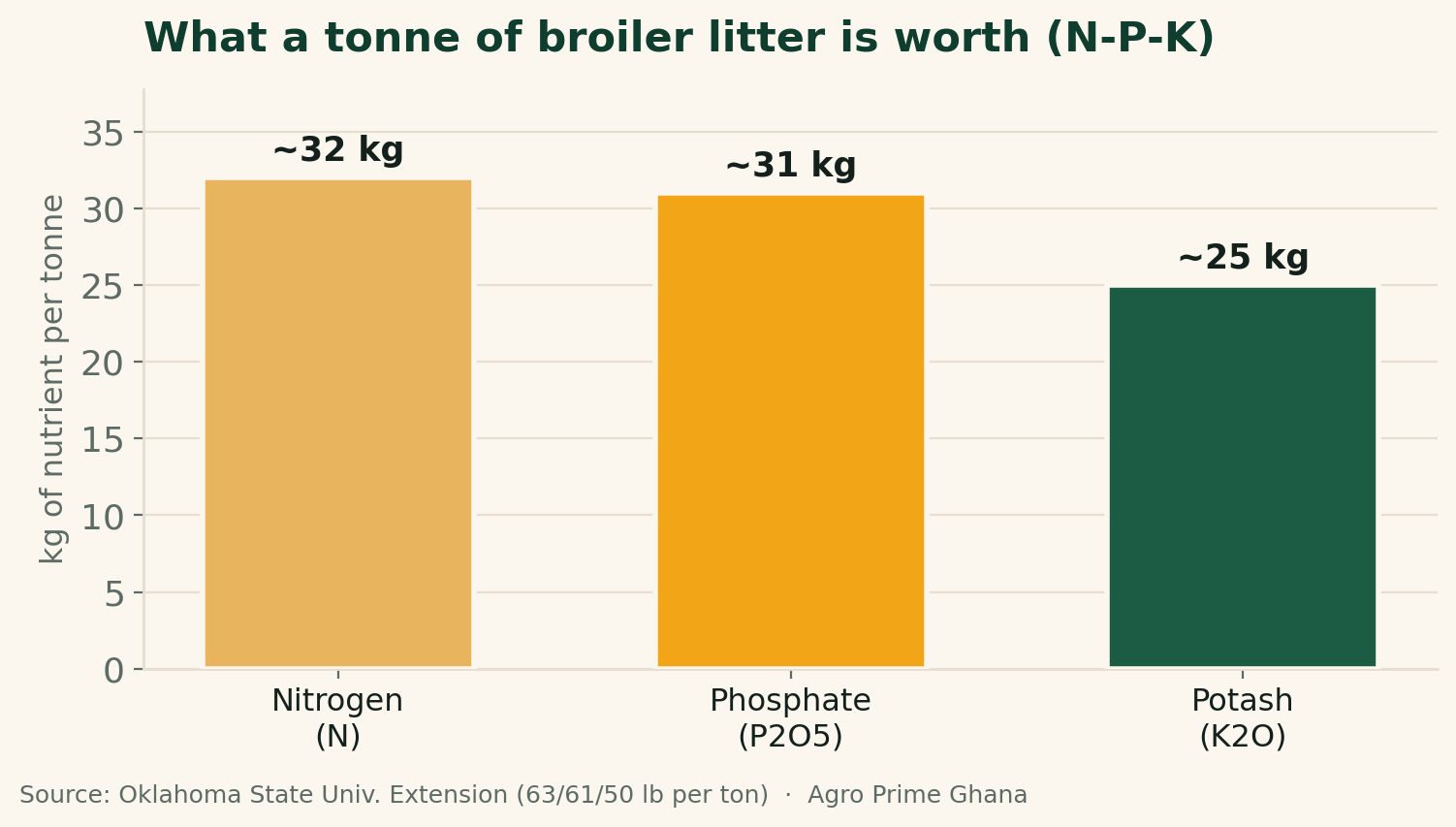
Poultry litter is a high-value organic fertilizer: broiler litter contains on the order of 63 lb of nitrogen, 61 lb of phosphate (P₂O₅) and 50 lb of potash (K₂O) per ton — roughly 30 kg each of nitrogen and phosphate and 25 kg of potash per tonne — plus soil-building organic matter. Not all of it is available at once: about 50–60% of the nitrogen is released in the first year (the rest over following years), while phosphorus and potassium are 80–100% available. Compost it first: composting cuts volume, odour and pathogens and produces a safe, easy-to-spread product; aim for a carbon-to-nitrogen ratio around 20–30 by mixing in dry bedding, crop residue or sawdust. Apply to a growing crop and work it into the soil to save nitrogen (raw manure loses nitrogen as ammonia gas). Handle it carefully — raw manure can carry Salmonella and E. coli — and it can become a real second income sold to crop farmers.
Why poultry manure is such a good fertilizer
Poultry manure stands out among organic fertilizers because it is concentrated. Chickens are fed a nutrient-dense ration, and what they do not use comes out in the droppings, so poultry litter is richer in nitrogen and phosphorus than cattle or most other livestock manures. According to Oklahoma State University Extension, typical broiler litter (droppings mixed with bedding) contains about 63 pounds of nitrogen, 61 pounds of phosphate (P₂O₅) and 50 pounds of potash (K₂O) per ton — roughly 30 kilograms each of nitrogen and phosphate and 25 kilograms of potash in every tonne. Those are the very three numbers printed on a bag of compound fertilizer (the N-P-K), which is why a few tonnes of well-managed litter can replace a large share of a small farm's chemical fertilizer bill. But the nutrients are only half the value. Unlike a bag of urea, poultry manure also delivers organic matter that improves soil structure, water-holding and the life of the soil — exactly what Ghana's many worn, sandy, low-organic-matter soils need. In short, it feeds both the crop and the soil, while chemical fertilizer mainly feeds the crop.
How much of the nutrient does the crop actually get?
An important subtlety separates the farmers who get good results from those who are disappointed: not all the nutrient in manure is available to the crop in the first season. Much of the nitrogen in poultry litter is in organic form and has to be broken down by soil microbes before plants can use it, so it releases gradually. Oklahoma State Extension figures put first-year nitrogen availability at roughly 50% for surface-applied litter and about 60% when it is worked into the soil, with a further 15% in the second year and around 6% in the third — so a single application keeps feeding the soil for two to three seasons. Phosphorus and potassium behave differently, being largely available straight away — phosphorus around 90% and potassium roughly 80–100% in the year of application. The practical lesson: plan for the available nutrient, not the total on paper, and because manure keeps releasing nitrogen for years, fields manured season after season build up fertility, so you can taper rates over time rather than repeating the same heavy dose forever.
| Nutrient | Roughly how much a crop can use | What it means for you |
|---|---|---|
| Nitrogen (N) | ~50% year 1 (surface) or ~60% (worked in); +15% year 2; +6% year 3 | Releases slowly — apply enough to cover the season, and expect benefit for 2–3 years |
| Phosphate (P₂O₅) | ~90% available in year 1 | Builds up in regularly manured fields — watch for excess over time |
| Potash (K₂O) | ~80–100% available in year 1 | Largely available at once, like chemical potash |
Why you should compost the manure first
The single best thing you can do with raw poultry manure is compost it before it goes on your crops. Fresh droppings are wet, strong-smelling, high in ammonia, can carry disease organisms and weed seeds, and are awkward to spread. Composting fixes all of that: as microbes work through the heap it heats up, which reduces pathogens and weed seeds, shrinks the volume, kills the sharp ammonia smell, and turns the material into a dark, crumbly product that is far kinder to plant roots. NC State Extension notes that composting poultry manure reduces manure volume, pathogens and odour, and that the key is getting the carbon-to-nitrogen (C:N) ratio right — around 20 to 30 — by mixing the nitrogen-rich droppings with a carbon-rich material such as straw, dry bedding, sawdust or dried crop residue. On a Ghanaian farm: pile the manure with plenty of dry bedding or crop residue mixed in, keep it moist like a wrung-out sponge, and turn the heap every week or two so it stays hot and airy. A well-run heap heats strongly, then cools and matures over several weeks into finished compost — a safer, more uniform fertilizer that is also far easier to sell. Managing the litter well in the house first, as in our poultry litter management guide, gives you better raw material.
Field note: a hot heap is a working heap
The simplest sign that your compost is doing its job is heat. When we build a manure heap correctly — droppings mixed through with enough dry bedding or crop residue, kept just moist and turned regularly — it warms up noticeably within a few days; push your hand or a stick into the middle and it should feel hot, sometimes hot enough to steam in the morning. That heat is what tames the ammonia and knocks back the disease organisms and weed seeds. A heap that stays cold, slimy and smelly is usually too wet and too short of carbon: add dry material, turn it to let air in, and it will start to work. A heap that is dusty and inert is too dry: sprinkle water as you turn it. You are aiming for warm, earthy and crumbly — not wet and sour.
How to apply poultry manure for the best results
Getting the most from manure is mostly about timing and placement. The biggest avoidable loss is nitrogen escaping into the air: NC State Extension notes that the ammonia form of nitrogen volatilizes if manure is left on the surface, so working the manure into the soil soon after spreading saves a large share of its nitrogen. Timing matters too — apply to an actively growing crop rather than months ahead, so nutrients release when the crop can catch them; extension guidance suggests applying within about a month of planting or of a crop breaking dormancy. For rates, work from the crop's nitrogen need and the availability discount: as a benchmark, roughly 2 tonnes of litter per acre supplies on the order of 130 lb of total nitrogen, and 4 tonnes about 260 lb, so a few tonnes per acre, incorporated, covers the nitrogen demand of many field crops. Two cautions: do not overdo it on the same field year after year, because phosphorus builds up and excess can run off into streams; and keep raw manure well away from the edible parts of vegetables eaten raw, allowing a generous interval before harvest — composting first largely removes this worry, one more reason to compost.
The cautions: pathogens, ammonia and food safety
Poultry manure is valuable, but it must be handled with respect, and glossing over the risks does farmers no favours. There are three to keep in mind. First, pathogens: raw poultry manure can carry disease organisms such as Salmonella and E. coli that are a risk both to people and, potentially, back to poultry — which is why composting (with its heat) and sensible hygiene matter, and why manure handling belongs inside your farm's biosecurity thinking. Never spread fresh, raw manure on leafy vegetables or salad crops close to harvest, and wash hands and produce properly. Second, ammonia: fresh manure is high in ammonia — the gas that stings the nose in a closed poultry house — which is both a nitrogen loss and, if piled against plant stems or applied too heavily, a cause of "burning" and scorched roots; composting and incorporation both tame it. Third, disease carry-back to your own flock: manure from a sick flock can harbour the organisms that made the birds ill, so do not move raw litter carelessly around a farm that keeps live birds. Handled thoughtfully — composted, applied to crops, kept away from live birds and raw-eaten produce — poultry manure is safe and hugely beneficial; handled carelessly, it can spread disease and disappoint the crop.
Field note: site the heap away from the birds and the borehole
Where you put the manure heap matters as much as what you do with it. We keep our composting heap well away from the live poultry houses and, crucially, downhill and well away from any borehole, well or stream, so run-off from a rained-on heap never drains back towards the birds' drinking water or a water source people use. A raw heap beside the poultry house is an open invitation for flies, rodents and disease to cycle straight back into the flock. Give the heap its own corner of the farm, on ground that drains away from water and housing, and you get the fertilizer benefit without the disease risk.
Turn your litter into inputs and income — talk to Agro Prime
Agro Prime Ghana runs a mixed agribusiness in Kasoa, so we live on both sides of this: we produce and use poultry manure on our own crops, and we help other farmers do the same. Whether you want advice on composting and applying your litter, are looking for well-composted organic manure and other farm inputs, or want to set up your poultry unit so the manure becomes a planned second income, we can help — alongside supplying healthy day-old chicks, point-of-lay pullets, feed and farm support. Message us on WhatsApp at +233 24 915 1503 or book a visit to talk manure, chicks or crops.
Which crops benefit most in Ghana
Almost every crop responds to good poultry manure, but the payoff is greatest on hungry crops grown on poor soil. Maize, the crop most Ghanaian mixed farmers grow, is a heavy nitrogen feeder and responds strongly to manure that supplies its nitrogen while building the soil — a natural fit on a farm that already keeps poultry. Vegetables such as tomatoes, pepper, garden eggs, okra and leafy greens are high-value and reward the steady nutrient supply composted manure gives, though these are exactly the crops where you must use composted, not raw, manure for food safety. Plantain, cassava and other staples also benefit from the organic matter and slow nutrient release. Because manure feeds the soil as well as the crop, its biggest long-term wins show up on tired, sandy, low-organic-matter fields, where a few seasons of manuring visibly lift structure, water-holding and yield.
Selling poultry manure as a second income
For a poultry farmer, manure is not just an input to save on — it can be a product to sell. Crop farmers, vegetable growers and gardeners actively seek good organic manure, and a poultry unit produces a steady, reliable supply that many will pay for, especially when it is composted, bagged and easy to handle. Composted, bagged manure commands a better price than a wet, smelly raw heap, because the buyer gets something pleasant to handle, safer to use and richer per kilo carried. Build relationships with nearby maize and vegetable farmers, and the manure that once cost you effort to dispose of becomes a second revenue line that also solves your waste problem — the joined-up thinking that makes a mixed poultry-and-crop farm more profitable than either enterprise alone. Our guides to poultry marketing and farm record keeping can help you price and track it as a real part of the business.
The bottom line on poultry manure
Poultry manure is one of the most valuable resources on a mixed Ghanaian farm, not a waste to be dumped behind the pens. A tonne carries roughly 30 kilograms each of nitrogen and phosphate and 25 kilograms of potash, plus the organic matter that rebuilds soil — real fertilizer value that can cut your chemical fertilizer bill and lift your crops. The keys are simple: compost it first so it is safe, uniform and pleasant to handle; apply it to a growing crop and work it into the soil so you keep the nitrogen instead of losing it to the air; plan for the nutrient the crop can actually use, remembering that nitrogen releases over two to three seasons; and respect the cautions around pathogens, ammonia and food safety by composting, keeping raw manure off raw-eaten produce, and siting it away from your live flock. Do that, and the humble chicken-house waste becomes two things at once — cheaper, better crops on your own farm, and a second income from the farmers next door.
Frequently asked questions
What is the N-P-K value of poultry manure?
Should I compost poultry manure before using it?
How much poultry manure should I apply per acre?
Can poultry manure burn my crops?
Is poultry manure safe to use on vegetables?
How much of the nitrogen in poultry manure does the crop actually use?
How do I stop poultry manure losing its nitrogen?
Can I make money selling poultry manure in Ghana?
Sources & further reading
- Oklahoma State University Extension — Using Poultry Litter as Fertilizer (N-P-K content per ton, nitrogen availability by year, phosphorus and potassium availability, application-rate benchmarks).
- NC State Extension — Poultry Litter as a Fertilizer Source (nitrogen availability, ammonia volatilization and incorporation, composting and carbon-to-nitrogen ratio, application timing).
- Agro Prime Ghana guides: poultry litter management, poultry biosecurity, poultry marketing, and farm record keeping.
About Agro Prime Ghana
Agro Prime Ghana Limited runs a poultry hatchery and mixed agribusiness in Kasoa, keeping poultry and growing crops side by side. We supply healthy day-old chicks (broilers and layers), point-of-lay pullets, quality feed, farm inputs and hands-on advice — including how to turn your poultry litter into better crops and extra income. This article is general educational information, not a substitute for professional agronomic advice for your specific soils and crops. Ready to start or expand? Book a visit or message us on WhatsApp (+233 24 915 1503) to order chicks, feed, inputs or advice.


