Few things sink a poultry keeper's spirit faster than arriving at the farm to find the pop-holes forced, a run of point-of-lay birds gone in the night, or a torn corner of netting and a scatter of feathers where a stray dog or a hawk got in. In Ghana, where many farms sit on open plots at the edge of a growing town, the perimeter is doing three jobs at once: it keeps thieves out, it keeps predators out, and — the job most keepers forget — it forms the outer line of your biosecurity, the barrier that stops disease walking onto the farm on other people's shoes and other animals' feet. A good fence is not an expense you tack on at the end; it is the first structure that decides whether everything you invest inside it is safe. This guide sets out how to think about fencing and security for a Ghanaian farm, layer by layer.
Written by the Agro Prime Ghana poultry team and reviewed against current references (poultry biosecurity industry manuals and a Ghana-specific study of smallholder biosecurity adoption). Last updated September 2026.
Key takeaways
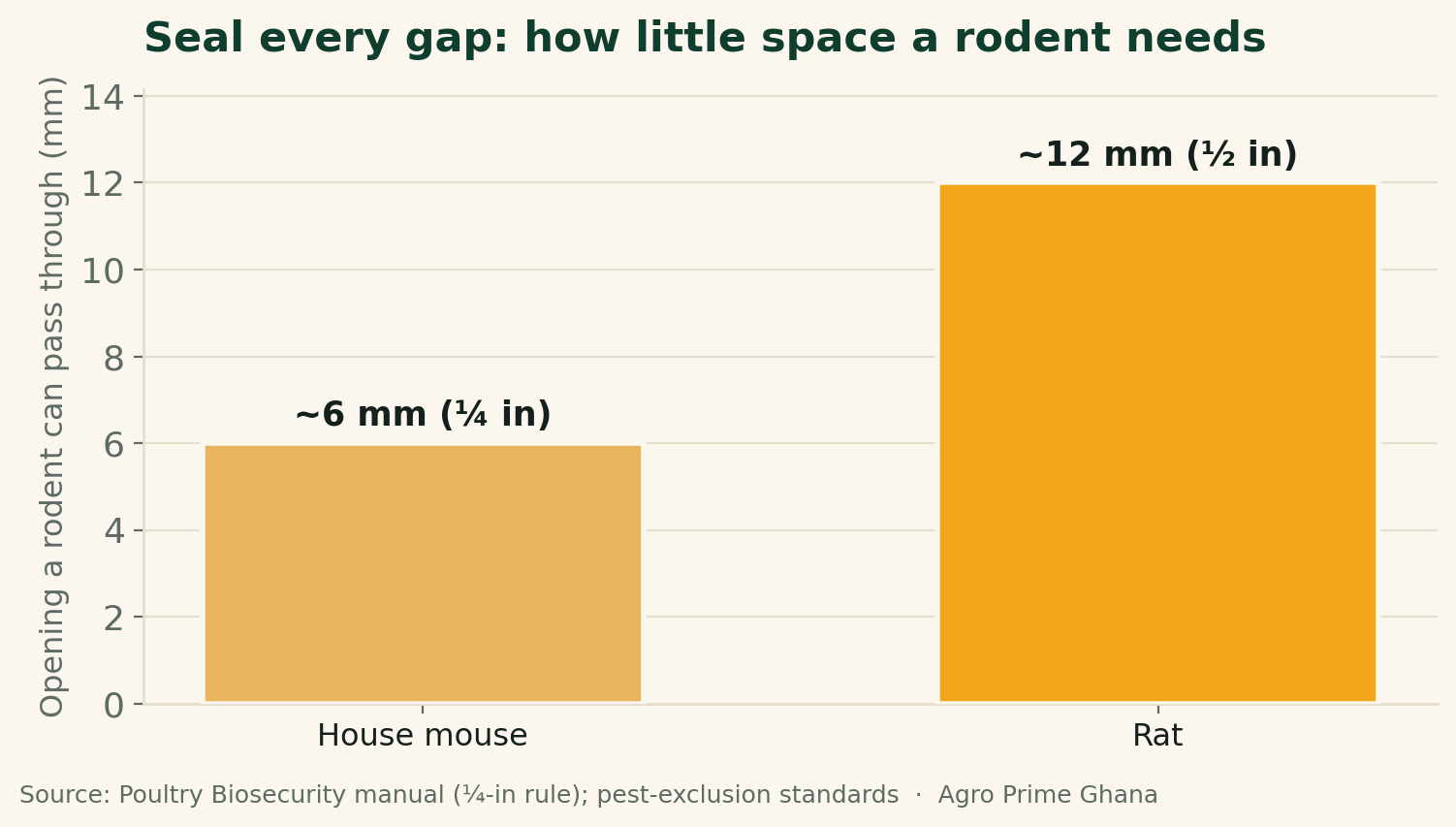
Your perimeter does three jobs: it deters theft, excludes predators (stray dogs, hawks, snakes, rats, wild birds), and forms the outer wall of your biosecurity. Think in layers — a perimeter fence with a single, controlled gate; a rodent- and predator-proofed house; and a clear line of separation at the door. Rodents matter more than most keepers think: a mouse slips through a gap of about 6 mm (¼ inch) and a rat through roughly 12 mm, so every larger opening must be sealed. Industry guidance recommends a gravel strip at least ~0.9 m (3 ft) wide around the house to stop burrowing, a single controlled entry, and clear signage. In Ghana the biggest barrier to good fencing is upfront cost — but disease, theft and predator losses cost far more than the fence would.
Three jobs one perimeter has to do
Be explicit about what you are asking a fence and gate to achieve, because the three jobs pull in different directions and a fence built for only one leaves the others open. The first is security against theft: poultry are portable, saleable and easy money, and a flock of grown birds or a store of feed is a tempting target on an unfenced plot near a road or settlement. The second is predator exclusion — stray and village dogs, hawks and kites, snakes that come for eggs and chicks, and the small, persistent raiders (rats and wild birds) that steal feed and, far more importantly, carry disease. The third, most under-valued, is biosecurity: the perimeter controls who and what crosses onto your farm, the single most important principle in keeping disease out. A good design serves all three; a chicken-wire fence that stops a dog but lets people, rats and wild birds through has solved only part of the problem.
Why the perimeter is really a disease barrier
Most keepers think of a fence as protection against thieves and dogs, and it is — but its quieter, more valuable role is disease control. Industry biosecurity guidance describes a perimeter buffer area as "the first line of defense to protect the poultry housed on a farm," with entry "restricted to a limited number of controlled access points," and a line of separation — the walls and doorways of the house itself — as the last line of defense. The logic is simple: diseases such as Newcastle, Gumboro and avian influenza are carried in on visitors' shoes and clothing, on vehicle tyres, on shared equipment, and on the bodies of rodents, wild birds and stray animals. A perimeter you cannot control is one across which all of those wander freely. Everything in our guide to poultry biosecurity depends on first having a boundary — the fence turns biosecurity from a poster on the wall into something you can enforce.
Think in layers, not a single wall
The strongest farms do not rely on one heroic fence; they use several modest layers, so anything getting past the first still meets a second and a third. Picture three rings. The outer ring is the perimeter fence and gate — the boundary of the plot, with one controlled way in. The middle ring is the house itself: walls, wire mesh, sealed gaps and a predator-proof floor line that keep out what the fence missed. The inner ring is the line of separation at the door, where people change footwear, step through a footbath and cross from the "dirty" outside to the "clean" bird side. Building in layers lets you spend where it matters most and improve over time.
| Layer | Mainly stops | Practical measures |
|---|---|---|
| Perimeter fence & gate | Thieves, dogs, roaming livestock, casual visitors | Solid fence around the plot; one lockable gate; signage; clear line of sight |
| House structure | Snakes, rats, wild birds, hawks | Wire mesh on openings, sealed gaps <6 mm, secure doors, roof and floor line |
| Line of separation | Disease on shoes, hands and clothing | Footbath, dedicated boots, hand-wash, changing point at the door |
| Rodent & pest control | Rats, mice, insects | Gravel strip ~0.9 m wide, bait stations, no bush or clutter against walls |
The outer ring: fence, gate and sightlines
The perimeter fence sets the tone for everything inside it. For theft and larger animals it needs to be a genuine obstacle — tall and solid enough that it cannot be stepped over, pushed through or easily cut, and maintained so a sagging corner or a wet-season gully washout does not quietly reopen the farm. Industry guidance notes that, optimally, a perimeter fence "with an electric wire provides a layer of security to make sure that individuals and wildlife do not bypass the site." Just as important is the discipline of a single controlled entrance: one lockable gate everyone uses, so people, vehicles and deliveries all pass one point you can watch, record and disinfect, with any other gap barricaded. Two low-cost measures multiply the fence's value: keep the ground on both sides clear of bush and clutter so there is nowhere for a thief, snake or nesting rat to hide, and position the house and gate for a clear line of sight. A fence you can see along beats a taller one hidden behind undergrowth.
Field note: the gate is only as good as the habit
The weakest part of most farm perimeters is not the fence but the way people use the gate. A strong fence with a gate propped open all day, or a second "quick" gap the workers use because it is closer to the road, protects nothing. The rule that works is boring and absolute: one entrance, kept shut and latched, used by everyone including the owner, with the footbath and boot-change right there. When entry becomes a habit rather than a decision, the perimeter starts doing its job — and that costs nothing but consistency.
The middle ring: making the house predator-proof
A fence keeps the plot secure, but the house itself is the last physical barrier between your birds and the animals that hunt them. In Ghana the common raiders are snakes, which come for eggs and chicks through surprisingly small gaps; birds of prey, which take chicks from open runs; and, night after night, rodents. Predator-proofing is mostly about closing openings. Cover every window and vent with strong wire mesh fixed firmly to the frame, not loose netting a dog can tear or a snake push aside; make doors latch with no gap at the threshold; and pay attention to the floor line and wall-to-roof junction, where snakes and rodents get in. The aim is a house that breathes — ventilation still matters, as covered in our guide to poultry house ventilation — but only through screened openings a predator cannot pass. A well-meshed house also blocks wild birds, a biosecurity win as much as a predator one.
The unglamorous enemy: rodents
If you asked which single intruder does the most damage to Ghanaian poultry farms, the answer would not be the dramatic dog or hawk — it would be the rat. Rodents eat and foul feed, gnaw wiring and structures, and above all carry disease between houses and farms. What makes them so hard to exclude is how little space they need: a house mouse can squeeze through a gap of only about 6 mm (a quarter inch) and a rat through roughly 12 mm, which is why biosecurity manuals advise plugging every hole larger than ¼ inch with steel wool or metal mesh. Three measures keep pressure down. Deny them shelter: line the building perimeter with a gravel strip at least about 0.9 m (3 ft) wide to discourage burrowing, and keep bush, spills and clutter away from walls. Deny them food: store feed in rodent-proof containers off the floor and clean up spills promptly. Control the population with secured bait stations and traps along walls and the perimeter, checked regularly. Rodent control is not a one-off job but a permanent routine — and one of the highest-value things you can do for both disease control and your feed bill.
Field note: seal the gaps you cannot see at eye level
When we walk a house looking for the ways pests get in, the openings that matter are rarely at eye level — they are at the floor line, where the roofing sheets meet the wall, and around pipes and cables. A gap the width of your finger is a highway for a mouse and an invitation to a snake. We close every one with mesh, steel wool and sealant, then check again after a few weeks, because new gaps open as timber dries and structures settle. It is slow work, but a house sealed at the small scale keeps out the intruders a tall fence never touches.
The inner ring: the line of separation
The last barrier is not made of wire at all — it is a line at the doorway and a habit attached to it. Biosecurity guidance calls this the line of separation, where the "dirty" outside world ends and the "clean" bird side begins, and recommends a single controlled crossing for each house, clearly marked. In practice that means a defined changing point at the door: dedicated boots that never leave the bird side, a working footbath with fresh disinfectant, a place to wash hands, and ideally a bench or line you physically step over. This is where the perimeter's disease-control purpose becomes real — and where discipline most often slips. The Ghana research is honest about this: farmers frequently own a footbath but do not use it consistently — one participant admitted, "I do not use the footbath though, but I have it." A line of separation only works if crossing it correctly is the only way in, every time.
The Ghana reality: cost, and why it still pays
There is no point pretending fencing is cheap. A study of smallholder poultry biosecurity in Ghana found that the biggest barriers to good practice were financial — the high upfront cost of constructing farm fencing, and the ongoing cost of consumables like disinfectant — and that farmers tend to prioritise avoiding small immediate costs even while knowing that treating an outbreak costs far more than preventing it. The answer is to be clear-eyed about the maths: a single theft of grown birds, one outbreak through an unprotected flock, or a season of steady rodent losses can each cost more than a decent perimeter. Because you can build in layers, you need not fund everything at once — start with the controlled single gate and a sound house, add rodent-proofing and the gravel strip, and strengthen the outer fence as the farm earns. Fencing is not money spent to make the farm look finished; it protects everything already inside it.
The bottom line on fencing and security
A poultry farm's perimeter does more than keep thieves and dogs out — it is the outer wall of your biosecurity, the boundary that decides whether disease can walk onto the farm on other feet. Think in layers: a solid perimeter fence with a single controlled gate; a house sealed and meshed against snakes, wild birds and the rodents that slip through a 6 mm gap; a gravel strip and pest routine that deny burrowers shelter and food; and a line of separation at the door where everyone crosses cleanly. The honest obstacle in Ghana is cost, but theft, predators and disease each cost far more than the fence, and building in layers lets you invest as the farm grows. Above all, back the structures with habits — one gate kept shut, gaps sealed, footbath used — because a perimeter is only ever as strong as the way you use it.
Frequently asked questions
Why does a poultry farm need a fence beyond stopping thieves?
How high or strong should a poultry farm fence be?
What predators threaten poultry in Ghana?
How do I keep rats and mice out of a poultry house?
What is a "line of separation" and why does it matter?
Should visitors and vehicles be allowed onto the farm?
Fencing is expensive — is it really worth it for a small farm?
Does good fencing reduce disease as well as theft?
Sources & further reading
- Poultry Biosecurity — Information Manual for Implementing Poultry Biosecurity (perimeter buffer area and line of separation, controlled access points, ¼-inch rodent gap rule, ~3 ft gravel strip, perimeter fencing, signage).
- Frontiers in Veterinary Science — Factors influencing biosecurity adoption on smallholder poultry farms in Ghana (financial barriers to fencing, inconsistent footbath use).
- Agro Prime Ghana guides: poultry biosecurity and poultry house ventilation.
About Agro Prime Ghana
Agro Prime Ghana Limited runs a poultry hatchery and mixed agribusiness in Kasoa, supplying day-old chicks and working alongside poultry keepers across the country. These guides draw on that hands-on hatchery and farm experience, checked against current technical references. This article is general educational information, not a substitute for professional advice tailored to your site and security situation. Need chicks, feed advice or farm support? Book a visit or message us on WhatsApp (+233 24 915 1503).