Plantain is a Ghanaian staple with a steady, year-round market — the backbone of fufu, the star of kelewele and fried plantain, and a crop that keeps producing for years once established. It grows well across the forest and transition zones, fits neatly alongside cocoa and other crops, and rewards a farmer with regular bunches rather than a single harvest. With good suckers, decent soil and protection from wind and disease, a plantain field becomes a long-running income. This guide covers how to grow plantain successfully in Ghana and sell it well.
Key takeaways
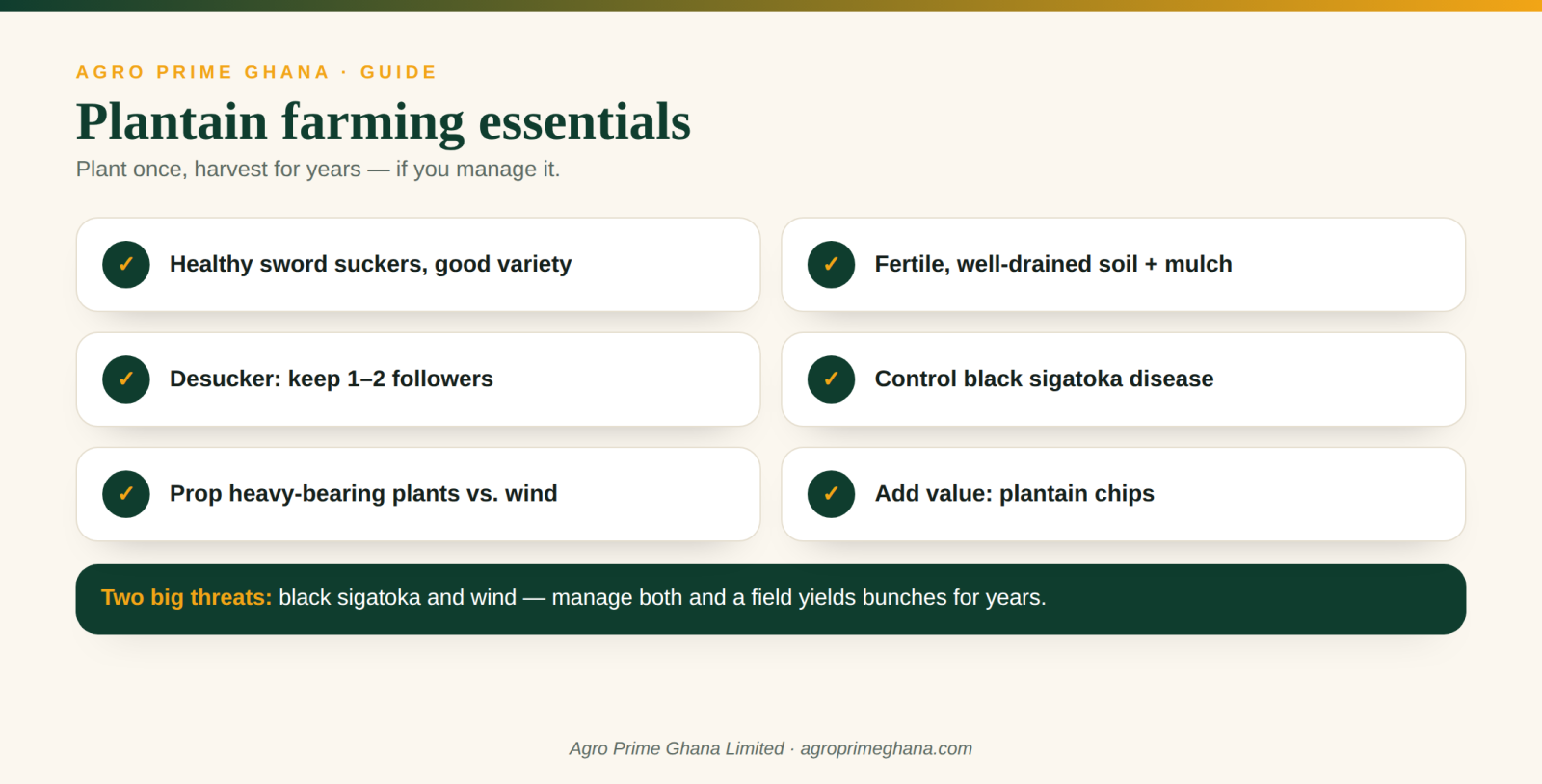
Plantain is a perennial staple with reliable demand and a multi-year productive life. Plant healthy suckers of a good variety in fertile, well-drained soil with organic matter, control weeds, and manage black sigatoka disease and wind damage — the two biggest threats. It fruits within about a year and then produces successively from follower suckers. Value addition (chips, fried plantain) lifts returns on a perishable crop.
Why plantain is a strong crop
Plantain sits at the heart of Ghanaian eating — boiled, roasted (as "kaakro" and roasted plantain), fried, and pounded into fufu — so demand is deep and constant, not seasonal or faddish. Unlike annual crops, a plantain field is a long-term asset: once established, the mother plant fruits and is replaced by follower suckers, so a well-managed field yields bunches for several years from one planting. Plantain grows well in the forest and transition zones and pairs naturally with tree crops like cocoa, where it provides early shade and income while the trees mature. For a farmer with suitable land, plantain offers a dependable, repeat-harvest income backed by a market that never goes away.
Land, soil and planting material
Plantain rewards good land. It does best in deep, fertile, well-drained soils rich in organic matter, in the higher-rainfall forest and transition zones; it dislikes waterlogging and struggles on poor, dry soils without help. Your planting material is suckers (the young shoots from the base of a mother plant) or, increasingly, clean tissue-cultured plantlets. Choose healthy suckers — sword suckers (narrow-leaved, from vigorous plants) are preferred — from disease-free fields, since suckers can carry pests and disease from the parent. Using clean, healthy planting material of a good local variety, ideally from a reputable source, sets the field up for years of productive life and keeps disease out from the start.
Planting and spacing
Prepare the land well and plant suckers at the start of the rains so they establish with moisture. Dig good planting holes, add organic matter or compost, and space plants correctly — too close and plants compete, shade excessively and yield small bunches; too wide and you waste land. Correct spacing also improves air movement, which helps against disease. In cocoa and tree-crop systems, plantain is planted at wider spacing to give early shade and income while the trees grow. Mulch around young plants to conserve moisture and suppress weeds. Getting establishment right — good holes, organic matter, correct spacing, moisture — gives strong plants that carry heavy bunches and productive followers.
Managing the field through its life
A plantain field needs steady, light management rather than heavy inputs:
- Feed the soil: plantain is a heavy feeder, so organic matter, compost, mulch and modest fertiliser keep bunches large over the years.
- Control weeds and keep the plantation clean, especially while plants are young.
- Manage suckers (desuckering): keep the mother plant plus one or two well-placed followers, removing excess suckers so the plant's energy goes into good bunches and orderly succession.
- Remove dead leaves and keep the field tidy to reduce disease pressure and pests.
- Mulch heavily, which conserves moisture, feeds the soil and suppresses weeds — plantain loves it.
The two big threats: black sigatoka and wind
Two problems cause most plantain losses in Ghana, and managing them defines success. The first is black sigatoka, a fungal leaf-spot disease that destroys leaves, weakens plants and shrinks bunches — manage it with resistant or tolerant varieties, good spacing and airflow, removing and destroying infected leaves, and field hygiene. The second is wind damage: a plantain carrying a heavy bunch is top-heavy and easily blown over, losing the whole bunch. Prop heavily-bearing plants with forked sticks or ties, plant windbreaks where wind is a problem, and keep plants well-anchored and healthy. Alongside these, watch for nematodes and weevils (helped by clean planting material) and manage soil fertility. Stay on top of sigatoka and wind, and a plantain field stays productive for years; neglect them and bunches and plants are lost.
Harvesting and the cash cycle
A plantain plant flowers and produces its first bunch roughly a year or so after planting, and because followers succeed the mother plant, a field yields bunches continuously rather than all at once — smoothing income across the year. Harvest bunches when mature but still green (for the fresh market and transport), as fully ripe plantain is perishable and bruises easily. Handle bunches carefully to avoid damage that lowers their value. Because different plants fruit at different times, you harvest and sell steadily, which is one of plantain's real advantages over single-harvest crops. Plan handling and transport to get bunches to market in good condition, since appearance strongly affects price.
The economics and markets
Plantain combines steady demand with a long productive life. Your main costs are land preparation, planting material and establishment, plus ongoing weeding, feeding and propping; after establishment the field produces for years, spreading that cost. Demand is constant from households, market traders, chop bars and restaurants, and the roadside fried-plantain and kelewele trade, plus processors. Green plantain for the fresh market is the standard sale; ripe plantain and value-added products can earn more. Keep records of costs and yields so you know your real margin per field over its life — the same discipline behind good farm record keeping. With deep, dependable demand and multi-year production, plantain offers some of the steadiest returns in Ghanaian cropping.
Value addition: chips and fried plantain
Fresh plantain is perishable and its price swings with supply, so value addition steadies and lifts returns. Plantain chips — thinly sliced, fried and packaged — are a hugely popular snack with strong, growing demand, good shelf life and a far better margin than raw bunches, and they turn surplus or lower-grade plantain into premium product. Ripe plantain feeds the kelewele and fried-plantain trade, and dried plantain flour is used in food products. Even simple, hygienic chip-making or supplying the fried-plantain trade captures more of the crop's value and cushions you against fresh-market price dips and spoilage. For a farmer, pairing plantain growing with even small-scale processing or a reliable link to processors is a smart way to earn more from every bunch.
Keeping a plantation productive for years
A plantain field's great advantage is its multi-year life, but that life has to be actively managed or it declines. After the mother plant fruits, you keep it producing through its follower suckers — selecting one or two strong, well-placed followers on each stool to carry the next bunches and removing the rest, so the stool renews itself in an orderly way rather than becoming a crowded, unproductive clump. Over several years, though, yields on old stools gradually fall and disease and pests build up, so a good grower plans renewal: gradually replanting sections of the field with fresh, clean suckers or tissue-cultured plantlets, rather than letting the whole plantation age and collapse at once. Keeping soil fertility up with mulch, organic matter and modest fertiliser slows the decline and sustains bunch size. Rotating or resting badly-declined ground before replanting helps break disease cycles. Thinking of the plantation as a living asset to be maintained and gradually renewed — not a one-off planting — is what keeps a plantain field earning steadily for many years, and it is the difference between a grower who plants once and watches yields fade and one who runs a genuinely long-term, productive enterprise.
Common mistakes to avoid
- Planting poor or infected suckers, importing pests and disease and giving weak plants. Use clean, healthy material.
- Ignoring black sigatoka, letting leaf disease shrink bunches and weaken the field.
- Not propping heavy-bearing plants, losing whole bunches to wind.
- Starving the soil, since plantain is a heavy feeder that needs organic matter and mulch for good bunches.
- Neglecting desuckering, so crowded stools give small bunches and disorderly succession.
- Rough handling at harvest, bruising perishable bunches and cutting their value.
Frequently asked questions
Is plantain farming profitable in Ghana?
How long does plantain take to fruit?
How is plantain planted?
What is black sigatoka?
Why do plantain plants fall over?
Can I grow plantain with cocoa or other crops?
What can I make from plantain?
What soil does plantain need?
The bottom line on plantain farming
Plantain is a long-game crop that pays a farmer back for years: plant it once, manage it well, and it yields bunches continuously into a market that Ghana never stops buying. Success rests on a few essentials — start with clean, healthy suckers of a good variety on fertile, well-drained soil; feed the soil generously with organic matter and mulch, since plantain is a heavy feeder; keep the field clean and desuckered; and stay on top of the two big threats, black sigatoka and wind, with tolerant varieties, hygiene and propping. Harvest and handle bunches carefully, sell steadily as plants fruit, and add value through chips and the fried-plantain trade to lift returns and beat perishability. Do that, and a plantain field becomes one of the most dependable, repeat-earning enterprises on a Ghanaian farm — especially alongside tree crops, poultry and other ventures in a diversified operation.
Add a long-earning staple to your farm
Agro Prime Ghana Limited runs a hatchery and agribusiness in Kasoa. Plantain adds steady, multi-year income to a diversified farm. Talk to us about building a resilient operation: book a visit or message WhatsApp (+233 24 915 1503).