Phase feeding is the practice of changing a flock's ration as the birds age, so that what is in the feed bag always matches what the bird can actually use at that stage of life. Instead of one "all-purpose" feed from day-old to slaughter or from point-of-lay to cull, you feed a planned sequence — starter, grower, finisher for broilers, or pre-lay, early-lay, mid-lay and late-lay for layers — each with slightly less of the nutrients the bird has grown out of needing, and more of the ones it now needs. Done well, phase feeding is one of the most powerful cost-control tools in poultry, because it stops you paying for expensive protein and calcium the bird cannot use, and cuts the waste that ends up in the litter. This guide explains how to phase-feed under Ghanaian conditions, with real nutrient ranges for each stage.
Written by the Agro Prime Ghana poultry team and reviewed against current industry references (Aviagen/Ross and Cobb broiler specifications, Teagasc layer guidance and peer-reviewed poultry nutrition literature). Last updated September 2026.
Key takeaways
Phase feeding means matching nutrient density to the bird's age and production stage. Broilers move through starter → grower → finisher, with crude protein falling from about 21–23% down to 17–19% and energy rising as the bird ages. Layers move through pre-lay → early-lay → mid-lay → late-lay, with protein, energy and phosphorus falling and calcium rising steadily to protect eggshells in older hens. Because protein and minerals are the costly parts of feed, phasing them down as needs fall lowers feed cost per bird and cuts nitrogen and phosphorus waste into the environment. Feeding a single ration throughout is simpler but less economical, produces more waste, and either shortchanges young birds or overfeeds older ones.
What is phase feeding in poultry?
Phase feeding is a system that uses several specifically formulated feeds over the bird's life to meet its changing nutritional requirements, rather than a single fixed diet. The principle rests on a basic fact of biology: a bird's nutrient needs are not constant. A day-old broiler building muscle and immune tissue needs far more protein per kilo of feed than the same bird two weeks before slaughter, when it is mostly laying down weight. A pullet coming into lay needs a different balance again — and once she is laying, her calcium demand climbs steadily as she ages and her shell-forming ability declines. Phase feeding simply follows that curve. As one peer-reviewed review of the practice puts it, phase feeding modifies "the ingredients and chemical composition of the diet" over time to align with the birds' developmental needs. The pay-off is twofold and well documented: because you stop supplying nutrients the bird no longer requires, phase feeding can significantly lower nitrogen and phosphorus excretion and reduce feed cost at the same time. You are not being generous by feeding a rich ration to an older bird — you are wasting money and loading the litter.
Why does phase feeding cut cost and waste?
Phase feeding saves money because the most expensive nutrients in a ration — protein/amino acids and minerals like calcium and phosphorus — are exactly the ones whose requirement changes most with age. Protein, supplied by soybean meal, fishmeal and other concentrates, is the priciest component of poultry feed, and a bird can only use so much of it at a given stage. Feed more protein than the bird needs and it does not store the surplus as extra meat or eggs — it strips off the nitrogen, excretes it, and the excess ends up as ammonia and nitrogen in the litter. You paid for that protein twice: once at the feed shop, and again in poorer litter and higher ammonia. The same logic applies to a layer's calcium: too little in an old hen and her shells crack; too much in a young pullet and it is simply wasted. By stepping each nutrient down (or, for layer calcium, up) as the requirement changes, phase feeding keeps supply close to need. Teagasc's layer guidance is blunt about the alternative: feeding a single diet throughout production "is less economic, results in more waste and has a higher carbon footprint per kg of eggs produced." For Ghanaian producers squeezed by feed prices, that waste is margin walking out of the gate.
Broiler phases: protein down, energy up
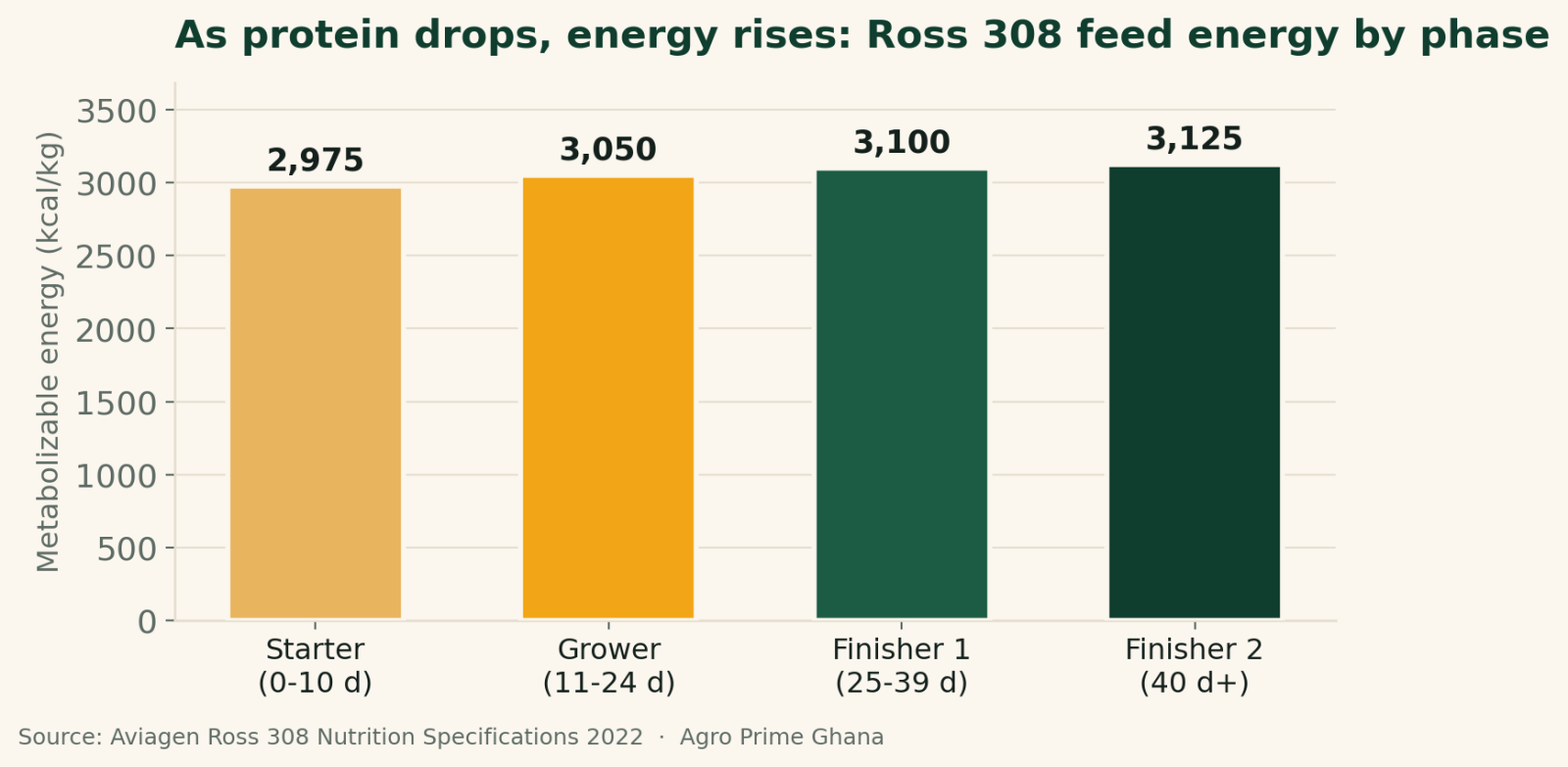
For broilers, phase feeding runs starter → grower → finisher over roughly six weeks, with protein stepping down and energy stepping up at each stage. The starter (day-old to about 10–12 days) is the richest ration — around 21–23% crude protein — to build the chick's frame and immune system in the critical first two weeks. The grower (about days 11–24) eases protein back to roughly 19.5–21.5%. The finisher (about day 25 to sale) drops to around 17–19.5% protein but carries the highest energy, because the near-market bird is mainly adding weight, which energy fuels. The table below shows the pattern from the Ross 308 and Cobb 500 specifications. For the full breakdown of the two ends of this program, see our dedicated guide to broiler starter versus finisher feed.
| Broiler phase | Approx. age | Crude protein | Energy (ME) |
|---|---|---|---|
| Starter | 0–10/12 days | ~21–23% | ~2,900–2,975 kcal/kg |
| Grower | 11–24/28 days | ~19.5–21.5% | ~2,950–3,050 kcal/kg |
| Finisher 1 | 25–39/40 days | ~17.5–19.5% | ~3,100 kcal/kg |
| Finisher 2 | 40 days–market | ~17–18% | ~3,125–3,150 kcal/kg |
Layer phases: the calcium curve is the whole story
For layers, phase feeding is driven above all by calcium, which must rise as the hen ages while protein, energy and phosphorus gradually fall. The stages, following Teagasc's guidance for the modern layer, run roughly:
- Pre-lay (before about 18 weeks, as the pullet is reared) — see our guide to grower and pullet feeding — building body reserves and preparing the bird for the huge demand of lay.
- Early lay (about 18–30 weeks) — a ration "high in energy, amino acids, essential fatty acids" with higher phosphorus and relatively lower calcium, to support the bird as she climbs to peak production and is still growing slightly.
- Mid lay (about 30–60 weeks) — as the hen matures, "her requirement for energy, protein and phosphorus declines and the requirement for calcium increases significantly." Feeding her the early-lay diet now simply overspends and wastes nutrients.
- Late lay (about 55–60 weeks onward) — calcium is pushed higher still, because "the bird's natural calcium reserve is in decline" and shell quality suffers without it.
That calcium curve is the reason a single "layer mash" fed flat across the whole laying cycle underperforms: it is either too high in calcium for the young layer (wasteful, and hard on her kidneys) or too low for the old hen (thin, cracked shells and lost sales). For more on getting shell strength right, see our guide to calcium for laying hens.
Field note: the old-hen shell problem is almost always calcium timing
When a farmer tells us their older layers — birds past a year in lay — are throwing thin, cracked or soft-shelled eggs while a younger flock on the same farm is fine, the cause is very often that both flocks are eating the same feed. The younger birds cope; the older ones cannot, because their shell glands and bone reserves are tired and they need more available calcium, ideally with a share of it as coarse particles or oyster shell fed later in the day. Phase feeding — a genuinely higher-calcium late-lay ration for the old flock — usually fixes in a fortnight what farmers had blamed on "old birds" or "bad breed."
How many phases do you actually need in Ghana?
The right number of phases is a balance between nutritional precision and practical simplicity for your scale. Large integrated operations may run four, five or even six broiler phases to shave cost to the minimum, because at tens of thousands of birds even a tiny saving per bird adds up. A small or medium Ghanaian farm does not need that complexity and often cannot source that many distinct feeds. For most local broiler producers, a clean three-phase program (starter, grower, finisher) captures the great majority of the benefit; a simple two- or three-phase layer program (a rearing/grower feed, then early-lay, then a higher-calcium late-lay) does the same for eggs. The key is not to chase the maximum number of phases — it is to actually make the changes you have planned, on time, rather than letting one bag of feed run from day-old to market because it was convenient. Even moving from a single flat ration to a basic three-phase program captures most of the cost and waste savings.
Let Agro Prime build your phase-feeding plan
Phase feeding only saves money if the plan fits your birds, your scale and the feeds you can actually get. Agro Prime Ghana supplies day-old broiler and layer chicks, point-of-lay pullets and quality phase feeds, and we help farmers set up a simple, realistic feeding calendar — which feed to buy, how much per phase for your flock size, and exactly when to switch — so you stop wasting protein and calcium without over-complicating your store. Whether you run 200 layers or a few thousand broilers, message us on WhatsApp at +233 24 915 1503 or book a visit, and we will map a phase plan to your flock and your market.
Getting the transitions right
The benefit of phase feeding is only captured if the switches are made on time and made smoothly. A few practical rules keep the transitions from costing you the very gains they are meant to deliver:
- Switch by age and body condition, not by convenience. Plan the change dates before the batch even arrives and stick to them; don't let a leftover bag decide the bird's nutrition.
- Change gradually. Blend the outgoing and incoming feed over 2–3 days to avoid a digestive check, especially when the physical form changes from crumble to pellet.
- Weigh your birds. A cheap scale and regular weighing for uniformity tells you whether a flock is on target and ready for the next phase — far better than guessing from the pen.
- For layers, watch the flock's age in lay, not just the calendar. The move to a higher-calcium late-lay ration is best timed to production stage and shell quality, not a fixed date.
- Don't over-shorten a phase to save money. Cutting the starter or grower short to reach a cheaper feed early usually loses more in growth or lay than it saves. The goal is precision, not just cheapness.
The bottom line on phase feeding
Phase feeding is the discipline of feeding the bird you have today, not the bird you had last week. For broilers that means stepping protein down and energy up through starter, grower and finisher; for layers it means easing protein, energy and phosphorus back while steadily raising calcium from early lay to late lay. The reward is real money: because protein and minerals are the costly, requirement-sensitive parts of the ration, matching supply to need trims your feed bill and cuts the nitrogen and phosphorus that would otherwise be wasted into the litter. You do not need a dozen phases — a well-run three-phase broiler program or a simple early-lay/late-lay layer split captures most of the benefit. The single most expensive mistake is the easiest one to make: feeding one ration from start to finish because it was simpler. In a business where feed is roughly two-thirds of your cost, phasing it correctly is not fine-tuning — it is where the margin is.
Frequently asked questions
What is phase feeding in poultry?
Why does phase feeding save money?
How many feeding phases do broilers and layers need?
How does a layer's feed change as she gets older?
Does phase feeding reduce pollution or waste?
When should I change from one feeding phase to the next?
Is a single all-purpose feed ever acceptable?
Does phase feeding work with home-mixed feed in Ghana?
Sources & further reading
- Teagasc — Importance of Phase Feeding in the Modern Layer — layer phases, the rising calcium requirement, and the cost/waste case for phase feeding.
- Aviagen — Ross Broiler Nutrition Specifications (2022) and Cobb-Vantress — Cobb 500 Nutrition Supplement (2022) — broiler phase protein and energy targets.
- Phase Feeding Strategies to Optimize Poultry Production (Open Access Journal of Agricultural & Poultry Husbandry) — definition of phase feeding and its effect on nitrogen and phosphorus excretion.
- Agro Prime Ghana guides: broiler starter vs finisher feed, layer feeding guide, and reducing poultry feed cost.
About Agro Prime Ghana
Agro Prime Ghana Limited runs a poultry hatchery and mixed agribusiness in Kasoa, supplying day-old chicks and supporting poultry keepers nationwide. These guides combine hands-on hatchery and farm experience with current industry and veterinary references. This article is general educational information, not a substitute for tailored advice from a qualified poultry nutritionist. We supply healthy day-old broiler and layer chicks, point-of-lay pullets, quality phase feeds and hands-on farm support across Ghana. Want a phase-feeding plan built around your flock? Book a visit or message us on WhatsApp (+233 24 915 1503) to order chicks, feed or advice.