Moringa (Moringa oleifera, the "nebedaye" or drumstick tree that grows almost everywhere in Ghana) is a genuinely useful poultry feed ingredient, but only in modest amounts: its dried leaf meal carries roughly 25–27% crude protein plus useful vitamins and pigments, yet its fibre and antinutrients mean it works best as a supplement of about 5% of the diet rather than as a main protein source. Used that way it can deepen yolk colour, add micronutrients and trim a little off your feed bill; dumped into the ration at 15–20% to "save money," it drags down growth and laying. Every dry season a farmer messages us convinced the moringa tree in the compound can replace the soya or fishmeal in the feed. It can help, but it cannot do that. This guide explains what moringa leaf meal really offers a Ghanaian flock, how much to include, how to process it, and what it does to your eggs.
Written by the Agro Prime Ghana poultry team and reviewed against current feed-science references (Feedipedia and peer-reviewed poultry-nutrition studies). Last updated September 2026.
Key takeaways
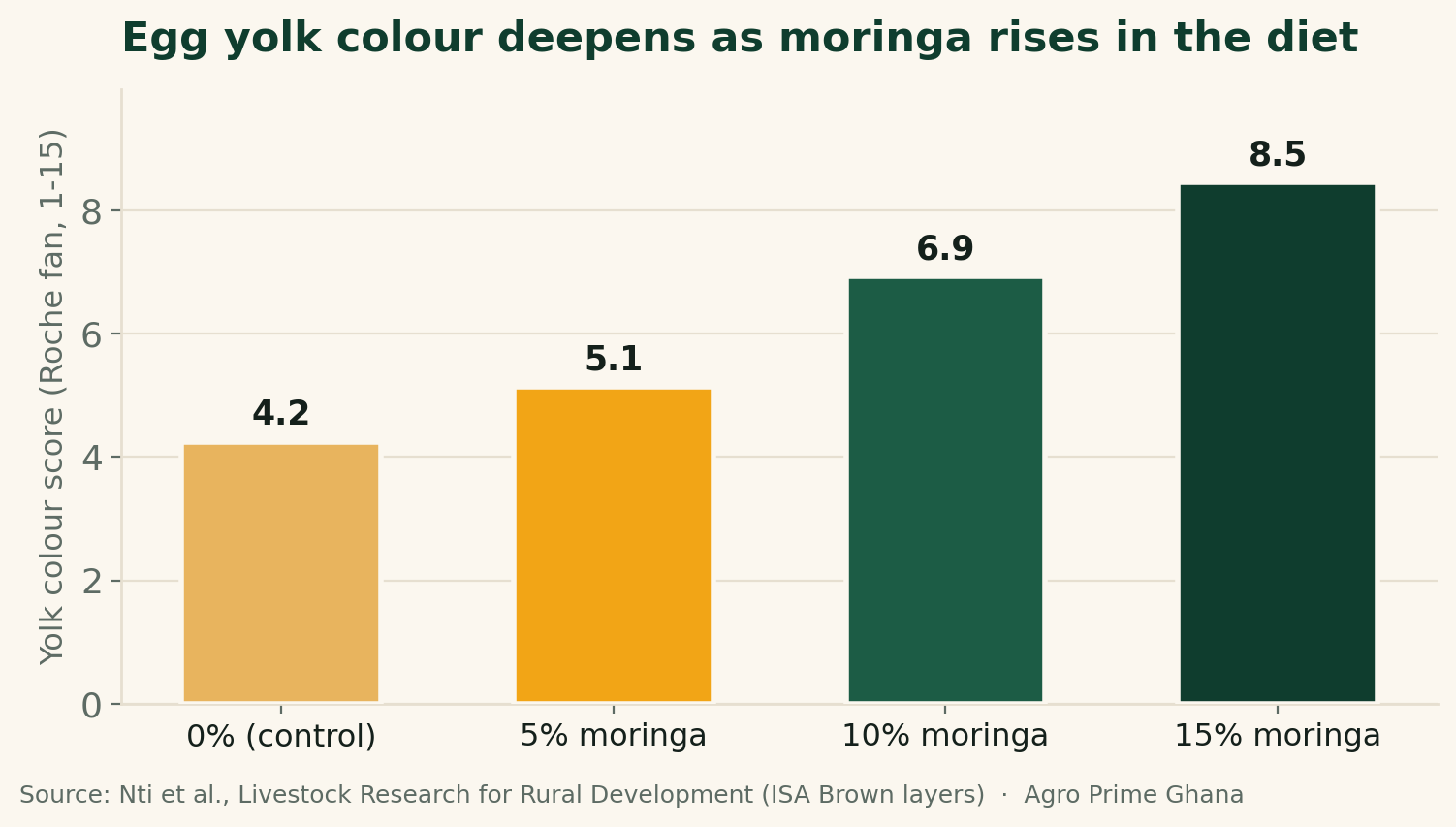
Dried moringa leaf meal contains about 26.8% crude protein (fresh leaves ~24%), along with vitamins A, C and E, minerals and the yellow-orange pigments (carotenoids) that colour egg yolks. But it is fibrous and carries antinutrients (saponins, phenolics) and an unbalanced amino-acid profile, so digestibility is lower than soybean meal. Keep inclusion modest: roughly up to 5% for layers, and for broilers no more than about a 25% replacement of soybean protein (~7% of the diet) before growth and feed conversion start to suffer. Its standout benefit is yolk colour — in one layer trial yolk score rose from about 4 to over 8 on a 15-point fan as moringa went from 0% to 15%. Dry the leaves in the shade, not full sun, to protect the vitamins and pigments, then mill into a green meal. Treat moringa as a value-adding supplement, not a replacement for real protein sources.
What moringa leaf meal actually is
Moringa leaf meal is simply the leaves of the moringa tree, dried and ground into a fine green powder that can be mixed into poultry feed. Its appeal is easy to see: moringa grows fast and hardy across every zone in Ghana, survives the dry season, and its leaves are unusually nutrient-dense. According to Feedipedia, the international feed-resource database run by INRAE, CIRAD, AFZ and FAO, fresh moringa leaves contain about 24.3% crude protein on a dry-matter basis and dried leaf meal about 26.8% — far richer than most forages — and also supply carotenoids, vitamins A, C and E, calcium, iron and other minerals. On paper it reads like a miracle feed. The catch is what the protein comes packaged with. Feedipedia is blunt: the leaf meal's relatively high fibre content lowers the digestibility of the protein (and therefore the amino acids) and limits its usable energy for poultry, and it contains saponins and phenolics that can have negative metabolic effects at higher levels. In other words, a bird cannot extract all of that 27% protein the way it can from soybean meal — some passes straight through. That single fact governs how you should use moringa.
Why moringa interests Ghanaian poultry keepers
Moringa matters here for one blunt reason: feed is the biggest cost in poultry, and imported protein is the most expensive part of the feed. Soybean meal, fishmeal and groundnut cake prices climb with the exchange rate and with seasonal shortage, and every keeper wants something home-grown to take the edge off. Moringa is attractive because it is free or cheap to grow, thrives in the hot, dry conditions where other greens fail, and keeps producing leaf through the harmattan when pasture is brown. For the backyard and semi-intensive flocks that make up most of Ghana's poultry, a tree or two in the compound is a renewable source of vitamins, minerals and pigment that costs almost nothing. The mistake is to over-promise on the protein. Because of the fibre and antinutrient limits, the research consensus is that moringa earns its place as a micronutrient-and-pigment supplement and partial protein extender — not a wholesale replacement for soya or fishmeal. Within its limits it lowers cost and adds quality; pushed past them it costs more than it saves. If you mix your own ration, moringa is one tool among several — see our guides to making poultry feed and alternative protein sources.
How much moringa can you safely include?
The honest answer is "less than you would like," and the right number depends on the bird. Research using graded levels is consistent: benefits appear at low inclusion and reverse at high inclusion. In a broiler trial in Livestock Research for Rural Development, moringa leaf meal replaced soybean protein at rising levels, and growth and feed conversion held steady up to a 25% substitution of soybean protein — about 7% moringa leaf meal in the diet — then declined sharply at 37.5% and 50%. Feedipedia's summary of the wider literature is more cautious still for fast-growing birds, noting that inclusion rates as low as 5–7.5% have reduced broiler growth in some studies and that performance consistently deteriorates at 20% and above. For layers, Feedipedia recommends using moringa cautiously at no more than about 5% of the diet, because higher rates lower laying and feed efficiency. Slow-growing local and dual-purpose birds — Kuroiler, Noiler, indigenous fowl — tolerate a little more, up to around 10% in some trials. The safe, practical rule for most Ghanaian flocks is to keep moringa leaf meal at around 5% of the ration, treat anything above that as experimental, and never let it crowd out your real protein sources.
| Bird type | Practical moringa leaf-meal inclusion | What to expect |
|---|---|---|
| Layers | Up to ~5% of the diet | Deeper yolk colour, extra vitamins/minerals; laying holds. Above 5%, feed efficiency and lay tend to fall |
| Broilers | Up to ~5–7% (≈25% of soya protein) | Growth and FCR maintained at low levels; both worsen clearly beyond ~7% |
| Local / dual-purpose (Noiler, Kuroiler, indigenous) | Up to ~10% in some studies | Slower birds tolerate more; still watch growth and appetite |
| All birds — the danger zone | 15–20% and above | Reduced growth and laying, poorer feed conversion, wasted potential |
Field note: let the birds tell you when it is too much
When we raise moringa in a ration, we watch the flock rather than trust a number on paper. The signs that you have gone too far are quiet but consistent: birds pick at the feed and leave more in the trough, growth slows or lay eases off, and droppings turn looser and greener. If you see that after nudging moringa up, drop it back. It is far safer to start low — around 5% — confirm appetite and performance hold, and only then edge upward in small steps, than to mix a big batch at 15% and discover a fortnight later that the flock has gone off its feed.
What moringa does to your eggs
The single most visible thing moringa does is deepen yolk colour — a real, marketable benefit in Ghana, where buyers link a rich orange yolk to a healthy, "natural" egg. The colour comes from carotenoid pigments (lutein and relatives) in the green leaf. In an ISA Brown layer trial published in Livestock Research for Rural Development, yolk colour on the 15-point Roche fan rose steadily from 4.24 in the control to 5.14, 6.93 and 8.45 as moringa leaf powder went from 0% to 5%, 10% and 15% of the diet — a striking, dose-dependent darkening. That trial also reported heavier eggs and thicker shells at higher inclusion. In fairness, it pushed inclusion above the conservative 5% many reviews advise, and results vary between studies and breeds — do not read one favourable trial as licence to feed 15% moringa to every flock. But the direction of travel is clear and widely repeated: modest moringa gives you a visibly richer yolk, often with a small lift in egg quality, and no additives. For a farmer selling table eggs at market or to neighbours, that deeper yolk is a genuine selling point. If richer, more consistent lay is your goal, pair moringa with the fundamentals in our guide to increasing egg production.
Field note: dry moringa in the shade, never in full sun
How you dry the leaf decides how much of its value survives. The vitamins and the yellow-orange pigments that colour the yolk are exactly the compounds that sunlight destroys — leaves spread on a black tarpaulin in the Ghanaian midday sun can lose much of their vitamin content and fade badly. Strip the leaflets from the stalks, spread them thinly in a shaded, airy place (a raised net, a screened veranda, an open shed), turn them for a day or two until they crumble crisp and stay green, then mill into a fine powder. Green, sweet-smelling meal is good; brown, hay-smelling meal has lost most of what made moringa worth the trouble. Store the milled meal dry and use it within a few weeks — like any leaf meal it slowly loses vitamin activity in storage.
Why moringa cannot replace your protein source
It is worth spelling out plainly, because this is where money is lost. Soybean meal works so well because it is highly digestible and its amino-acid profile — especially lysine and methionine — closely matches what a bird needs to build muscle and make eggs. Moringa falls short on both: its fibre lowers digestibility, so much of its protein is not absorbed, and its amino-acid balance is poorly matched to the bird's needs, so even what is digested is less useful gram-for-gram. Replace too much soya with moringa and you are feeding a lower-quality, less-digestible protein — growth stalls and hens ease off lay. This is also why moringa does not remove the need to get your amino acids right; if anything it makes it more important. If you formulate your own feed, read our guide to amino acids in poultry feed before leaning on any leaf meal. The productive way to think about moringa is as a bonus layer of vitamins, minerals and pigment sitting on top of a properly balanced ration — not as a cheaper substitute for the protein that ration is built around.
Grow your own moringa — but build the ration on proper feed and chicks
A few moringa trees in the corner of the farm are one of the cheapest quality upgrades a Ghanaian flock can have. But moringa only pays off on top of solid fundamentals: healthy, well-started birds and a balanced base ration. Agro Prime Ghana supplies strong day-old chicks (broilers and layers), point-of-lay pullets and quality feed, and we can help you work out a sensible moringa inclusion for your own mix rather than guessing. Message us on WhatsApp (+233 24 915 1503) or book a visit to talk through your feed plan, and get the birds and base feed right first.
Other benefits worth knowing about
Beyond yolk colour, moringa brings a few extras. As a green rich in vitamins A, C and E and in minerals, it is a natural micronutrient top-up — useful for backyard and free-range flocks whose diets can be patchy, and during the harmattan when green feed is scarce. Its plant compounds are also studied for mild antioxidant and gut-health effects, with several trials reporting modest improvements at low inclusion, though results are mixed and moringa is not a medicine. Keep expectations proportionate: it is a quality-and-resilience supplement, valuable because it is cheap and locally grown — layers for yolk and micronutrients, local birds as a partial protein extender, all flocks as dry-season insurance — earning its keep at 5%.
The bottom line on moringa in poultry feed
Moringa leaf meal is a genuinely useful Ghanaian feed resource that is easy to over-sell. Its ~27% crude protein, vitamins, minerals and yolk-colouring pigments are real, but its fibre, antinutrients and unbalanced amino acids cap how much a bird can use — which is why the science lands on modest inclusion: around 5% for layers, up to ~7% for broilers, a little more for local birds, and trouble above 15–20%. Use it that way and moringa gives you deeper yolks, extra micronutrients, dry-season resilience and a small saving on bought protein. Dry it in the shade, mill it fine, and keep it on top of a balanced ration built on real protein sources — never in place of them. Do that, and the humble nebedaye tree in your compound becomes one of the best-value additions to your feed store.
Frequently asked questions
How much moringa leaf meal can I add to poultry feed?
What is the protein content of moringa leaves?
Does moringa make egg yolks more orange?
Can moringa replace soybean meal or fishmeal in poultry feed?
How do I process moringa leaves for poultry feed?
Is moringa good for layers or broilers?
Are there any risks in feeding moringa to chickens?
Does moringa reduce feed cost?
Sources & further reading
- Feedipedia (INRAE, CIRAD, AFZ, FAO) — Moringa (Moringa oleifera) (crude protein content, fibre and antinutrient limitations, inclusion guidance for poultry).
- Kolam et al., Livestock Research for Rural Development — graded moringa leaf meal replacing soybean protein in broilers (performance up to ~25% substitution).
- Nti et al., Livestock Research for Rural Development — moringa leaf powder in ISA Brown layers (yolk colour, egg weight and shell effects at 0–15%).
- Agro Prime Ghana guides: how to make poultry feed, alternative protein sources, amino acids in poultry feed, and how to increase egg production.
About Agro Prime Ghana
Agro Prime Ghana Limited runs a poultry hatchery and mixed agribusiness in Kasoa, supplying day-old chicks and supporting poultry keepers across the country. These guides combine hands-on hatchery and farm experience with current feed-science references. This article is general educational information, not a substitute for professional nutritional or veterinary advice tailored to your flock. We supply healthy day-old chicks (broilers & layers), point-of-lay pullets, quality feed and hands-on farm support across Ghana. Want help building a ration that uses moringa sensibly? Book a visit or message us on WhatsApp (+233 24 915 1503) to order chicks, feed or advice.