Feed is where most livestock enterprises make or lose their money. It is usually the single biggest cost of keeping animals, and it is also the biggest determinant of how well they grow, milk or breed. Yet feeding livestock well in Ghana need not mean buying expensive compounded rations — the country is full of pastures, crop residues, agro-industrial by-products and fodder that, combined sensibly, can feed animals productively at reasonable cost. The skill lies in balancing energy, protein and roughage, using cheap local resources, and bridging the dry-season slump. This guide covers how to feed livestock — cattle, sheep, goats and pigs — economically and well in Ghana.
Key takeaways
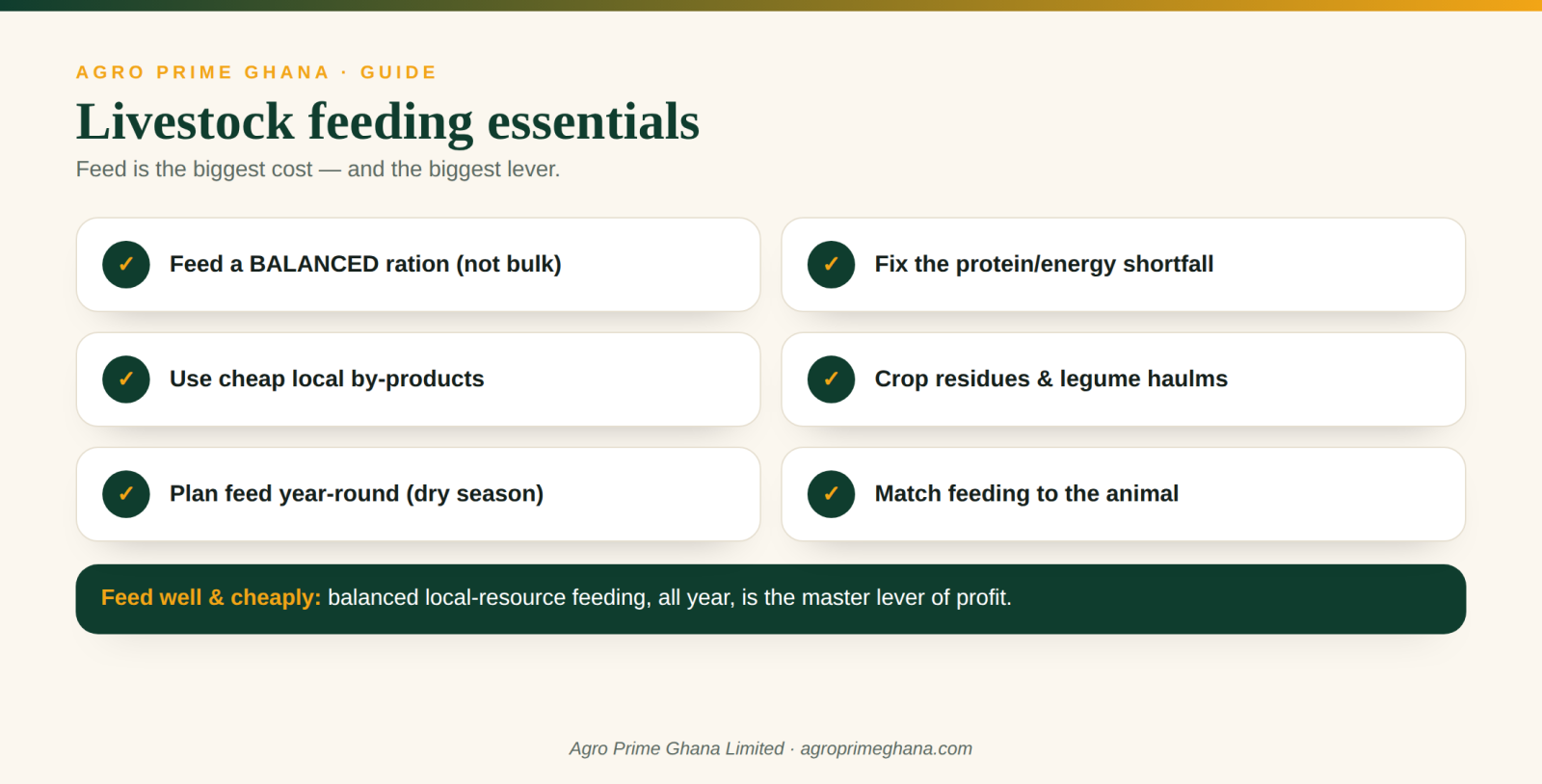
Feed is usually the biggest cost and the biggest driver of livestock performance. Feed animals a balanced ration: roughage (grass, fodder, crop residues) for the base, plus protein and energy supplements/concentrates as needed, with minerals and clean water. Use cheap local resources — crop residues, agro-industrial by-products, fodder legumes — to cut costs. Bridge the dry-season feed slump with conserved fodder and supplements. Match feeding to the animal (ruminant vs pig) and its stage. Feed well and cheaply, and animals repay it.
Why feeding is the heart of livestock farming
Feeding sits at the centre of every livestock enterprise for two reasons. First, feed is almost always the largest single cost of keeping animals, so how you feed largely determines your costs and whether the enterprise is profitable. Second, feed is the biggest driver of performance: what and how well you feed animals determines how fast they grow, how much milk they give, how well they breed and how healthy they are — a well-fed animal thrives, an underfed one grows slowly, produces poorly, breeds badly and is more prone to disease, regardless of its breed or potential. This double importance — biggest cost and biggest performance driver — means that getting feeding right is the heart of livestock farming, and getting it wrong undermines everything else. The challenge in Ghana is to feed animals well enough for good performance while keeping feed costs low enough for profit, and to do so year-round despite the seasonal feed cycle. This is achievable, because Ghana offers many feed resources — pasture and fodder, crop residues, and agro-industrial by-products — that, used wisely and balanced properly, can feed livestock productively without excessive cost. The farmer who masters economical, balanced, year-round feeding controls both the biggest cost and the biggest performance lever in the whole enterprise. Feeding is not a detail; it is the core of livestock success.
Understanding a balanced ration
Feeding animals well means giving them a balanced ration — the right mix of nutrients — rather than just filling their bellies. The main components are: roughage (bulky fibrous feed like grass, fodder and crop residues), which is the base of the diet especially for ruminants; energy (from grains, energy-rich by-products and good forage), which fuels growth, work and production; protein (from fodder legumes, protein-rich by-products and supplements), which is crucial for growth, milk and reproduction and is often the limiting nutrient in Ghanaian feeds (grass and residues alone are typically low in protein); plus minerals and vitamins and, always, clean water. A ration is "balanced" when it supplies enough energy, protein, minerals and roughage for the animal's needs. The common failing in Ghana is feeding plenty of low-quality roughage (dry grass, residues) that fills the animal but lacks enough protein and energy, so the animal survives but does not grow or produce well — which is why supplementing with protein and energy sources matters so much. Understanding that animals need balanced nutrition, not just bulk — and especially that protein is often the missing piece — lets a farmer feed for real performance. Balancing the ration, particularly by adding protein and energy to a roughage base, is the key nutritional principle in feeding livestock well.
Feeding economically with local resources
The key to profitable feeding is meeting the animals' needs using cheap, locally available resources rather than relying on expensive bought feed. Ghana offers many such resources: pasture and grown fodder (grasses and legumes, discussed in fodder production) as the base; crop residues — the leftovers of crops such as cereal straws and stovers (maize, sorghum, rice), and the valuable haulms of legumes like cowpea and groundnut (which are relatively protein-rich) — which are abundant, cheap and otherwise often wasted; and agro-industrial by-products — the by-products of processing, such as brans, oilseed cakes/meals, brewers' and other residues — which can be excellent, affordable sources of energy and especially protein. Combining these wisely — a roughage base of fodder and crop residues, supplemented with protein- and energy-rich by-products and legume forage — can feed livestock productively at far lower cost than purchased compound feed. The skill is in using what is locally and seasonally available and cheap, and combining it to make a reasonably balanced ration. This is where a farmer's knowledge really pays: sourcing crop residues after harvest, obtaining agro-industrial by-products, growing fodder and legumes, and putting them together sensibly turns Ghana's abundant low-cost feed resources into productive, affordable animal nutrition. Feeding economically is not about feeding less — it is about feeding well using cheap local resources rather than costly bought feed.
Bridging the dry-season feed slump
The greatest feeding challenge in Ghana is the dry-season slump, when grazing and fresh forage become scarce and poor, feed prices rise, and animals lose condition and productivity. Planning for this is central to good livestock feeding. The strategies tie directly to the resources above: conserve fodder from the plentiful wet season as hay or silage to feed in the dry months (the single most powerful step); store crop residues after harvest to feed through the lean season; stock up on affordable by-products for dry-season supplementation; and provide supplementary feeding (energy and especially protein) to maintain animals when natural feed is poor, along with minerals and water. The goal is to ensure animals are fed adequately year-round, so they keep growing and producing instead of losing in the dry season everything they gained in the rains. A farmer who plans feed for the whole year — conserving and storing feed when it is abundant and cheap, and feeding it out when it is scarce and dear — avoids the wasteful annual cycle of gain and loss and keeps animals productive and profitable in every season. Bridging the dry-season slump through conserved and stored feed and sensible supplementation is one of the most important feeding disciplines, and it is what separates steadily productive herds from those that shrink each dry season.
Matching feeding to the animal
Good feeding also means matching the diet to the type of animal and its stage of life, because different livestock and different stages have different needs. Ruminants (cattle, sheep, goats) have specialised stomachs that let them digest large amounts of roughage — grass, fodder and fibrous crop residues — so roughage is the base of their diet, supplemented with protein and energy as needed for higher performance; feeding ruminants is largely about good forage plus targeted supplementation. Pigs (and poultry) are non-ruminants that cannot live on roughage the way ruminants can; they need more concentrated feed — energy and protein sources (grains, by-products, protein meals) — in a more complete ration, so feeding pigs relies more on concentrates and less on bulky roughage. Beyond species, the animal's stage matters: young growing animals, pregnant and lactating females (a milking cow or a sow with piglets), and animals being fattened all have higher or particular nutritional needs and should be fed accordingly, while maintenance animals need less. Feeding every animal the same, or feeding a high-demand animal (like a lactating cow) as if it were on maintenance, wastes potential or feed. Matching the ration to the animal — roughage-based for ruminants, concentrate-based for pigs, and adjusted for growth, pregnancy, lactation or fattening — ensures feed is used efficiently for the performance you want. Feeding to the animal's real needs is part of feeding both well and economically.
The economics of livestock feeding
Because feed is the biggest cost and the biggest performance driver, feeding decisions dominate livestock economics. The goal is the best possible performance per unit of feed cost: enough good nutrition for animals to grow, milk or breed well, achieved as cheaply as possible using local resources. The keys are the disciplines above: feed a balanced ration (not just bulk), correcting the common protein/energy shortfall so animals actually perform; use cheap local resources (fodder, crop residues, agro-industrial by-products) to keep costs down; plan feed year-round, conserving and storing for the dry season to avoid the costly slump and the loss of condition; and match feeding to the animal and its stage so feed is used efficiently. Getting these right means animals convert feed into meat, milk and offspring efficiently and profitably; getting them wrong — underfeeding, unbalanced diets, no dry-season plan, or relying on expensive bought feed — either starves performance or inflates costs, undermining profit. Because feed so dominates the economics, improving feeding is often the highest-return change a livestock farmer can make. A farmer who feeds animals well and cheaply, year-round and appropriately, controls the master lever of livestock profitability. Feed well, feed cheaply using local resources, feed year-round, and feed to the animal — and the whole enterprise becomes more productive and more profitable.
Common mistakes to avoid
- Feeding bulk without balance, filling animals with low-protein roughage so they survive but don't grow or produce — correct the protein/energy shortfall.
- No dry-season feed plan, letting animals lose in the dry season what they gained in the rains.
- Relying on expensive bought feed, instead of cheap local residues and by-products.
- Wasting crop residues and by-products, that could be valuable, cheap feed.
- Feeding all animals the same, ignoring the higher needs of growing, pregnant, lactating or fattening stock.
- Forgetting minerals and clean water, which are part of proper nutrition.
Frequently asked questions
Why is feed so important in livestock farming?
What is a balanced ration?
How can I feed livestock cheaply?
How do I feed animals through the dry season?
Do cattle, goats and pigs need different feeding?
Why is protein often the missing nutrient?
Should I feed growing and lactating animals differently?
Is improving feeding worth the effort?
The bottom line on feeding livestock
Feeding is the heart of livestock farming, because feed is at once the biggest cost of keeping animals and the biggest driver of how well they perform. Feed animals well and cheaply, and the whole enterprise becomes productive and profitable; feed them poorly or expensively, and no breed or intention makes up for it. Doing it right in Ghana rests on four linked disciplines. Feed a balanced ration, not just bulk — correcting the common shortage of protein and energy in roughage-heavy diets so animals actually grow and produce. Feed economically, using Ghana's abundant cheap resources — fodder, crop residues, and agro-industrial by-products — instead of costly bought feed. Feed year-round, conserving and storing feed to bridge the dry-season slump so animals don't lose in the dry months what they gained in the rains. And feed to the animal — roughage-based for ruminants, concentrate-based for pigs, and adjusted for growth, pregnancy, lactation and fattening. Master these, and you control the master lever of livestock profitability, turning Ghana's plentiful, low-cost feed resources into well-fed, productive, profitable animals in every season.
Feed well, feed cheaply, feed all year
Agro Prime Ghana Limited runs a hatchery and agribusiness in Kasoa. Good, economical feeding is the master lever of livestock profitability. Talk to us about building a resilient, well-fed farm: book a visit or message WhatsApp (+233 24 915 1503).


