In livestock farming, the difference between profit and loss is often the difference between healthy animals and sick ones. A single disease outbreak can wipe out a flock or herd in days, and even low-level, unseen ill-health — worms, ticks, chronic infection — quietly drains growth, production and profit all year round. The good news is that most livestock health problems in Ghana are preventable, and prevention is far cheaper and more effective than cure. This guide covers how to keep livestock healthy in Ghana — the prevention-first approach built on vaccination, parasite control, good husbandry and biosecurity — that protects animals, and the farmer's investment, across cattle, sheep, goats, pigs and other stock.
Key takeaways
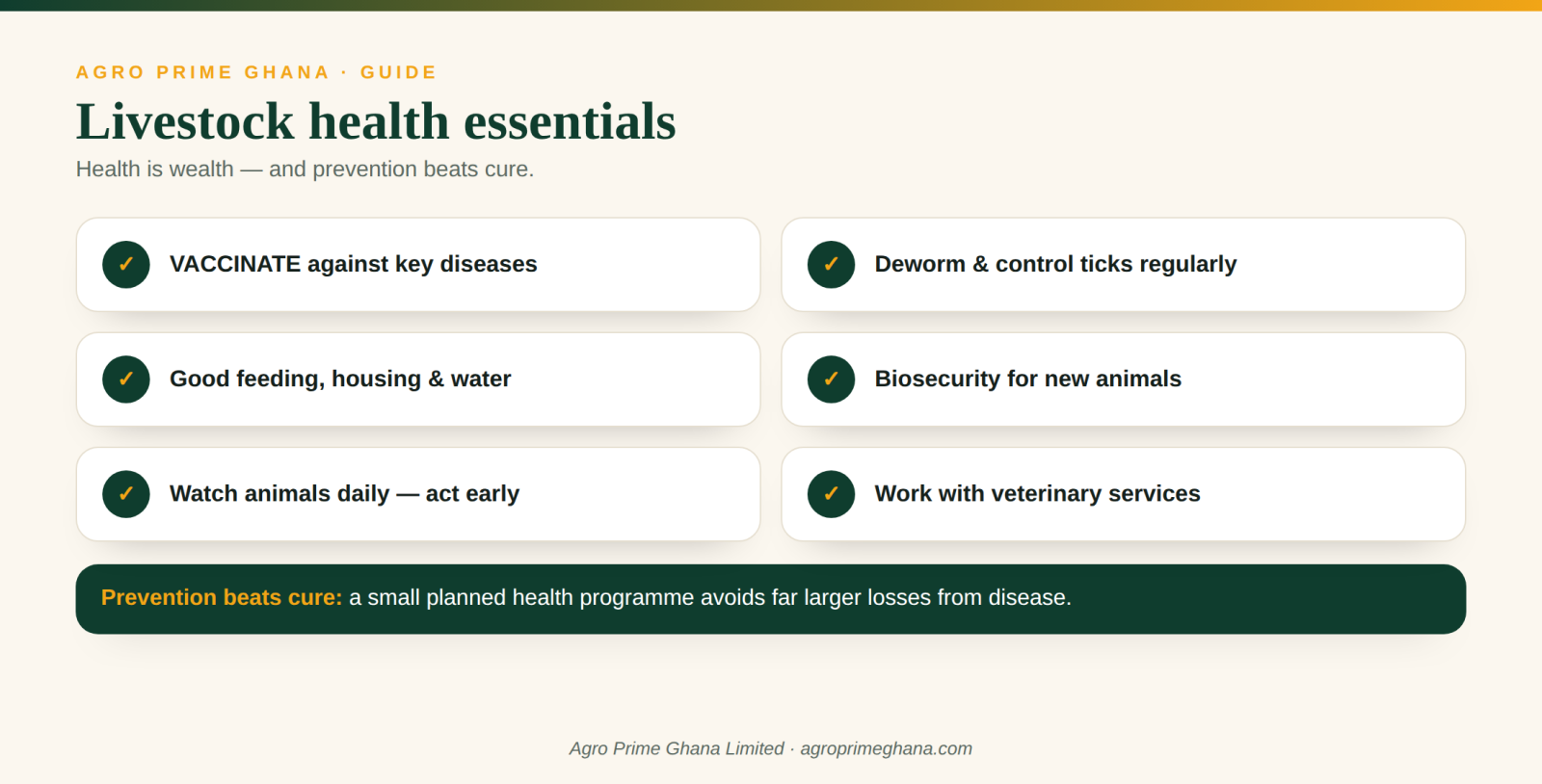
Animal health makes or breaks livestock profitability, and prevention beats cure. Build a health programme on: vaccination against the important preventable diseases; parasite control (regular deworming and tick control); good husbandry (proper feeding, clean housing, clean water — well-kept animals resist disease); and biosecurity (care when bringing in new animals, and controlling disease spread). Watch animals daily for early signs, isolate sick ones, and work with veterinary services for advice, vaccines and treatment. Healthy animals grow, produce and profit.
Why animal health is central to profit
Animal health is not a side issue in livestock farming — it is central to whether the enterprise makes money. Disease affects the bottom line in two ways. First, catastrophic losses: a serious disease outbreak can kill many animals quickly, wiping out a flock, herd or the farmer's entire investment in a short time — a devastating, sometimes business-ending event. Second, and less visible but often larger in total, chronic drains: even without dramatic deaths, ongoing ill-health — internal parasites (worms), external parasites (ticks, mange), and low-level infections — quietly reduces growth, milk, reproduction and feed efficiency and increases costs, so animals grow slowly, produce poorly and eat more feed for less result, eroding profit all year. Sick or unhealthy animals are simply unproductive and costly animals. Conversely, healthy animals grow well, produce well, breed well and use feed efficiently, turning good feeding and management into real returns. Because health so directly determines both survival and productivity, protecting it is one of the highest priorities in livestock farming. And the key insight is that most of this is preventable: the diseases and parasites that cause these losses can largely be avoided through a planned health programme, at far less cost than the losses they cause. Investing in animal health — mostly prevention — is therefore one of the most important and profitable things a livestock farmer can do.
Prevention beats cure
The single most important principle in livestock health is that prevention beats cure. It is far cheaper, easier and more effective to keep animals from getting sick than to treat them once they are — and for many diseases, by the time animals are visibly ill, treatment is difficult, costly, or too late, and losses have already occurred. Prevention protects animals before disease strikes, avoids the losses and treatment costs, and keeps the whole herd or flock productive. This principle shapes the entire approach to animal health: rather than waiting for disease and then reacting, the farmer builds a planned, proactive health programme — vaccination, parasite control, good husbandry and biosecurity (all covered below) — that keeps disease out and animals healthy. Reactive, treatment-only livestock keeping, where the farmer only acts once animals are sick, is a recipe for recurring losses; proactive, prevention-based management keeps animals healthy and productive and is far more economical. This does not mean treatment has no place — sick animals need prompt, appropriate treatment, ideally with veterinary guidance — but treatment is the backup, not the strategy. The strategy is prevention. A farmer who internalises "prevention beats cure" and builds a prevention-first health programme protects both the animals and the profitability of the enterprise, avoiding the far greater costs of disease. This mindset — proactive prevention rather than reactive treatment — is the foundation of good livestock health management.
Vaccination against key diseases
A cornerstone of prevention is vaccination against the important preventable diseases. Many of the most serious and deadly livestock diseases — the kinds that cause devastating outbreaks and mass deaths — can be prevented by vaccination, making a vaccination programme one of the most valuable protections a farmer can put in place. Different livestock face different key diseases (cattle, sheep, goats, pigs and poultry each have their own important vaccine-preventable diseases), and the appropriate vaccines and schedules depend on the species, the local disease situation and official recommendations. The practical approach is to work with veterinary services and follow their guidance on which vaccines your animals need and when, and to vaccinate on schedule rather than waiting for disease. Vaccinating animals against the key diseases in your area, on the correct schedule, dramatically reduces the risk of the catastrophic outbreaks that can wipe out a herd or flock — a small, planned cost that prevents potentially enormous losses. Skipping vaccination to save a little leaves animals exposed to exactly the diseases most likely to cause disaster. A reliable vaccination programme, guided by veterinary advice and suited to your species and area, is a fundamental, high-value part of any livestock health plan, and one of the clearest expressions of prevention beating cure.
Parasite control: worms and ticks
Alongside the dramatic diseases, parasites are a constant, often-underestimated drain on livestock, and controlling them is essential. There are two main fronts. Internal parasites (worms) live in the animal's gut and organs, quietly robbing it of nutrition and causing poor growth, weight loss, weakness, poor production and, in heavy burdens, death — worm infestation is one of the biggest hidden causes of poor livestock performance, especially in young animals and under wet conditions. Controlling worms means regular deworming (giving appropriate deworming treatments on a suitable schedule) along with management to reduce worm burdens. External parasites — above all ticks, plus mites (mange), lice and flies — damage animals directly and, critically, spread serious diseases (ticks transmit dangerous tick-borne blood diseases, a major cattle problem). Controlling them means regular tick and external-parasite control (dipping, spraying or applying appropriate treatments) and keeping animals and housing clean. Parasite control is a routine, ongoing part of livestock health — not a one-off — and because parasites so quietly and continuously drain growth and production (and ticks spread deadly disease), keeping on top of deworming and tick control delivers a large return in healthier, better-performing animals. Regular, planned parasite control is one of the most cost-effective animal-health practices a Ghanaian livestock farmer can maintain.
Husbandry, biosecurity and watchfulness
Vaccination and parasite control work best on a foundation of good husbandry, biosecurity and watchfulness. Good husbandry underpins health: well-fed animals (proper nutrition, covered in feeding and fodder) resist disease far better than underfed ones, so good feeding is itself disease prevention; clean, dry, adequate housing and clean surroundings reduce disease and parasite pressure; and clean water and general good management keep animals in the healthy condition that fights off illness. Biosecurity — keeping disease out and limiting its spread — matters greatly: be careful when bringing in new animals (a common way diseases enter a farm), ideally isolating and observing them before mixing with the herd; limit contact with outside animals and sources of infection; and, if disease strikes, isolate sick animals promptly to stop it spreading. And watchfulness ties it together: observe animals daily for early signs of ill-health (off feed, dull, isolated, abnormal droppings, lameness, coughing, swelling), because catching problems early allows prompt action — isolation and treatment — before disease spreads or an animal is lost. Throughout, working with veterinary services for advice, vaccination, diagnosis and treatment is invaluable, especially for serious or unfamiliar problems. Good husbandry to keep animals strong, biosecurity to keep disease out and contained, and daily watchfulness to catch problems early — together with vaccination and parasite control — form a complete, prevention-first health programme that keeps livestock healthy and productive.
The economics of animal health
The economics of animal health are compelling and firmly favour prevention. On one side are the costs of disease: catastrophic losses from outbreaks (dead animals, wiped-out investment), the chronic drain of parasites and low-level illness (slow growth, poor production, wasted feed), and the cost and difficulty of treating sick animals — often large, sometimes ruinous. On the other side are the costs of prevention: vaccination, deworming and tick control, good feeding and housing, biosecurity and veterinary support — modest, planned, and small compared with the losses they avert. This asymmetry is the whole economic case: a small, planned investment in prevention avoids far larger losses from disease, so a good health programme is not a cost to be minimised but an investment with a high return. Because healthy animals also grow, milk, breed and convert feed far better than unhealthy ones, animal health directly boosts productivity and returns on top of avoiding losses. The keys to the economics are therefore to invest in the prevention-first programme — vaccination, parasite control, good husbandry, biosecurity and watchfulness — rather than gamble on treating disease after it strikes, and to work with veterinary services to do it right. A farmer who skimps on animal health to save small amounts risks catastrophic and chronic losses that dwarf the savings, while one who invests sensibly in prevention keeps a healthy, productive, profitable herd or flock. In livestock farming, health is wealth: protecting it is among the most profitable investments a farmer can make.
Common mistakes to avoid
- Reacting instead of preventing, only acting once animals are sick — prevention beats cure.
- Skipping vaccination, leaving animals exposed to the deadly diseases most likely to cause disaster.
- Neglecting deworming and tick control, letting parasites quietly drain growth and spread disease.
- Bringing in new animals carelessly, importing disease without isolation or observation.
- Not watching animals daily, missing early signs until disease spreads or animals die.
- Not using veterinary services, going without expert advice, vaccines and diagnosis.
Frequently asked questions
Why is animal health so important to livestock profit?
What does "prevention beats cure" mean for livestock?
Why should I vaccinate my livestock?
How do I control parasites in livestock?
What is biosecurity on a livestock farm?
How does good feeding relate to animal health?
How do I catch disease early?
Do I need a veterinarian?
The bottom line on livestock health
In livestock farming, health is wealth. Disease threatens the enterprise from both directions — the catastrophic outbreak that can wipe out a herd in days, and the quiet, constant drain of parasites and low-level illness that erodes growth, production and profit all year — while healthy animals turn good feeding and management into real returns. The decisive insight is that most of this is preventable, and that prevention beats cure: a small, planned investment in keeping animals healthy avoids far larger losses from disease. So the path to healthy, profitable livestock is a proactive, prevention-first health programme built on four pillars — vaccination against the key deadly diseases, regular parasite control (deworming and tick control) against the hidden drains, good husbandry (proper feeding, clean housing and water) that keeps animals strong, and biosecurity and daily watchfulness that keep disease out and catch problems early — all supported by veterinary services. A farmer who builds this programme protects both the animals and the profitability of the whole enterprise, avoiding the far greater costs of disease. Prevent rather than react, keep animals healthy, and they will grow, produce and profit — the surest foundation of successful livestock farming in Ghana.
Healthy animals are profitable animals
Agro Prime Ghana Limited runs a hatchery and agribusiness in Kasoa. A prevention-first health programme is one of the highest-return investments in livestock. Talk to us about building a resilient, healthy farm: book a visit or message WhatsApp (+233 24 915 1503).