Cattle are the largest livestock a Ghanaian farmer can keep, and for beef they represent real wealth: a store of value, a source of meat in constant demand, and — especially across the northern savannah — a way of life. Yet cattle farming in Ghana is mostly extensive and traditional, with animals grazing freely and yielding far less than they could. The biggest constraints are feed, especially in the long dry season, and disease. For a farmer willing to move beyond pure free-ranging toward better feeding, health and management, beef cattle offer a durable, valuable enterprise. This guide covers how to rear beef cattle successfully in Ghana and how to lift them from low-yielding tradition to real productivity.
Key takeaways
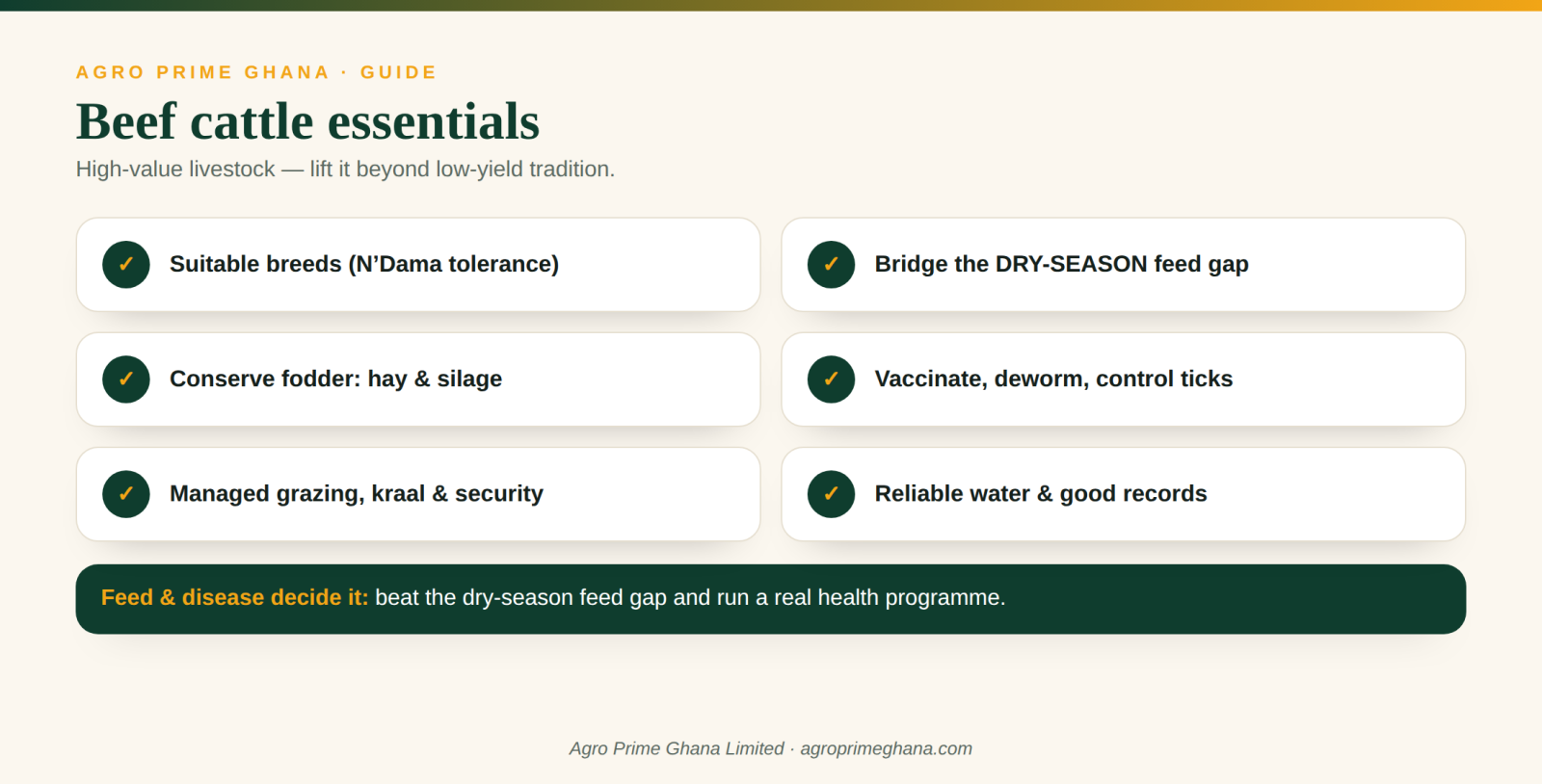
Beef cattle are a high-value store of wealth and meat, mostly kept extensively in Ghana's northern belt. The two biggest challenges are feed (especially the dry-season gap) and disease (tick-borne diseases and trypanosomiasis spread by tsetse fly). Local breeds like N'Dama offer valuable disease tolerance. Improving productivity means better nutrition (grazing plus supplementary and conserved feed), good health management, and moving from pure free-ranging toward managed herding, housing/kraaling and record-keeping.
Why beef cattle matter
Cattle hold a special place in Ghanaian farming. For beef, they are a high-value asset: a mature animal represents significant wealth, cattle serve as a traditional store of value and savings, and beef is in constant, strong demand from households, markets, butchers, chop bars and the growing meat trade. Cattle also provide by-products (hides, and manure valuable for crops) and, in mixed systems, draught power. They are concentrated in the northern savannah belt, where extensive grazing land supports herds, though cattle are kept elsewhere too. The reality, however, is that most cattle rearing in Ghana is extensive and traditional — animals graze communal or open land, often herded by pastoralists, with limited feeding, health care or improvement — so productivity (growth rates, weights, offtake) is far below potential, and losses to feed shortage and disease are high. This is the opportunity: the demand and value are strong, and there is large room to improve returns by feeding, health and management. For a farmer who moves beyond pure free-ranging toward better husbandry, beef cattle can be a durable, valuable, wealth-building enterprise. But it demands respect for the two great constraints — feed and disease — that shape the whole endeavour.
Breeds and the trypanotolerance advantage
Breed choice in Ghanaian cattle is shaped heavily by disease and adaptation. The main cattle are hardy indigenous breeds adapted to local conditions — notably the West African Shorthorn and Sanga types, and the N'Dama. The N'Dama is especially important for one reason: it is trypanotolerant, meaning it can tolerate trypanosomiasis (the disease spread by the tsetse fly that devastates susceptible cattle in infested zones), making it able to survive and produce where larger, non-tolerant breeds cannot. This disease tolerance and hardiness are hugely valuable in Ghana's conditions, even though these local breeds are smaller and slower-growing than exotic beef breeds. Larger exotic or crossbred cattle can grow faster and heavier, but they are generally less adapted and more vulnerable to local diseases, heat and poor feed, so they require much better management, feeding and health care to survive and perform. The practical lesson is to match the breed to your conditions and management level: hardy, disease-tolerant local breeds (like N'Dama) for extensive, tougher conditions and tsetse-affected areas, and improved or crossbred cattle only where you can provide the superior feeding and health care they need. Respecting the trypanotolerance and hardiness of local breeds is central to sensible cattle farming in much of Ghana.
The first great challenge: feed and the dry-season gap
The single biggest constraint on cattle productivity in Ghana is feed, and above all the dry-season feed gap. In the rainy season, grazing is abundant and cattle do well; but in the long dry season, natural pasture withers, becomes scarce and loses quality, and cattle commonly lose weight and condition, sometimes severely, undoing the gains of the wet season — a cycle that keeps productivity low and can cause real losses. Overcoming this is the key to lifting cattle performance. The strategies are clear: improve and manage grazing (better pasture, rotational grazing where possible), grow and conserve fodder (planting fodder grasses and legumes, and conserving surplus wet-season forage as hay or silage to feed in the dry season), use crop residues and by-products (such as crop stovers and agro-industrial by-products) as dry-season feed, and provide supplementary feeding and clean water and minerals, especially in the lean months. Simply carrying cattle through the dry season without losing condition — by having conserved or supplementary feed ready — dramatically improves productivity and reduces losses. The farmers who solve the dry-season feed problem are the ones whose cattle grow steadily and reach market weight; those who rely only on natural grazing watch their animals shrink each dry season. Feed, and the dry-season gap in particular, is the constraint that most determines success in cattle farming.
The second great challenge: disease and health
The other major constraint is disease, and good health management is essential to keep cattle alive and productive. Ghana's cattle face several important disease threats: trypanosomiasis (spread by the tsetse fly, a major reason trypanotolerant breeds like N'Dama are so valuable), tick-borne diseases (ticks spread serious blood diseases, so tick control matters), and other diseases and parasites including those preventable by vaccination, plus internal parasites (worms). Left unmanaged, disease causes heavy losses and poor performance. Good health management rests on prevention: vaccination against the important preventable diseases (following veterinary/official recommendations), parasite control (regular deworming and tick control), keeping animals in good condition (well-fed animals resist disease better), providing clean water, and working with veterinary services for advice, treatment and disease outbreaks. In tsetse zones, using trypanotolerant breeds and, where appropriate, tsetse and trypanosomiasis control measures is important. Biosecurity and careful management when introducing new animals also help. The practical point is that cattle health cannot be left to chance: a planned programme of vaccination, deworming and tick control, good feeding, and veterinary support protects the herd and its value. Disease and feed together are the twin challenges that decide whether cattle farming thrives or merely survives.
Management: from free-ranging to managed herds
Beyond feed and health, better management is what lifts cattle from low-yielding tradition toward real productivity. Much of Ghana's cattle keeping is very extensive, but improvements make a large difference: controlled, managed grazing and herding (rather than uncontrolled free-ranging) protects the animals and the pasture; providing a kraal or housing for shelter, security and night enclosure protects cattle from theft, predators and weather and allows better care; good breeding management (selecting good animals, managing bulls and cows, controlling mating) improves the herd over time; and record-keeping (of animals, births, weights, health, costs) lets a farmer manage the herd as a business and know what is working. Managing cattle also means attention to security — cattle theft and conflict over grazing are real issues — and to the relationship with herders where labour is hired for herding. Water provision, especially in the dry season, is another management essential. None of this requires abandoning extensive systems entirely, but moving toward more managed, deliberate husbandry — better grazing, housing, breeding, records and security — steadily raises productivity and reduces losses. Good management ties together the feeding and health improvements into a coherent, more profitable cattle enterprise.
The economics of beef cattle
Cattle economics combine high value with slow returns and real risks. Cattle are a long-term, high-value enterprise: an animal takes time to grow to market weight, tying up capital, but represents significant wealth and a store of value, and beef sells into strong, constant demand. Costs include the animals themselves, feed (especially supplementary and conserved feed to bridge the dry season), health care (vaccination, deworming, tick control, veterinary services), herding labour, water, and housing/security. The main risks — and the main drains on profit — are the two great challenges: feed shortage (dry-season weight loss) and disease (losses and poor performance), plus theft. The keys to profitable cattle farming are therefore to attack exactly these: solve the dry-season feed gap through conserved fodder, residues and supplementation so animals gain rather than lose condition; run a disciplined health programme; choose breeds suited to your conditions (valuing trypanotolerance where relevant); and manage the herd deliberately with good husbandry, security and records. Because so much Ghanaian cattle keeping is low-productivity, the opportunity for a farmer who feeds, treats and manages cattle well — turning slow, loss-prone extensive rearing into steady, healthy growth to market weight — is substantial. Cattle reward patient investment and good management with a durable, wealth-building, strongly-demanded enterprise.
Common mistakes to avoid
- Relying only on natural grazing, so cattle lose condition badly every dry season — plan conserved and supplementary feed.
- Neglecting health, skipping vaccination, deworming and tick control and losing animals to disease.
- Using unsuitable breeds, keeping non-tolerant exotic cattle in tsetse zones or under poor management.
- Pure uncontrolled free-ranging, with no managed grazing, housing, breeding or records.
- Ignoring water provision, especially in the dry season.
- No security against theft, a real risk with valuable animals.
Frequently asked questions
Is beef cattle farming profitable in Ghana?
What is the biggest challenge in cattle farming?
Why is the N'Dama breed important?
What diseases affect cattle in Ghana?
How do I keep cattle from losing weight in the dry season?
Should I keep local or exotic cattle breeds?
Where are cattle mainly kept in Ghana?
How can I improve traditional cattle rearing?
The bottom line on beef cattle farming
Beef cattle are among the most valuable livestock a Ghanaian farmer can own — a store of wealth and a source of strongly-demanded meat — yet in Ghana they are mostly kept in extensive, traditional systems that yield far below their potential. The path to a profitable cattle enterprise runs directly through the two great constraints. The first is feed, above all the dry-season gap that strips condition from cattle each year: bridging it with improved grazing, grown and conserved fodder, crop residues and supplementary feeding is the single biggest lever on productivity. The second is disease: a disciplined programme of vaccination, deworming and tick control, good feeding and veterinary support keeps the herd alive and performing, with trypanotolerant breeds like N'Dama a vital asset in tsetse-affected zones. Build on these with deliberate management — managed grazing, housing, breeding, records and security — and beef cattle turn from slow, loss-prone tradition into a durable, wealth-building enterprise. Feed them through the dry season, keep them healthy, and manage them as a business, and cattle reward the Ghanaian farmer with real and lasting value.
Build wealth with well-managed livestock
Agro Prime Ghana Limited runs a hatchery and agribusiness in Kasoa. Larger livestock like cattle reward better feeding, health and management. Talk to us about building a resilient, mixed farm: book a visit or message WhatsApp (+233 24 915 1503).