Layer feed in Ghana is sold as laying mash or pellets, and its price depends on the maker, the protein and calcium levels, the bag size and the market that week. Agro Prime Ghana supplies layer feed from its Kasoa hatchery and quotes today's price on WhatsApp, so you pay for the bag you are actually buying. Layers are not fed one fixed diet for life. A hen's need for protein falls and her need for calcium rises as she ages, so the right layer feed changes with the age of your flock. This guide shows how that works using the Lohmann Brown-Classic nutrient tables, the dated market figures we could verify, and what to ask before you pay.
From the Agro Prime Ghana team — a working hatchery in Kasoa supplying day-old chicks, point-of-lay pullets and feed across Ghana. Last updated October 2026.
Quick answer
Layer feed is bought by hen age: a laying hen in her first phase needs more protein, and as she ages her calcium need rises to keep eggshells strong. Agro Prime sells layer feed from our Kasoa hatchery, and we do not publish a fixed bag price here, because prices change with the maker and the season. For a current quote, message us on WhatsApp (+233 24 915 1503) with your flock size and the age of your hens. Collection is available in Kasoa, and we arrange transport for customers elsewhere in Ghana, with the cost confirmed when you order.
Why a laying hen's feed changes with her age
A layer's job changes over her life. In her first laying phase she is building a strong, consistent egg output, and her daily protein requirement is at its highest. Later she lays a little less, but each egg still needs a steady supply of calcium, and the calcium she needs per day goes up. Feed makers handle this by moving hens to a new feed at set points in their life, and the Lohmann Brown-Classic recommendations, published by the breeder, set those points by age.
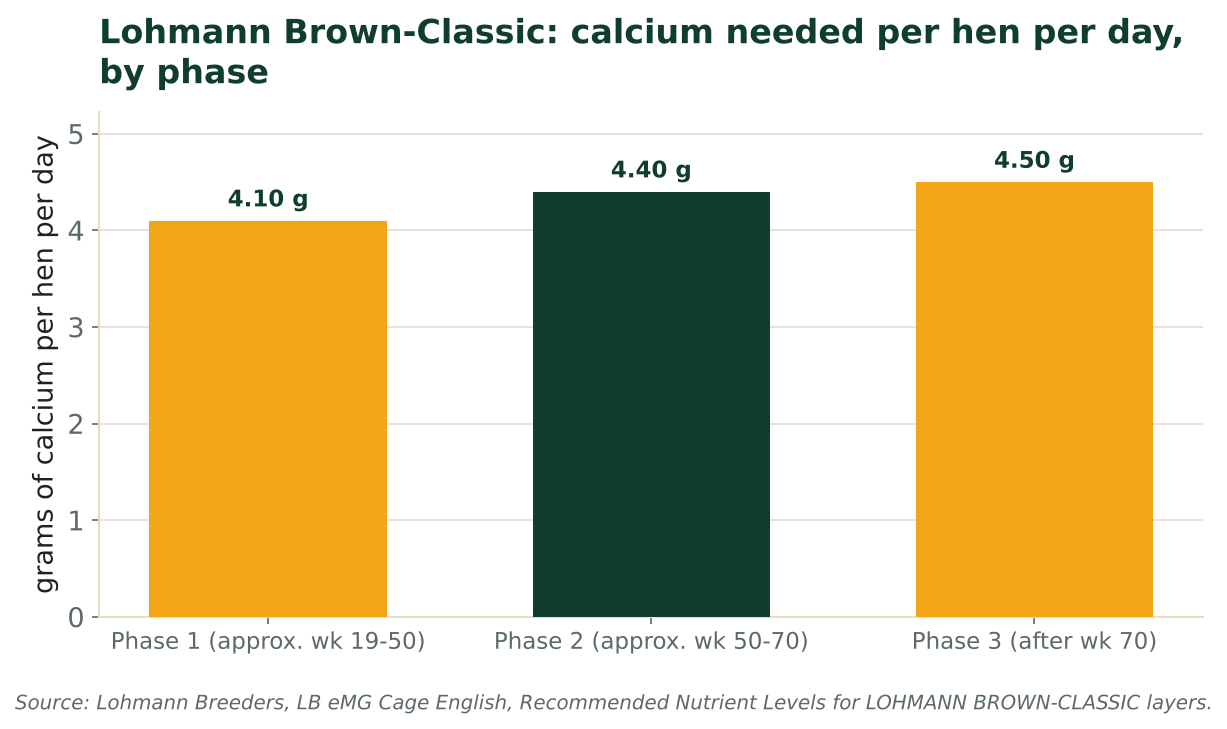
The breeder's tables give the daily need for each phase in grams per hen per day. For the first phase (roughly weeks 19 to 50, while egg mass is above 59 g per hen per day) the need is 18.5 g protein and 4.10 g calcium. In the second phase (roughly weeks 50 to 70) protein falls to 18.0 g and calcium rises to 4.40 g. After week 70 the figures are 17.0 g protein and 4.50 g calcium. A bird that eats 110 g of feed a day therefore gets about 16.8 per cent protein and 3.73 per cent calcium on the phase 1 feed, rising to about 4.09 per cent calcium on the late-lay feed, while protein drops.
| Hen phase (Lohmann Brown-Classic) | Approximate age | Protein need (g/hen/day) | Calcium need (g/hen/day) | What it means for your bag |
|---|---|---|---|---|
| Phase 1 | About week 19 to 50 | 18.50 | 4.10 | Highest protein; a peak-lay feed. Keep this feed while egg output is high. |
| Phase 2 | About week 50 to 70 | 18.00 | 4.40 | Slightly less protein, more calcium. Move over gradually as output eases. |
| Phase 3 | After about week 70 | 17.00 | 4.50 | Lowest protein, highest calcium. Shell quality is the thing to watch. |
Point-of-lay pullets: which feed to switch to, and when
Point-of-lay pullets are bought around the time they start laying, so the feed question is usually about the switch. Ask which feed the pullets have been on before you collect them, and keep that feed for a few days when you bring them home, so the birds are not stressed by a sudden change. Then move to your layer feed gradually, mixing the two over several days rather than switching overnight. Feed changes that are too abrupt can cause a drop in intake, and intake is what drives egg output.
Pullets also do best on a steady daily routine, so keep feeding times and feeder levels consistent through the switch. Our layer feeding guide for Ghana covers the transition in more detail, including how to read egg output as a signal that the feed is right.
What is happening to feed prices, with the dates
Feed is the largest ongoing cost in an egg operation, and in Ghana the pressure has come mainly from ingredients. A February 2025 report on Ghana's poultry sector quoted the Association of Feed Millers of Ghana saying that a 50 kg bag of maize rose from US$16 in January to US$29 over the period that ended in September (2024). The same report says maize is about 50 to 55 per cent of poultry feed and soybean about 30 per cent, so a jump in either grain goes straight into the bag.
These are US dollar figures from 2024, the most recent dated figures we could verify. We have not found a current, dated cedi price for layer feed, so we have not put a GH¢ number on this page. Treat the ingredient trend as a reason to track your feed cost per egg every month, not once a year.
How to compare layer feed prices properly
Compare price per kilogram for the same phase, not price per bag. A cheaper bag that is a different phase, or that is low in calcium for an older flock, can cost you more in weak shells and lower output. When you check a bag, look at:
- The phase and age range. A peak-lay feed given to hens in their late-lay phase, or the reverse, is the most common mistake. Match the bag to the age of your hens.
- Protein and calcium. Check both on the specification. Calcium is the one that shows up as thin or soft shells when it is short.
- Form and freshness. Mash and pellets suit different set-ups, and both lose quality in heat and damp. Use the manufacturing date and keep bags dry and raised off the floor.
If you are still choosing a layer breed, our guide to the best chicken breeds in Ghana is a useful starting point before you settle on a feed programme.
Get today's layer feed price
Feed prices move, so the honest answer is the current quote. Message us on WhatsApp (+233 24 915 1503) with your flock size, the age of your hens and the phase you need, and we will quote the bag, the total and the collection or delivery option. To see the feed and the birds in person, book a visit If you would rather invest than run the birds yourself, see how you can partner with our farm. to the Kasoa hatchery.
How to order layer feed from Agro Prime
Layer feed is sold as part of our hatchery supply, and local buyers can collect it at the Kasoa hatchery. To get an accurate price, send us the following on WhatsApp:
- Your flock. Breed (for example Lohmann Brown), number of hens and their age in weeks.
- The phase you need. The feed for your hens' stage, and how many bags.
- Your timing. When you need the feed, so we can confirm it will be ready for that date.
- Your location. Whether you will collect in Kasoa or need transport to another town.
Before you pay we confirm the bag price, the total, and the collection or delivery arrangement. We will tell you what we can confirm for your order and what depends on the day.
Delivery, collection and the landed price
Collect in Kasoa, or let us arrange transport across Ghana. For delivery, the cost depends on your town and the quantity, so we confirm it when you message us rather than quoting it here. Compare the landed cost, meaning the bag price plus transport, when you weigh our quote against anyone else's. Keep the feed dry and off the ground when it arrives, and check the count against the delivery note straight away.
Bottom line
Layer feed is a phase-by-phase purchase. Match the bag to the age of your hens, watch protein and calcium, compare price per kilogram within the same phase, and keep the feed fresh and dry. We will not guess at a bag price for you; we will give you the current quote for your flock. Message us on WhatsApp and we will reply with the figures for your order. If you are still setting up a layer unit, our guide to starting a poultry farm in Ghana covers the steps in the right order, with feed as one of them.
Ready to switch to the right phase?
Send us your flock size, the age of your hens and the phase you need, and we will quote the bags and the collection or delivery option. WhatsApp us on +233 24 915 1503 to get started, or book a visit to the Kasoa hatchery to see the feed for yourself.
Frequently asked questions
What is layer feed price in Ghana right now?
When should I switch from peak-lay to late-lay feed?
Why are my eggshells thin, and could it be the feed?
Is mash or pellet better for layers?
How do I compare two layer feeds fairly?
Can I buy point-of-lay pullets and layer feed together?
Do you deliver layer feed outside Kasoa?
How much feed does a layer eat per day?
Sources
- Lohmann Breeders, LB eMG Cage (English), Recommended Nutrient Levels for LOHMANN BROWN-CLASSIC Layers, Phases 1 to 3 (protein and calcium per hen per day and as percentage of feed at 105 to 120 g intake): lohmann-breeders.com
- Food Business MEA, "Ghana's poultry sector struggles as high feed costs pressure farmers", published 4 February 2025 (maize bag price and maize and soybean share of poultry feed): foodbusinessmea.com
Order from Agro Prime Ghana
Agro Prime Ghana Limited runs a poultry hatchery in Kasoa and supplies healthy day-old chicks (broilers & layers), point-of-lay pullets, quality feed and hands-on advice to farmers across Ghana, with delivery arranged to your area. Message us on WhatsApp (+233 24 915 1503) for a current quote and to order, or book a visit.