
A question we field almost every week at the hatchery is some version of: "Do I actually need a cockerel?" Sometimes it comes from a layer keeper worried their hens will not lay without one; sometimes from a farmer whose single rooster is battering the hens bald; sometimes from a neighbour at the end of their patience with the 4 a.m. crowing. The honest answer is that most poultry keepers need fewer cockerels than they think, and those they do keep need managing — because a rooster is either a genuine asset (fertile eggs, a flock protector, a valued festive bird) or a liability (fighting, over-mated hens, endless noise), and which one you get depends almost entirely on the numbers and the management. This guide sets out when a cockerel earns his keep, the right cock-to-hen ratios for fertility, and how to manage males so they help the flock rather than harm it.
Written by the Agro Prime Ghana poultry team and reviewed against current poultry-breeding references (Mississippi State University Extension and Cackle Hatchery). Last updated September 2026.
Key takeaways
Hens lay eggs perfectly well without any cockerel — you only need a male if you want fertile eggs to hatch. For fertility, run roughly one cock to 8–12 hens for light, active breeds and about 1 to 6 for heavy or docile breeds; heavier broiler-type males sit at the lower end. A hen stays fertile for about 3–4 days after a single mating, so a cock only needs to mate each hen every few days. Too many cockerels means fighting, over-mated hens with bare backs, and lower lay; too few means favourite hens are over-worked and fertility across the flock is uneven. One good male mating a day, roughly every 7–10 days per hen, maintains fertility. Manage crowing, aggression and spurs, and cull or separate surplus males early.
Do you even need a cockerel?
Start here, because it saves a lot of trouble. The most persistent myth in backyard poultry is that hens need a rooster to lay — they do not. A hen's ovary produces eggs on its own cycle regardless of whether a male is present; a cockerel changes only one thing, which is whether those eggs are fertile and can hatch into chicks. So if you keep layers purely for table eggs, you need no cockerel at all, and you avoid the noise, the aggression and the feed cost of a bird that lays nothing. You need a cockerel only if you want to breed — to set eggs under a broody hen or in an incubator and raise your own replacements. There are two secondary reasons keepers value a male: a good rooster acts as a flock protector and lookout, watching for hawks and predators and warning the hens, and in Ghana a mature cock is itself a valuable bird, especially prized live for festive occasions. But none of those requires more than one, and none requires a male at all if eggs are your only goal. Deciding honestly what you actually want from a cockerel is the first management decision, and it determines everything that follows.
The right cock-to-hen ratio for fertility
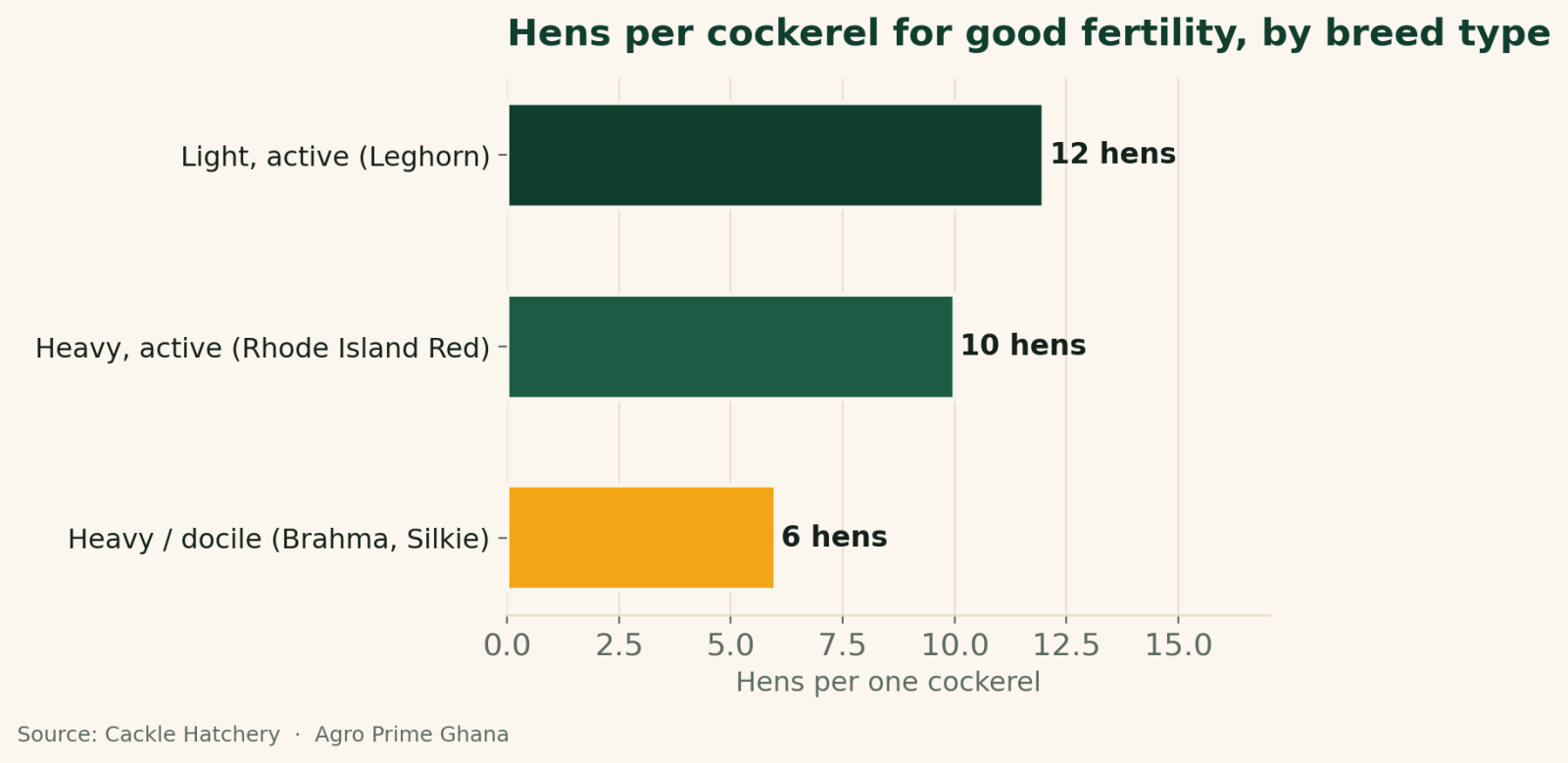
If you are breeding, the ratio of males to females is the single biggest lever on fertility — and getting it wrong in either direction costs you. The workable range depends on the breed's build and temperament. Drawing on breeding guidance compiled by Cackle Hatchery, light and active breeds such as Leghorns run well at about one cock to 12 hens, medium-heavy active breeds such as Rhode Island Reds at around 1 to 10, and heavy or docile breeds — Brahmas, Silkies and the like — at roughly 1 to 6, because a big, placid male covers fewer hens effectively. As a practical rule of thumb for the mixed local and improved flocks common here, one cockerel to 8–10 hens keeps fertility high without crowding the flock with males. The biology behind the numbers is reassuring: Mississippi State University Extension notes a hen holds greatest fertility for about 3 to 4 days after a single mating, so the male-to-female ratio only has to be enough to ensure every hen is mated every few days — Cackle puts it at roughly one day of mating every 7 to 10 days per hen being enough to maintain fertility. You do not need a rooster chasing every hen every hour; you need enough males that no hen goes unmated across that fertile window.
Too many, or too few: what goes wrong
Both extremes damage the flock, and understanding how helps you settle on the right number. Too many cockerels is the more common and more visible problem. Surplus males spend their energy fighting each other, injuring themselves and stressing the whole flock, and they over-mate the hens: hens mated far too often lose the feathers from their backs and the backs of their wings, develop bare or scratched skin, start hiding from the males, and — because they are stressed — lay less. A flock that is visibly rooster-heavy is usually a flock of anxious, patchy-backed hens. Too few males causes a subtler loss: a single cock tends to favour a handful of hens, mating them repeatedly while ignoring the rest, so you get over-mating of the favourites and poor fertility from the neglected ones — uneven hatching results across the same flock. The table below summarises the trade-offs.
| Situation | What happens | What to do |
|---|---|---|
| No cockerel | Hens still lay normally, but eggs are infertile and cannot hatch | Perfect for table-egg flocks; add a male only if you want to breed |
| Correct ratio (~1:8–12) | High, even fertility; calm flock; hens in good feather | The target — match the exact ratio to breed weight and temperament |
| Too few males for the flock | Male favours a few hens; those over-mated, the rest under-fertilised; uneven hatch | Add a male, or split the flock so one cock covers a workable group |
| Too many males | Fighting and injury, over-mated bare-backed hens, more noise, hens lay less | Remove surplus cockerels early; keep only your best one or two |
Field note: read the hens' backs, not the calendar
The quickest way to know whether your ratio is right is to look at the hens, not to count the roosters. When we walk a breeding pen, the hens' feathers tell the story: smooth, well-covered backs mean the mating load is spread sensibly; bare, scratched backs and wing fronts, and hens skulking away from the males, mean there are too many cockerels or one is far too rough, and it is time to pull males out. A good breeding cock is calm, attentive and shares himself around the flock; a bird that singles out and harries a few hens relentlessly is doing harm even if your headline ratio looks correct. We would rather run slightly fewer, better-tempered males than crowd a pen with young cocks all proving themselves.
Managing the noise
Crowing is the complaint that turns neighbours into enemies, and in Kasoa's tighter compounds it matters. It helps to be clear about what crowing is and is not. A cockerel does not only crow at dawn — cocks crow through the day and can start well before sunrise, and it is a territorial, communicative behaviour you cannot train out of a healthy bird. What you can do is manage it. Keeping fewer males is the first and biggest lever: several cocks crow competitively, egging each other on, so cutting to one dramatically reduces the racket. A darkened, enclosed night house helps delay the pre-dawn crowing, since cocks respond to light — a solid, less-transparent coop that keeps early light and passing disturbances out will often quiet the earliest crows. Siting the night house away from the boundary you share with neighbours, and being realistic that a rooster in a residential area is a genuine nuisance, are part of responsible keeping. If crowing is intolerable where you are and you keep hens only for eggs, the cleanest answer circles back to the first section: you do not need a cockerel at all.
Aggression, spurs and handling
A cockerel's job includes defending the flock, and that same instinct can be turned on you, on children, or on other males. Some cocks are simply human-aggressive — flying at legs, striking with spurs — and this is worth taking seriously, because a mature cock's spurs can cause real injury, especially to children. Handle young cockerels calmly and confidently from early on, do not play-fight or "spar" with them (it teaches them you are a rival), and be firm but not cruel with a bird that challenges you. A cock that is dangerously and persistently aggressive to people is a cull decision, not a training project — there is no shortage of calmer males. Spurs grow long and sharp on mature cocks and can gash hens during mating or injure other males; they can be blunted or trimmed carefully by someone who knows how, keeping well clear of the living quick inside. Between competing males, the same rule applies as with any flock: don't keep more entire males together than the flock and space can absorb, and separate or remove birds that fight to injury rather than settling a stable order.
Field note: grow out surplus cockerels, don't let them fester in the flock
Every hatch throws roughly half males, and the mistake we see is leaving all of them running in the flock while the keeper "decides." Young cockerels left together past a certain age turn a calm pen into a battleground and start harassing the pullets. Our practice is to separate or grow out the surplus males early — either as a bachelor group reared for meat or the festive market, or moved on — and keep back only the one or two best-tempered, best-conformed birds you actually want for breeding. This protects the hens, keeps the noise down, and lets the retained cocks mature into steady breeding birds rather than one of a squabbling crowd. In Ghana a well-grown mature cock also sells well, so surplus males need never be a dead loss.
Feeding and looking after a breeding cock
A working breeding cockerel needs to be fit, not fat. An overweight, sluggish male mates less effectively and can have poorer fertility, while an underfed or worm-burdened cock lacks the vigour to cover his hens. Run your breeding males on a sound balanced ration alongside the hens — in a mixed breeding flock the cocks generally do well on good layer or breeder feed — and keep them in steady, hard condition rather than letting them run to fat on scraps and excess maize. Fertility also depends on the whole bird being healthy: keep the breeding flock well dewormed and free of external parasites like lice and mites, and protect them from the heat stress that suppresses breeding performance in our climate — our guide to heat stress in poultry covers keeping birds productive through hot spells. A run-down male is a poor breeder no matter how good the ratio on paper. And remember that fertility declines as a cock ages, so plan to replace your breeding males before they slow down. For choosing which birds to breed from in the first place, see our guide to the best chicken breeds for Ghana.
The bottom line on keeping cockerels
A cockerel is a tool, not a default. If you keep hens for table eggs, you need no male at all — your hens will lay just as well, and you spare yourself the crowing, the fighting and the over-mated hens. Keep a cockerel only to breed, and then keep the right number: roughly one to 8–12 hens for light active breeds, nearer one to six for heavy or docile ones, adjusted by watching the hens' backs rather than counting roosters. Too many males wreck the flock with fighting and over-mating; too few leave fertility patchy. Manage the noise by keeping males few and housing them in a dark night house away from neighbours, handle and cull for temperament so your cock protects the flock without menacing people, keep spurs in check, and grow out or sell surplus males early rather than letting them brawl in the pen. Feed and health your breeding cock as carefully as your hens, replace him before age dulls his fertility, and a single good rooster becomes exactly what he should be — quiet insurance for the next generation of your flock.
Frequently asked questions
Do hens need a rooster to lay eggs?
What is the best rooster-to-hen ratio?
How often does a rooster need to mate a hen for fertile eggs?
What happens if I keep too many roosters?
How do I reduce rooster crowing for my neighbours?
Why is my rooster tearing the feathers off my hens' backs?
Are roosters dangerous, and what about the spurs?
What should I do with all the surplus cockerels from a hatch?
Sources & further reading
- Mississippi State University Extension — The Only Good Broiler Breeder Egg Is a Fertilized Egg (mating frequency, how long a hen stays fertile after mating, male-to-female coverage).
- Cackle Hatchery — Rooster-to-Hen Ratio — Why It Matters (ratios by breed type, over-mating signs, problems with too many or too few males).
- Agro Prime Ghana guides: best chicken breeds for Ghana and heat stress in poultry.
About Agro Prime Ghana
Agro Prime Ghana Limited runs a poultry hatchery and mixed agribusiness in Kasoa, supplying day-old chicks and breeding stock and supporting poultry keepers nationwide. These guides combine hands-on hatchery and farm experience with current poultry-breeding references. This article is general educational information, not a substitute for advice from a qualified veterinary or extension officer. Need chicks, breeding stock, feed advice or farm support? Book a visit or message us on WhatsApp (+233 24 915 1503).