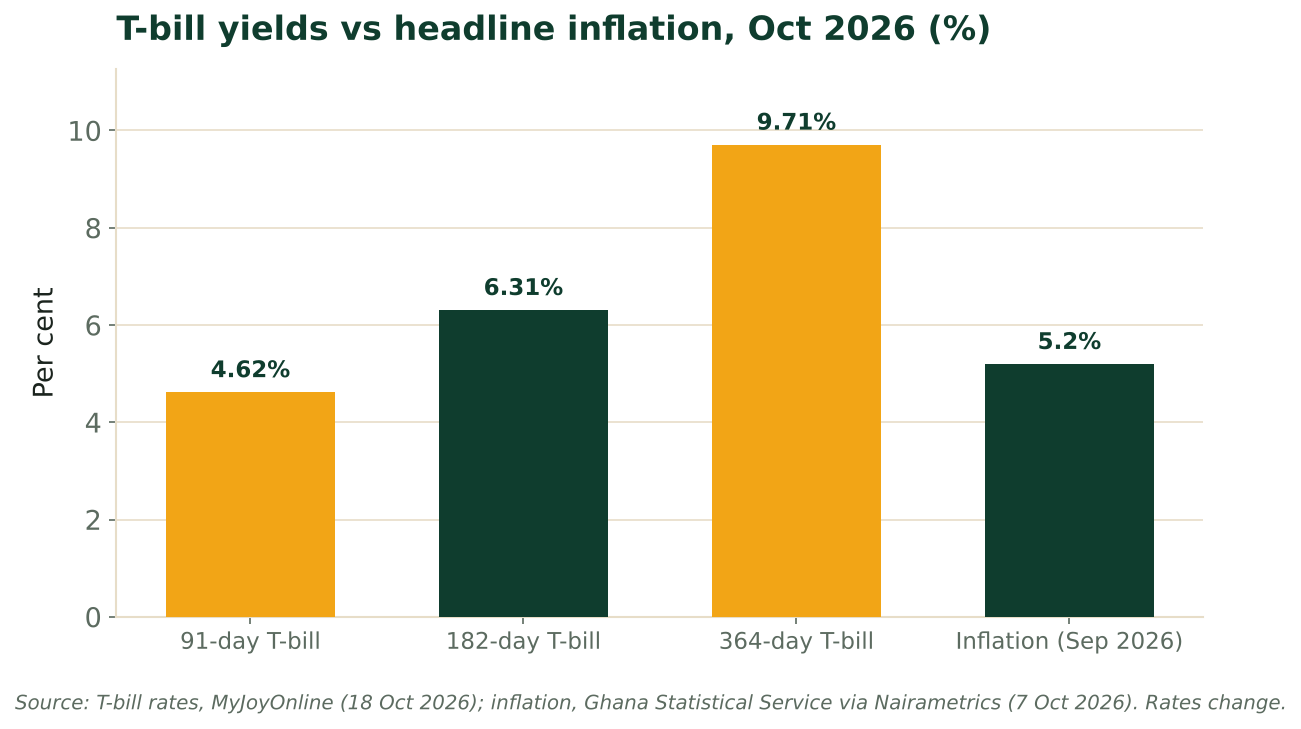
You invest in agriculture in Ghana by putting money into farming or agribusiness: directly, by buying a stake in a production batch or farm business; indirectly, through a licensed fund that holds agricultural assets; or by lending to an enterprise. Each route trades return against risk, liquidity and effort, and none of them is guaranteed. In the auction reported on 18 October 2026, the 91-day Treasury bill yielded 4.62%, while headline inflation for September 2026 was 5.2%, so a short government bill was not keeping pace with prices. That gap is why many Ghanaian savers now look at productive assets. This guide sets out the main options, the real risks agribusiness carries, and a practical way to test any opportunity before you commit a cedi.
Written by the Agro Prime Ghana team and reviewed against current market references (the Bank of Ghana's September 2026 monetary policy statement, Ghana Statistical Service inflation releases, and recent Treasury bill auction reports). Last updated October 2026. General information, not financial advice.
Key takeaways
The Bank of Ghana's policy rate was held at 14.0% at its 132nd Monetary Policy Committee meeting (23 to 24 September 2026). Headline inflation rose to 5.2% in September 2026, from 5.0% in August. In the auction reported on 18 October 2026, the 91-day bill yielded 4.62%, the 182-day 6.31% and the 364-day 9.71%. Those rates were much higher in June, when the 364-day bill was at 12.82%, so they move quickly. Agriculture can offer higher potential returns than a government bill, but it carries higher risk, weaker liquidity and no guaranteed return.
What investing in agriculture actually means
"Agriculture" covers several very different investments, and treating them as one is the most common mistake new investors make. A shareholding in an agriculture-linked company is exposed to share prices on the Ghana Stock Exchange. A fund that holds farmland, processing or agribusiness assets depends on how that fund is run. A lending arrangement to a farm depends on whether the borrower can repay. A direct production partnership, where you back a defined batch of birds or crops and receive a share of the proceeds, depends on that one enterprise doing what it said it would do.
Before you decide, be clear about which of these you are buying. Ask yourself who owns the asset, who controls the money, what happens to your capital if the enterprise fails, and how you would get it back. Those four questions separate a reasoned investment from a hopeful one.
Why agriculture is drawing attention in Ghana right now
There are real economic reasons why agriculture is discussed as an investment theme, and they are worth stating plainly. Ghana imports a large share of the food it eats. The Ghana Statistical Service's annual trade report for 2025, covered by Graphic Online on 31 July 2026, recorded frozen chicken imports of GH¢2.84 billion, ranking second among food imports behind processed cereal grains at GH¢2.94 billion.
The clearest data on the poultry gap comes from the USDA Foreign Agricultural Service. Its January 2022 Voluntary Report, which covers the 2021 marketing year, estimated domestic chicken consumption at about 400,000 tonnes, imports at about 350,000 tonnes, and said domestic broiler production met only about 2% of chicken demand. The same year, a Ghana National Association of Poultry Farmers study cited by Graphic Online put the imported share of the chicken market at 98%. These are 2021 and 2022 figures, not current ones, so treat them as the direction of the market rather than a live measurement.
Inflation is the other reason. Headline inflation rose to 5.3% in June 2026 from 3.7% in May, according to the Ghana Statistical Service release reported by MyJoyOnline on 1 July 2026, and it reached 5.2% in September. The September release showed food inflation at 4.0% and non-food inflation at 6.2%. Ghana News Agency's report on the Governor's September 2026 briefing cited crude oil above US$100 a barrel and utility tariff increases as pressures on prices.
| Option | Typical horizon | Liquidity | Risk level | How you enter |
|---|---|---|---|---|
| Government Treasury bills (91, 182, 364-day) | 91, 182 or 364 days, set at issue | Limited before maturity; held to term in most cases | Low credit risk, but yields reset at every auction | Through bank or Bank of Ghana auction channels |
| Listed equities (Ghana Stock Exchange) | No fixed term | Can sell on trading days, subject to market depth | High price volatility | Through a licensed stockbroker |
| Licensed fund or collective scheme with agri assets | Set by the fund's terms | Often redeemable on the fund's schedule | Depends on the fund's assets and management | Directly with a licensed manager; check the SEC register |
| Direct stake in a production batch (profit share) | Tied to the batch cycle; broiler grow-out is about 5 to 7 weeks | Low; you usually wait for the batch to close | High: disease, feed, price and operator risk | Written agreement with the operator |
| Lending to a farm or agri enterprise | Agreed loan term | Low until repayment | High: default risk | Loan agreement, often with security |
How the main options work
Government Treasury bills are the benchmark most Ghanaians already know. You lend to the government for a fixed period and receive a rate agreed at auction. Their appeal is a defined term and a known rate at purchase. The 364-day bill was at 12.82% in the auction reported on 29 June 2026, and at 9.71% in the auction reported on 18 October 2026. A saver who bought in June locked in a much higher rate than one who bought in October. Rates are set by the market at each auction, so check the latest figures before you decide.
Listed equities give you a share of company profits and a share price that moves daily. The Ghana Stock Exchange Composite Index delivered a year-to-date return of 75.99% at the close of July 2026, according to a MyJoyOnline report published on 11 August 2026. That report does not say whether the figure includes dividends, and it describes one period. A single strong year tells you very little about what comes next, and the same market can fall sharply. Equities suit money you can leave alone for years.
Licensed funds and collective schemes pool money from many investors and are run by a manager. Their protection comes from licensing, reporting and the rules that govern them, not from the assets alone. Before you invest, read the fund's offer document, check the manager's licence and understand how and when you can withdraw.
A direct production partnership is the option most relevant to agribusiness. You fund part of a defined production batch and share in the proceeds once it is sold. The returns depend on the batch's survival rate, feed costs, the price at which birds or eggs sell, and whether costs are deducted honestly before profit is shared. This is the model behind Agro Prime Ghana's partner page, an invitation to discuss backing its farming production on a profit-share basis. Nothing about it is guaranteed, and the terms you agree are what count.
Where the returns come from, and where they disappear
Agribusiness returns come from a sequence of costs and sales. A 2022 study in the International Food and Agribusiness Management Review looked at broiler production in Accra, Kumasi and Dormaa and found that feed and day-old chicks are the largest cost items. When only cash costs are counted, broiler production was profitable in every system the study examined. However, medium-scale farms in Dormaa became unprofitable over the medium and long term once depreciation and opportunity costs were included. A batch can look profitable on cash alone and still fail to repay the full cost of capital.
Feed is the variable that most often surprises investors. A February 2025 report in Food Business Africa, citing the Association of Feed Millers of Ghana, said a 50 kg bag of maize rose from US$16 in January to US$29 at that time. That figure is more than a year old, so check current feed prices before you model any return. The point stands: feed costs can move faster than bird prices.
Imports also shape prices. The 2022 study noted that imports make local selling seasonal, and that small-scale producers are hit hardest by import competition.
The risks you must price in
Agriculture carries risks that a Treasury bill does not. Disease can wipe out a batch, which is why vaccination records and biosecurity matter. Feed prices can squeeze margins. Market prices can fall when supply floods in, and the 2022 study shows that the timing of sales matters. Operators can make mistakes or run out of cash. Liquidity is usually poor: money in a batch is often locked in until the batch closes. If your returns are in cedis but some inputs are priced in dollars, currency moves can change your margin.
There is also the risk of fraud. The Securities and Exchange Commission warned the public on 15 July 2026 against two platforms, YEPBIT Exchange and BONCHAT, which it said were suspected fraudulent investment schemes. Reporting on 22 July 2026 said the SEC had named 23 entities operating online or on social media without SEC licences and urged the public not to invest in their products. A farming pitch that promises high, fixed returns, pays early "dividends" from new deposits or cannot show a written agreement should be treated as a warning sign.
Investor note: test the yield against inflation
Compare any return with the inflation rate, not just the headline percentage. In the auction reported on 18 October 2026, the 91-day bill's 4.62% sat below September's inflation of 5.2%, which means a short bill at that rate would not have kept your purchasing power intact. The 364-day bill at 9.71% was above that inflation figure. Always ask: what is the return after inflation, and what is the return after tax and fees?
How to test any agriculture investment before you commit
Use the same checklist whether the opportunity is a fund, a farm or a production batch. First, confirm the licence. For anything that takes investors' money for a collective purpose, check that the company is licensed by the SEC and read the offer document. Second, get the terms in writing, including what you are buying, how much you are putting in, when you will be paid, and how profit is calculated. Third, ask for the cost breakdown. A partner should show you the feed, chicks, vaccines, labour and other costs that come out before any profit is shared.
Fourth, ask what happens when things go wrong. If a batch suffers high mortality, does your share fall, and who carries the loss? Fifth, check whether you can visit the site or see the operation. A real farm or hatchery can usually be visited, and an operator confident in its work will welcome questions. Sixth, be cautious about pressure. A legitimate opportunity does not need you to decide this week.
If you are considering a production partnership with a working business, start by asking to see the process. Agro Prime Ghana, which runs a hatchery and mixed agribusiness in Kasoa, sets out its approach on the see how partnering with Agro Prime works page. You can also book a visit to see the operation, or message the team on WhatsApp (+233 24 915 1503) to ask about terms before you commit anything.
Where agribusiness fits in a portfolio
Most people who invest sensibly keep several tools. A portion can sit in liquid, low-risk holdings so that money is available for emergencies. Another portion can go into longer-term investments that you can afford to leave alone. A smaller portion, which you can genuinely afford to lose, can go into higher-risk ventures such as a production batch. The size of each portion depends on your income, your obligations and your temperament, which is why this article does not give personal allocation advice.
Agribusiness suits investors who understand the business, accept lower liquidity and can tolerate losses in a single batch. It is less suitable for money you may need within months.
Investor note: know what you can lose
Only commit money in a production partnership that you could lose without affecting your rent, food, school fees or emergency fund. A single batch can produce a loss as well as a profit, and your capital may not come back on the timetable you expect. Ask the operator to put the worst case in writing as well as the best.
Bottom line
Investing in agriculture in Ghana can be a serious option for people who want exposure to real production and are willing to accept higher risk for potentially higher returns than a government bill. The honest case rests on Ghana's large chicken import bill, on food demand that does not disappear, and on the tangible nature of a farm. The honest counter-case rests on disease, feed prices, market timing, weak liquidity and the risk of unlicensed operators. Compare every option with current inflation and current bill yields, read the terms, and do your own research or speak to a licensed adviser before you commit.
Frequently asked questions
Is investing in agriculture in Ghana safe?
What is the current Treasury bill rate in Ghana?
What is the Bank of Ghana's policy rate?
What was Ghana's inflation rate in September 2026?
How long does a broiler batch take to grow?
Can I lose my money in a poultry partnership?
How do I check if an investment company is licensed?
Should I invest in agriculture instead of keeping money in a bank?
Sources & further reading
- Bank of Ghana: MPC decision statement, September 2026
- Ghana News Agency: BoG maintains policy rate at 14 per cent (25 September 2026)
- Nairametrics: Ghana inflation rises for second month, hits 5.2% in September (7 October 2026)
- MyJoyOnline: Inflation for June 2026 rises to 5.3% (1 July 2026)
- MyJoyOnline: T-bills auction, interest rates register mixed performance (18 October 2026)
- Citi Newsroom: Treasury bill auction, June 2026 (29 June 2026)
- MyJoyOnline: GSE delivers 75% year-to-date return as of July 2026 (11 August 2026)
- Citi Newsroom: SEC names 23 unlicensed online investment schemes (22 July 2026)
- Securities and Exchange Commission Ghana: public notice on YEPBIT Exchange and BONCHAT (15 July 2026)
- Graphic Online: Ghana spent over GH¢36bn importing food in 2025 (31 July 2026)
- USDA Foreign Agricultural Service: Poultry Voluntary Report, Ghana, GH2021-0010 (25 January 2022)
- Graphic Online: 98% of frozen chicken consumed is imported (18 August 2022)
- International Food and Agribusiness Management Review: Broiler production systems in Ghana, economics and the impact of frozen chicken imports (2022)
- Food Business Africa: Ghana's poultry sector struggles as high feed costs pressure farmers (4 February 2025)
- Appenate: broiler production guidelines (grow-out period of 5 to 7 weeks)
- Securities and Exchange Commission Ghana
About Agro Prime Ghana & a note on risk
Agro Prime Ghana Limited runs a poultry hatchery and mixed agribusiness in Kasoa and invites partners to invest in its farming production through a profit-share on a production batch. This is general educational information, not financial advice, and investing carries risk including loss of capital — always do your own research or consult a licensed adviser. The partner page is an invitation to discuss backing Agro Prime's farming production, not an offer of securities or a guaranteed return. Explore it: see how it works, book a visit, or message WhatsApp (+233 24 915 1503).