Chick mash is the starter feed for day-old chicks, and in Ghana it is sold in bags by feed makers and hatcheries at a price that moves with the maker, the bag size and the week. Agro Prime Ghana supplies chick mash from its Kasoa hatchery, and we quote today's price on WhatsApp for the bag size you need, so you are not working from an out-of-date figure. The first two weeks set the pace for the whole flock, because a chick that eats well from the start grows evenly. This guide explains what chick mash does, how much a chick actually eats in those early days, what to have ready before the chicks arrive, and how to order the feed with your chicks.
From the Agro Prime Ghana team — a working hatchery in Kasoa supplying day-old chicks, point-of-lay pullets and feed across Ghana. Last updated October 2026.
Quick answer
Chick mash is a fine, starter-stage feed for the first weeks of life, and it should be in the brooder when the chicks arrive. Agro Prime sells chick mash from our Kasoa hatchery. We do not publish a fixed bag price here, because prices change with the maker and season. We could not verify a current dated cedi price for chick mash. For today's price on the bag size you need, message us on WhatsApp (+233 24 915 1503), tell us how many chicks you are starting with, and we will quote the feed alongside your chicks, with delivery or collection confirmed.
What chick mash does in the first two weeks
A day-old chick is small, its digestive system is still developing, and it has only a little reserve from the egg. The feed it eats in the first days has to be easy to find, easy to eat and rich enough to support fast early growth. That is what starter mash is for. The feed is finely ground so tiny beaks can pick it up, and it is formulated for the nutrient needs of the very young bird.
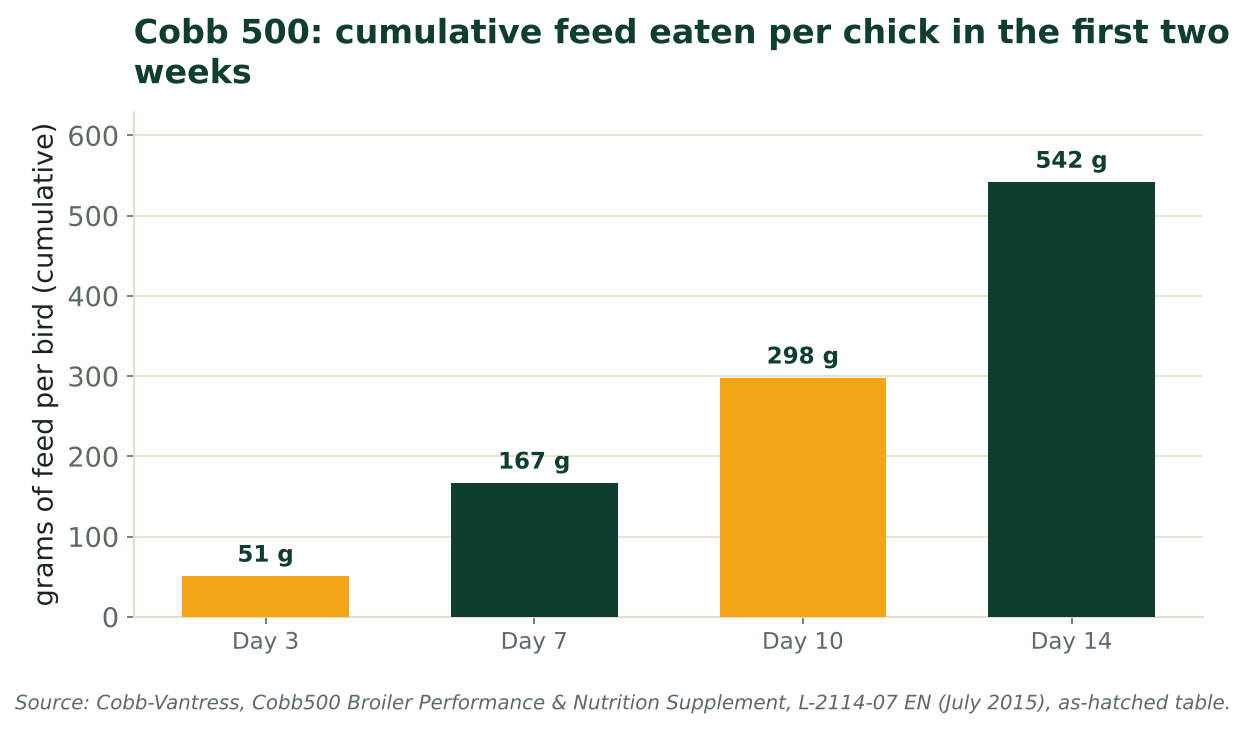
The intake figures below come from the Cobb 500 broiler performance supplement, so they describe broiler chicks. Layer chicks eat differently, and the right starter for a layer flock follows the breed guide for that bird, but the broiler table shows clearly how fast early intake builds. A Cobb 500 eats about 51 g of feed by day 3, about 167 g by day 7, and about 542 g by day 14. Over the same period, the same table has the bird's live weight climbing from 42 g at hatch to about 185 g at day 7 and 465 g at day 14.
Chick mash by stage: what to watch in each part of the first weeks
Chick mash is usually fed for the early weeks and then swapped for a grower or layer feed. Exactly when to switch depends on the breed, the flock and the feed maker, so use the age range on the bag and your breed guide rather than a fixed date.
| Period | What the chick is doing | What the feed should do | What you check |
|---|---|---|---|
| Day 0 to 3 | Arrives tired, learns to find food and water; cumulative broiler intake about 51 g by day 3 | Be easy to find and easy to eat; within reach of every chick | Crops feel full when you check them; birds spread out evenly, not huddled |
| Day 4 to 10 | Feed intake rises quickly; cumulative broiler intake about 167 g by day 7 and 298 g by day 10 | Keep the feeder full and clean; fine particles still suit the chick | Droppings look normal; feed is eaten from the trays, not scattered and wasted |
| Day 11 to 14 | Intake keeps climbing; cumulative broiler intake about 542 g by day 14 | Continue the starter until the age printed on the bag or in your breed guide | Weight is rising; no sign of uneven growth between the early and late birds |
What chick mash costs and what drives the price
The price of chick mash follows the cost of its ingredients, and maize and soybean are the big two. A February 2025 report on Ghana's poultry sector quoted the Association of Feed Millers of Ghana saying that a 50 kg bag of maize rose from US$16 in January to US$29 over the period that ended in September (2024). The same report puts maize at about 50 to 55 per cent of poultry feed and soybean at about 30 per cent. Those are dollar figures from 2024, and we have not found a current, dated cedi price for chick mash, so we do not quote one here.
For a buyer, the practical point is this: compare chick mash on price per kilogram, check the manufacturing date, and keep the bag dry. A cheap bag that is stale or damp is not a bargain for a day-old chick, whose early intake matters most.
What to have ready before the chicks arrive
The feed is only one part of the first days. Public guidance from the University of Florida IFAS on the first 24 hours of broilers describes the basics that matter most, and they carry over to layer chicks too:
- Brooder warm and ready. Chicks need about 88 to 92 degrees Fahrenheit (31 to 33 degrees Celsius) in the first 24 hours. Check the temperature at litter level before they arrive, and watch how the chicks spread: huddling means cold, and avoiding the heat source means too warm.
- Water first, then feed. Chicks should ideally reach the farm and get water and feed within about eight hours of hatch. For long journeys, offer water for the first three to four hours before feed. Many managers add sugar to the water for the first hours, and some add a vitamin supplement for the first days. Ask your supplier or breed guide before you do either.
- Chick mash in clean feeders. Enough feeders and drinkers for every chick to reach them, with mash spread on clean paper or trays for the first days so the birds find it easily.
- Dry, fresh litter. Free of caking, dust and wetness, and warmed for at least 24 hours in cold weather.
For the full set-up, our guide to brooding day-old chicks in Ghana walks through the first week step by step, and the brooder temperature chart shows how to adjust heat as the birds grow.
Ask for chick mash with your chicks
The easiest way to get the right feed in the brooder on arrival is to order it with the chicks. Message us on WhatsApp (+233 24 915 1503) with the breed, the number of chicks and the date you need them. We will quote the chick mash for your batch alongside the chicks, and confirm delivery or collection. If you want to see the feed before you buy, book a visit If you would rather invest than run the birds yourself, see how you can partner with our farm. to the Kasoa hatchery.
How to choose chick mash for your flock
Three questions help you pick the right chick mash. First, is it a starter feed for your bird? Broiler starter and layer chick mash are formulated differently, so check the bag's stated use. Second, how long will you feed it? Plan to switch to the next stage at the age on the bag or in your breed guide, not when the first bag runs out. Third, how much will you use? Estimate from the table above and your flock size, and buy enough for the early weeks with a margin, so you are not switching mid-stage.
If you are still deciding what kind of chicks to start with, the guide to choosing healthy day-old chicks covers what to look for at the point of purchase, and the layer feeding guide and broiler feeding guide set out what comes after the starter stage.
Bottom line
Chick mash is the first feed your birds will eat, and the early weeks decide how evenly the flock grows. Buy the right starter for your bird, compare price per kilogram, keep the bag fresh and dry, and have the brooder ready before the chicks arrive. We do not guess at a price. Message us on WhatsApp for the current quote and we will give you the figure for your batch.
Plan the feed with your chicks
Tell us the breed, the number of chicks and the date you need them, and we will quote the chick mash for your batch alongside the birds. WhatsApp us on +233 24 915 1503 to start, or book a visit to see the feed and the hatchery before you decide.
Frequently asked questions
How much is chick mash in Ghana?
Can I start day-old chicks on any mash?
How long should chicks stay on chick mash?
Should I put chick mash in the brooder before the chicks arrive?
Do I give water before chick mash?
What if some chicks do not eat the mash?
Do you deliver chick mash with the chicks?
Is there a cheaper alternative to buying chick mash?
Sources
- Cobb-Vantress, Cobb500 Broiler Performance & Nutrition Supplement, document L-2114-07 EN (July 2015), as-hatched performance objectives table (cumulative feed and weight by age): cobbgenetics.com
- Butcher, Nilipour and Miles, "Broiler Management: The First 24 Hours" (VM091), UF/IFAS Ask IFAS, published February 2019, last modified February 2025 (arrival within about 8 hours, water before feed, brooding temperature): ask.ifas.ufl.edu
- Food Business MEA, "Ghana's poultry sector struggles as high feed costs pressure farmers", published 4 February 2025 (maize bag price and feed composition): foodbusinessmea.com
Order from Agro Prime Ghana
Agro Prime Ghana Limited runs a poultry hatchery in Kasoa and supplies healthy day-old chicks (broilers & layers), point-of-lay pullets, quality feed and hands-on advice to farmers across Ghana, with delivery arranged to your area. Message us on WhatsApp (+233 24 915 1503) for a current quote and to order, or book a visit.