Ghana drinks a great deal of milk — in tea, in cooking, in yoghurt and drinks — yet produces very little of it, importing large quantities of milk powder and dairy products to fill the gap. That gap is a genuine opportunity for local dairy farming. But dairy is a specialised, demanding branch of cattle keeping, quite different from raising beef: it depends on the right milk-producing animals, good feeding for milk, and — above all — scrupulous hygiene and a working cold chain, because milk is one of the most perishable and easily contaminated products a farm can make. This guide covers how to run a dairy enterprise successfully in Ghana and how to turn an import-heavy market into a local opportunity.
Key takeaways
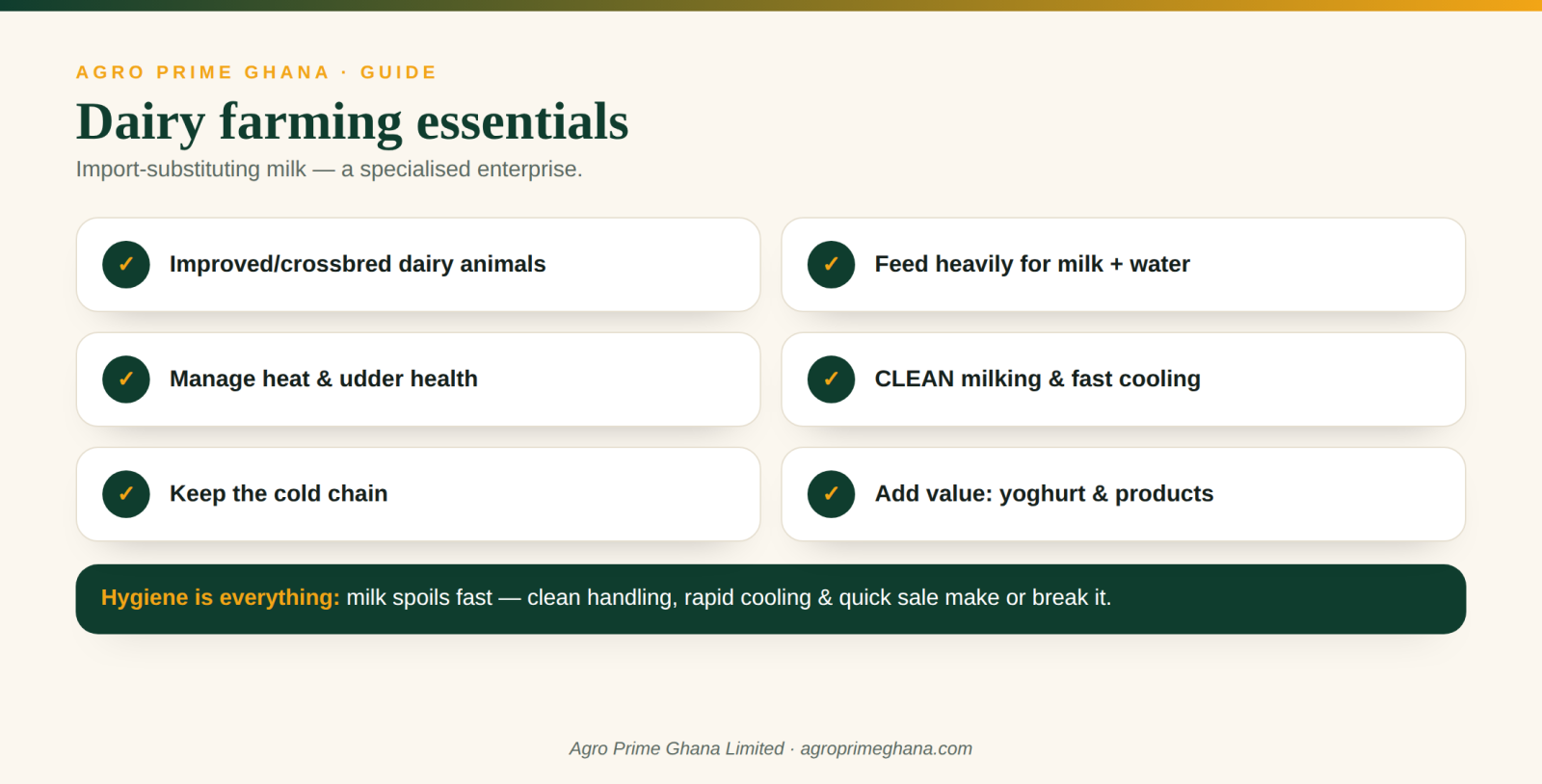
Ghana imports most of its dairy, so local milk production is a real opportunity. Dairy is specialised: it needs milk-producing animals (improved or crossbred dairy cattle, well managed), good feeding for milk (a well-fed cow milks well; a hungry one does not), and, decisively, strict milk hygiene and a cold chain — milk is highly perishable and easily contaminated. Manage heat, feed and animal health, keep everything clean, cool and move milk fast, and add value (yoghurt, local products) to capture more.
Why dairy is an opportunity
Dairy sits on a clear market gap. Ghanaians consume substantial amounts of milk and dairy products, yet the country produces only a small fraction locally and imports large quantities of milk powder and dairy goods to meet demand. That means there is real, unmet demand and a genuine import-substitution opportunity for local dairy producers — fresh milk, and value-added products like yoghurt, sell readily. Dairy also offers a continuous income: unlike beef, where you wait for an animal to grow and sell it once, a milking cow produces daily, giving a regular cash flow, and the enterprise can start relatively small and grow. The reasons local production is limited — and therefore the challenges to overcome — are specific: much of Ghana's cattle are hardy local breeds that produce little milk, the hot climate and feed shortages depress milk yields, and milk's perishability and the weak cold chain make handling and marketing difficult. So dairy is a real opportunity but a demanding, specialised one: it rewards farmers who provide the right animals, feeding, health and — critically — hygiene and cooling that milk production requires. For a farmer able to meet those demands, dairy taps a large, import-dependent market with a product in constant, everyday demand.
The animals: breeds for milk
Dairy begins with the right animals, because milk yield depends heavily on the cow. Ghana's common indigenous cattle (hardy, disease-tolerant breeds suited to local conditions) produce relatively little milk — enough traditionally for a calf and modest household use, but far below dairy potential. Serious milk production therefore usually means improved dairy or crossbred animals: crossing local cows with dairy breeds, or keeping adapted dairy/crossbred cattle, to combine higher milk yield with some of the hardiness and heat/disease tolerance needed to survive in Ghana. Pure exotic high-yielding dairy breeds give the most milk but are the least adapted — very vulnerable to heat, local disease and feed shortage — so they demand excellent management (housing, cooling, feeding, health care) and are risky without it; crossbreds often strike a more practical balance for Ghanaian conditions. The key point is to match the animals to your management capacity: better milk-producing genetics only pay off if you can feed, cool, house and care for the animals well, since a high-potential cow that is underfed, heat-stressed or sick will not deliver. Choosing suitable milk-producing animals — typically improved crossbreds managed well — is the foundation of a dairy enterprise, and it goes hand in hand with the feeding and management that let those animals actually produce milk.
Feeding for milk
Feeding is where much of a dairy cow's potential is won or lost, because milk production is hugely demanding of nutrition: a well-fed cow milks well, while an underfed or poorly-fed cow simply does not produce, no matter her genetics. Good dairy feeding means providing enough quality feed to meet the high energy and protein demands of lactation: good grazing and quality forage (fodder grasses and legumes), and — importantly — supplementary feeding and concentrates to meet the extra needs of a milking cow, plus minerals and plentiful clean water (a milking cow drinks a great deal, and water directly affects milk yield). As with all Ghanaian cattle, the dry-season feed gap is a major threat, and it hits dairy especially hard because milk yield collapses when feed runs short — so growing and conserving fodder (hay, silage) and having reliable feed and water year-round is essential for steady milk production. Consistent, quality feeding and abundant clean water are non-negotiable in dairy: they are what turn a good dairy animal into a productive one. A farmer who invests in good milk-producing animals but skimps on feed and water is wasting the animals' potential. Feed for milk, and feed consistently, and the cows repay it daily in the bucket.
The decisive factor: milk hygiene and the cold chain
Here is what most sets dairy apart from other farming and most decides its success: milk hygiene and the cold chain. Milk is one of the most perishable and easily contaminated products a farm can produce — it spoils quickly, especially in the heat, and readily picks up bacteria that make it go off or become unsafe. So scrupulous cleanliness and rapid cooling are absolutely central. This means clean milking (clean hands, clean udder, clean containers and equipment, healthy cows — milk from a cow with mastitis is unusable), getting the milk cool and to market or processing fast before it spoils in the heat, and maintaining a cold chain (cooling and keeping milk cold from the cow to the consumer or processor) wherever possible. The weak cold chain and hot climate are exactly why milk handling is such a challenge in Ghana, and why so much milk is lost or must be sold or processed immediately. A dairy farmer who milks and handles hygienically and cools milk promptly delivers safe, good-quality milk that sells; one who is careless produces spoiled, unsafe milk that is rejected or dangerous, wasting the whole effort of feeding and milking the cows. Because milk is so unforgiving, hygiene and cooling are not optional refinements but the core discipline of dairy. Getting the milk clean, cold and to market fast is as important as producing it in the first place — arguably more so, since good milk carelessly handled becomes worthless.
Health, management and value addition
Around the animals, feeding and hygiene, good health and management keep a dairy enterprise productive. Dairy cows need the same disciplined health care as all Ghanaian cattle — vaccination, deworming, tick control, veterinary support — plus particular attention to udder health (mastitis), which directly ruins milk and must be prevented through clean milking and prompt treatment. Managing heat matters greatly, since heat stress cuts milk yield, so shade, ventilation, cooling and water help. Good management — proper milking routines, care of the cow around calving and through lactation, breeding to keep cows in milk, and record-keeping (of milk yields, feeding, health, breeding) — runs the dairy as a business and steadily improves it. Then there is value addition: because milk is perishable and demand for dairy products is strong, processing milk into yoghurt, local dairy products and other goods extends its life, adds value, and taps the demand now met by imports — often more profitable and practical than selling only fresh milk, especially given the cold-chain challenge. Adding value also helps absorb milk that cannot be sold fresh quickly. Together, good health (especially udder health), heat and lactation management, and value addition round out a dairy enterprise, turning the daily milk from well-fed, healthy cows into a safe, saleable, value-added product.
The economics of dairy
Dairy economics offer continuous income against real demands and a perishable product. On the plus side, a milking cow yields daily, giving regular cash flow rather than a single sale, and dairy taps a large, import-dependent market with constant demand and value-addition potential (yoghurt and local products). Costs, though, are significant and specific: good milk-producing animals, quality feed and concentrates (dairy cows are expensive to feed well), abundant water, health care (including udder health), and the hygiene and cooling infrastructure the cold chain requires. The main risks are the ones the whole guide centres on: poor feeding (which collapses milk yield, especially in the dry season), heat and disease (which cut production), and above all milk spoilage from weak hygiene or cold chain (which wastes the product entirely). So dairy profitability depends on getting the whole chain right: suitable milk animals, consistent quality feeding and water, good health and heat management, and — decisively — clean handling, rapid cooling and fast marketing or processing of the milk. Because Ghana imports so much dairy, a farmer who can produce and deliver safe, good-quality milk (and value-added products) reliably taps a genuine, sizeable opportunity. Dairy is not a casual venture — it is a specialised, hygiene-critical enterprise — but for the farmer who commits to its demands, it offers continuous income from a market hungry for local milk.
Common mistakes to avoid
- Poor milk hygiene and no cooling, letting perishable milk spoil or become unsafe — the fatal dairy mistake.
- Expecting milk from low-yielding local cows, without improved or crossbred dairy animals.
- Underfeeding milking cows, so yield collapses despite good genetics — a milking cow must be fed well.
- Ignoring the dry-season feed gap, which hits milk yield especially hard.
- Neglecting udder health (mastitis) and general herd health.
- Selling only fresh milk, missing value addition (yoghurt, products) that fits a perishable product and strong demand.
Frequently asked questions
Is dairy farming profitable in Ghana?
Why does Ghana import so much milk?
What cattle do I need for dairy?
Why is milk hygiene so important?
How does feeding affect milk production?
What is the cold chain and why does it matter?
Should I process my milk into products?
How do I keep dairy cows healthy and productive?
The bottom line on dairy farming
Dairy is one of Ghanaian agriculture's clearest opportunities and one of its most demanding: the country imports most of its dairy, leaving a large, hungry market for local milk and products, while a milking cow offers something rare — daily, continuous income. But capturing that opportunity means meeting dairy's specific demands rather than treating it as ordinary cattle keeping. It starts with suitable milk-producing animals — usually improved crossbreds managed well, since local breeds yield little milk. It depends on feeding for milk — consistent quality feed, concentrates and abundant water, bridging the dry-season gap that otherwise collapses yield. And it is decided, above all, by hygiene and the cold chain — because milk is so perishable and easily contaminated that clean milking, rapid cooling and fast marketing or processing are the difference between a saleable product and a spoiled, worthless one. Add good health and heat management and value addition into yoghurt and local products, and dairy becomes a continuous-income enterprise that turns Ghana's dependence on imported milk into a real local opportunity — for the committed farmer willing to do dairy properly.
Tap the market for local milk
Agro Prime Ghana Limited runs a hatchery and agribusiness in Kasoa. Import-substituting enterprises like dairy offer continuous income for committed farmers. Talk to us about building a resilient farm: book a visit or message WhatsApp (+233 24 915 1503).