Cassava peel can work as a cheap energy filler in poultry feed in Ghana, but only in small amounts, only after it is properly dried, and never fresh — because raw peel carries cyanide and far too much fibre for a chicken to handle. Used well, dried cassava peel meal replaces a slice of your maize at up to about 5–10% of a broiler ration and around 5% for layers, trimming feed cost without wrecking growth. Used carelessly — wet, poorly dried, or piled in at high rates — it poisons birds, scours them, and stalls the flock. This guide explains exactly how to turn peel from a market nuisance into a useful, safe feed ingredient under Ghanaian conditions.
Written by the Agro Prime Ghana feed and poultry team and reviewed against current animal-nutrition references (Feedipedia and FAO). Last updated September 2026.
Key takeaways
Cassava peel is an energy source, not a protein source — it carries only about 5.2% crude protein and a high 14% crude fibre on a dry-matter basis, so it dilutes a ration rather than building it. Its real danger is cyanide (from cyanogenic glycosides) in the fresh peel; sun-drying brings hydrogen cyanide down to the roughly <50 mg/kg that is acceptable for poultry. Because of the fibre and its low nutrient density, keep it to about 5–10% of broiler diets and around 5% for layers — inclusion at 20% cut egg production by roughly 15% in trials. It also carries phytate (up to ~1% DM) that ties up phosphorus. Dry it hard, mill it fine, use it sparingly, and it becomes a genuine way to stretch expensive maize.
What is cassava peel and why consider it as feed?
Cassava peel is the thick outer skin removed when cassava roots are processed into gari, fufu flour, dough, starch or chips — and Ghana produces it in enormous quantities. Cassava is the country's single biggest food crop by tonnage, so processing centres, gari factories and household kitchens generate mountains of peel every day, most of it dumped or left to rot. For a poultry keeper squeezed by the price of maize, that abundance is the whole attraction: peel is cheap or free, it is starchy, and starch means energy. According to Feedipedia's data on cassava peels, the material can substitute for part of the cereal energy in a ration when it is properly processed. The catch is that peel is not maize: it is far more fibrous, much lower in protein, and it carries a natural toxin that has to be removed before a chicken should ever eat it. Understanding those three limits is what separates a keeper who saves money from one who kills birds.
What is the nutrient profile of cassava peel?
Cassava peel is best understood as a dilute, high-fibre energy ingredient. On a dry-matter basis, Feedipedia puts its crude protein at only about 5.2% and its crude fibre at a stiff 14.0%. Compare that with maize, at roughly 8–9% protein and only 2–3% fibre, and the picture is clear: peel gives some starchy energy but almost no protein, and brings a lot of indigestible bulk with it. Chickens digest fibre poorly, so every extra percentage point of peel lowers the diet's energy density and can slow absorption of the whole ration. That single fact, more than the cyanide, is why cassava peel is a minor ingredient and never a base. It stretches maize; it does not replace it. Treat peel as a small, deliberate substitution and rebalance protein and energy around it — our guide to feed formulation with the Pearson square shows how.
Why does cassava peel matter for feed cost in Ghana?
Feed is the largest single cost in poultry, usually 60–70% of the money that leaves a farm, and maize is the most expensive line inside that feed. When maize is scarce or dear, every keeper starts hunting for something to take the pressure off, and cassava peel is one of the few genuinely local, abundant options, sitting unused at processing sites within reach of most Ghanaian farms. Replacing even a modest slice of maize with well-dried peel can shave a real amount off the cost per bag, which is why it keeps coming up in conversations about reducing poultry feed cost. But the saving is only real if the peel is processed properly and kept to safe levels. Peel that scours your flock, or fresh peel that poisons it, is the most expensive feed you will ever use.
How much cassava peel can you safely include?
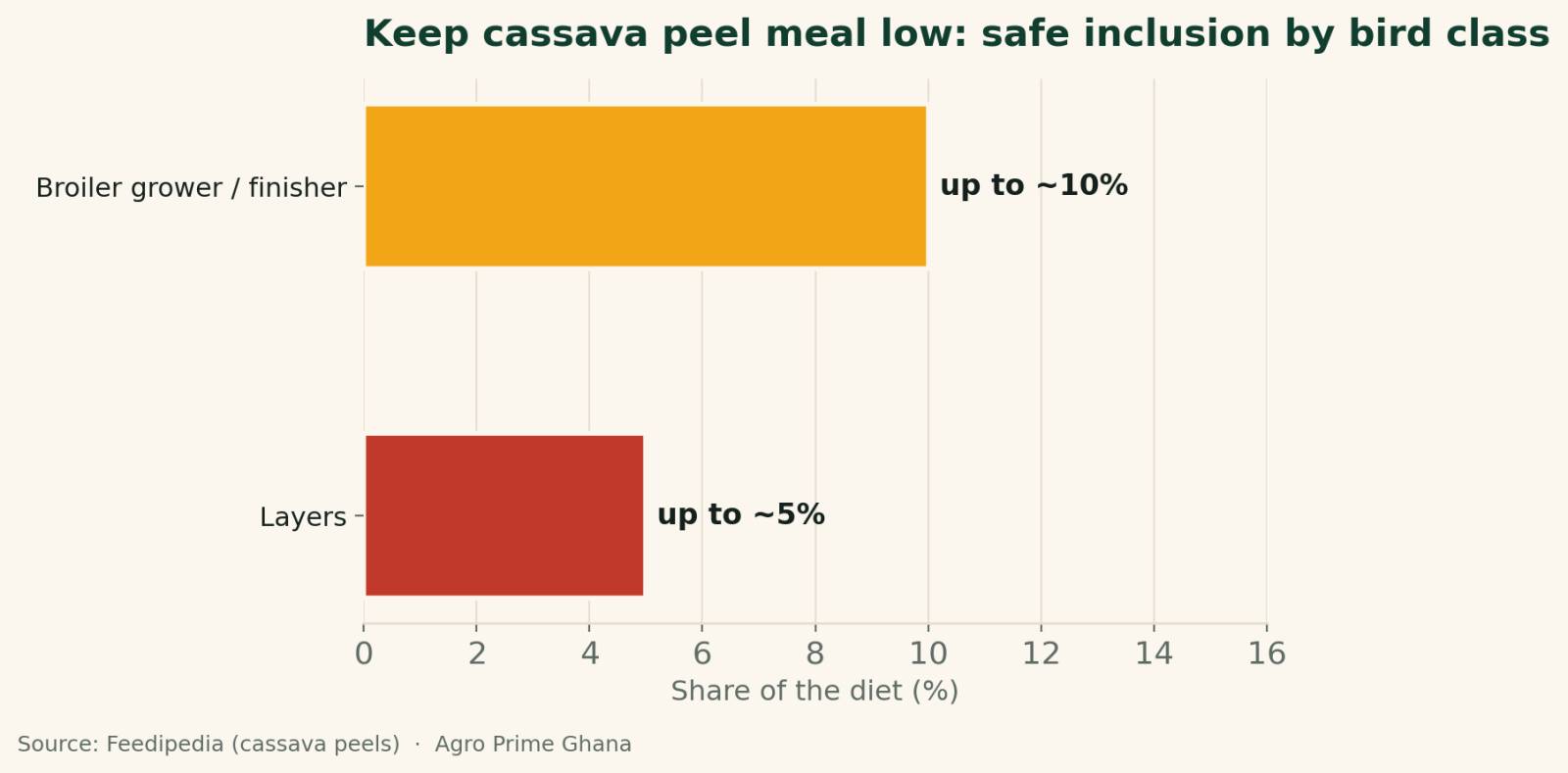
Keep it low. Based on Feedipedia's recommendations, well-processed cassava peel meal can go into broiler diets at around 5–10% of the ration, depending on quality and how well the rest of the feed is formulated, and into layer diets at only about 5%. The layer limit is stricter for a reason: Feedipedia notes that pushing peel to 20% of a layer ration cut egg production by roughly 15% — a price that wipes out any feed saving many times over. Slow-growing local and dual-purpose birds can tolerate a little more, but even then the fibre ceiling applies. The table below sets out sensible working limits.
| Bird class | Sensible maximum (dried peel meal) | Why the limit |
|---|---|---|
| Broiler starter (0–3 wk) | Avoid or keep minimal | Young broilers need dense energy; fibre and dilution hurt most here |
| Broiler grower / finisher | ~5–10% | Can carry some fibre; still dilutes energy, so rebalance the ration |
| Layers | ~5% | 20% inclusion cut egg output ~15% in trials — keep it low |
| Slow-growing / local / dual-purpose | Modestly higher, with care | Less demanding birds tolerate more fibre, but the cyanide rule still applies |
How dangerous is the cyanide in cassava peel?
Fresh cassava peel is genuinely dangerous, and this is the point no keeper can afford to get wrong. Cassava contains cyanogenic glycosides — compounds that release hydrogen cyanide (HCN), a real poison, when the plant tissue is damaged. The peel and the outer layers hold far more of this cyanogenic potential than the white inner flesh, so peel is the riskiest part of the plant to feed. Fed fresh, it can sicken or kill birds outright. The good news is that the toxin is volatile and can be driven off by processing. Feedipedia notes that sun-drying reduces HCN to acceptable levels for poultry, below about 50 mg/kg, and that soaking or ensiling followed by drying works too: chopping, grating and drying lets the released cyanide escape as gas before the peel reaches the trough. This is why the rule is absolute — never feed fresh, wet or partly dried cassava peel to poultry. Dry it properly first, every time.
Field note: how we treat peel before it goes anywhere near feed
The habit we keep is simple and non-negotiable: peel is chopped or grated small, spread thin — not heaped — on a clean, raised drying surface or tarpaulin, and sun-dried hard until it snaps rather than bends. Thin spreading matters because a deep pile dries on the outside and stays damp and toxic in the middle — exactly how keepers get caught out. We never dry peel on bare ground where it picks up soil, droppings and mould, and we are wary of the wet season when it simply cannot dry fast enough — damp peel that sits also grows the moulds that produce aflatoxin, a second poison on top of the cyanide. If it will not dry crisp within a day or two, it is not worth the risk.
How do you process cassava peel into a safe feed?
Turning peel into a usable ingredient is low-tech but has to be done right. The sequence is: collect fresh and clean before it starts to rot; chop or grate it small to open up the tissue and speed drying; spread thin and sun-dry on tarpaulins or raised racks until it is bone-dry and brittle, which both drives off cyanide and stops mould; then mill it into a meal fine enough to blend evenly into feed. Milling matters more than it sounds — coarse, chunky peel will not mix uniformly and birds may sort it out or gorge on pockets of it. Where the weather allows, soaking or ensiling before drying reduces cyanide further, but for most smallholders thorough sun-drying is the practical, proven route. Store the finished meal like any feed ingredient — dry, off the floor, ventilated and pest-free — as covered in our guide to feed storage on the poultry farm. Well-dried peel meal protected from re-wetting is stable and storable; damp peel is a liability.
What are the other limits — anti-nutrients and balance?
Cyanide gets the attention, but two quieter limits also shape how much peel you can use. The first is fibre, which we have already met: at 14% crude fibre the peel dilutes energy and, in excess, produces loose, bulky droppings and wetter litter — a knock-on problem for foot health and disease. The second is phytate, which Feedipedia notes can reach around 1% of dry matter in cassava peel. Phytate binds phosphorus and some minerals, making them less available to the bird, so a ration heavy in peel can quietly become short of usable phosphorus unless you account for it. Both point to the same discipline: peel supplements a properly formulated ration, it does not replace balancing it. If you lean on peel, make sure the diet still hits its targets for energy, protein, phosphorus and amino acids — the same logic that governs any local ingredient, as we discuss in choosing poultry feed ingredients in Ghana.
Cut your maize bill without cutting corners — talk to us first
Cassava peel, palm kernel cake and other local by-products can genuinely lower your feed cost, but only inside a ration that still delivers the energy, protein and minerals your birds need — and only if the birds themselves are strong enough to perform. Agro Prime Ghana supplies healthy, vaccinated day-old chicks and point-of-lay pullets, quality feed, and hands-on help formulating least-cost rations around the local ingredients you can actually source. If you are thinking of using cassava peel or other alternatives, message us on WhatsApp (+233 24 915 1503) or book a visit, and we will help you build a ration that saves money without setting your flock back.
Where can you source cassava peel in Ghana?
Peel is everywhere cassava is processed, which in Ghana is nearly everywhere. The reliable sources are gari and cassava-flour processing centres, starch factories, and larger household or community processing sites, especially in the cassava-heavy belts of the Eastern, Central, Volta, Bono and Ashanti areas — but even peri-urban Kasoa and Accra markets generate steady volumes. The practical challenge is not finding peel; it is getting it fresh and clean, and drying it fast. Peel that has sat in a heap for a day or two in the heat is already fermenting and moulding, which is why the best arrangements are standing agreements to collect it the same day it is generated.
Field note: count the true cost before you commit
Peel looks free, but "free" ingredients rarely are once you count the work. Before we lean on cassava peel, we tally the real cost: transport, drying space, the labour to chop, spread, turn and mill, and the losses from any batch that spoils before it dries. Only when that total sits comfortably below the maize it replaces does peel actually save money. It pays best on larger flocks in the dry season, when sun is reliable and volumes justify the effort — and pays poorly for a handful of birds, or in the rains when nothing dries. Do the sum honestly rather than assuming cheap peel equals cheap feed.
Is cassava peel worth it? The cost-value verdict
Cassava peel earns its place as a modest, local energy extender — not as a headline ingredient. Its value is real but bounded: used at 5–10% in growers or finishers it can trim your maize bill, but its low protein, high fibre, cyanide risk and phytate mean it can never carry a diet. The keepers who win with peel treat processing as seriously as feeding: they collect it fresh, dry it hard, mill it fine, keep inclusion sensible, and rebalance the ration around it. Do that, and cassava peel becomes a quiet, dependable way to make your feed budget stretch further. Skip the drying or overdo the dose, and it becomes the most expensive shortcut on the farm — useful in its place, dangerous out of it, and its place is small, dry and well-managed.
Frequently asked questions
Can chickens eat cassava peel?
Is cassava peel poisonous to poultry?
How do you process cassava peel for chicken feed?
How much cassava peel can I put in poultry feed?
What is the protein content of cassava peel?
Why can't chickens eat a lot of cassava peel?
Does drying remove cyanide from cassava peel?
Does cassava peel cause aflatoxin problems?
Sources & further reading
- Feedipedia — Cassava peels, cassava pomace and other cassava by-products (composition, cyanide/HCN and sun-drying, phytate, inclusion rates for broilers and layers).
- FAO — A review of cassava in Africa (cassava's role and by-products in West Africa, including Ghana).
- Diarra, S.S. (2018), Peel meals as feed ingredients in poultry diets, Journal of Animal Physiology and Animal Nutrition (chemical composition and dietary recommendations for peel meals).
- Agro Prime Ghana guides: reducing poultry feed cost, poultry feed ingredients, feed formulation with the Pearson square and feed storage on the poultry farm.
About Agro Prime Ghana
Agro Prime Ghana Limited runs a poultry hatchery and mixed agribusiness in Kasoa, supplying day-old chicks and supporting poultry keepers across the country. We supply healthy day-old chicks (broilers and layers), point-of-lay pullets, quality feed and hands-on farm support, and we help farmers formulate least-cost rations around the local ingredients they can actually source. This article is general educational information, not a substitute for professional nutritional or veterinary advice. Ready to cut feed cost without cutting corners? Book a visit or message us on WhatsApp (+233 24 915 1503) to order chicks, feed or ration advice.