Good feed storage means keeping your feed dry, cool, off the ground and used in order — so it reaches the bird as fresh and clean as the day it was milled. In Ghana's hot, humid climate, poorly stored feed is one of the most expensive silent losses on a poultry farm: within weeks a bag can cake, grow mould, lose vitamins and develop aflatoxin — a poison that suppresses growth and immunity long before the feed looks or smells "off." Because feed is roughly two-thirds of your total cost, wasting it in the store is like tearing up money you have already spent. This guide explains how moisture, heat and pests destroy feed value under Ghanaian conditions, and the simple, low-cost practices — pallets, ventilation, FIFO rotation and rodent control — that protect it.
Written by the Agro Prime Ghana poultry team and reviewed against current references (FAO grain-storage guidance, MSD/Merck Veterinary Manual and industry storage guidelines). Last updated September 2026.
Key takeaways
Feed spoils fastest in warmth and moisture — exactly Ghana's climate. Moulds begin to grow once the surrounding air sits above about 65–70% relative humidity, which is why cereals must be stored at or below their safe moisture (about 13% for maize). Complete feed generally keeps well for only about 3 months in the heat (vitamin premixes can degrade in as little as 2 months in hot weather). Protect feed by storing it dry, cool, ventilated and off the floor on pallets, rotating stock first-in-first-out (FIFO), keeping the store rodent- and pest-proof, and buying only what you will use in a few weeks. Never feed mouldy, caked or musty feed — the aflatoxin it may carry harms growth, immunity and food safety, and there is no cure once birds are poisoned.
Why does feed go bad so fast in Ghana?
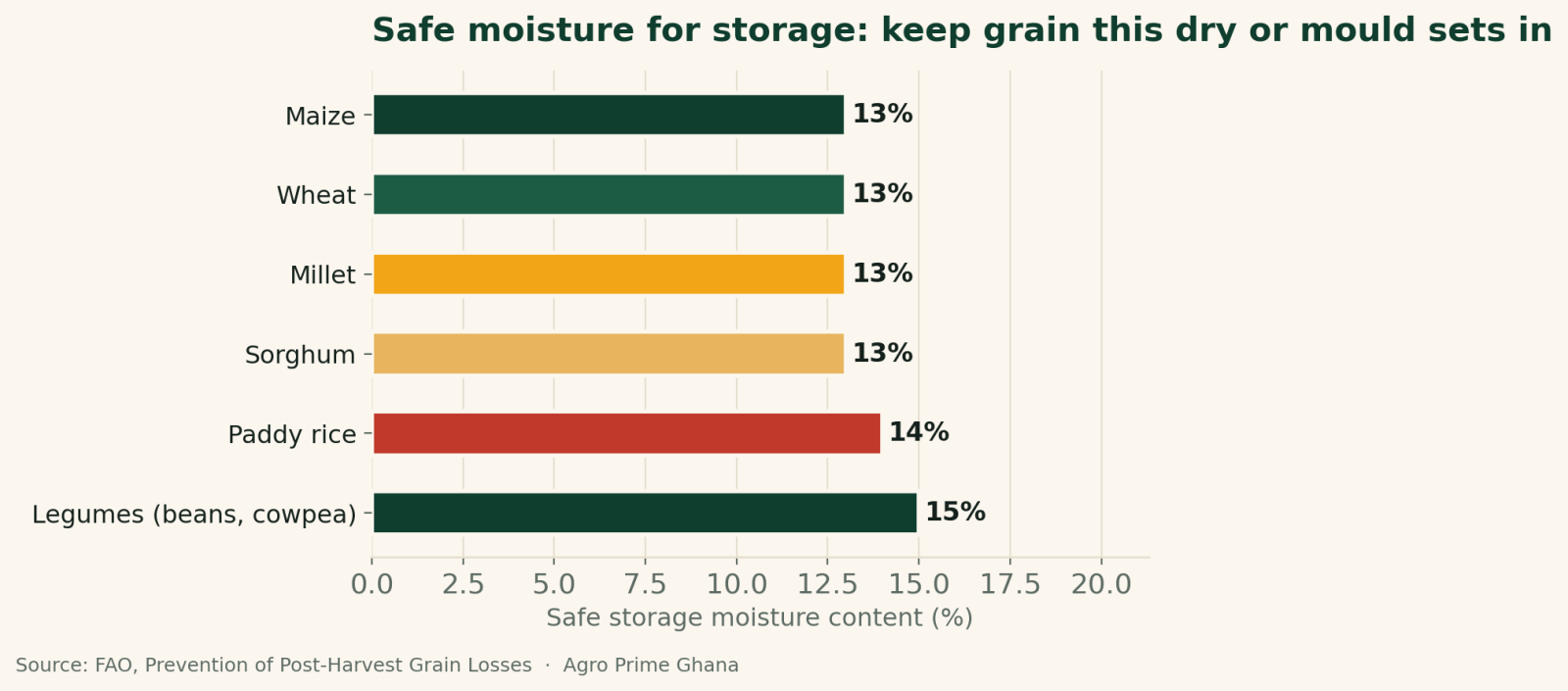
Feed spoils quickly here because the warm, humid climate is ideal for the moulds and pests that destroy it. Feed and its raw ingredients — maize, groundnut cake, wheat bran, soybean meal — are living, perishable materials. The moment grain or finished feed sits in air that is warm and damp, moisture creeps into it, and once its moisture content rises, mould takes hold. The FAO's grain-storage guidance is precise about the threshold: fungi start growing once the surrounding air is above about 65–70% relative humidity, and to stay safe, cereals such as maize, wheat and millet must be kept at or below roughly 13% moisture content (legumes about 15%). In much of Ghana, ambient humidity sits above that mould threshold for large parts of the year, so feed left in a damp, poorly ventilated store is under constant attack. Add our heat — which accelerates every chemical and biological process — and feed that would keep for months in a cool, dry climate can deteriorate in weeks here. This is not bad luck; it is physics and biology working against you, and it is exactly what good storage is designed to counter.
What poor storage actually costs you
Poor storage damages feed in three ways at once — it grows toxins, it loses nutrients, and it feeds pests — and all three cost you real money. The most dangerous is aflatoxin: a poison produced by Aspergillus moulds growing on damp maize and groundnut. As we cover in depth in our guide to aflatoxin in poultry feed, it damages the liver, suppresses the immune system so vaccines work poorly, slows growth and worsens feed conversion — and it does harm at levels measured in parts per billion, well below what looks or smells spoiled. The MSD Veterinary Manual notes that young poultry tolerate only about 50 ppb in feed. Second, storage steadily destroys nutrients: the Merck Veterinary Manual warns that vitamin and mineral premixes last only about 3–6 months, and as little as 2 months in summer heat, and that feed should be stored dry and cool "to keep vitamins from breaking down and to prevent fungal growth." A months-old bag in a hot store may be nutritionally hollow even if it looks fine. Third, rodents and insects eat feed, foul far more than they eat with droppings and urine, and carry disease into your biosecurity. Every one of these losses is paid for with feed you already bought.
The table below turns the storage principles into a practical checklist you can apply to your own feed store today.
| Storage factor | The risk if you get it wrong | What good practice looks like |
|---|---|---|
| Moisture / humidity | Mould and aflatoxin once air is above ~65–70% RH | Dry, weather-tight store; grain at ≤13% moisture; no leaks or damp walls |
| Floor contact | Damp wicks up from the floor into bottom bags | Stack on wooden or plastic pallets, ~10–15 cm clear of the floor |
| Temperature | Heat speeds mould and destroys vitamins | Cool, shaded, well-ventilated room; out of direct sun |
| Stock age (rotation) | Old feed sits and spoils behind new stock | First-in-first-out: use oldest bags first, date them |
| Pests / rodents | Eaten and fouled feed, disease spread | Sealed store, rodent-proofing, no spillage, bins with tight lids |
| Quantity held | Large stocks age past their shelf life | Buy for a few weeks' use, not months, in the heat |
Keep it dry: moisture is the enemy
Controlling moisture is the single most important thing you can do, because moisture is what lets mould grow and aflatoxin form. A feed store must be genuinely dry: a sound roof with no leaks, walls that do not sweat or wick damp, and no rain blowing in. Crucially, feed and grain must never sit directly on a concrete or earth floor — floors draw up moisture, and the bottom layer of bags is where caking and mould almost always start. Stack every bag on pallets (wooden or plastic) that lift the feed about 10–15 cm clear of the floor and allow air to circulate underneath, and keep bags a hand's width off the walls for the same reason. Ventilation matters just as much as dryness: air movement carries away the moisture and heat that feed and grain naturally give off, so a store with good cross-ventilation (protected from driving rain) stays far safer than a sealed, stuffy room. If you buy or dry your own maize, make sure it is properly dried to that safe ~13% moisture before it goes into store — grain put away damp will mould no matter how good the building is.
Field note: the bottom bag tells the truth
When we inspect a feed store, the first thing we check is the bottom bag on each stack and the ones against the wall. If the feed there is caked, warm, discoloured or smells musty while the top bags look fine, the store is wicking moisture and you are losing feed from the bottom up. It is a cheap fix — a few pallets and a gap from the wall — but farmers routinely skip it and pay for it in mouldy feed and slow birds. Turn a bag over and squeeze it: fresh feed is loose and cool; spoiling feed clumps and feels warm. Trust that check more than a quick glance at the top of the pile.
Use it in order: first-in, first-out (FIFO)
FIFO — first-in, first-out — means always using your oldest feed before your newest, and it is the simplest discipline for keeping feed fresh. Feed does not last forever even in a good store: complete poultry feed generally keeps well for only about three months, and less in the heat, while vitamin activity fades faster still. The classic mistake is to stack new deliveries in front of older bags, so the old feed gets buried, ages past its useful life and is eventually fed to birds — or thrown out — long after its vitamins have degraded and mould has set in. The fix costs nothing: put new stock behind or below existing stock, mark each bag or batch with its delivery date, and always draw from the oldest first. Pair this with buying sensibly — in Ghana's climate it is better to buy smaller quantities more often than to hold a big stock that will age past its shelf life before your birds can eat it. A slightly higher delivery frequency is far cheaper than a store full of feed that has quietly lost its value.
Keep pests and rodents out
A feed store is a magnet for rats, mice and insects, and keeping them out protects both feed and flock health. Rodents do triple damage: they eat feed, contaminate far more than they eat with droppings and urine, and carry diseases such as salmonella into your operation, which makes rodent control a biosecurity issue as much as a feed one. The practical defences are straightforward: keep the store sealed and rodent-proofed — block gaps under doors and holes in walls; store loose or opened feed in bins or drums with tight-fitting lids (metal or heavy plastic) that rodents cannot chew into; clean up every spillage promptly, because scattered feed both attracts pests and feeds them; and keep the area around the store clear of bush, rubbish and standing water that harbour rodents and insects. Regularly inspect for signs — droppings, gnawed bags, tracks — and act at the first sign rather than waiting for an infestation. Insect pests such as weevils also thrive in warm, undisturbed grain, which is another reason to rotate stock and not let feed sit for months.
Store your feed the way Agro Prime supplies it — fresh
The best-formulated feed only performs if it reaches the bird fresh, so at Agro Prime Ghana we help farmers buy and store feed the smart way: the right quantity for your flock and cycle, so you are never sitting on stock that ages past its value in the heat. We supply quality broiler, grower and layer feed alongside vaccinated day-old chicks and point-of-lay pullets, and we are happy to advise on setting up a simple, dry, pest-proof feed store and a FIFO routine that stops you losing feed you have already paid for. Want help sizing your feed orders or fixing a damp store? Message us on WhatsApp at +233 24 915 1503 or book a visit.
How long does poultry feed last, and how do you tell it has gone bad?
As a working rule, complete poultry feed is best used within about three months of milling, and sooner in hot weather, because vitamins degrade and the risk of mould and rancidity climbs with time and heat. Medicated feeds and those with added vitamins have the shortest useful life. To judge whether feed is still good, use your senses as a first screen — but know their limit. Good feed is loose, cool to the touch, has a fresh cereal smell and an even colour. Spoiling feed shows one or more warning signs: a musty, mouldy or sour smell; caking or clumping; visible mould, discolouration or fuzzy patches; warmth in the bag; webbing, insects or weevils; or a rancid, oily smell from oxidised fats. Any of these means the feed should not go to your birds. The hard truth, though, is that aflatoxin can be present in feed that looks and smells perfectly fine, because the toxin remains long after the mould that made it — so clean senses are the minimum bar, not proof of safety. That is why prevention through good storage, trusted suppliers and, for larger farms, a toxin binder and testing, matters more than any sniff test. When in genuine doubt, throw it out: a discarded bag is far cheaper than a poisoned or stunted flock.
The bottom line on feed storage
Feed is the biggest cost on almost every Ghanaian poultry farm, and how you store it decides whether that money buys growth or grows mould. The enemies are heat, moisture and pests — all of which our climate supplies in abundance — and the defences are cheap and simple: keep the store dry, cool and ventilated; stack feed on pallets off the floor and away from walls; buy only what you will use in a few weeks; rotate stock first-in-first-out and date your bags; and keep the store sealed against rats, mice and insects. Never feed mouldy, caked or musty feed, and remember that aflatoxin can hide in feed that looks clean. None of this requires new buildings or big spending — just a routine, applied consistently. Get it right and every bag delivers the growth you paid for; get it wrong and you lose feed, vitamins, birds and food safety, all at once, from stock you had already bought.
Frequently asked questions
How should poultry feed be stored on a farm?
How long can you store chicken feed before it goes bad?
Why does feed grow mould in Ghana so easily?
Why should feed bags be stored on pallets?
What is FIFO in feed storage?
Can I feed my birds feed that has gone slightly mouldy?
How do I keep rats and insects out of my feed store?
Does stored feed lose its vitamins over time?
Sources & further reading
- FAO — Manual on the Prevention of Post-Harvest Grain Losses: The Fundamentals of Storage — safe moisture contents for cereals and the ~65–70% relative-humidity threshold for mould growth.
- MSD / Merck Veterinary Manual — Management of Backyard Poultry (vitamin/premix shelf life, dry-cool storage) and Aflatoxicosis in Animals (aflatoxin tolerance levels).
- Agro Prime Ghana guides: aflatoxin in poultry feed, maize quality for poultry feed, and poultry feed ingredients.
About Agro Prime Ghana
Agro Prime Ghana Limited runs a poultry hatchery and mixed agribusiness in Kasoa, supplying day-old chicks and supporting poultry keepers across the country. These guides combine hands-on hatchery and farm experience with current veterinary and industry references. This article is general educational information, not a substitute for professional advice — if you suspect aflatoxin or spoiled feed, seek guidance and have feed tested where possible. We supply healthy day-old chicks (broilers and layers), point-of-lay pullets, quality feed and hands-on farm support. Need feed, chicks or storage advice? Book a visit or message us on WhatsApp (+233 24 915 1503).