Buying poultry feed and ingredients in bulk in Ghana can genuinely cut your feed bill — often the difference between a profitable batch and a losing one — but only if you can store it dry, protect it from mould and pests, and afford to tie up the cash. Feed is by far the largest cost in poultry, typically 58–70% of total production cost, so a small saving per bag is a large saving per bird. The catch is that a bulk purchase you cannot keep dry becomes a bulk loss: maize that goes above 13% moisture grows mould and can develop aflatoxin within weeks. This guide explains when bulk buying pays in Ghana, how much you realistically save, how to store grain and feed safely, and how to manage the cash-flow and spoilage risks so the discount actually reaches your pocket.
Written by the Agro Prime Ghana poultry team and reviewed against current industry and agricultural references (FAO and Feedipedia). Last updated September 2026.
Key takeaways
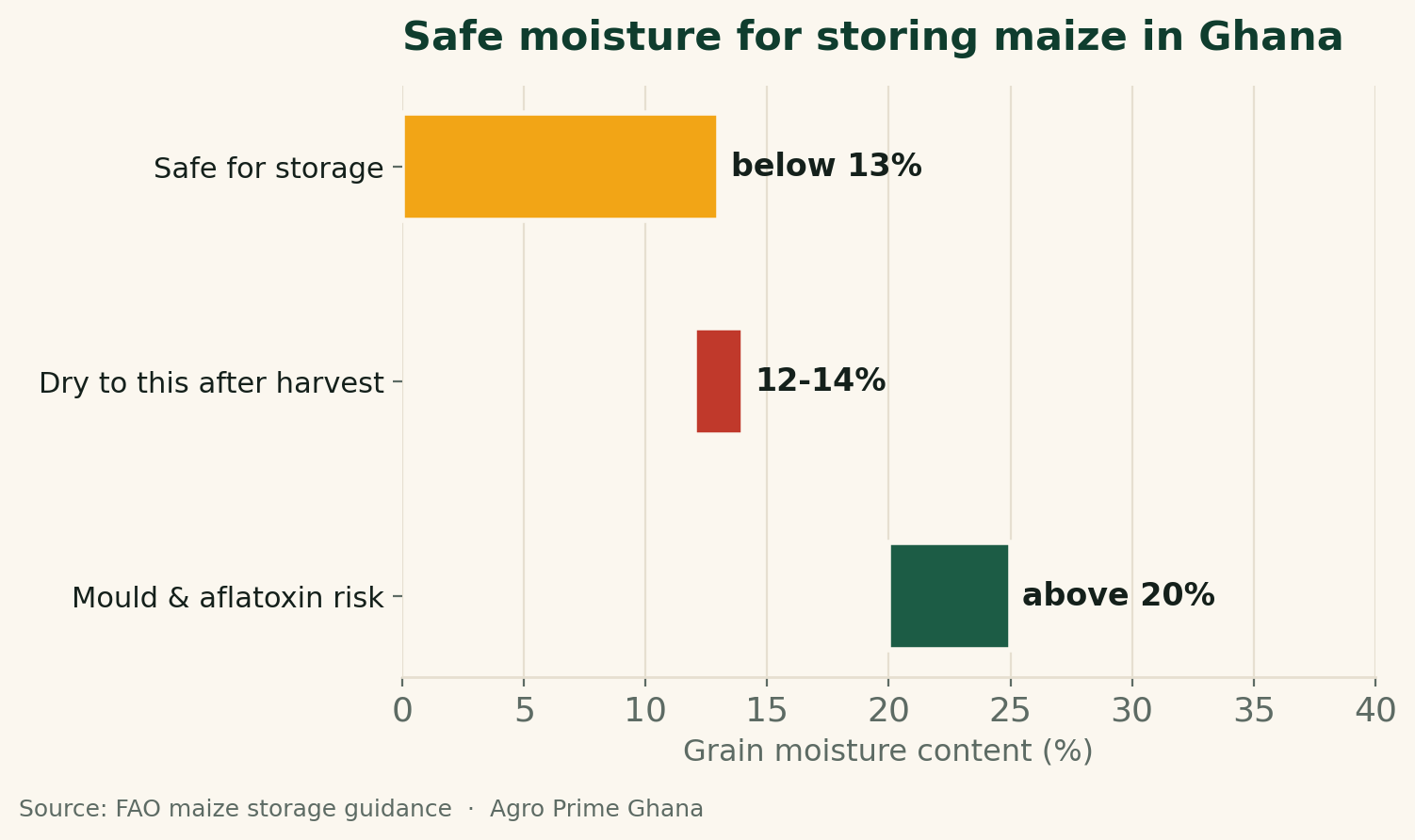
Feed is the biggest cost in poultry — around 58–70% of total production cost — so cutting the price per bag has an outsized effect on profit. Buying maize, concentrate and finished feed in bulk usually earns a wholesale discount and shields you from price spikes in the lean season, but it only pays if you can store it properly. Maize must be kept below 13% moisture, where mould growth is negligible; above about 20% moisture mould and aflatoxin risk climbs fast in our heat. Bulk buying also ties up cash and carries spoilage and theft risk, so match the quantity you buy to what you can pay for, keep dry, and use within a few months. Buy clean, well-dried grain from reliable sources, store it off the floor in a dry, ventilated, rodent-proofed room, and use oldest stock first.
Why feed cost decides whether poultry pays in Ghana
Feed is the single largest expense in any poultry enterprise, and it is not close. Analyses of layer production put feed at roughly 58% to 68% of total production cost, and industry figures for broilers and breeders put it as high as 70% of the cost. In Ghana that share often feels even heavier, because maize and soya prices swing sharply between the harvest glut and the lean season. When feed is that dominant a cost, the price you pay per bag is one of the few levers with real power over your margin: shave 8–10% off the feed price and you can move the whole enterprise from marginal to comfortably profitable. This is exactly why serious keepers pay so much attention to how and when they buy, not just what they feed. For a fuller treatment of the cost side, see our guide to reducing poultry feed cost.
How much does buying in bulk actually save?
Buying in bulk saves money in three separate ways. The first is the plain wholesale discount: a full-load or multi-bag price from a mill, a maize aggregator or an ingredient dealer is almost always lower per kilo than buying a bag or two at a time from a retail shop. The second, larger in most years, is timing: maize is cheapest at the main harvest and dearest in the lean months before the next crop, so a keeper who buys and stores a few months' maize at harvest can pay far less than one buying hand-to-mouth in the lean season. The third is fewer trips: transport, loading and your own time all cost money, and consolidating them trims that overhead. Because maize is only about 9% crude protein but forms the bulk of the ration by weight, it is usually where bulk buying and good timing move the most money — the energy base is where most of your feed cedis go.
| Buying approach | Best for | Main advantage | Main risk to manage |
|---|---|---|---|
| Hand-to-mouth (a bag or two at a time) | Very small flocks, no storage, tight cash | No storage or spoilage risk; minimal cash tied up | Highest price per bag; exposed to lean-season spikes |
| Bulk finished feed (weeks' supply) | Keepers who don't mix their own | Wholesale price; fewer trips; supply security | Finished feed spoils faster; buy only what you'll use in ~4 weeks |
| Bulk maize/ingredients at harvest | Keepers who mix, with a dry store | Biggest saving — harvest price plus wholesale discount | Storage, drying, mould/aflatoxin, pests, cash tied up for months |
| Group / cooperative buying | Smallholders pooling orders | Wholesale price without huge individual outlay | Coordination, trust, shared storage and fair splitting |
Finished feed versus raw ingredients: which to bulk-buy
There is an important split here. Finished, milled feed spoils faster than whole grain, because grinding exposes more surface to air and moisture and the added fat can go rancid. As a rule, buy only as much finished feed as your flock will eat within about a month, and store it well; holding milled feed for many months in Ghanaian heat invites mould, rancidity and vitamin loss. Whole maize and other whole grains, by contrast, keep far better if properly dried — which is why the keepers who save the most on feed are usually those who buy maize in bulk at harvest and mill in smaller, fresher batches. If you mix your own ration, bulk-buying the maize (and, where sensible, the concentrate or soya) captures the harvest-price advantage while letting you keep the finished feed fresh. If you don't mix, you can still bulk-buy finished feed from a mill for a wholesale price, but keep the quantity modest and rotate it quickly. Our guides to making poultry feed and choosing feed ingredients go deeper on the mixing route.
The real risk: storing bulk grain without ruining it
This is where most bulk-buying plans succeed or fail. The single most important number to know is moisture. According to FAO guidance on maize storage, mould growth is negligible when maize moisture content is below 13%, and wet maize should be dried to 12–14% moisture immediately after harvest. Above about 20% moisture, mould takes hold quickly, and high moisture combined with warmth and kernel damage is the chief cause of mould in stored maize. In our climate this matters enormously: the same Aspergillus moulds that spoil grain also produce aflatoxin, a poison that damages birds' livers and suppresses immunity, and it can develop in poorly dried, poorly stored grain even when the maize still looks acceptable. So the golden rule of bulk buying is blunt: only buy grain that is properly dry, and only in a quantity you can keep dry. Buying a cheap ten-bag lot of under-dried maize is not a saving — it is a slow write-off.
Practical storage that works on a Ghanaian farm comes down to a few disciplines. Buy grain that is already well dried — test or insist on it rather than planning to dry a large lot yourself. Store it off the floor on pallets and away from walls, so damp cannot wick up and air can move. Keep the store dry, well ventilated and rain-proof, with no leaking roof or floor seepage. Rodent- and bird-proof it, because rats and wild birds both eat grain and foul far more than they eat. Use oldest stock first (first-in, first-out) so nothing sits for months forgotten in a corner. And check the pile regularly — warm spots, caking, a musty smell or insect activity are all early warnings to act on. Materials held above 13% moisture are especially prone to insect and mould attack, so dryness is the master control for everything else.
Field note: buy the dryness, not just the price
The mistake we see again and again is a keeper chasing the lowest quoted price on a maize lot without checking how well it was dried. On our own buying we treat dryness as the first question, not the last — grain that is warm in the sack, that was clearly dried on bare ground, or that feels even slightly soft is a warning sign, however good the price. A quick bite test (well-dried maize is hard and cracks sharply rather than denting) and a look and smell for mould, caking and insect damage takes a minute and has saved us from lots that would have gone mouldy within weeks. Cheap wet grain is the most expensive feed you can buy.
Managing cash flow: don't let a good deal choke you
The other side of bulk buying is money, and it is why many farms shouldn't bulk-buy as much as they'd like. A bulk purchase converts weeks or months of feed spending into one large upfront payment. That earns the discount, but it ties up cash you might need for chicks, drugs, wages or an emergency, and a single bad month — a disease scare, a delayed egg payment, a family need — can then leave you unable to run the farm even though your store is full of feed. The discipline is to match the size of your bulk buy to your cash position and your flock's real needs, not to the size of the discount. Group or cooperative buying is a powerful answer: several smallholders pooling one wholesale order each get the bulk price without any one of them making a crippling outlay. Keeping clear feed and cash records — see record-keeping for poultry farms — makes these decisions far easier, because you know your true feed consumption rather than guessing.
Field note: buy for a horizon you can store and afford
We size a bulk buy by two numbers, not one. First, how much feed the flock will genuinely eat before the grain reaches its safe storage limit — buy past that and you're storing spoilage. Second, how much cash we can commit without starving the rest of the farm of working capital. The discount is the last thing we look at, not the first. A store you can keep dry, a horizon you can use up, and a cash cushion left over: get those three right and the saving takes care of itself.
How to judge the quality of what you're buying in bulk
The bigger the lot, the more a quality mistake costs, so bulk buying demands more scrutiny, not less. Before committing to a large purchase, inspect a real sample from the actual lot — not a clean display bag. Look for mould, discolouration, caking, insect damage, stones and sand; smell for a musty or sour odour; and check that grain is genuinely dry. Adulteration is a real risk in ingredient markets — sand or dirt bulking out a lot, or low-grade material sold as high-grade — and it is exactly the kind of problem a bulk purchase multiplies. Our companion guide, how to test and judge poultry feed quality, walks through the physical checks and lab options in detail; run those checks before you pay for a big lot, not after.
Get reliable feed and healthy chicks from one place
Bulk feed only pays if the birds eating it are worth feeding. Agro Prime Ghana supplies strong, well-started day-old chicks (broilers and layers) and point-of-lay pullets alongside quality feed and honest sourcing advice — including help working out how much feed your flock will actually need over a batch, so you buy the right quantity in bulk instead of guessing. If you'd like a hand planning your feed buying, checking a maize lot, or ordering chicks and feed together, message us on WhatsApp (+233 24 915 1503) or book a visit to the farm.
Bulk buying and feed wastage: two sides of the same coin
Saving on the buying price is only half the job — the other half is making sure the feed reaches the birds rather than the floor, the rats or the rain. It is a hollow victory to negotiate a 10% discount and then lose as much again to spillage, spoilage and pests, and bulk buyers have the most to lose because they hold the largest stock. Treat storage and feeder discipline as part of the same saving: keep the store dry and pest-proof, and keep feeders correctly filled and adjusted so birds don't rake feed onto the floor. Our guide to cutting poultry feed wastage covers the feeding side; together with good buying and storage, it protects the whole chain from purchase to trough.
When bulk buying is NOT the right move
Bulk buying is a tool, not a virtue, and there are clear cases where it is the wrong choice. If you have nowhere dry and secure to store grain, don't do it — spoilage will erase the saving and may poison your flock. If buying in bulk would leave you short of cash to run the rest of the farm, don't do it — a full feed store and an empty wallet is a bad trade. If your flock is small and can't use a large lot within its safe storage life, the grain will spoil before you feed it. In these situations, buying smaller quantities more often — or joining a group purchase so someone with proper storage holds the stock — is the smarter path. The goal is never to buy the most feed; it is to get the lowest true cost per bird fed, spoilage and risk included.
The bottom line on bulk feed buying in Ghana
Because feed is 58–70% of the cost of keeping poultry, the price you pay for it is one of the biggest levers on your profit — and buying maize, ingredients and finished feed in bulk, especially at harvest, is one of the most reliable ways to pull that lever. But the discount is only real if the feed survives to be eaten: maize must be kept below 13% moisture to stay mould-free, finished feed must be used fresh, the store must be dry and pest-proof, and the cash you commit must not starve the rest of the farm. Buy dry grain from reliable sources, buy only what you can store and afford, rotate stock oldest-first, and pair good buying with tight storage and feeding discipline. Do that and bulk buying becomes exactly what it should be — a steady, honest saving on the biggest bill you have.
Frequently asked questions
Is it cheaper to buy poultry feed in bulk in Ghana?
How long can I store maize and poultry feed?
What moisture level is safe for storing maize?
What are the risks of buying feed in bulk?
Should I bulk-buy finished feed or raw ingredients?
How can I bulk-buy if I only have a small flock?
How do I stop bulk-stored grain from going mouldy?
Does bulk buying help protect against price swings?
Sources & further reading
- FAO — Small-scale poultry production: economics (feed as 58–68% of production cost).
- FAO — Mycotoxin prevention: inspection, sampling and storage of maize and groundnuts (safe moisture below 13%; dry to 12–14%; risk above 20%).
- FAO — Quality control in feed manufacturing (moisture above 13% prone to insect and mould attack; physical checks).
- Feedipedia — Maize grain (nutrient composition and aflatoxin susceptibility).
- Canadian Poultry / Avinews — The costs and impacts of feed wastage (feed up to 70% of cost).
- Agro Prime Ghana guides: reducing poultry feed cost, testing feed quality, reducing feed wastage, and making poultry feed.
About Agro Prime Ghana
Agro Prime Ghana Limited runs a poultry hatchery and mixed agribusiness in Kasoa, supplying day-old chicks and supporting poultry keepers across the country. We supply healthy day-old chicks (broilers and layers), point-of-lay pullets, quality feed and hands-on farm support, and we help keepers plan sensible feed buying and storage. This article is general educational information, not a substitute for professional agronomic or veterinary advice. Ready to start or expand? Book a visit or message us on WhatsApp (+233 24 915 1503) to order chicks, feed or advice.