You can judge most poultry feed quality in Ghana with your eyes, nose and hands before you ever reach a laboratory: reject feed that is mouldy, musty, caked, dusty, discoloured, insect-infested or full of stones and sand, and be suspicious of anything that looks or smells wrong or is priced too good to be true. Those physical checks catch the worst material and cost nothing. But the two things that matter most — the real protein content and hidden aflatoxin — cannot be seen or smelled, and for those you need a declared analysis you trust or a laboratory test. This guide explains how to judge feed and ingredient quality in Ghana: the physical checks that catch bad feed, how to spot adulteration, what protein and moisture figures to expect, when to test for aflatoxin, and where laboratory options exist.
Written by the Agro Prime Ghana poultry team and reviewed against current industry and veterinary references (FAO, MSD Veterinary Manual and cooperative-extension guidance). Last updated September 2026.
Key takeaways
Start every batch of feed or ingredients with a physical check: look for mould, caking, discolouration, insects and foreign matter (stones, sand, metal); smell for a musty, sour or rancid odour; and check that grain is genuinely dry and finished feed is fresh. Watch for adulteration — sand or dirt bulking out a lot, cheap material sold as premium — which laboratory ash and acid-insoluble-ash tests can expose. Know your target numbers so you can spot a bag that can't be right: broiler starter should be about 20–23% crude protein, layer feed about 15–19% with 3.6–4.2% calcium, and moisture ideally below 13%. The two dangers you can't see — true protein level and aflatoxin — need lab or rapid testing; birds tolerate only about 50 ppb aflatoxin (young) to 100 ppb (adult) in feed. When it matters, send a proper representative sample to a feed laboratory.
Why feed quality is worth checking in Ghana
Feed is the largest cost in poultry, so paying for feed that under-delivers is the most expensive mistake you can make twice. Poor-quality feed shows up as slow, uneven growth, poor feed conversion, disappointing egg numbers, weak shells and flocks that respond badly to vaccines — often blamed on "bad chicks" or "weak breed" when the real fault is in the bag. Two problems dominate in Ghana. The first is low or variable nutrient content: a feed that claims a protein level it doesn't contain, or an ingredient lot poorer than it looks. The second is aflatoxin — a mould poison that rides in on maize and groundnut, the backbone of local rations. Research on Ghana's poultry chain has repeatedly detected aflatoxin in feed ingredients, finished feed and even poultry products, so this is a live local problem, not a theoretical one. Both are invisible to a casual glance, which is exactly why a disciplined checking routine pays for itself.
The physical checks anyone can do
Most bad feed can be caught with a careful sensory inspection, and you should do it every single time before feed or ingredients go into the store or the trough. FAO's feed quality-control guidance centres physical inspection on three things: evidence of wetting or mould, the presence of foreign contaminants (scrap metal, stones, dirt), and signs of insect infestation. In practice, work through your senses:
- Look. Reject anything discoloured, caked or lumpy (a sign of past dampness), visibly mouldy, dusty (excess fines suggest poor quality), or contaminated with stones, sand, husks, string or metal. Insect webbing, live weevils or bored kernels are a clear fail.
- Smell. Fresh feed smells clean and grainy. A musty odour means fungal growth; a sour smell means it got wet; a rancid, paint-like smell means the fat has oxidised — common in the tropics and a real problem in feeds and oilseed cakes. Any off-smell is a reason to reject.
- Touch. Feel for dampness, warmth and caking. Grain should be hard and dry — well-dried maize cracks sharply when bitten rather than denting. Warm grain in a sack warns of active mould or insects.
These checks are the minimum bar. They reliably catch spoiled, wet, infested and grossly adulterated material — but, crucially, they do not guarantee safety, because the two worst problems (true protein content and aflatoxin) can be present in feed that looks and smells fine.
Know your target numbers — so you can spot what can't be right
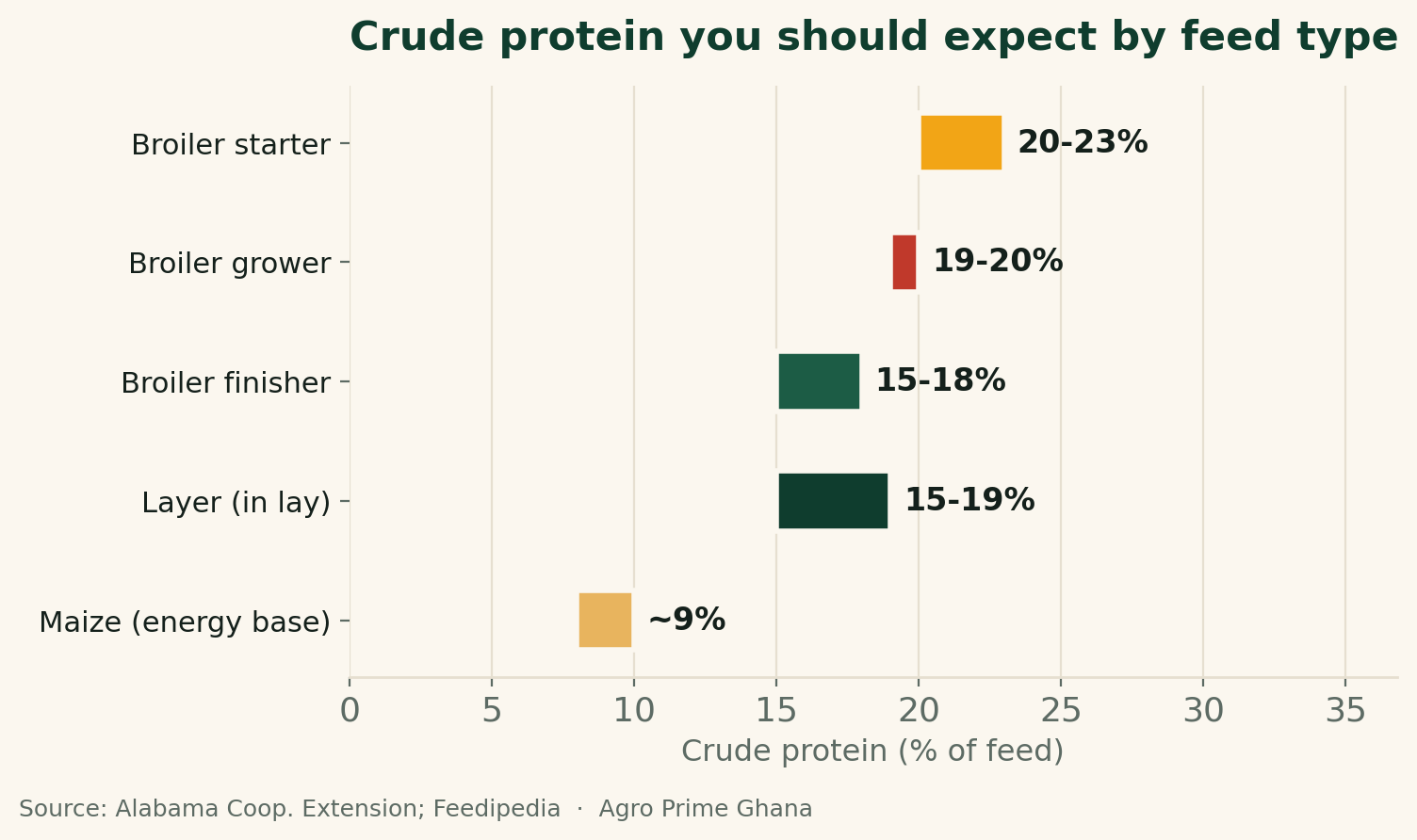
You can't measure protein by eye, but knowing the correct figures lets you challenge a claim that doesn't add up. Standard crude-protein levels, drawn from cooperative-extension feeding guidance, give you a yardstick to check a feed label or a home mix against. If a "broiler starter" is being sold as high-protein but is mostly maize — which is only about 9% crude protein — the number simply cannot be right, and that is worth questioning before you buy in quantity. The table below sets out the ranges to expect.
| Feed / stage | Crude protein (typical) | Other key spec |
|---|---|---|
| Broiler starter (0–4 wks) | 20–23% | High energy; often contains a coccidiostat |
| Broiler grower (4–8 wks) | 19–20% | Balanced amino acids for frame growth |
| Broiler finisher (>8 wks) | 15–18% | High energy; withdrawal period for any medication |
| Layer (in lay, >20 wks) | 15–19% | Calcium 3.6–4.2% for shell quality |
| Maize (energy base) | ~9% | Reference only — shows why maize alone can't be "high protein" |
| All feeds — moisture | — | Ideally below 13%; above 13% invites mould and insects |
How to spot adulteration and cheating
Adulteration is one of the most common quality problems in ingredient markets, and it is designed to fool a quick look. The classic tricks are bulking a lot with cheap filler — sand, dirt, ground husk or stones added to maize or by-products to add weight — and selling low-grade material as high-grade, such as poor fishmeal, adulterated groundnut cake, or wheat bran padded with husk. Some of this you can catch physically: run grain through your fingers to feel for grit, look for excess dust or foreign particles, and be sceptical of a price that undercuts everyone else. But the reliable way to expose filler is in the laboratory: FAO notes that testing total ash, and specifically acid-insoluble ash, gives "an indication of the amount of sand or other dirt present" — an abnormally high acid-insoluble ash is a fingerprint of soil or sand adulteration. Certain ingredients also carry natural anti-nutrients that quality control checks for: urease in under-processed soybean, gossypol in cottonseed, and toxins in cassava and linseed. This is why serious buyers treat a suspiciously cheap "bargain" as a red flag, not an opportunity.
Field note: the tests your senses can't pass
We rely on physical checks for every intake — they catch the obvious spoilage and the crude adulteration, and they cost nothing. But we're honest about their ceiling. Two of the things that hurt a flock most, a shortfall in real protein and the presence of aflatoxin, can sit invisibly in feed that looks clean and smells fine. When performance is slipping for no clear reason, or when we're committing to a large ingredient purchase, that's the point where senses stop being enough and a laboratory number earns its cost. Treating a clean look as the minimum bar rather than proof of safety is the mindset that separates guessing from knowing.
What a laboratory actually tests: the proximate analysis
When you send feed or an ingredient to a laboratory, the workhorse test is the proximate (Weende) analysis, which breaks the sample into six fractions: moisture, crude protein, crude fat, crude fibre, ash, and nitrogen-free extract. From these you learn what matters most: whether protein meets the specification you're paying for; whether moisture is safely low (above ~13% and feed is prone to mould and insects); whether fibre is too high (padding with husk or low-grade by-product); and whether ash is abnormally high (sand, soil or excess mineral). A fuller test can add amino acids (lysine and methionine, which matter more than crude protein alone), calcium and phosphorus for layers, and a dedicated aflatoxin assay. You needn't test every batch — but for a large purchase, a new supplier, a home-mixed ration, or a flock underperforming for no clear reason, a proximate analysis turns guesswork into fact.
Aflatoxin: the test that can save a flock
Aflatoxin deserves its own attention because it is both invisible and genuinely dangerous, and because our staple ingredients — maize and groundnut — are its classic carriers. The critical fact is how little it takes. The MSD Veterinary Manual gives tolerable dietary levels of only about 50 parts per billion (ppb) for young poultry and about 100 ppb for adults, with clinical disease and deaths at roughly double those levels, and growing birds are most susceptible. Because the toxin remains in grain long after the mould that made it has gone, and survives normal milling and feed processing, you cannot see, smell or cook it out — so the only way to know a suspect lot is safe is to test it. Options range from rapid on-site kits (lateral-flow strips that give a quick estimate, useful for screening incoming grain) to a full laboratory assay for a precise figure. If you buy or mix in bulk, screening maize and groundnut for aflatoxin is one of the highest-value tests you can run. Our companion article on making poultry feed covers keeping contamination out at the mixing stage.
Buy feed and chicks you don't have to second-guess
Testing exists because so much feed on the market can't be trusted — but the simplest quality control is buying from a source that stands behind what it sells. Agro Prime Ghana supplies quality feed and strong, well-started day-old chicks and point-of-lay pullets, and we're happy to talk you through judging an ingredient lot, reading a feed label, or deciding when a sample is worth sending to a lab. If you want reliable feed, healthy birds, or a second opinion on a batch you're unsure about, message us on WhatsApp (+233 24 915 1503) or book a visit to the farm.
Where to get feed tested in Ghana
Laboratory feed analysis is more accessible in Ghana than many keepers assume. Samples can be analysed at university and research-institute laboratories (agricultural, animal-science and food-research departments run proximate analysis and, in some cases, aflatoxin testing), at government and standards laboratories, and at some private feed mills and commercial labs. For most small keepers the practical route is to ask your veterinary or extension officer, a reputable feed mill, or a nearby agricultural university where samples can be sent and what a test costs. The result is only as good as the sample, though — see the next section — so get the sampling right before you pay. Rapid aflatoxin kits are increasingly used by larger farms and mills for fast on-site screening between full lab tests.
Getting a sample that actually represents the lot
A laboratory can only test what you send it, and the single most common reason a good test gives a misleading answer is a bad sample. Aflatoxin in particular is distributed unevenly — a few badly contaminated kernels in a sack can carry most of the toxin — so one scoop off the top of one bag can easily miss it or exaggerate it. The fix is to take a representative composite sample: draw small amounts from many points across the lot — different bags, and different depths within each bag — combine them into a larger pooled sample, mix it thoroughly, and then take your final test portion from that well-mixed pool. FAO's guidance on sampling maize and groundnuts for aflatoxin stresses exactly this point, because poor sampling is the biggest source of error in mycotoxin testing. The more sampling points, the more the result reflects the true state of the whole lot rather than one lucky or unlucky handful.
Field note: the rancid smell most keepers miss
Everyone checks for mould, but the off-smell we've learned to take just as seriously is rancidity — a faint paint-like or stale-oil odour in feed or oilseed cake. In our heat, the fat in feed oxidises quickly, and rancid feed both tastes bad to birds (so they eat less) and destroys some of the vitamins in the ration. It's easy to miss because the feed can look perfectly fine. If a bag smells stale or oily rather than clean and grainy, we treat it as suspect, however good it looks.
Building a simple feed-quality routine
You don't need a laboratory on the farm to run good quality control — you need a consistent routine: physically inspect every intake (look, smell, touch) and reject anything mouldy, musty, wet, caked, infested or adulterated; buy from reliable suppliers and treat suspiciously cheap lots as a warning; know your target numbers so you can challenge a protein or calcium claim that can't be true; store everything dry; and escalate to laboratory or rapid testing when the stakes are high — a big purchase, a new supplier, a home-mixed ration, or a flock underperforming for no clear reason. Keep brief records of what you bought, from whom, and how the flock performed, so a dip that coincides with a new feed batch is easy to spot. This layered approach — free checks for everything, paid tests where they matter — gives most of the protection at a fraction of the cost of testing blindly.
The bottom line on judging feed quality
Good feed-quality control in Ghana is layered. Your eyes, nose and hands do most of the work for free, catching the mould, damp, insects, foreign matter and crude adulteration that ruin so many lots — and you should run those checks on every intake without exception. Knowing the right numbers (broiler starter around 20–23% protein, layer feed 15–19% with 3.6–4.2% calcium, moisture below 13%) lets you challenge claims that can't be true. But the two things that hurt flocks most — a real protein shortfall and invisible aflatoxin — sit beyond the reach of your senses, and for those you need a declared analysis you trust or a laboratory test, drawn from a proper representative sample. Treat a clean look as the minimum bar rather than proof of safety, buy from sources that stand behind their feed, and test when the stakes are high. That discipline turns feed from your biggest gamble into your most controllable cost.
Frequently asked questions
How can I tell if poultry feed is good quality?
Can I test poultry feed quality without a laboratory?
What protein content should poultry feed have?
How do I detect adulteration in feed ingredients?
How much aflatoxin is dangerous in poultry feed?
Where can I test poultry feed in Ghana?
What does a proximate feed analysis measure?
How do I take a good feed sample for testing?
Sources & further reading
- FAO — Quality control in feed manufacturing (physical inspection, proximate/Weende analysis, ash and acid-insoluble ash, anti-nutrients, moisture threshold).
- FAO — Inspection, sampling and analysis of maize and groundnuts for aflatoxin (representative sampling, safe moisture).
- MSD Veterinary Manual — Aflatoxicosis in Animals (tolerable ppb levels, susceptibility).
- Alabama Cooperative Extension — Nutrition for poultry flocks (crude protein and calcium targets by feed type).
- Feedipedia — Maize grain (composition, ~9% crude protein).
- Nsiah et al. — Aflatoxin contamination in poultry ingredients, feed and products in Ghana (evidence of local contamination).
- Agro Prime Ghana guide: how to make poultry feed.
About Agro Prime Ghana
Agro Prime Ghana Limited runs a poultry hatchery and mixed agribusiness in Kasoa, supplying day-old chicks and supporting poultry keepers across the country. We supply healthy day-old chicks (broilers and layers), point-of-lay pullets, quality feed and hands-on farm support, and we're glad to help you judge an ingredient lot or decide when a sample is worth testing. This article is general educational information, not a substitute for professional laboratory analysis or veterinary advice. Ready to start or expand? Book a visit or message us on WhatsApp (+233 24 915 1503) to order chicks, feed or advice.