Brown and white eggs are nutritionally the same — the shell colour comes from the hen's breed, not from any difference in quality, taste or health value. A brown egg is not more "natural," more nutritious, or more "organic" than a white one; it just came from a hen genetically programmed to lay brown. In Ghana this matters, because our market runs almost entirely on brown eggs and many shoppers assume brown is automatically better — and are suspicious of a white egg. This guide explains what actually sets shell colour, why the ear-lobe of a hen can predict it, whether there is any real nutritional or taste difference (there isn't), what truly changes the egg's inside, and why brown eggs dominate the Ghanaian market.
Written by the Agro Prime Ghana poultry team and reviewed against current industry and university-extension references (Texas A&M AgriLife and British Egg Information Service). Last updated September 2026.
Key takeaways
Egg shell colour is set by the hen's breed and genetics, not by diet, quality or farming method. Every egg shell starts out white (calcium carbonate); brown breeds add a pigment called protoporphyrin on the outside, while blue-egg breeds add oocyanin that colours the shell right through. A hen's ear-lobe colour is a handy predictor: white-lobed breeds tend to lay white eggs, red/dark-lobed breeds tend to lay brown. There is no nutritional or taste difference between brown and white eggs — a large egg is about 72 kcal with 6.3 g protein regardless of colour. What actually changes the egg inside is the hen's feed: it sets the yolk colour (deep orange from maize and greens), not the shell. Brown eggs often cost a little more mainly because the larger brown-laying hens eat more feed.
What determines the colour of an egg shell?
Egg shell colour is determined by the hen's breed and genetics — full stop. As Texas A&M AgriLife Extension poultry specialist Dr Gregory Archer explains in the university's discussion of egg colour, "the color of an egg is primarily determined by the chicken's genetics." Particular breeds reliably lay particular colours: white Leghorns lay white eggs, brown breeds such as Rhode Island Reds, Lohmann Brown and ISA Brown lay brown eggs, and Araucana or Ameraucana birds lay blue or green ones. Crucially, Archer notes that "all eggs start out white because the shells are made from calcium carbonate. They get their color from the hen's genetics as the egg forms." In other words, the base shell is always white; colour is a pigment layer the hen's body adds as the egg passes through the last part of the oviduct in the roughly 20 hours it spends there. The colour tells you which breed of hen laid the egg — and nothing else about its quality, freshness or nutrition.
Why the pigments differ: brown outside, blue all through
The reason brown eggs are white on the inside of the shell while blue eggs are coloured throughout comes down to two different pigments. Brown colour comes from protoporphyrin, a pigment derived from haemoglobin that is laid down late, as a coating on the outside of the shell. Because it is applied at the surface, it "rarely penetrates the shell's interior," which is exactly why, if you look inside a brown egg's shell, it is white. This is also why you can sometimes gently rub a little brown colour off a very fresh brown egg, or see it fade with harsh washing — the pigment is on the surface. Blue eggs are a different story: the pigment oocyanin (a bile pigment) is incorporated as the shell is built, so it "can penetrate both the exterior and interior of the shell," colouring it right the way through. Green eggs are simply a blue base with a brown coating layered on top. None of these pigments has anything to do with the egg's food value — they are cosmetic, breed-driven finishes on an otherwise identical shell.
Can a hen's ear-lobe predict egg colour?
Yes — for commercial breeds, the colour of a hen's ear-lobe is a surprisingly reliable predictor of the colour of eggs she will lay. Dr Archer notes that "hens with white earlobes will produce white eggs," while hens with darker (red) ear-lobes typically lay coloured — usually brown — eggs. Hendrix Genetics confirms the pattern for commercial layers: "white egg layers have white earlobes, where our brown egg layers have red earlobes." It is a genuinely useful field trick — look at the ear-lobe of a laying hen and you can usually guess her egg colour before you ever see an egg. But it comes with an honest caveat: this is a correlation from a century of selective breeding, not a hard genetic law. As Hendrix stresses, the direct genetic link between ear-lobe colour and shell colour "is not present," and among ornamental backyard breeds there are "clear exceptions." So for the standard commercial brown and white layers a Ghanaian farmer keeps, the ear-lobe rule holds up well; for unusual local or fancy breeds, treat it as a good guess rather than a guarantee.
Is there any nutritional difference between brown and white eggs?
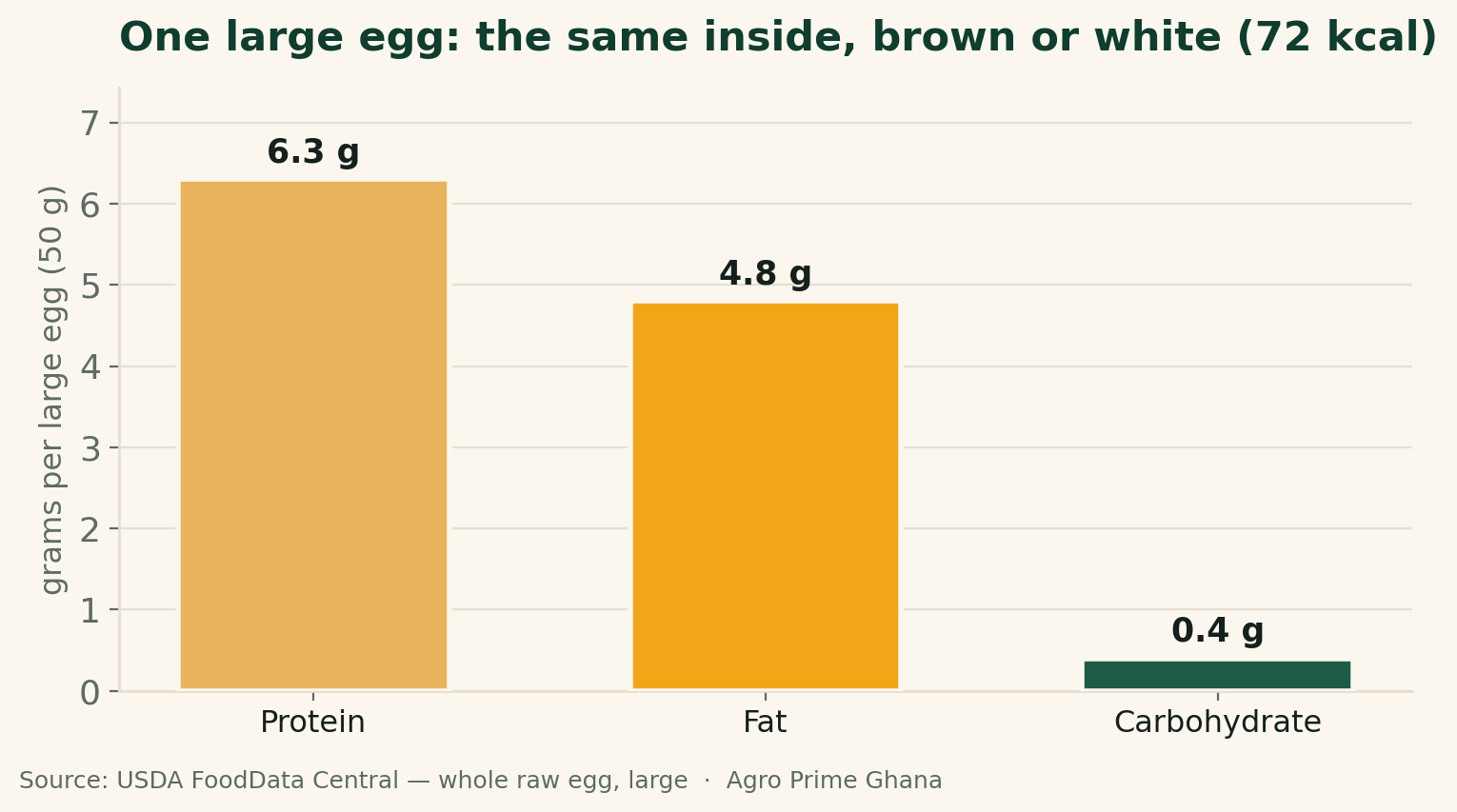
No — there is no meaningful nutritional difference between brown and white eggs. This is the single most important myth to put to rest, because so many shoppers pay more for brown eggs believing they are healthier. The British Egg Information Service is blunt: "there are no nutritional differences between brown or white eggs." Both deliver the same package of high-quality protein, vitamins and minerals; a large egg supplies roughly 72 kcal, 6.3 g of protein and 4.8 g of fat whatever the shell colour, according to USDA figures. Dr Archer of Texas A&M reaches the same conclusion from the research side: "all chicken eggs have no major differences in taste or nutritional composition," regardless of shell colour. In blind conditions, people cannot tell a brown egg from a white one by taste — as egginfo notes, while some consumers believe one tastes better, "there is no difference from a scientific perspective." If a brown egg and a white egg came from hens fed the same ration and kept the same way, their insides are, for all practical purposes, identical.
| Question | Brown egg | White egg |
|---|---|---|
| What sets the shell colour? | Breed/genetics (protoporphyrin coating) | Breed/genetics (no pigment added) |
| Nutrition (large egg) | ~72 kcal, 6.3 g protein | ~72 kcal, 6.3 g protein |
| Taste | No scientific difference | No scientific difference |
| Yolk colour | Set by feed, not shell | Set by feed, not shell |
| Typical Ghana price | Usually a little higher | Rare in market; not preferred |
| Blood spots | More common / harder to candle | Rarer / easier to candle out |
What actually changes the egg inside: the feed
If shell colour tells you nothing about the egg's quality, what does change the inside? The answer is the hen's diet — and its most visible effect is on yolk colour, not shell colour. Yolk colour comes from pigments called carotenoids (xanthophylls) that the hen absorbs from her feed and deposits in the yolk. A hen eating plenty of yellow maize, green forage and pigment-rich ingredients lays eggs with deep golden-orange yolks; a hen on a paler diet (for example one heavy in white grains) lays paler, lemon-yellow yolks. As the Texas A&M specialist explains, yolk colour depends on diet, so a hen eating plants "with yellowish-orange pigmentation" produces more orange yolks. This is why Ghana's maize-based rations tend to give the rich yellow yolks local buyers like — and why deepening yolk colour is a feed decision, not a matter of shell colour or breed. It also means the thing people should judge an egg by — a good, deep yolk and a firm white — is controlled by feeding, which we cover in our layer feeding guide. Feed quality, freshness and hygiene are what make one egg genuinely better than another; the shell colour is just packaging.
Field note: sell the egg, not the shell colour
Because Ghana's market prizes brown, some keepers assume the colour itself is what sells, and worry needlessly about slight shade differences from one hen to the next. What we have learned is that customers who understand a little more become better, steadier buyers: what actually makes your eggs stand out is a deep golden yolk, a firm white, a clean shell and reliable freshness — all of which come from good feeding, good storage and quick turnaround, not from the shell colour. A well-fed brown flock and a well-fed white flock lay equally good eggs inside; the deep-yolk richness people associate with "quality" is on your feed bill, not your hens' genetics.
Why does Ghana favour brown eggs?
Ghana favours brown eggs mainly because of the breeds farmers keep and long-standing consumer preference, not because brown eggs are better. The commercial layer stock imported into and reared in Ghana — Lohmann Brown, ISA Brown, Hy-Line Brown and similar — are brown-egg breeds, so the country's egg supply is overwhelmingly brown by default. Over time, shoppers have come to associate brown eggs with "farm," "natural" and "local," and white eggs (uncommon here) with something imported or artificial, even though that association has no basis in the egg itself. There is also a modest, real economic reason brown eggs often cost a little more, and it is not about quality: the larger brown-laying hens tend to eat more feed than smaller white-egg breeds like Leghorns, so brown eggs can carry a slightly higher production cost, which flows through to price. For a Ghanaian producer the practical takeaway is straightforward — keep the brown-egg breeds your market wants, but understand and, where helpful, explain that the brown shell is a preference and a breed trait, not a mark of superior nutrition. If you are choosing your layer stock, our guide to the best layer breeds for Ghana walks through the practical options.
Choosing layers for the Ghanaian market? Start with proven brown-egg pullets
Ghana's buyers want brown eggs, so the sensible commercial choice is proven brown-laying stock reared to lay well and evenly. Agro Prime Ghana supplies healthy point-of-lay (POL) pullets of established brown-egg breeds, along with layer-feeding advice that gives you the deep golden yolks and firm whites customers actually judge quality by — plus fresh table eggs if you would rather buy than keep birds. Want layers matched to the Ghanaian market, or a steady egg supply for your shop or home? Message us on WhatsApp (+233 24 915 1503) or book a visit to the farm in Kasoa. See also our Lohmann Brown layer guide.
The bottom line on brown vs white eggs
Brown and white eggs differ in exactly one thing: the colour of the shell, which is set by the hen's breed and the pigment her body adds to an otherwise identical, naturally white shell. Brown comes from a surface coating of protoporphyrin; blue from oocyanin laid right through the shell; and a hen's ear-lobe colour is a handy — if not absolute — clue to which she'll lay. Beyond the shell, brown and white eggs are the same egg: the same roughly 72 calories and 6.3 grams of protein, the same taste, the same food value. What genuinely changes an egg's inside is the hen's feed, which sets the yolk colour and, together with freshness and hygiene, the real quality. Ghana runs on brown eggs because that is what our breeds lay and our buyers expect, and brown can cost a little more simply because bigger brown hens eat more — not because the egg is better. Judge an egg by its yolk, its freshness and how it was kept, and let the shell colour be what it is: packaging.
Frequently asked questions
Are brown eggs healthier than white eggs?
What determines the colour of an egg shell?
Do brown and white eggs taste different?
Can you tell what colour eggs a hen lays from her ear-lobe?
Why are Ghana's eggs almost all brown?
Why do brown eggs sometimes cost more?
What makes an egg yolk more orange?
Is one shell colour easier to keep clean or check for spots?
Sources & further reading
- Texas A&M AgriLife Today — Cracking the mystery on chicken eggs (Dr Gregory Archer: genetics set shell colour, pigments, ear-lobes, no nutritional/taste difference, feed sets yolk colour).
- British Egg Information Service — Brown vs white eggs (breed determines shell colour, no nutritional or taste difference, pigments).
- Hendrix Genetics (Laying Hens) — What does the ear-lobe tell you about egg-shell colour? (ear-lobe/egg-colour correlation and its limits).
- USDA FoodData Central — nutrition of a whole raw large egg (72 kcal, 6.3 g protein, 4.8 g fat).
- Agro Prime Ghana guides: best layer breeds for Ghana, layer feeding guide, Lohmann Brown layer guide.
About Agro Prime Ghana
Agro Prime Ghana Limited runs a poultry hatchery and mixed agribusiness in Kasoa, supplying day-old chicks, point-of-lay pullets and fresh eggs, and working alongside poultry keepers across the country. These guides combine hands-on farm experience with current industry and university-extension references. This article is general educational information, not a substitute for professional veterinary or agronomic advice. We supply healthy day-old chicks (broilers & layers), point-of-lay pullets, quality feed and fresh table eggs, plus hands-on farm support across Ghana. Ready to start or expand your layer flock? Book a visit or message us on WhatsApp (+233 24 915 1503) to order pullets, eggs, feed or advice.