Every year in the second week of December our phone at the hatchery starts ringing with the same story. A farmer in Techiman or Sunyani or Nkawkaw took delivery of 500 chicks, set up the brooder the way he always does, and lost sixty of them in the first four nights. The chicks were fine at collection. The feed was fresh. The water was clean. What changed was the weather: the harmattan had arrived, the night temperature fell to 17 degrees, the charcoal pot burned out at two in the morning, and 500 chicks piled into a corner to keep warm.
Harmattan brooding is not more difficult in principle than brooding in any other month. The physics are identical. What changes is the margin for error. In August a brooder that drops a few degrees overnight costs you nothing because the ambient air is 24 degrees and humid. In January the same drop lands the chicks in 16-degree air that is dry enough to crack lips, and the losses arrive by morning. Everything you already do for brooding has to be done more carefully, for longer, and with a specific list of extra risks in mind: cold nights, big day-night swings, dust, dehydration, carbon monoxide and fire.
We brood chicks through every harmattan at our Kasoa hatchery and we supply farmers from the coast to the Upper East, where the season is harder than anything we see on the coast. This guide is what we have learned.
Written from our hatchery floor
This guide reflects day-to-day practice at the Agro Prime hatchery in Kasoa, where we hatch and supply day-old chicks to farmers across Ghana. Always confirm current prices and confirm any medication or vaccination programme with your veterinarian.
What the harmattan does to a brooder
The harmattan is a dry, dust-laden northeasterly wind off the Sahara that reaches northern Ghana in November and the coast usually by mid-December, fading out between late January and early March. It replaces humid maritime air with air that can drop below 20 percent relative humidity in the north and 30 to 40 percent on the coast. Because dry air holds little heat, night temperatures fall sharply once the sun goes down. Tamale and Bolgatanga regularly see nights of 13 to 17 degrees with afternoons of 34 to 37. Kumasi and the Bono regions see 17 to 20 at night. Even Kasoa and Accra, which are normally mild, record nights around 20 to 22 with a stiff dry breeze.
Three consequences follow for chicks. First, the brooder loses heat faster to cold surrounding air, so any heat source has to work harder and any lapse hurts more. Second, the temperature swing between 3 pm and 3 am can be 15 to 20 degrees, which means a heat setting that is right in the afternoon is badly wrong at night and a setting that is right at night cooks the chicks at midday. Third, the dry air pulls water out of chicks and litter. Chicks lose moisture through breathing, the litter dries to powder, and the fine dust of shavings and droppings combined with harmattan haze irritates the airways of a bird whose respiratory system is a few days old.
A day-old chick cannot regulate its own temperature at all. It has almost no fat, a large surface area for its weight, and a yolk sac that must be absorbed in the first three days to provide energy and antibodies. A cold chick burns that yolk to stay warm instead of to grow, absorbs it poorly, and is left with a wet, unabsorbed yolk that becomes a site for E. coli infection. This is why "cold at night" in week one produces deaths on days four to seven that look like omphalitis: swollen navels, a bad smell, and chicks that sit hunched with closed eyes. The cold did not kill them directly. It set up the infection that did.
Setting the brooder up for cold nights
Start with the building. In harmattan the enemy is a draught at chick level, so the brooding area needs solid or curtained walls to at least a metre above the floor and a ceiling or roof lining that keeps the warm air in. Open-sided houses with only wire mesh need heavy polythene or tarpaulin curtains on the windward side, which for most of Ghana is the north and east, dropped fully at night and raised in the afternoon. A cheaper option we see working well is to brood in a small enclosed room or a partitioned end of the house rather than heating the whole building.
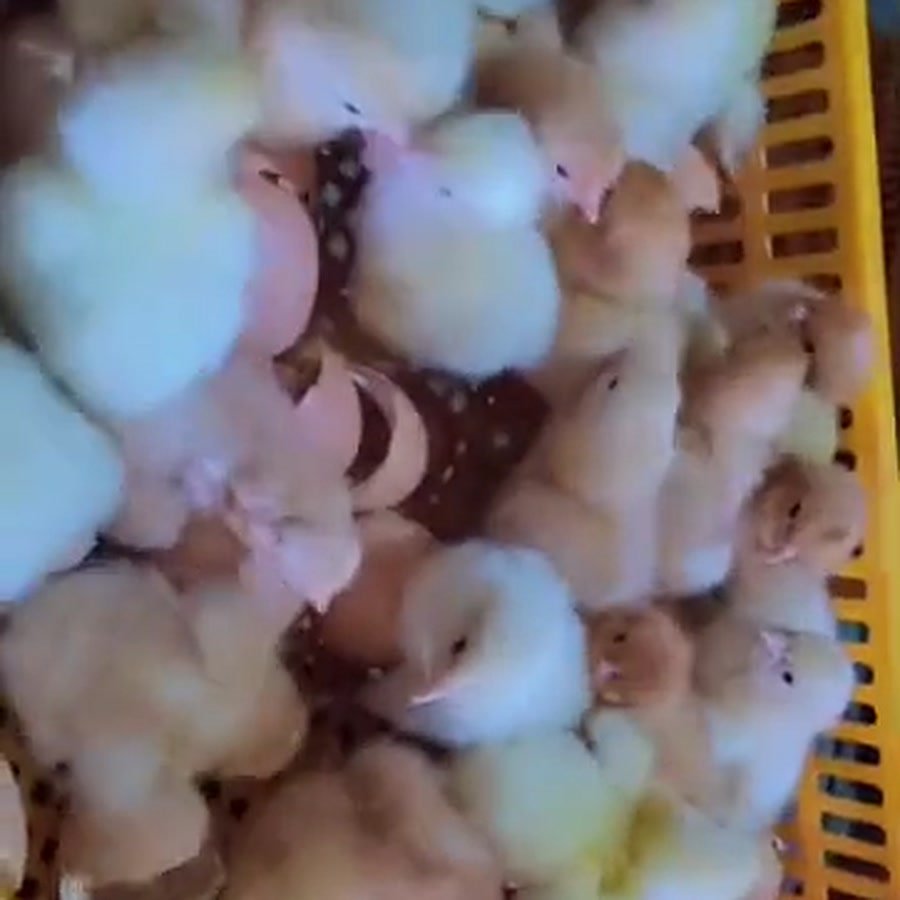
Use a brooder guard, and make it smaller than usual. A ring of cardboard or hardboard 45 to 50 cm high, enclosing chicks at roughly 40 to 50 per square metre for the first three days, keeps them close to the heat and stops the corner-piling that kills. Round every corner. Increase the ring size every two to three days as the chicks grow. Deep litter matters more in harmattan than any other time: 8 to 10 cm of dry wood shavings insulates the chicks from a cold concrete floor that pulls heat out of them from below. Preheat for at least 24 hours before the chicks arrive. In harmattan the litter and the floor beneath it must be warm, not just the air, and a floor takes a day to warm through. Check by placing your palm on the litter; it should feel comfortably warm, not neutral.
Heat sources each have a harmattan weakness. A charcoal pot gives good radiant heat but burns out unpredictably, produces carbon monoxide, and is a fire risk in a dry house. Gas brooders are steady but expensive to run and the cylinder can run out at night. Infrared lamps depend on the grid or generator, and harmattan is also the season of dry-season load management. Whatever you use, the rule is redundancy: two heat sources, or one heat source plus a plan. A farm running gas should have a charcoal pot ready to light. A farm on the grid should have a charged battery for at least one lamp, or a generator with fuel in it. Our brooder temperature chart gives the week-by-week targets; the table below adjusts them for the harmattan day-night swing.
| Chick age | Target at chick level | Harmattan night action (10 pm–7 am) | Harmattan day action (12 pm–4 pm) | Brooding duration |
|---|---|---|---|---|
| Day 1–3 | 33–35 °C | All heat on, curtains fully down, second heat source lit, night check at 11 pm, 2 am and 5 am | Partially raise curtains on the leeward side; heat may need reducing if chicks pant | Ring small; full heat |
| Day 4–7 | 32–33 °C | Full heat, curtains down | Curtains half up; watch for panting | Full heat |
| Week 2 | 29–31 °C | Heat on, curtains down; keep one source lit until dawn | Curtains up on leeward side, heat off or low at midday | Night heat essential |
| Week 3 | 26–29 °C | Heat on at night, especially in the north | Heat off, curtains up | Night heat still needed |
| Week 4 | 24–26 °C | Heat on nights below 20 °C; in the north usually every night | No heat | Extend brooding to 4 weeks in harmattan |
| Week 5 | Ambient | Heat only on unusually cold nights in the north | None | End of brooding; 5–6 weeks in Upper regions |
Temperatures are measured at chick height, 5 cm above the litter, under the edge of the heat source, not at the roof. Adjust by watching the chicks; the numbers are a starting point.
The night check: the one habit that saves the batch
Every harmattan loss story we hear has the same middle: nobody looked between midnight and six. Charcoal pots, in particular, have a burn life of four to six hours depending on the pot and the charcoal, and a pot lit at 8 pm is out by 1 am. The cold hours of a harmattan night are 2 am to 6 am, exactly when an unattended pot is cold. A single visit at 2 am to top up the charcoal or check the gas is worth more than any supplement or medicine you can buy for chicks in week one.
And read the chicks. Huddled in a tight mass under the lamp with a few chirping loudly: cold, add heat now. Spread out in a ring away from the heat, panting: too hot, reduce it. All on one side of the ring: a draught from the other side, find and block it. Spread evenly, quiet, some eating, some sleeping: right. This reading is more reliable than a cheap thermometer and takes five seconds.
Charcoal, carbon monoxide and fire
A charcoal pot in a fully curtained, sealed brooder produces carbon monoxide that kills chicks and can kill the worker sleeping beside them. Leave a ventilation gap at the top of the curtains, never at chick level, and place the pot on a metal or block stand with a wire guard so litter and curtains cannot touch it. Harmattan litter is tinder-dry; farm fires in January are common and a brooder house full of shavings burns in minutes. Keep a bucket of sand and a bucket of water inside the house at all times.
Water and dehydration in dry air
Farmers watch temperature in harmattan and forget water, but dehydration is the quieter killer. Dry air at 25 percent humidity draws moisture from a chick's airways with every breath, water in open drinkers evaporates fast, and chicks that are chilled do not go to drink. A day-old chick is around 70 percent water and can lose enough in 24 hours to become sluggish and stop eating.
Give water first and give it warm. In the cool early morning fill drinkers with water at about 25 to 30 degrees rather than cold water from an overnight tank, because chicks avoid cold water and cold water chills them from inside. Add a vitamin and electrolyte product for the first three to five days, following the label. Provide more drinker points than usual, so no chick is more than a metre from water, and refill three times a day in harmattan rather than twice; evaporation and dust settling on the surface make water unattractive faster. Cover the water tank so dust does not settle in it. Our guide to clean water for poultry covers hygiene, but in harmattan the extra step is simply frequency.
Dust, dry litter and the respiratory system
The harmattan haze itself carries fine mineral dust, and inside the brooder it combines with dust from bone-dry shavings, powdered droppings and feed fines. A chick's trachea and air sacs are lined with delicate tissue that dust inflames, and inflamed airways are where Mycoplasma, E. coli and infectious bronchitis take hold. The sneezing and gasping farmers report in week two of a harmattan brood is very often started by dust and finished by bacteria.
Control it at the source. Use good-quality shavings, not sawdust, and sieve out fines if the batch is dusty. Lightly damp the litter surface with a watering can in the afternoon if it has gone to powder, taking care not to wet it, because wet litter in the cold brings its own problems with coccidiosis and ammonia. Damp the floor of the walkway outside the ring. Avoid sweeping inside the house while chicks are in it. Reduce feed dust by using a mash with a coarser grind or a crumb, and by not overfilling feeders so that chicks scratch fines out. The litter management guide has more, but the harmattan-specific advice is: keep it dry enough to be hygienic and damp enough not to fly.
Ventilation cannot be zero. Fully sealed curtains keep heat in but trap dust, ammonia, moisture from breathing and carbon monoxide from charcoal. Leave a gap of 15 to 30 cm at the top of the curtain on the side away from the wind, so air moves above the chicks without a draught at floor level. A worker who walks into the brooder at 6 am and finds the air stinging his eyes has had the curtains too tight, and the chicks have breathed that all night.
Feeding for warmth
A cold chick uses energy to stay warm, and a chick that has spent the night huddled has not eaten. Use a good chick starter of 20 to 22 percent protein and make it available in trays or on paper for the first three days so it is easy to find, then in feeders. In harmattan we feed a little more often, five or six small feeds a day for the first week, because chicks come out of a cold spell hungry and a full feeder in the warm afternoon lets them catch up. Do not add oil or fat to starter feed on your own; a properly formulated starter already has enough energy, and unbalanced additions cause diarrhoea and wet litter that you do not want in the cold.


Disease pressure and vaccination timing in the dry season
Harmattan is Newcastle disease season across Ghana. Dry, cold, dusty conditions stress birds, dust carries the virus, and village flocks around most farms lose birds to Newcastle from December through February. That means the vaccination schedule must be followed to the day, with the first Newcastle and Gumboro vaccinations given on time, and biosecurity tightened: no visitors, no borrowed equipment, and a footbath that is actually used. Chicks bought from a hatchery that vaccinates at day-old, as we do for Marek's and in most batches for Newcastle, start with protection but still need the follow-up doses.
Respiratory disease is the second pressure. Sneezing, snicking, swollen faces and nasal discharge in week two or three usually mean infectious bronchitis, Mycoplasma or infectious coryza on a background of dust and cold. Do not medicate blindly; call your vet, describe the signs precisely, and follow the prescription and withdrawal periods. Early treatment on the vet's advice usually works; treatment after three days of guessing rarely does. Coccidiosis, by contrast, is a smaller risk in harmattan than in the rains because oocysts need moisture, but any patch of wet litter under a leaking drinker will grow it, so fix leaks the same day.
A worked example: 1,000 broiler chicks in Sunyani, January
A farmer who buys Cobb 500 chicks from us for the Easter market brooded 1,000 in a brick-walled 8 by 12 metre house with an open mesh strip under the eaves. Night temperatures that week were 16 to 18 degrees. He lined the eave gap with polythene leaving a 20 cm slot on the south side, laid 10 cm of shavings, set two brooder rings of 500 each with a gas brooder in each and a charcoal pot on a stand as backup, and preheated for 30 hours. His worker slept in the house with an alarm at 11 pm, 2 am and 5 am, and logged the chick-level temperature at each check.
On night three the gas in one cylinder ran out at about 1 am. The 2 am check found the ring at 26 degrees and chicks starting to huddle; the charcoal pot was lit, the cylinder swapped by 2:30, and the chicks were spread normally by 3 am. Week-one mortality was 9 birds, under one percent. He damped the walkways each afternoon, ran three water refills a day with electrolytes for five days, and brooded with night heat for four full weeks. Total mortality to 6 weeks was 27 birds, 2.7 percent, in a season where neighbouring farms without a night check were reporting 10 to 15 percent. Nothing in his setup was expensive. The difference was the second heat source and the man with the alarm.
Frequently asked questions
What temperature should a brooder be during harmattan?
How long should I brood chicks in harmattan?
Why do my chicks die at night in December and January?
Is a charcoal pot safe for brooding?
Should I give chicks warm water in harmattan?
How do I stop dust affecting my chicks in the dry season?
Brooding through the dry season? Talk to us first
Agro Prime supplies vaccinated day-old broiler and layer chicks from Kasoa throughout the harmattan, and we will tell you honestly whether your setup is ready for the cold nights before you collect. We also stock brooder guards, gas brooders, chick drinkers and starter feed. WhatsApp or call +233 24 915 1503, email support@halaalfarmsghana.com, or book a visit and we will walk you through a harmattan-ready brooder.