A broiler farm's daily routine in Ghana runs from an early-morning check of feed, water, temperature and bird behaviour, through mid-day heat management and top-ups, to an evening walk and a records update at night — repeated every day of the roughly 5-to-7-week grow-out, with the tasks shifting as the birds age. The single most important habit is walking the flock several times a day and reading what the birds tell you, because in fast-growing broilers small problems become expensive losses within hours. In Ghana's heat, the routine also bends around the weather: the hardest work happens early and late, and the middle of the day is about keeping birds cool and drinking. This guide walks you through a realistic morning-to-night broiler routine, with the target numbers that tell you whether each day is going well.
Written by the Agro Prime Ghana poultry team and reviewed against current industry references (Aviagen Ross Broiler management guides and MSD Veterinary Manual). Last updated September 2026.
Key takeaways
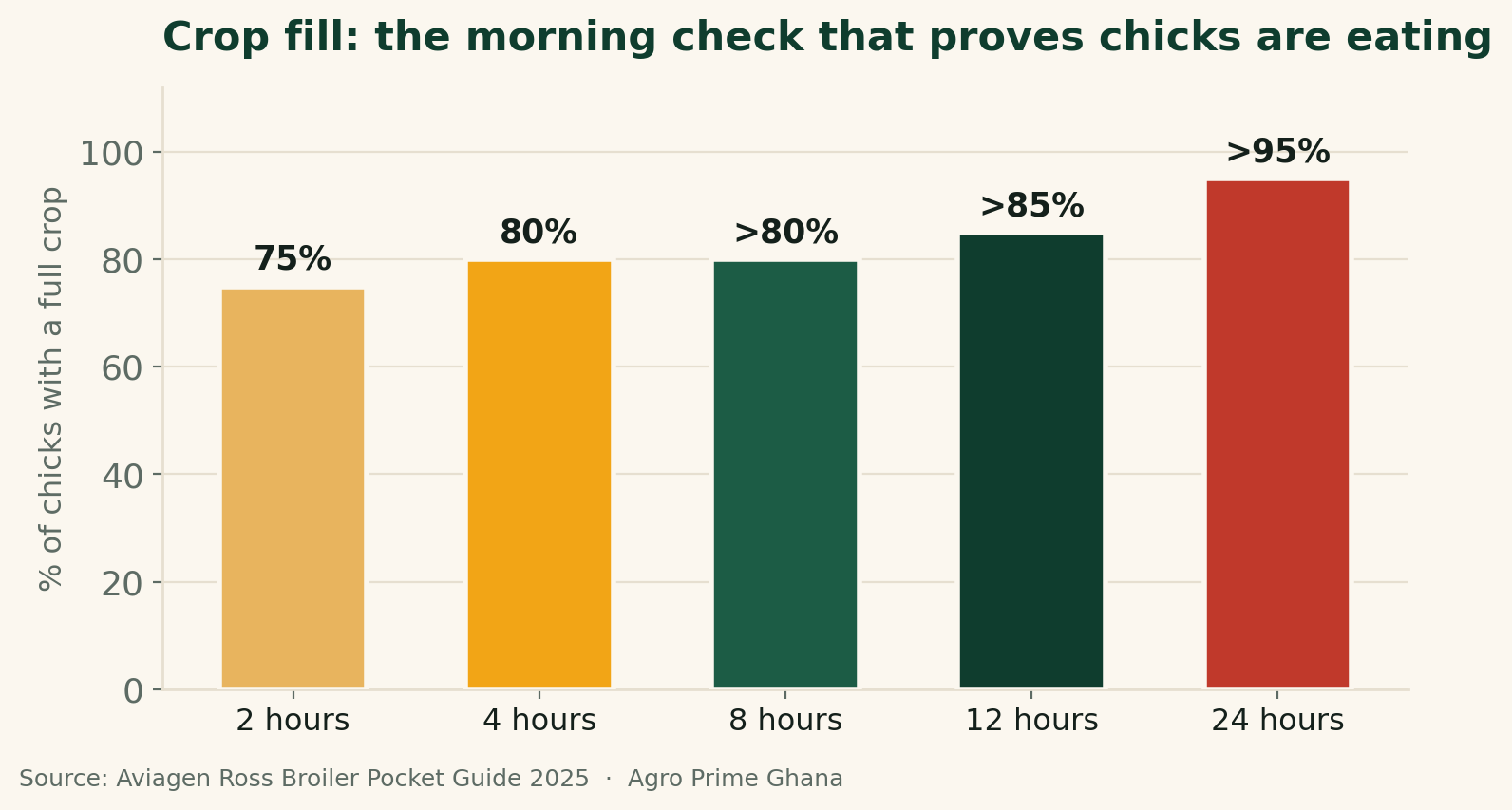
A broiler day has a rhythm: early morning — check temperature, feed, water and how birds are spread; through the day — top up feed and water, manage heat, walk the flock; evening — final feed/water check and flock walk; night — update records. On day 1, prove chicks are eating by crop-fill checks: aim for about 75% of chicks with full crops at 2 hours and over 95% by 24 hours. Start brooding around 30 C at chick level with 60-70% humidity. Keep ammonia below 10 ppm (above 20 ppm sharply raises disease risk). Weigh a sample weekly (≥100 birds or 1%) against target. In Ghana's heat, do the heavy work early and late and keep clean, cool water flowing at all times. Watch the birds constantly — they are your best instrument.
What a broiler daily routine is built around
A broiler daily routine is built around four things the birds need without fail — feed, water, the right temperature and clean air — plus the daily human job of noticing when any of them slips. Broilers are bred to grow extremely fast, which makes them profitable but also unforgiving: a flock that goes short of water on a hot afternoon, or sits in cold, ammonia-heavy air overnight, loses growth quickly, and it is hard to recover. Everything in the routine below is a way of checking those four essentials several times a day, adjusting as birds grow from fragile day-old chicks needing 30-degree warmth into near-market birds needing cooling and space.
The daily fundamentals: seven things to check every walk
Every time you walk a broiler house, you are reading the same short list of signals — and reading them well is the core skill of broiler farming. The Aviagen Ross guidance centres daily management on observing bird distribution, feed and water intake, respiratory sounds, posture, litter quality and ventilation. In practice, on each walk you check: are birds evenly spread, or huddled, panting or crowded away from a draught? Are they active and feeding, or listless? Do you hear coughing or rattling? Is litter dry and friable, or wet and caking? Does the air smell of ammonia? Are feeders and drinkers full, clean and at the right height? And are there dead or weak birds to remove? Learning to read these quickly, several times a day, is what separates farmers who catch problems in hours from those who discover them in days.
Morning to night: a realistic broiler day
The table below lays out a practical daily routine for a Ghanaian broiler house. Exact times flex with your farm and the birds' age, but the shape — heavy work early and late, heat management in the middle, records at night — holds throughout the grow-out.
| Time of day | Main tasks | What you are checking for |
|---|---|---|
| Early morning | Enter quietly; check temperature & air first; observe bird spread; top up feed; clean and refill drinkers; remove dead birds | Overnight chilling or ammonia build-up; birds huddled or gasping; empty feeders/drinkers; unexpected mortality |
| Mid-morning | Refill feed/water as needed; adjust curtains/ventilation as the day warms; walk and observe closely; weigh sample (on weigh day) | Feed and water intake; heat starting to build; any sick or lame birds; growth against target |
| Midday (hottest) | Prioritise cooling: maximise ventilation/airflow, ensure abundant cool water, avoid disturbing birds; light or no feeding at peak heat | Panting, wings held out, crowding at drinkers — signs of heat stress; water supply keeping up |
| Afternoon | Top up feed and water; continue heat management; walk and observe; spot-clean wet litter | Recovery from midday heat; feeders/drinkers full; litter condition |
| Evening | Final feed top-up; clean/refill drinkers; final flock walk; begin closing house against night cold/harmattan | Full crops before dark; birds settling calmly; house set for a comfortable night |
| Night | Late check if possible; update records (feed, water, mortality, weights); plan next day | Night temperature and comfort; the day's numbers vs targets |
Day one and the first week: getting chicks eating and drinking
The first days set up the whole flock, and the routine in week one is more intensive than at any other time. Chicks arrive unable to control their body temperature, so the house is pre-warmed to about 30 C at chick level with 60-70% relative humidity before they come, and warmth is checked constantly. The critical first-day task is confirming chicks have found feed and water, and the tool for this is the crop-fill check: gently feel the crops of a sample of chicks and count how many are full. Aviagen's targets are about 75% full crops at 2 hours after placement, 80% at 4 hours, over 85% by 12 hours and over 95% by 24 hours. Low crop fill means chicks are not finding feed or water — perhaps the house is too cold, drinkers are wrong, or lighting is poor — and you act immediately. Light is kept long and bright early (around 23 hours in the first days) to help chicks find resources, then reduced. Getting week one right is the foundation of the whole crop; our broiler feeding guide for Ghana covers the feed side in detail.
Field note: the crop check tells you the truth about day one
It is easy to place chicks, see them running around, and assume all is well — but the crop check is what actually proves it. A couple of hours after placement we pick up a random handful of chicks from different parts of the house and feel their crops: a good crop feels soft and full, like a small rounded pocket. If far fewer than three-quarters are full at two hours, something is wrong right then — often the house is a touch cold so chicks are huddling instead of eating, or the drinkers are not obvious to them. Catching that in hour two, not day two, is the difference between an even, thriving brood and a stunted, patchy one.
Water and heat: the Ghanaian broiler's daily battle
In Ghana, managing heat and water is the defining daily challenge of broiler keeping, especially as birds grow large and the afternoon builds. Water is the priority: broilers drink far more than they eat, and clean, cool water must be available at all times — an interruption on a hot day causes fast, visible losses. The Aviagen guidance puts the feed-to-water intake ratio around 1.6 to 1.8 to 1 in comfortable conditions, and water intake climbs steeply as temperature rises, so on hot days drinkers and supply must keep up with much higher demand. Ideal drinking water is cool, around 18-21 C, and birds should never travel far to reach it. Through the heat of the day the routine shifts to cooling: maximise airflow, ensure abundant cool water, keep birds calm, and avoid heavy feeding at peak heat — many Ghanaian farmers concentrate feeding in the cooler morning and evening. Watch for panting, wings held away from the body and crowding at drinkers, the classic signs of heat stress; our guides to heat stress in poultry and feeders and drinkers cover cooling and water access in depth.
Air, litter and ammonia: the overnight risks
Air quality and litter are daily jobs because they turn dangerous overnight, when houses are closed against the cool. As birds grow, their droppings and moisture build up in the litter, and closed night ventilation lets ammonia accumulate — the Aviagen guidance flags an ideal of below 10 ppm ammonia, with levels above 20 ppm increasing susceptibility to respiratory disease. High ammonia burns the airway and eyes and quietly damages performance, so your morning routine starts with a read of the air: if it stings your eyes and nose when you walk in, the birds breathed that all night. The daily answer is to keep litter dry and friable — spot-remove wet, caked patches (especially under drinkers), fix any leaks at once, and balance night closure against the need to let moisture and ammonia escape. In the harmattan this is a genuine tension between keeping birds warm and keeping the air clean; the solution is ventilation high up that vents stale air without draughting the birds.
Field note: your nose at the door is a free ammonia meter
Most small farms will never own an ammonia meter, but you carry a decent one on your face. The test we use is simple: crouch down to bird level as you enter in the morning, before the house is opened up, and breathe. If your eyes prickle and your nose stings at bird height, ammonia is too high and the flock has been breathing it all night — time to pull out wet litter, check for a leaking drinker, and open up sooner. Doing this at bird level matters, because ammonia sits low where the chicks are, and standing at head height you can miss what they cannot escape. It costs nothing and catches a problem that quietly wrecks growth and airways.
Weighing and tracking growth through the grow-out
Weighing a sample of birds weekly keeps the whole crop honest, because it tells you whether the feeding and management is actually converting into growth. The Aviagen approach is to weigh weekly from placement, sampling at least 100 birds or 1% of the flock, and to compare both the average against the breed target and the flock's uniformity. A flock behind target, or becoming uneven, is signalling a problem — feed quality or quantity, feeder space, heat stress or disease — while there is still time to correct it and protect your finishing weight and feed conversion. Alongside the scale, your daily records of feed used, water drunk and mortality build the picture; a sudden drop in feed or water intake is often the very first sign of trouble, sometimes before birds look sick. Our guide to weighing and uniformity explains how to sample and interpret the figures.
Strong chicks make the daily routine work — start with the right birds
Even a perfect daily routine struggles with weak, uneven chicks. A good broiler crop starts with robust, uniform day-old chicks from healthy parent stock, delivered well and placed onto a properly prepared, pre-warmed house. At Agro Prime Ghana we supply strong day-old broilers and can help you set up the brooding, feeding and heat-management routine that carries them from placement to market weight — including practical advice for Ghana's heat and harmattan. Planning your next broiler batch? Message us on WhatsApp (+233 24 915 1503) or book a visit to order chicks and get a daily-management plan built around them.
The bottom line on a broiler daily routine
A successful broiler day in Ghana follows a simple, repeatable rhythm: check temperature, feed, water and bird behaviour first thing; top up feed and water and manage heat through the day; walk the flock several times, reading the birds for distribution, sound, posture, litter and air; do the heavy work early and late and keep birds cool and drinking through the midday heat; and update your records at night. Anchor the routine with the numbers that matter — crop fill above 95% by 24 hours, brooding around 30 C, ammonia below 10 ppm, and weekly sample weights on target — and let the birds be your final instrument. Fast-growing broilers punish neglect quickly and reward attention just as fast. Run this routine consistently across the grow-out, and you give a Ghanaian flock its best shot at reaching market weight healthy, uniform and profitable.
Frequently asked questions
What should I check first thing in the morning on a broiler farm?
How many times a day should I feed broilers?
What is a crop-fill check and when do I do it?
How do I keep broilers cool during the hot Ghanaian afternoon?
How much water do broilers drink compared to feed?
How often should I weigh broilers?
Why does ammonia matter in a broiler house?
How does the broiler routine change over the grow-out?
Sources & further reading
- Aviagen — Ross Broiler Pocket Guide (2025) (crop-fill targets, brooding temperature and humidity, feed:water ratio, ammonia limits, weekly weighing, daily management fundamentals).
- MSD Veterinary Manual — Mycoplasma gallisepticum (Chronic Respiratory Disease) (poor air quality and crowding worsen respiratory disease).
- Agro Prime Ghana guides: broiler feeding guide, heat stress, feeders & drinkers, weighing & uniformity and litter management.
About Agro Prime Ghana
Agro Prime Ghana Limited runs a poultry hatchery and mixed agribusiness in Kasoa, supplying day-old chicks and supporting poultry keepers across the country. These guides draw on hands-on hatchery and farm experience, checked against current industry references. This article is general educational information, not a substitute for professional veterinary or extension advice tailored to your flock. We supply healthy day-old chicks (broilers & layers), point-of-lay pullets, quality feed and hands-on farm support across Ghana. Planning a broiler batch? Book a visit or message us on WhatsApp (+233 24 915 1503) to order chicks, feed or advice.