Since it arrived in Ghana, the fall armyworm has become the single biggest threat to maize yields — and because maize is the backbone of poultry feed, every maize farmer and every poultry farmer who grows their own grain has a stake in beating it. Left unchecked, fall armyworm can slash a maize harvest dramatically. The good news: with early scouting and a mix of sensible controls, you can keep it in check without spending a fortune. This guide explains how to spot, prevent and control fall armyworm in Ghanaian maize.
Key takeaways
Scout early and often — the worm does most damage in the first six weeks. Look for windowpane leaf damage and moist sawdust-like frass in the funnel. Combine controls: clean fields, timely planting, hand-picking on small plots, natural enemies, and targeted pesticide only when damage crosses the threshold. Never spray blindly on a calendar.
Know your enemy
The fall armyworm is the caterpillar (larva) of a night-flying moth. The moth lays egg masses on maize leaves; the caterpillars hatch and feed, hiding deep in the plant's funnel (whorl) during the day. They are most damaging on young maize in the first six weeks, chewing leaves and boring into the growing point and later the cob. Identify them by the pale, inverted "Y" on the head and four dark spots forming a square on the second-to-last body segment.
How to spot an infestation early
- Windowpane damage: young larvae scrape the leaf surface, leaving thin, see-through patches.
- Ragged holes and torn leaves as the caterpillars grow.
- Frass: moist, sawdust-like droppings packed into the funnel — a tell-tale sign a worm is inside.
- Damaged growing point: in bad cases the central whorl is chewed out.
Walk your field at least twice a week in the first six weeks. Check plants in several spots and estimate the share showing fresh damage — that number decides whether to act.
Integrated control: combine methods, don't rely on one
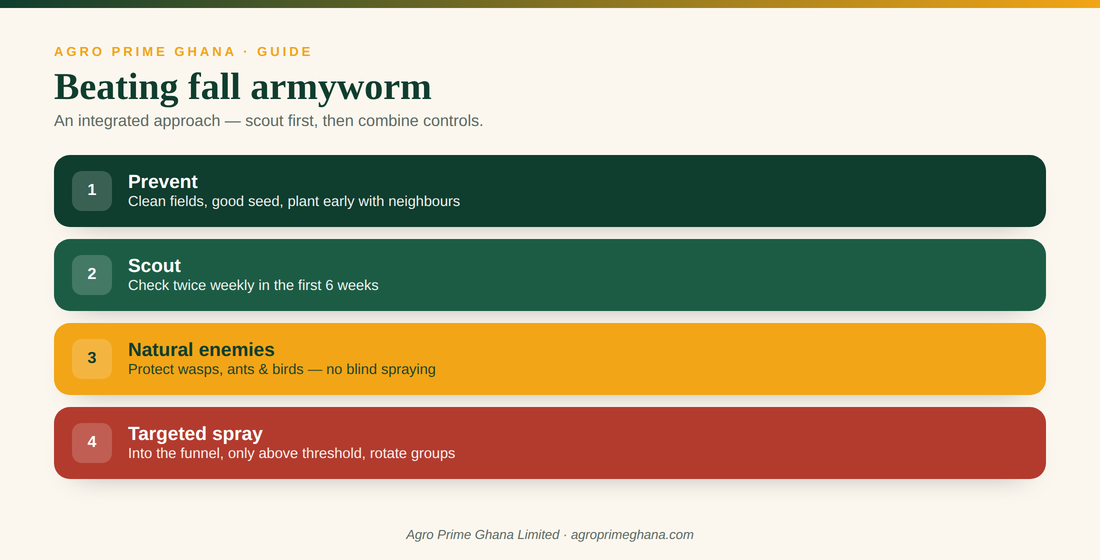
No single tool beats fall armyworm on its own. The reliable approach is integrated pest management — stack several methods so the pest never gets ahead:
- Clean and prepare fields: plough under crop residue and control grass weeds that harbour the moth between seasons.
- Plant early and uniformly: a whole community planting together, early in the season, escapes the worst of the build-up. Follow a sensible maize planting plan.
- Scout and hand-pick: on small plots, physically removing egg masses and caterpillars — or dropping a pinch of dry sand or ash into the funnel — is cheap and effective.
- Protect natural enemies: parasitic wasps, ants, birds and predatory bugs all attack the worm. Avoid blanket spraying that kills them along with the pest.
- Targeted pesticide: when fresh damage crosses roughly 1 in 5 young plants, spot-spray an approved product into the funnel in the cool of early morning or evening. Rotate active ingredients so the worm does not build resistance, and always follow the label and safety guidance.
When and how to spray (if you must)
Spray only when scouting shows damage above the action threshold, and aim the spray into the funnel where the larvae hide — spraying the whole plant wastes product and misses the target. Treat in the early morning or late evening when larvae are active and feeding near the surface, and when it is cooler and less windy. Use an approved insecticide, follow the dose and the pre-harvest interval exactly, and rotate between different chemical groups across sprays to slow resistance. Wear protective clothing and keep children and animals away.
Start with the right seed and a clean field
The battle against fall armyworm is easier to win before the crop is even up. Choose vigorous, well-adapted maize varieties — a fast, uniform, healthy crop shrugs off some damage and outgrows early feeding, while a weak, patchy stand is a soft target. Where treated seed is available, it gives young seedlings a head start against early attack. Prepare the land well: ploughing under old crop residue destroys pupae hiding in the soil, and controlling grassy weeds removes the alternative hosts where moths shelter and breed between crops. Planting early and, ideally, in step with neighbouring farmers means the whole community's maize passes through its vulnerable young stage together, before pest numbers build to their peak — a simple, free tactic that repeatedly proves one of the most effective. These same good agronomy habits also lift your overall yield, as covered in our maize farming guide.
A season-long management calendar
Think of armyworm control as a rhythm across the season rather than a single reaction:
| Stage | What to do |
|---|---|
| Before planting | Clear residue and weeds; plough; choose good seed; plan to plant early with neighbours |
| Emergence to knee-high | Scout twice weekly; hand-pick egg masses and larvae; sand/ash in funnels on small plots |
| Knee-high to tasseling | Keep scouting; spot-treat into funnels only where damage crosses the threshold; protect natural enemies |
| Tasseling to harvest | Watch for cob damage; harvest and dry promptly to deny mould a foothold |
The heaviest damage happens in the first six weeks, so your scouting effort should be greatest then. Once the plant is tall and past tasseling, it can tolerate more leaf damage, and your attention shifts to protecting the developing cob and preparing for a clean, dry harvest.
Why this matters for poultry farmers
Maize makes up 55–65% of most poultry rations, so armyworm damage that cuts the national maize crop pushes up feed prices for everyone — see our feed price guide. If you grow maize to feed your own birds, protecting the crop directly protects your feed bill. And a healthy, well-dried harvest is also your best defence against the next hidden threat — read storing maize and preventing aflatoxin.
Safer control options and biopesticides
Not every spray has to be a harsh chemical. A growing range of safer options fits well into a Ghanaian smallholder's toolkit and protects the natural enemies that do so much of the work. Biopesticides based on naturally occurring bacteria or on the pest's own diseases target the caterpillars while sparing beneficial insects, and simple home preparations — a pinch of dry sand, wood ash or fine soil dropped into the funnel — physically disrupt the larvae hiding there and cost nothing. Neem-based products, made from a tree that grows widely in Ghana, are another low-cost option many farmers use on young plants. These approaches work best exactly where fall armyworm is most vulnerable: on small plots, caught early, with regular scouting so you treat while larvae are young and near the surface. They will not rescue a field that is already overwhelmed, which is why early detection matters so much — but used promptly they can keep an infestation below the level that hurts yield without reaching for the strongest chemicals.
When you do need a conventional insecticide, treat it as a precision tool, not a blanket. Spray only the affected plants, aim into the funnel, choose an approved product, follow the label dose and pre-harvest interval exactly, and rotate between different chemical groups across the season so the worm cannot build resistance. Wear protective clothing, keep children and livestock away, and never spray near your drinking water or your poultry. The overall goal is a light touch that keeps the pest in check while preserving the field's own defences — because a field full of predators and parasites is your cheapest, most durable protection against the next generation of armyworm.
Protect your free workforce: natural enemies
One of the cheapest and most sustainable weapons against fall armyworm costs nothing — the natural predators and parasites already living around your field. Parasitic wasps lay their eggs in armyworm eggs and larvae; ants, earwigs and predatory bugs eat the caterpillars; and birds pick them off the plants. Blanket calendar spraying kills these allies along with the pest, and because the pest bounces back faster than its enemies, you can end up worse off — needing to spray more and more. This is the heart of integrated pest management: spray only where and when scouting shows you must, target the funnel rather than the whole field, rotate chemical groups, and let nature do the rest of the work for free. Farmers who protect their natural enemies often find that after the vulnerable early weeks, the field largely defends itself. Combine that patience with clean fields, early planting and good agronomy, and you keep the worm below the level that hurts your yield without draining your budget on chemicals.
Frequently asked questions
How do I identify fall armyworm in maize?
What is the best way to control fall armyworm in Ghana?
When should I spray for fall armyworm?
Can I control fall armyworm without chemicals?
Can I use wood ash or sand against fall armyworm?
Does fall armyworm attack crops other than maize?
The bottom line on fall armyworm
Fall armyworm is here to stay, but it is beatable — and beating it does not require the strongest chemicals or the deepest pockets. The winning approach is integrated and early: prepare clean fields and choose good seed, plant early and in step with your neighbours, then scout twice a week through the first six weeks when the pest does most of its damage. Deal with what you find using the cheapest effective tool — hand-picking and sand or ash in the funnel on small plots, biopesticides or neem where useful, and a targeted, into-the-funnel spray of an approved product only when fresh damage crosses the threshold. Protect the natural enemies that fight the worm for free by never spraying on a blind calendar. Do this and you keep the worm below the level that hurts your yield, protect the maize that feeds your birds or fills your feed store, and set up a clean, healthy harvest ready for safe drying and storage.
From healthy maize to healthy birds
Agro Prime Ghana Limited runs a hatchery and agribusiness in Kasoa, supplying vaccinated day-old chicks and farm produce. Growing your own maize for feed? Talk to us about chicks and feed planning — book a visit or message WhatsApp (+233 24 915 1503).