A flock of point-of-lay pullets on good commercial feed starts to look wrong: feathers ruffled, birds thin and weak despite eating, some with watery, swollen eyes that later fill with a cheesy white material until they cannot see. Layers that should be climbing toward peak instead lay poorly, and the eggs that do come set badly, with dead embryos in the shell. It looks like a mystery infection — but often it is a shortage of a single nutrient the birds cannot make for themselves: vitamin A. Because the body stores vitamin A, the shortage builds quietly for weeks before it shows, then appears to strike all at once. This guide explains what vitamin A does, how deficiency looks in chicks and adults, why it happens on Ghanaian farms, and how to prevent and correct it.
Written by the Agro Prime Ghana poultry team and reviewed against current veterinary references (MSD Veterinary Manual and NRC nutrient requirements). Last updated September 2026.
Key takeaways
Vitamin A is essential for vision, healthy skin and mucous membranes, growth, reproduction and immunity, and birds cannot make it — they must get it from feed. Because it is stored in the liver, a deficient diet causes no signs at first: the MSD Veterinary Manual notes adult birds can be fed a deficient ration for 2–5 months before signs appear, while chicks with low maternal reserves can show signs within 7 days. Classic signs are white cheesy pustules in the mouth and throat ("nutritional roup"), white cheesy material in the eyes (xerophthalmia), poor growth, weakness, ruffled feathers, pale combs, and in layers a sharp drop in egg production and hatchability. Growing chicks typically need around 1,500 IU of vitamin A per kg of feed and breeders/layers more (roughly 3,000–4,000 IU/kg). Deficiency is prevented with well-formulated feed, fresh vitamin premix, green feed and yellow maize, and good feed storage; it is corrected by supplementing vitamin A promptly.
What vitamin A does — and why birds depend on feed for it
Vitamin A is a fat-soluble vitamin with an outsized job list. It is essential for normal vision, for maintaining the epithelial tissues — the skin and the mucous membranes lining the eyes, mouth, throat, gut, airways and reproductive tract — and for growth, bone development, reproduction and immune defence. Those mucous membranes are the body's first physical barrier against infection, so when vitamin A runs short they break down, dry out and form abnormal cells, opening the door to secondary infections all over the body. Crucially, chickens cannot synthesise vitamin A themselves. They obtain it in two ways: as pre-formed vitamin A (retinol) added to feed as a supplement, or by converting carotenoids — especially the beta-carotene in green plants and yellow maize — into vitamin A in the gut wall. This is why the yellow-orange pigments in a bird's natural diet matter so much, and why a ration built on white maize and poorly stored ingredients, with no green feed and a weak or degraded vitamin premix, can quietly leave birds short of one of their most important nutrients.
Why it stays hidden, then appears all at once
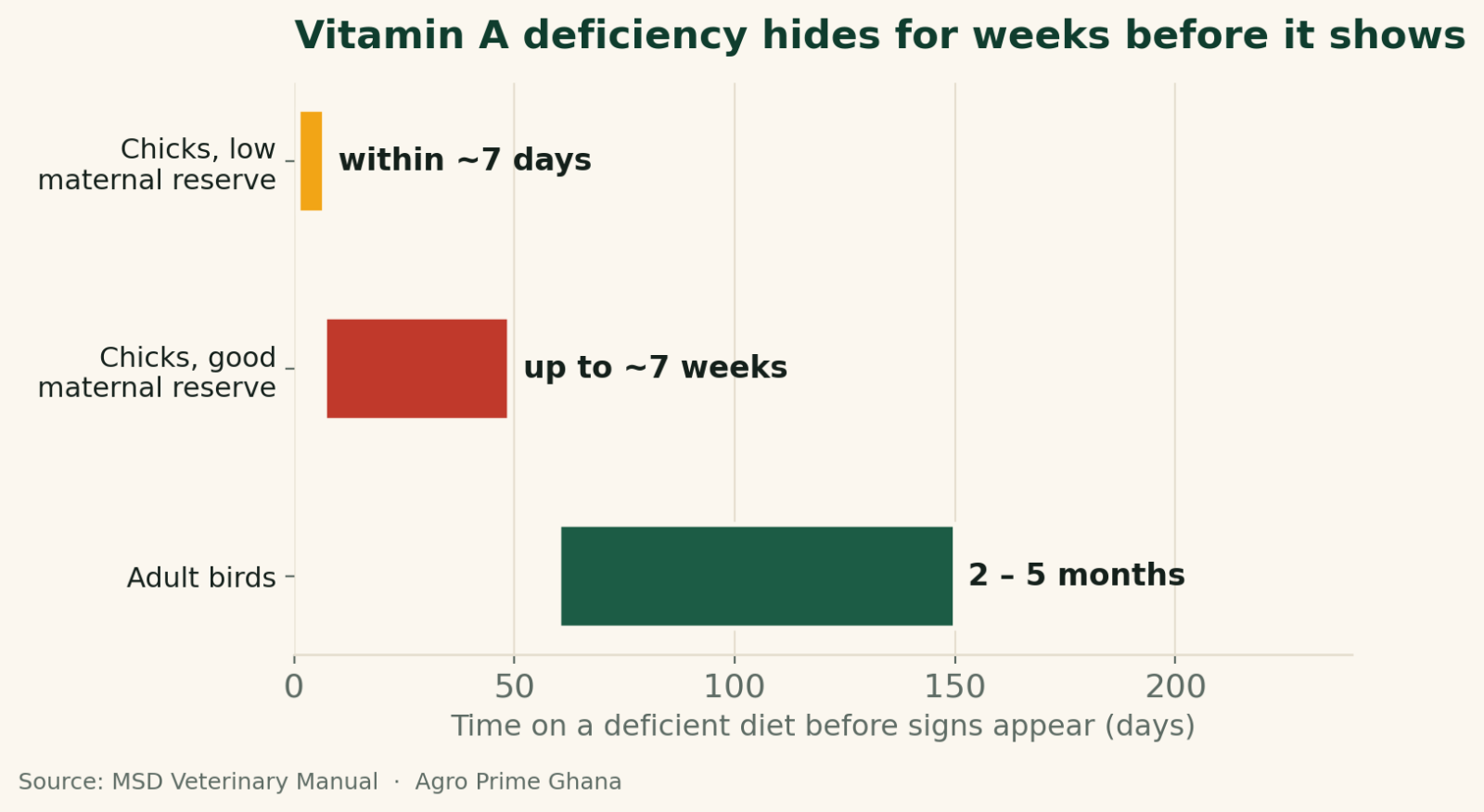
The most confusing thing about vitamin A deficiency is its delay. The liver stores vitamin A, so a bird put on a deficient diet keeps drawing down its reserves and looks perfectly healthy — until those reserves are exhausted, at which point signs appear seemingly overnight. The MSD Veterinary Manual is specific: depending on liver stores, adult birds can be fed a vitamin A-deficient diet for 2 to 5 months before any signs show. In chicks the timeline depends on what they inherited from the hen. A day-old chick from a well-supplied breeder hen carries a reserve that can last up to 7 weeks; but a chick from a deficient hen, with little carryover, can show signs within 7 days of hatching. This delay is exactly why the problem is so often misread. A farmer changes to a cheaper or home-mixed ration, sees no immediate problem, and concludes the feed is fine — then weeks later a wave of eye and mouth lesions, poor growth or collapsing egg production appears, and the feed change made months earlier is never suspected. The deficiency was building silently the whole time.
How deficiency looks in chicks versus adults
The signs differ with age, and knowing both pictures helps you catch it. In growing chicks, the MSD Veterinary Manual describes anorexia (going off feed), growth retardation, drowsiness, weakness, incoordination and ruffled feathers, with pale combs and wattles and a loss of the normal yellow pigment in shanks and beaks. Cheesy material may appear in the eyes, but true xerophthalmia (drying and clouding of the eye) is seldom seen in chicks because they usually die before it develops. In adult birds, the classic triad is emaciation and weakness with ruffled feathers; a marked drop in egg production and hatchability with increased embryonic deaths; and the eye and mouth lesions — milky white, cheesy material accumulating in the eyes causing xerophthalmia and vision loss, and small white pustules forming in the nasal passages, mouth, oesophagus and pharynx. This throat and mouth involvement is the old "nutritional roup," and because the protective mucous membranes have broken down, secondary bacterial infections frequently pile in on top. The table below summarises the two pictures.
| Where you look | Chicks / growers | Adults / layers |
|---|---|---|
| General | Off feed, poor growth, drowsy, weak, incoordinated, ruffled feathers | Emaciation, weakness, ruffled feathers |
| Colour | Loss of yellow in shanks and beak; pale comb and wattles | Pale comb and wattles |
| Eyes | Cheesy material may form; xerophthalmia seldom seen (chicks die first) | Milky white cheesy material in eyes; xerophthalmia and vision loss |
| Mouth / throat | Membrane changes; prone to secondary infection | White pustules in mouth, throat, oesophagus and nasal passages ("nutritional roup") |
| Production | Stunted, high mortality | Sharp drop in egg production and hatchability; more dead-in-shell embryos |
Field note: don't mistake the throat pustules for fowl pox or coryza
The white, cheesy pustules of vitamin A deficiency in the mouth and throat can look alarmingly like the wet form of fowl pox, or get lumped in with the swollen faces of infectious coryza — and treating for the wrong thing wastes time while the birds keep declining. What tips us toward a nutritional cause is the whole picture: no rapid contagious spread through the flock, birds that are thin and weak despite eating, faded shank and comb colour, and a history of a ration change, home mixing, or feed that has been stored too long. When several of those line up, we look hard at the feed and the vitamin supply before assuming it is an infection. A ration built without fresh premix or any green feed is a red flag.
How much vitamin A birds actually need
Vitamin A is measured in International Units (IU), and the requirements are modest in absolute terms but non-negotiable. Standard poultry nutrient requirements (the widely used NRC figures, reflected in the Merck/MSD nutritional requirements tables) put the vitamin A need of growing chickens at around 1,500 IU per kilogram of feed, with laying and breeding hens needing more — on the order of 3,000 to 4,000 IU/kg — because they are exporting vitamin A into every egg and depend on it for hatchability. In practice, commercial feeds and vitamin premixes are formulated well above these minimums to allow a safety margin, precisely because vitamin A is fragile and loses potency in storage. That safety margin is your friend: it is the buffer that protects birds when feed sits a little too long or is stored a little too warm. The danger zone is the ration that has no margin to begin with — a home mix with no premix, or feed relying on a vitamin source that has already degraded.
Why it happens on Ghanaian farms
Several very ordinary situations set up a deficiency:
- Home-mixed rations without a proper vitamin premix. Mixing your own feed is a good way to control cost and quality, but a ration of maize, soya and other raw ingredients contains little pre-formed vitamin A. Without a fresh, correctly-dosed premix, the birds simply do not get enough. Our guide to making poultry feed covers where the vitamin and mineral premix fits in.
- White maize and no green feed. Yellow maize supplies carotene that birds convert to vitamin A; white maize, common in Ghana, supplies almost none. If the ration is built on white maize and the birds get no green forage, one of their natural vitamin A sources is missing entirely.
- Heat and storage losses. Vitamin A is easily destroyed by heat, light, oxygen, moisture and time. In Ghana's warm, humid conditions, feed and premix that sit too long — or are stored badly — can lose much of their vitamin A before the birds ever eat it, so a ration that was adequate on paper becomes deficient in the bag.
- Deficient breeder hens. Chicks hatched from hens short of vitamin A start life with almost no reserve and can show signs within a week, before any starter feed can rescue them.
- Rancid fats and disease. Rancid (oxidised) fat in feed destroys vitamin A, and gut diseases that damage absorption can precipitate deficiency even when intake looks adequate.
Preventing vitamin A deficiency
Prevention is straightforward and cheap once you know the traps. Feed a well-formulated ration with a fresh, correctly-included vitamin-mineral premix — this is the single most reliable safeguard and the one home-mixers most often neglect. Buy feed and premix in quantities you will use reasonably quickly rather than stockpiling for months in the heat, and store everything cool, dry, dark and pest-free, off the floor and away from damp walls, so the vitamin A does not degrade before it is eaten. Where practical, provide green feed — leafy greens and forage supply carotene and are a useful, low-cost insurance layer, especially valuable for layers and breeders. Prefer yellow maize where you can source it, since its carotene both supplies vitamin A and helps yolk and skin colour. Avoid rancid fats and old, musty ingredients. And pay particular attention to breeders and layers, whose higher requirement and role in stocking the next generation with reserves make their vitamin A status especially important — our layer feeding guide puts this in the context of the whole laying ration. Get these basics right and vitamin A deficiency essentially disappears as a risk.
Field note: the premix is not the place to cut corners
When feed prices bite, the vitamin-mineral premix is a tempting thing to skimp on because it is a small part of the mix by weight and leaving it out changes nothing you can see — at first. We have learned to treat it the opposite way: the premix is one of the last things to compromise, because the losses it prevents (poor growth, weak immunity, failed hatches, blind and dying birds) dwarf its cost. We also treat premix as perishable: bought fresh, kept sealed, cool and dark, and used within its life rather than left open in a hot store for months. A premix that has gone stale is quietly no premix at all.
Treatment: correcting a deficiency once it appears
Vitamin A deficiency is correctable if caught before the damage is fatal, and the response can be quick. The approach is to supplement vitamin A promptly and generously. The MSD Veterinary Manual describes feeding vitamin A at up to about twice the normally recommended level for roughly two weeks, and notes that giving it via the drinking water speeds recovery — useful because sick, weak birds often keep drinking even when they eat poorly, and water dosing reaches the whole flock fast. Alongside the vitamin A itself, fix the underlying cause so the problem does not simply return: correct the ration, replace stale premix, sort out feed storage, and add green feed where you can. Support birds with clean water and reduced stress, and be alert for the secondary infections that follow the breakdown of the mucous membranes, treating those on veterinary advice if they take hold. Birds with mild-to-moderate signs often improve noticeably within days of good supplementation; badly affected birds, especially chicks, may be beyond saving, which — as always — is the argument for prevention over rescue.
The bottom line on vitamin A
Vitamin A is a nutrient birds cannot make and cannot do without — it underpins their eyesight, the protective linings of their eyes, mouth, gut and airways, their growth, their fertility and their immune defence. Because it is stored in the liver, a shortage hides for weeks or months and then seems to strike all at once: cheesy pustules in the mouth and throat, cheesy material clouding the eyes, thin weak birds, pale combs, and layers whose production and hatchability fall away. The causes are ordinary — home mixes without fresh premix, white maize and no greens, and feed that loses its vitamin A sitting in a hot store. The fixes are just as ordinary: a properly formulated ration with fresh premix, sensible feed storage, some green feed and yellow maize, and prompt supplementation if signs appear. Treat vitamin A as the quiet essential it is, and you remove one more hidden reason good flocks fail to thrive.
Frequently asked questions
What are the signs of vitamin A deficiency in chickens?
Why does vitamin A deficiency take so long to show up?
How much vitamin A do chickens need?
What causes vitamin A deficiency on a farm?
Can vitamin A deficiency be cured?
Does yellow maize help prevent vitamin A deficiency?
Is "nutritional roup" the same as infectious respiratory disease?
How should I store feed and premix to protect vitamin A?
Sources & further reading
- MSD Veterinary Manual — Vitamin Deficiencies in Poultry (vitamin A roles, time to develop deficiency, signs in chicks and adults, xerophthalmia and nutritional roup, treatment).
- Merck/MSD Veterinary Manual — Nutritional Requirements of Poultry (NRC-based vitamin A requirements in IU/kg for growing and laying birds).
- Agro Prime Ghana guides: how to make poultry feed and layer feeding guide.
About Agro Prime Ghana
Agro Prime Ghana Limited runs a poultry hatchery and mixed agribusiness in Kasoa, supplying day-old chicks and supporting poultry keepers nationwide. These guides combine hands-on hatchery and farm experience with current veterinary and nutrition references. This article is general educational information, not a substitute for professional veterinary or nutritional advice — if your flock shows these signs, review the feed and seek qualified support. Need chicks, feed guidance or farm support? Book a visit or message us on WhatsApp (+233 24 915 1503).