Chickens forage constantly — it is what they are built to do — and most of the time that instinct keeps them healthy and cuts your feed bill. But a free-ranging flock in a Ghanaian compound is surrounded by plants and household substances that can quietly poison it: the ornamental hedge by the gate, the castor and rattlepod weeds along the field edge, poorly processed cassava peel thrown to the birds, mouldy leftovers, a spilt bag of salt. Poultry are not good at telling a safe leaf from a dangerous one, and some of these poisons kill within a day while others slowly rob growth and egg production without ever looking like a "disease." This guide sets out the plants and substances Ghanaian keepers most need to keep their birds away from, what each one does, and how to make your compound and feed store safe.
Written by the Agro Prime Ghana poultry team and reviewed against current veterinary references (the MSD Veterinary Manual and FAO feed-safety material). Last updated September 2026.
Key takeaways
The most dangerous plant hazards for Ghanaian flocks are castor bean (ricin), rattlepod / Crotalaria and other pyrrolizidine-alkaloid weeds, avocado leaves and skin (persin), green/sprouting potato and other nightshades (solanine), and poorly processed cassava, whose cyanide can exceed 200 mg/kg in bitter varieties and 1,000 mg/kg in the most bitter. Persin causes myocardial (heart) damage; Crotalaria seeds cause signs at just 0.05% of the feed and death at 0.3%. Non-plant killers matter too: salt above about 2% of the ration is toxic (birds under 21 days are most vulnerable), and mouldy feed carries aflatoxin. The defence is management, not medicine — most poisonings have no antidote, so keep birds away from the hazard and keep the feed store clean.
Why poisoning is easy to miss
Poultry poisoning rarely looks like a textbook disease. Depending on the poison and the dose, you may find a few birds dead overnight with nothing else to show for it, or you may see a slow, puzzling decline — poor growth, birds off their feed, a drop in eggs, sudden weakness — that gets blamed on "weak chicks," a bad batch of feed, or an infection that never quite fits. The MSD Veterinary Manual notes that poisonings in poultry come from a wide range of sources — feed contaminants, plants, drugs given at the wrong dose, rodenticides, disinfectants and industrial chemicals — and that the signs are often non-specific. That is exactly why poisoning is under-diagnosed: unless you already suspect it and go looking for the source, the flock's symptoms point everywhere and nowhere. For a keeper, the practical lesson is to think about what your birds can physically reach — in the run, along the fence line, in the kitchen scraps and in the feed store — because prevention depends entirely on removing access, not on treating after the fact.
The plant poisons that matter most in Ghana
Long international lists of "plants poisonous to chickens" are of limited use here — many feature temperate ornamentals we rarely grow. What matters is the handful of genuinely dangerous plants that are common in Ghanaian compounds, field margins and kitchens, plus the feed ingredients we actually use. Start with the ones most likely to be within a free-ranging bird's reach.
Castor bean (Ricinus communis). The castor-oil plant grows wild and as an ornamental across Ghana, and its mottled seeds contain ricin, one of the most potent plant toxins known. PoultryDVM's toxic-plant database lists the castor plant's lectins (ricin) as causing severe gastrointestinal and systemic poisoning. Birds that peck at fallen seeds can be badly affected, and there is no antidote — control is entirely about not having seeding castor plants where poultry forage.
Rattlepod and other Crotalaria weeds. These pea-family weeds are widespread on Ghanaian farmland and their seeds carry pyrrolizidine alkaloids that damage the liver. The MSD Veterinary Manual is specific about how little it takes: Crotalaria seed at more than 0.05% of the feed produces signs, and at 0.3% it can kill within about 18 days. Because these weeds set seed on the same fields that supply grain, contaminated maize or feed is as real a risk as birds eating the plant directly.
Coffee senna / sicklepod (Senna obtusifolia). Another common tropical weed whose seeds contaminate grain. MSD notes that coffee-weed seed at 2% or more of the diet depresses feed intake and egg production — a slow, sub-clinical drain rather than sudden death, and easy to blame on other causes.
Avocado (Persea americana). Avocado is grown and eaten widely here, and its leaves, bark, skin and stone all contain persin. According to the MSD Veterinary Manual, the leaves are the most toxic part, and affected birds show lethargy, laboured breathing (dyspnoea), loss of appetite, and characteristic swelling (subcutaneous oedema) of the neck and chest, with death caused by necrosis of the heart muscle. MSD notes chickens and turkeys are somewhat more resistant than caged birds like budgerigars, but "more resistant" is not "safe" — do not throw avocado peels and leaves to your flock.
Nightshades — green potato, tomato and pepper foliage. The nightshade family (Solanum and relatives) produces solanine and related steroidal alkaloids, concentrated in green or sprouting potatoes, potato peelings, and the leaves and stems of tomato and garden-egg plants. These affect the gut and nervous system. Ripe tomato and garden-egg fruit are fine treats; it is the green, unripe and leafy parts and sprouting tubers that are the problem.
The feed-store poisons: cassava, mould and salt
For most commercial keepers the bigger danger is not a wild shrub but what goes into the feed. Three hazards dominate.
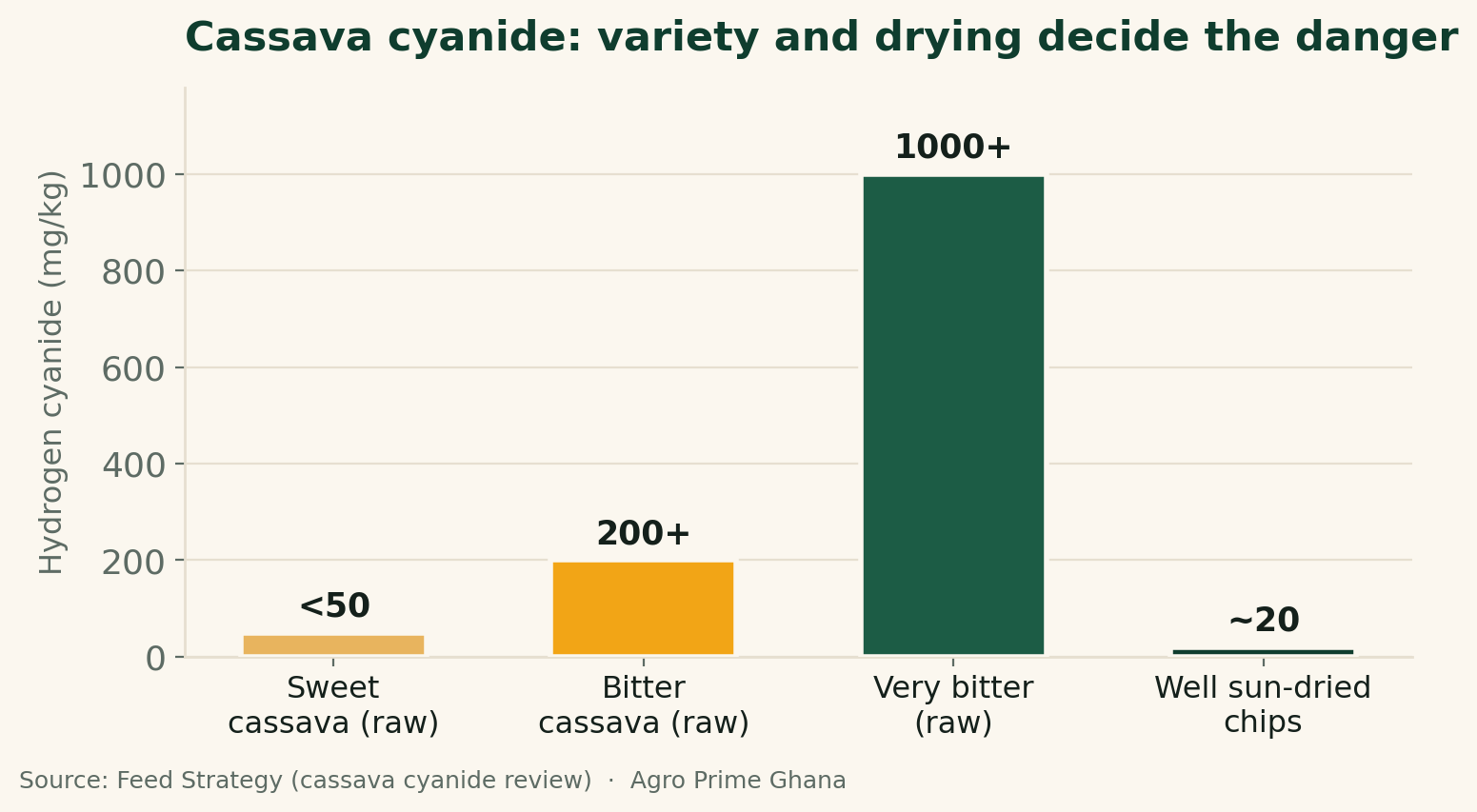
Cassava and cyanide. Cassava is one of Ghana's cheapest energy sources and a genuinely useful poultry feed ingredient — but raw and poorly processed cassava contains cyanogenic glycosides that release hydrogen cyanide. As feed-science reviews summarise, sweet varieties carry under about 50 mg/kg of cyanide, bitter varieties over 200 mg/kg, and the most bitter more than 1,000 mg/kg. The fix is processing: chipping and thorough sun-drying lets the volatile cyanide escape, and a reduction of at least 90% is considered adequate for animal feeding. Cassava peel thrown fresh to birds, or chips dried too briefly in a damp spell, is where poisoning happens. If you use cassava in rations, treat proper drying as non-negotiable — see our guides to cassava farming and making poultry feed.
Mouldy feed and aflatoxin. The single most common feed poison in Ghanaian poultry is aflatoxin from mould on maize and groundnut. MSD lists aflatoxin, ochratoxin and Fusarium trichothecenes among the mycotoxins that damage the liver, kidneys and immune system. Never feed mouldy, caked or musty grain, and store feed dry, cool and off the floor. We cover this fully in our aflatoxin guide.
Salt. Ordinary table or industrial salt is a surprisingly frequent poultry killer. MSD notes that while poultry rations need only about 0.5% salt, levels above roughly 2% become dangerous, and birds under 21 days old are most susceptible because their kidneys are immature; salty water above about 4,000 ppm depresses growth in young stock. Salt poisoning usually comes from spilt salt, over-salted kitchen scraps, or a batch of feed mixed with too much salt or fishmeal. Keep salt stores away from the birds and be careful with salty leftovers.
| Hazard | Toxic principle | What it does / danger level |
|---|---|---|
| Castor bean | Ricin (lectin) | Severe gut and systemic damage; no antidote — keep seeding plants away from foraging birds |
| Crotalaria (rattlepod) | Pyrrolizidine alkaloids | Liver damage; signs at 0.05% of feed, death at 0.3% (MSD) |
| Avocado (leaves, skin, stone) | Persin | Heart-muscle necrosis, breathing distress, neck/chest swelling (MSD) |
| Green/sprouting potato, nightshade foliage | Solanine (steroidal alkaloids) | Gut and nervous-system effects |
| Bitter/poorly-dried cassava | Cyanogenic glycosides (HCN) | Bitter types >200 mg/kg cyanide; need ≥90% reduction by drying |
| Salt (excess) | Sodium chloride | Toxic above ~2% of ration; under-21-day chicks most at risk (MSD) |
| Mouldy maize/groundnut | Aflatoxin & other mycotoxins | Liver damage, immune suppression, poor growth |
Field note: walk your compound the way a hungry hen would
The most useful thing we do before letting a batch out to range is to walk the whole area at a bird's eye level and ask a simple question: what here could a bored, hungry hen peck at? That is how you notice the castor plant that has quietly seeded by the wall, the avocado prunings tossed on the compost, the sprouting yam and potato in the kitchen corner, the open sack of salt in the store. Poisoning is almost always about access. Fence off or clear the hazard and you have solved the problem far more reliably than any treatment could — because for most of these poisons, once the bird has eaten enough, there is very little a vet can do.
Ornamentals and hedge plants to watch
Many decorative plants around Ghanaian homes and offices are toxic if eaten. Oleander, a common hedge and roadside ornamental, contains cardiac glycosides that can stop the heart; foxglove-type plants act the same way. Others on the veterinary toxic-plant lists — such as lantana, thorn-apple (Datura), and various lily and arum relatives — carry their own poisons. In practice, established adult birds tend to avoid strongly bitter ornamental foliage when they have plenty of other feed, so the real risk is a hungry, confined or curious flock with little else to eat. The safe approach is not to memorise every species but to follow one rule: do not let poultry forage where ornamental hedges and cuttings are within reach, and never dump garden prunings into the run. When in doubt about a specific plant, the PoultryDVM toxic-plant database lets you look it up by name.
Household and farm chemicals
Plants are only half the story. Free-ranging and even housed birds are regularly poisoned by substances around the farm: rodenticides (rat poison) left where birds can reach it, or in dead rats birds scavenge; disinfectants and pesticides used carelessly near feed and water; treated seed dressed with fungicide; and old paint or batteries containing lead. MSD notes second-generation anticoagulant rat baits (brodifacoum, bromadiolone and similar) can be acutely fatal to non-target animals. Store all chemicals well away from the poultry area, never place rat bait where birds can access it, and keep spray drift off feeders and drinkers. These are the poisonings that are entirely preventable with basic tidiness — and entirely avoidable causes of dead birds.
How to recognise possible poisoning
Because signs vary so much with the poison, no single picture defines it — but certain patterns should make you think of poisoning rather than infection. Suspect it when: several apparently healthy birds die suddenly with no prior illness; a problem appears abruptly right after a change of feed, a new batch of an ingredient, or access to a new area; the signs do not match a familiar disease and do not respond to the usual treatments; or you see nervous signs (staggering, tremors, paralysis), sudden weakness, or — with salt — intense thirst and wet droppings. Unlike a contagious disease, a poisoning often strikes the birds that shared the same exposure rather than spreading gradually through the flock. If you suspect poisoning, the most valuable steps are to remove the suspected feed or source immediately, provide clean water, and save a sample of the suspect feed or plant and a freshly dead bird for a veterinary or extension officer to examine — that is what turns guesswork into a diagnosis you can act on.
Field note: change one thing at a time and keep the bag
When birds suddenly go down, the feed is one of the first things we question — and the hardest to investigate after the fact if the evidence is gone. So two habits pay off. First, change feed and ingredients deliberately, one at a time, so that if trouble follows a change you can actually trace it. Second, never throw away the suspect bag or batch the moment you suspect it — set it aside, labelled, along with a note of when the birds started dying. If it turns out to be aflatoxin, a weed-seed contamination or a salt-mixing error, that retained sample is what lets a lab or officer confirm it and stops you repeating the mistake with the next delivery.
Prevention: a poison-safe farm routine
Almost every poultry poisoning is prevented the same way — by controlling access and controlling feed quality. A practical routine looks like this:
- Clear the range. Remove or fence off castor plants, seeding rattlepod and coffee-weed, oleander and other toxic ornamentals from areas where birds forage. Do not dump avocado prunings, garden cuttings or kitchen greens into the run.
- Process cassava properly. Only use cassava that has been chipped and thoroughly sun-dried; never feed fresh peel from bitter varieties in quantity.
- Guard the feed store. Reject and never feed mouldy or musty grain; store feed dry, cool, off the floor and rodent-proof. Sound ingredient buying and storage is covered in our feed-making guide.
- Lock away salt and chemicals. Keep salt, pesticides, disinfectants, treated seed and rat bait completely separate from feed and out of birds' reach, and mix salt into rations carefully at the correct low rate.
- Be careful with kitchen scraps. Scraps can be useful, but avoid green/sprouting potato, heavily salted food, mouldy leftovers and avocado waste.
- Keep good biosecurity habits. The same discipline that keeps disease out — controlled access, clean stores, careful sourcing — keeps poisons out too; see our poultry biosecurity guide.
The bottom line on toxic plants and substances
A foraging flock is an asset, but the same instinct that saves you feed will lead birds to peck at things that can kill them. In Ghanaian conditions the real dangers are a short, specific list: castor bean, rattlepod and coffee-weed on the field edge; avocado leaves and skin; green and sprouting nightshades; and — inside the feed store — poorly processed cassava, mouldy grain, and excess salt. Most of these poisons have no cure once eaten, which means the whole battle is fought before the bird ever swallows: clear the hazards from the range, process cassava correctly, keep the feed clean and dry, and lock salt and chemicals away. Do that consistently and poisoning stops being a mysterious cause of dead birds and becomes a risk you have simply designed out of your farm.
Frequently asked questions
What plants are most dangerous to chickens in Ghana?
Can chickens eat avocado?
Is cassava safe to feed poultry?
How much salt is toxic to chickens?
What are the signs a chicken has been poisoned?
Is there a treatment or antidote for plant poisoning in poultry?
Will free-range chickens naturally avoid poisonous plants?
Are kitchen scraps safe to give chickens?
Sources & further reading
- MSD Veterinary Manual — Poisonings in Poultry (salt toxicity, mycotoxins, rodenticides, Crotalaria and coffee-weed thresholds).
- MSD Veterinary Manual — Avocado (Persea spp) Toxicosis in Animals (persin, most-toxic plant parts, clinical signs, heart damage).
- PoultryDVM — Toxic Plants to Chickens A–Z (searchable database of toxic plants and their principles).
- Feed Strategy — Cassava and the problem of cyanide poisoning (cyanide levels by variety, processing and safe reduction).
- Agro Prime Ghana guides: how to make poultry feed, cassava farming and poultry biosecurity.
About Agro Prime Ghana
Agro Prime Ghana Limited runs a poultry hatchery and mixed agribusiness in Kasoa, supplying day-old chicks and supporting poultry keepers across the country. These guides draw on hands-on hatchery and farm experience, checked against current veterinary references. This article is general educational information, not a substitute for diagnosis by a qualified veterinary or extension officer — if you suspect poisoning in your flock, remove the source and seek professional help. Need chicks, feed advice or farm support? Book a visit or message us on WhatsApp (+233 24 915 1503).