
Cassava is Ghana's ultimate survival crop and one of its biggest agribusiness opportunities. It grows where other crops fail, tolerates drought and poor soils, stores in the ground until you need it, and feeds into a huge market — as fufu and kokonte, as gari and dough, as flour, starch and industrial products, and as a cheap energy source in poultry and livestock feed. For a farmer who plans for cassava's one weakness — it spoils fast once harvested — it is a dependable, versatile earner. This guide covers how to grow cassava successfully in Ghana and turn it into income.
Key takeaways
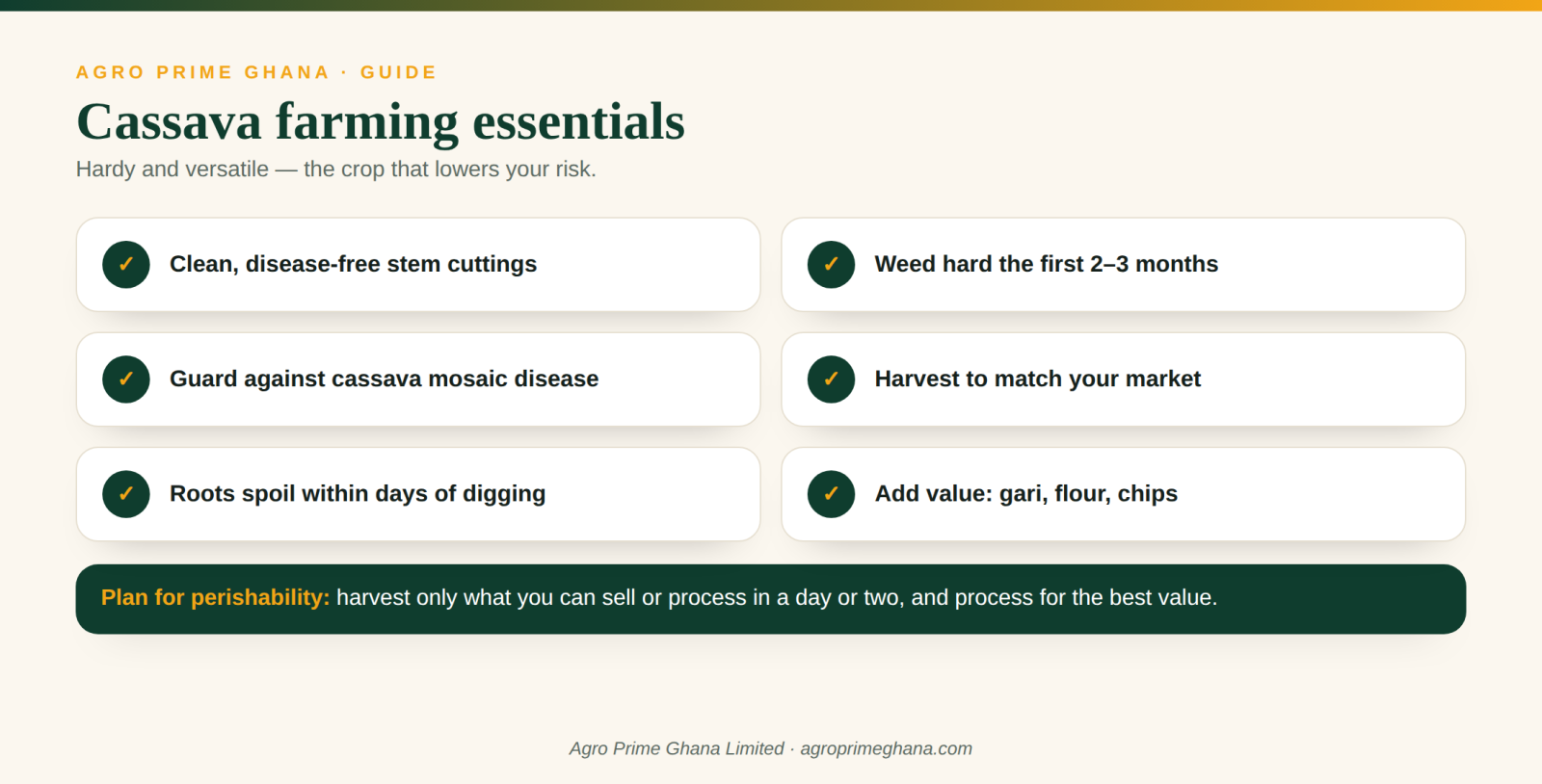
Cassava is hardy, drought-tolerant and grows on poor soils, making it a low-risk staple with many markets. Plant healthy, disease-free stem cuttings of a good variety, keep fields weed-free early, and use clean planting material to avoid cassava mosaic disease. It matures in about 8–15 months and can be left in the ground until needed — but roots spoil within days of harvest, so line up your market or processing before you dig.
Why cassava is a smart crop
Few crops are as forgiving or as useful as cassava. It thrives in poor, marginal soils and tolerates drought and erratic rainfall better than almost any other staple, so it lowers a farmer's weather risk. Its roots can be left in the ground for months and harvested as needed, acting as a living store of food and cash — a real advantage in the lean season. And the market is enormous and varied: cassava is a daily food for millions (fufu, banku, kokonte), the raw material for gari, dough, flour, starch and chips, and a cheap carbohydrate that features in poultry and livestock feed. Whether you sell fresh roots, process them, or use cassava as home-grown feed energy alongside your poultry feed, it is one of the most versatile crops a Ghanaian farmer can grow.
Choosing a variety and planting material
Cassava is grown from stem cuttings, not seed, so your planting material is everything. Start with an improved, high-yielding variety suited to your zone and purpose — some varieties are bred for high starch and gari, others for early maturity, disease resistance or low cyanide. Get clean, healthy cuttings from disease-free plants: this is the single most important step, because planting infected stems spreads cassava mosaic disease, the crop's biggest yield-killer. Take cuttings from mature, vigorous stems, and plant them promptly. Using certified or known clean planting material from a reputable source, rather than random stems from an unknown field, protects your whole crop from the start.
Land preparation and planting
Prepare a reasonably clean, loosened seedbed; cassava does not need rich soil, but good land preparation gives the young plants a head start against weeds. Plant the cuttings at the recommended spacing — usually on ridges or mounds in wetter areas for drainage, or on the flat in drier zones — inserting each cutting into the soil at a slant or upright with several buds above ground. Plant at the start of the rains so the cuttings establish with enough moisture. Correct spacing matters: too close and roots are small, too wide and you waste land. Cassava is often intercropped with maize, legumes or vegetables in its early months, making good use of the land before the cassava canopy closes.
Weed, pest and disease management
Cassava's care is light but front-loaded:
- Weed early and well. Young cassava competes poorly with weeds, so the first two to three months of weed control are critical; once the canopy closes, cassava shades out most weeds itself.
- Guard against cassava mosaic disease by using clean planting material and removing (roguing) badly infected plants — this virus, spread by whiteflies and infected cuttings, is the main threat to yield.
- Watch for pests such as mealybugs, green mites and, at times, grasshoppers; resistant varieties and healthy plants cope best.
- Manage soil fertility on poorer land with organic matter or modest fertiliser for better root yields, though cassava will still produce where little else can.
Harvesting and cassava's big weakness
Cassava matures in roughly 8–15 months depending on variety, and one of its charms is flexibility — you can harvest when roots are ready and leave the rest in the ground as a store. But here is the crucial catch every cassava farmer must plan around: fresh cassava roots deteriorate within two to three days of harvest, turning woody and discoloured. Unlike grain, you cannot dig your whole field and store the roots. This means you harvest to match your market or processing capacity: dig what you can sell fresh or process quickly, and leave the rest growing. Getting this timing right — harvesting in step with buyers or your gari/flour processing — is the difference between profit and spoiled roots. Never harvest more than you can move or process within a couple of days.
The economics and markets
Cassava's appeal is low input cost and multiple markets. Your main costs are land preparation, planting material and the early weeding labour; the crop needs little fertiliser and tolerates poor conditions, keeping costs down. On the sales side you can sell fresh roots to households, market traders and processors; process into gari, dough, flour, chips or starch for higher value; or use cassava as cheap feed energy. Fresh roots are cheapest and most perishable, so value addition through processing usually earns far more. Keep simple records of costs and yields per acre so you know your real margin — the same discipline behind good farm record keeping. With cheap production and a food that Ghana always eats, cassava offers dependable returns for the farmer who solves the perishability puzzle.
Value addition: from roots to gari, flour and more
Because fresh cassava is cheap and perishable, the real money is often in processing it into stable, higher-value products. Gari — grated, fermented, pressed and roasted cassava — is the classic: it stores for months, travels well, sells everywhere and turns a perishable root into a durable staple with a much better margin. Cassava dough for banku and fufu, high-quality cassava flour (used in baking and food industries), starch (for food and industry), and dried cassava chips (for storage, feed or export) all add value and shelf life. Even simple, hygienic processing lifts returns and cuts the losses that fresh roots suffer. For a farmer, pairing cassava growing with even small-scale processing — your own or a nearby processor — captures far more of the crop's value and removes the perishability problem in one move.
Cassava in poultry and livestock feed
For a mixed farmer, cassava has a special role as a cheap, home-grown energy source in animal feed. Dried cassava chips or meal can partly replace maize as the energy component of poultry and livestock rations, which matters because energy (largely maize) is one of the biggest feed costs. This has limits — cassava is lower in protein than maize and must be properly dried, and some varieties need processing to reduce cyanide — so it complements rather than fully replaces maize, and is best used with good feed formulation advice. But for a farmer who grows cassava and keeps poultry, turning some of the crop into feed energy is a smart way to cut the feed bill and use every part of the harvest, tying your crop and livestock enterprises together.
Finding buyers and the cassava value chain
Because fresh cassava is so perishable, lining up your route to market before harvest is part of growing it well. The simplest channel is selling fresh roots to households, market women and roadside sellers, but this is the lowest-value and most spoilage-prone route. Better returns come from connecting to the wider value chain: supplying gari and dough processors, selling to flour and starch factories, or feeding an industrial buyer that uses cassava starch. Increasingly, aggregators and processors contract farmers for cassava, which gives a more reliable market than the open one. If you process yourself — even small-scale gari-making — you become your own buyer and capture the most value. The practical rule is to know your buyer and their schedule before you dig, so roots move from field to sale or processing within a day or two. A farmer who has built relationships with processors, aggregators or a steady set of fresh-market customers, or who processes on-farm, turns cassava's perishability from a threat into a managed part of the business, and consistently earns more than one who harvests hopefully and scrambles to sell.
Common mistakes to avoid
- Planting infected or poor cuttings, spreading cassava mosaic disease and crippling yields. Use clean, healthy material.
- Weak early weed control, letting weeds smother young cassava before the canopy closes.
- Harvesting more than you can sell or process, so roots spoil within days.
- Selling only cheap fresh roots when processing into gari or flour would earn far more.
- Poor spacing, giving small roots (too close) or wasted land (too wide).
- Ignoring variety choice, planting whatever is on hand rather than a variety suited to your market.
Frequently asked questions
Is cassava farming profitable in Ghana?
How long does cassava take to mature?
How is cassava planted?
What is cassava mosaic disease?
Why does cassava spoil so quickly after harvest?
What can I make from cassava?
Can I feed cassava to my poultry?
Does cassava need good soil and fertiliser?
The bottom line on cassava farming
Cassava is the crop that lowers a farmer's risk: it grows where others fail, stores in the ground, and feeds into markets that never disappear. The keys to profiting from it are straightforward — plant clean, healthy cuttings of a good variety to keep cassava mosaic disease out; weed hard in the first months until the canopy closes; and, above all, plan for perishability by harvesting only what you can sell or process within a couple of days and by adding value through gari, flour, chips or starch rather than dumping cheap fresh roots. For a mixed farmer, cassava also doubles as home-grown feed energy for poultry and livestock, tying the farm together. Grow it well, process it or sell it in step with your market, and cassava becomes one of the most dependable, versatile earners in Ghanaian farming — a true all-weather crop.
Grow a dependable, versatile crop
Agro Prime Ghana Limited runs a hatchery and agribusiness in Kasoa. Cassava diversifies your income and can even feed your poultry. Talk to us about building a resilient, mixed farm: book a visit or message WhatsApp (+233 24 915 1503).