You deworm the flock on schedule, the birds have a good appetite, yet a handful stay thin, the feathers look dull, and growth is stubbornly uneven no matter how much feed you push. Then one morning you notice what looks like tiny grains of moving rice around a vent or in fresh droppings. That is the signature of tapeworm — a parasite most Ghanaian keepers never see coming, because unlike roundworm it is not cleared by the piperazine everyone reaches for, and it cannot get into your birds at all without a snail, a beetle, an ant or a housefly to carry it in first. This guide explains what tapeworms are, how to recognise them, the intermediate hosts that drive the whole problem, and how to actually control them under Ghanaian conditions.
Written by the Agro Prime Ghana poultry team and reviewed against current veterinary references (MSD Veterinary Manual and poultryDVM). Last updated September 2026.
Key takeaways
Tapeworms (cestodes) are flat, segmented gut parasites. The common poultry species in warm climates include Davainea proglottina (tiny — often under 4 mm, but very damaging) and several Raillietina species (which can exceed 30 cm). Every one of them needs an intermediate host to complete its life cycle: snails and slugs (Davainea), beetles (R. cesticillus), ants (R. echinobothrida, R. tetragona) and houseflies (Choanotaenia). Birds only get infected by eating that host — so you cannot stop tapeworm with dewormer alone; you must break the host cycle. Signs are weight loss despite a good appetite, stunted uneven growth, dull feathers and, in layers, lower egg output; the giveaway is rice-grain segments in droppings or around the vent. Treat with a suitable dewormer such as praziquantel (10 mg/kg) or fenbendazole (15 mg/kg for 3 days), but understand that expelling the worm is a short-term fix if the scolex stays attached or the intermediate hosts are left in place.
What tapeworms actually are
Tapeworms are flatworms (cestodes), built quite differently from the roundworms most keepers know. Where a roundworm is a single cylindrical body, a tapeworm is a chain: a tiny head called the scolex that hooks and buries into the gut wall, followed by a long ribbon of repeating segments (proglottids), each essentially a self-contained egg factory. The mature segments break off and pass out in the droppings packed with eggs — exactly what you see when you spot those pale, rice-like grains. According to the MSD Veterinary Manual, thousands have been recovered from a single bird. The size range is enormous: Davainea proglottina is often shorter than 4 mm and easy to miss even at post-mortem, while Raillietina species may exceed 30 cm — and the small ones are not the harmless ones, since Davainea is highly pathogenic despite its size.
The single most important fact about poultry tapeworms — the one that changes how you fight them — is that none of them can pass directly from bird to bird. A roundworm egg picked up straight off the litter can infect the next bird; a tapeworm cannot. Its egg must first be eaten by a specific intermediate host — a snail, slug, beetle, ant, earthworm or fly — inside which it develops into an infective larval stage, and only when your chicken eats that infected host does it pick up the worm. That detour through a second animal is the parasite's great weakness, and it is where your control effort should be aimed.
Why they matter on a Ghanaian farm
Tapeworm damage is rarely dramatic, which is precisely why it drains money quietly for months. The scolex, buried in the intestinal lining, causes local injury; the worm competes for nutrients the bird has paid for in feed; and the net effect is poor absorption, poor feed conversion and slowed growth. The MSD Veterinary Manual records that Davainea proglottina "may cause weight loss," that Raillietina tetragona causes "weight loss and decreased egg production," and that Raillietina echinobothrida produces granulomas — hard nodules — at its attachment sites, long known as nodular disease. On poultryDVM, the classic picture is weight loss despite a good appetite, stunted growth, dull feathers and lethargy, with rice-like segments in the faeces being the tell-tale sign.
Ghana's conditions make the intermediate-host side of the equation easy to satisfy. Warm, humid weather and damp ground around leaking drinkers are ideal for snails and slugs; open litter and spilt feed draw beetles; poor sanitation and rubbish breed houseflies. Free-ranging and semi-scavenging birds — extremely common here — spend all day deliberately hunting the very insects, worms and snails that carry tapeworm. So while a clean commercial broiler house on wire may rarely see cestodes, the typical Ghanaian layer flock on deep litter, and above all the local and cockerel birds that forage in the compound, are constantly exposed. The parasite is not exotic here; it is built into the way most birds are kept.
Know the species and their carriers
Because control means attacking the intermediate host, it helps to know which host goes with which worm. The table below pairs the common poultry tapeworms with the carrier they depend on and what each tends to do, drawn from the MSD Veterinary Manual.
| Tapeworm species | Intermediate host | Size & effect |
|---|---|---|
| Davainea proglottina | Slugs and snails | Tiny (often <4 mm) but highly pathogenic; weight loss, gut damage |
| Raillietina cesticillus | Beetles | Common; generally milder, but heavy loads still cost growth |
| Raillietina echinobothrida | Ants | Causes nodules ("nodular disease") at attachment sites |
| Raillietina tetragona | Ants | Weight loss and reduced egg production |
| Choanotaenia infundibulum | Houseflies | Can grow long; associated with fly-heavy, dirty environments |
There is a practical pattern in that table, noted by poultry extension specialists: the intermediate host tends to match the housing system. Caged birds are mostly exposed through houseflies, birds on litter through beetles and termites, and free-range birds through snails and earthworms — so how your birds are kept tells you where to point your control effort.
How to recognise a tapeworm problem
Tapeworm rarely kills outright, so you diagnose it by pattern rather than by a single dying bird. Watch for:
- Rice-grain segments — small, pale, sometimes still-moving flat grains in fresh droppings or around the vent feathers. This is the most specific sign and worth looking for deliberately.
- Weight loss and thinness despite a good appetite — birds that eat well but stay lean, with a prominent keel bone. The feed is going somewhere other than the bird.
- Stunted, uneven growth across a batch, with a tail of "poor doers" that never catch up.
- Dull, ruffled feathers and lethargy, and, in layers, lower egg production with heavier infestations.
The cheapest confirmation is a post-mortem: open the small intestine of a freshly dead or culled poor-doer and look for the worms attached to the lining — the long Raillietina ribbons are visible to the naked eye, though tiny Davainea needs a careful look. If you are seeing the pattern above without a clear cause, a post-mortem by someone who knows what they are looking at settles it quickly.
Field note: when the dewormer "isn't working"
A complaint we hear often is that a farmer dewormed the flock but the thin birds and rice-grain segments came straight back. Nine times out of ten it is one of two things. Either the product used was a plain roundworm dewormer (like piperazine) that simply does not touch tapeworm — different parasite, different drug. Or the birds were treated but nothing was done about the snails, beetles and flies around the house, so the birds re-infected themselves within weeks by eating fresh infected hosts. Deworming and host control are not alternatives; on a tapeworm farm you need both, every time.
The life cycle — and why it is your best weapon
Follow the cycle and the control plan writes itself. An infected bird passes egg-filled segments in its droppings onto the litter or ground. An intermediate host — a snail sliding over damp litter, or a beetle in spilt feed — eats those eggs, and inside that host they develop into an infective larval stage; the MSD Veterinary Manual notes that more than 1,500 infective parasites have been recovered from a single slug. Your chicken then eats the snail, slug, beetle, ant or fly, the larva is released in the gut, hooks on with its scolex, and grows into a new tapeworm — and thousands of Davainea have been recovered from a single bird, so the load builds fast where hosts are abundant.
The lesson is that the parasite cannot skip the host step. Break any link — get the segments out of the environment fast, deny the snails and beetles a home, keep flies down, or stop the birds accessing carriers — and you cut the cycle. This is why tapeworm is, in principle, more controllable than roundworm: you have an extra, vulnerable animal to attack.
Treatment: what actually works
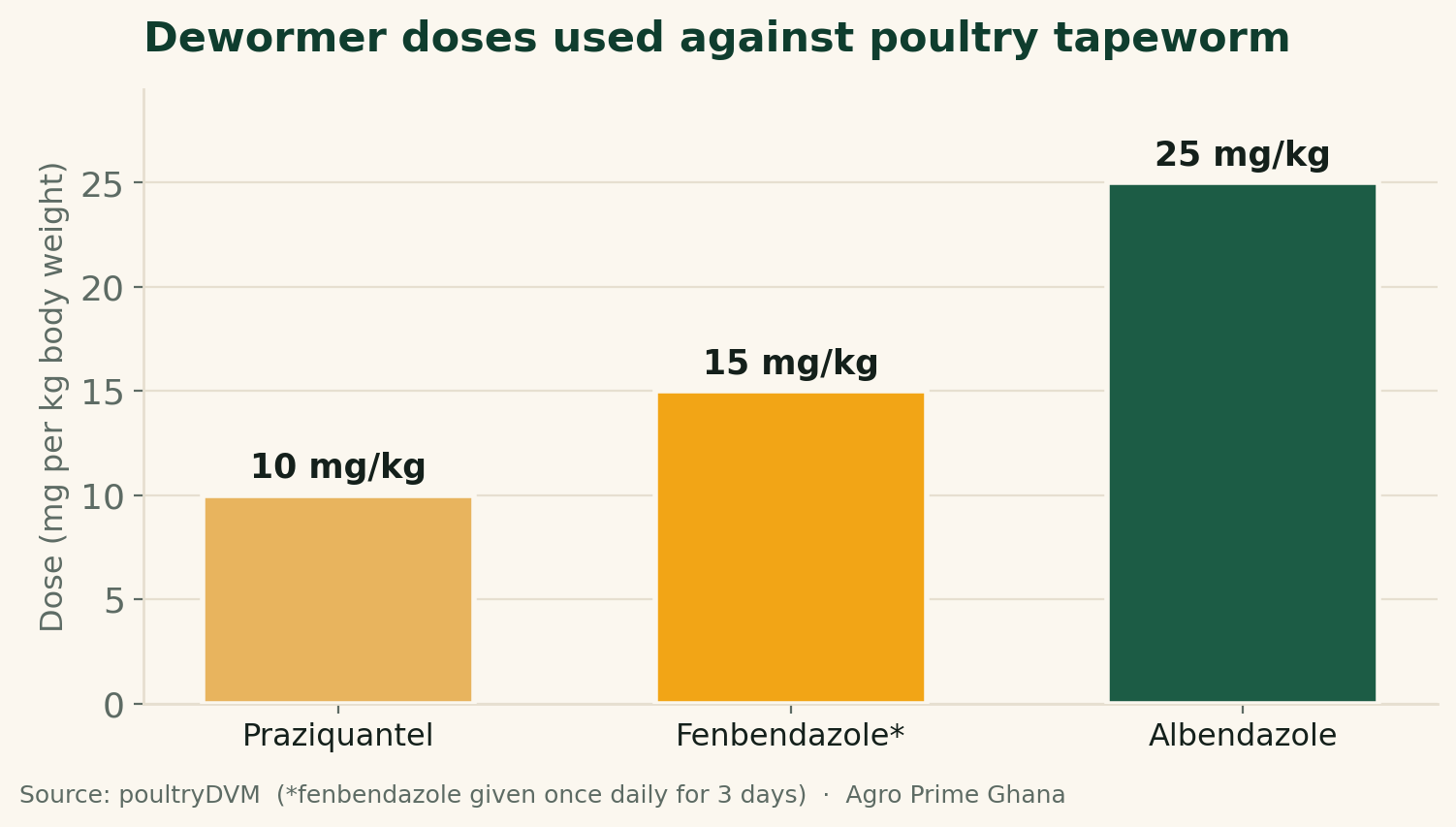
Deworming has its place, but be clear-eyed about what it does. Tapeworms are not affected by piperazine, the most widely sold poultry dewormer, so if tapeworm is your problem you need a product with the right active. On poultryDVM, the drugs used against poultry tapeworm are praziquantel at 10 mg/kg (repeated in 10–14 days), fenbendazole at 15 mg/kg once daily for 3 days, and albendazole at 25 mg/kg. Fenbendazole and albendazole are broad-spectrum and will also clear roundworms, useful on a mixed-parasite farm. A single dose is often not enough — praziquantel is repeated after 10–14 days to catch worms that were immature, or picked up again, at the first treatment.
There is an important limit to spell out. The MSD Veterinary Manual cautions that expelling the parasite is only a short-term remedy if the scolex is not removed or the intermediate host is not eliminated — if the head stays hooked in the gut wall the worm can regenerate, and if the snails, beetles, ants and flies still swarm the compound the birds simply re-load. Products approved specifically for poultry tapeworm are limited in many markets, so use a dewormer licensed for poultry, follow the label dose exactly, and — this matters for anyone selling eggs or meat — observe the stated egg and meat withdrawal period. When in doubt on drug choice, dose or withdrawal, ask a veterinary or extension officer. Our guide to deworming poultry in Ghana covers scheduling and safe use in more detail.
Field note: treat the ground, not just the bird
On the farm the routine that keeps cestodes down happens around the birds, not inside them. We keep litter dry and friable so snails and slugs have nowhere to thrive, clear spilt feed so beetles are not fed, cut back weeds and rubbish where flies and ants breed, and drain the damp patches under drinkers that snails love. Deworming with the right product goes on top of that — never instead of it. When keepers do the environmental work the intervals between worm problems stretch out on their own; when they only dose, the rice grains are back before the next batch is grown.
Prevention: breaking the host cycle
Because there is no vaccine and treatment alone does not hold, prevention is a management job aimed squarely at the intermediate hosts and the droppings that feed them. The measures that work:
- Keep litter dry and well managed. Damp litter is a nursery for snails and slugs and keeps segments moist and viable. Dry, friable litter is hostile to all of them — see our guide to poultry litter management.
- Control flies aggressively. Manage manure and moisture, clear rubbish, and keep the surroundings clean so houseflies — the carrier for Choanotaenia — are not breeding at your door.
- Deny beetles and ants a home. Clear spilt feed, don't let feed cake in corners, and keep the area around houses tidy and free of the debris that harbours darkling beetles and ants.
- Drain snail habitat. Fix leaking drinkers, grade water away from the house, and clear the wet, weedy spots where snails and slugs congregate.
- Rest and clean between batches. Clean out, disinfect and dry the house so a new flock does not inherit last flock's segments and hosts.
- Be realistic about free-range birds. Scavenging birds will always find hosts, so for them regular strategic deworming with the correct product plus general yard hygiene — the basis of our poultry biosecurity guide — is the practical compromise.
The bottom line on tapeworms
Tapeworms are the quiet tax on a lot of Ghanaian flocks — especially layers on litter and foraging local birds — costing growth, feed efficiency and eggs while rarely killing outright. They are unusual in that they cannot infect a bird directly: they must ride in on a snail, slug, beetle, ant or housefly, which is both why they thrive in our warm, damp, insect-rich conditions and their greatest weakness. Recognise them by the rice-grain segments and by thin birds that eat well; treat with the right drug — praziquantel or a benzimidazole, not piperazine — and repeat as directed; but above all attack the intermediate hosts and keep the environment dry and clean, because a worm you expel today just walks back in on tomorrow's snail if the ground is left as it was. Do both, consistently, and tapeworm becomes a managed background risk rather than a recurring mystery.
Frequently asked questions
What are the signs of tapeworm in chickens?
How do chickens get tapeworms?
What are the intermediate hosts of poultry tapeworms?
Will piperazine treat tapeworm?
How do you treat tapeworm in poultry?
Can I get tapeworms from my chickens?
Why do the worms keep coming back after I deworm?
Are free-range and local birds more at risk?
Sources & further reading
- MSD Veterinary Manual — Helminthiasis in Poultry (tapeworm species, sizes, intermediate hosts, pathogenicity, scolex, treatment limitations).
- poultryDVM — Tapeworm infection in chickens (signs, intermediate hosts, diagnosis, drug doses).
- Poultry Extension (eXtension) — Internal Parasites of Poultry (tapeworm vs roundworm, host control by housing system, deworming advice).
- Agro Prime Ghana guides: deworming poultry, poultry litter management, and poultry biosecurity.
About Agro Prime Ghana
Agro Prime Ghana Limited runs a poultry hatchery and mixed agribusiness in Kasoa, supplying day-old chicks and working alongside poultry keepers across the country. These guides draw on that hands-on hatchery and farm experience, checked against current veterinary references. This article is general educational information, not a substitute for diagnosis by a qualified veterinary or extension officer — if your flock is affected, get it seen and use only poultry-licensed dewormers at the correct dose and withdrawal period. Need chicks, feed advice or farm support? Book a visit or message us on WhatsApp (+233 24 915 1503).