Look closely at the legs of an older hen or, more often, an ageing cock in the flock. Instead of the smooth, flat, overlapping scales of a healthy shank, the leg is thickened and swollen, the scales lifted and standing proud, crusted with rough white deposits that look almost like the leg has been dusted with dried lime. In bad cases the toes are deformed and the bird walks stiffly and painfully. This is scaly leg, caused by a tiny burrowing mite called Knemidocoptes mutans that spends its whole life tunnelling under the leg scales. It spreads slowly, is easy to miss until it is well advanced, and — untreated — can cripple a bird. This guide explains how to spot it, treat it and keep it out of your flock in Ghanaian conditions.
Written by the Agro Prime Ghana poultry team and reviewed against current veterinary references (MSD Veterinary Manual and Poultry Keeper). Last updated September 2026.
Key takeaways
Scaly leg is caused by Knemidocoptes mutans, a microscopic mite that burrows under the scales of a bird's legs and feet to feed on keratin, lifting the scales into raised, crusty, thickened, unsightly deposits. It affects older birds most, spreads slowly by direct contact — often brought in on new birds — and its entire life cycle (about 10–14 days) happens on the bird. Left alone it causes lameness and deformity, and birds can eventually stop feeding and die after several months. There is no quick fix: treatment is smothering the mites with oil or petroleum jelly plus, in the UK, veterinary-prescribed ivermectin, repeated over several weeks — and the ugly scales can take up to a year to moult off and regrow normal. Prevention is quarantine of new birds, clean perches and early checking of legs.
What scaly leg actually is
Scaly leg is not a disease of the skin's surface — it is a parasitic mite infestation that works underneath it. The MSD Veterinary Manual describes Knemidocoptes mutans as a microscopic, roughly spherical, sarcoptic mite that tunnels into the tissue under the scales of the bird's legs. Down there it feeds on the keratin — the tough protein that makes up the scales — and its burrowing, together with the debris and the bird's own inflammatory response, forces the scales up and away from the leg. What you see on the outside as rough, raised, crusty scale is the visible result of a mite colony working away underneath. Poultry Keeper notes the mite feeds on the keratin beneath the scales, producing the characteristic scaly, raised, encrusted legs.
It belongs to the same broad family (Sarcoptidae) as the mange mites of mammals, and it has a close relative worth knowing about: the MSD Veterinary Manual also describes the depluming mite, which burrows into the skin at the base of the feathers rather than the legs, causing intense irritation, feather-pulling and feather loss. Both are "burrowing" mites that live within the skin, quite different from the blood-feeding red mite and northern fowl mite of the surface and house cracks — and knowing which you face matters, because the treatments differ.
Why it matters — and where it shows up in Ghana
Scaly leg is very much a problem of backyard, free-range and long-lived birds rather than fast-turnover commercial broilers. The MSD Veterinary Manual notes it is found primarily on older birds and is now rare in modern intensive poultry facilities but not uncommon in backyard flocks — which describes a great many Ghanaian holdings, where hens, cocks and local breeds are kept for years, roost together, and mix with neighbours' birds. Because broilers are slaughtered young, they rarely show it; it is the family layer, the breeding cock, the local fowl scratching around the compound — the birds that live long enough for a slow infestation to build — that suffer.
The harm is real. As the scales thicken and lift, the legs become sore and the bird grows lame. The MSD Veterinary Manual records that in neglected cases the scales become raised, the bird goes lame, stops feeding, and death can result after several months. Long before that, an infested bird is uncomfortable, less active, may struggle to perch, and — in a valuable breeding cock or a productive hen — is quietly underperforming. Crusty, deformed legs are also an obvious sign to any buyer that a flock is not being watched closely.
How to recognise scaly leg
The signs are on the legs and feet, and they build gradually, which is why regular looking matters. Early on you may see only a slight roughness or a few scales beginning to lift. As it progresses, the classic picture develops: thickened, swollen legs; scales that are clearly raised and standing out from the leg instead of lying flat; and rough, crusty, white or grey encrustations — Poultry Keeper and the University of Guelph's diagnostic lab describe white, powdery, exfoliating crusts and thickened skin with scales protruding. In advanced cases the feet swell, the toes and claws deform, and the bird becomes visibly lame, reluctant to move or perch. Compare a suspect bird's legs with those of a young, healthy bird in the same flock and the difference is unmistakable — smooth and flat versus rough, raised and crusty.
Diagnosis can be confirmed by a skin scraping examined under the microscope, as the MSD Veterinary Manual notes, which reveals the mites within the tissue. On most farms, though, the appearance of the legs, the fact that it is an older bird, and the slow spread through the flock are enough to make a confident working diagnosis and start treatment.
Field note: check the shanks whenever a bird is in your hands
Scaly leg rewards the keeper who looks. Every time a bird is handled — for weighing, dosing, selecting breeders or just catching one for the pot — it takes only a second to glance at the shanks and toes. Smooth, tidy, flat scales are what a healthy leg looks like; any roughening, lifting or crusting on an older bird is worth acting on straight away, because it is far easier to clear an early, mild case than a leg that is already thick, crusted and deformed. We pay special attention to the old cocks and the long-serving hens, since they are the ones most likely to be quietly carrying it.
The mite's life cycle — and why that shapes treatment
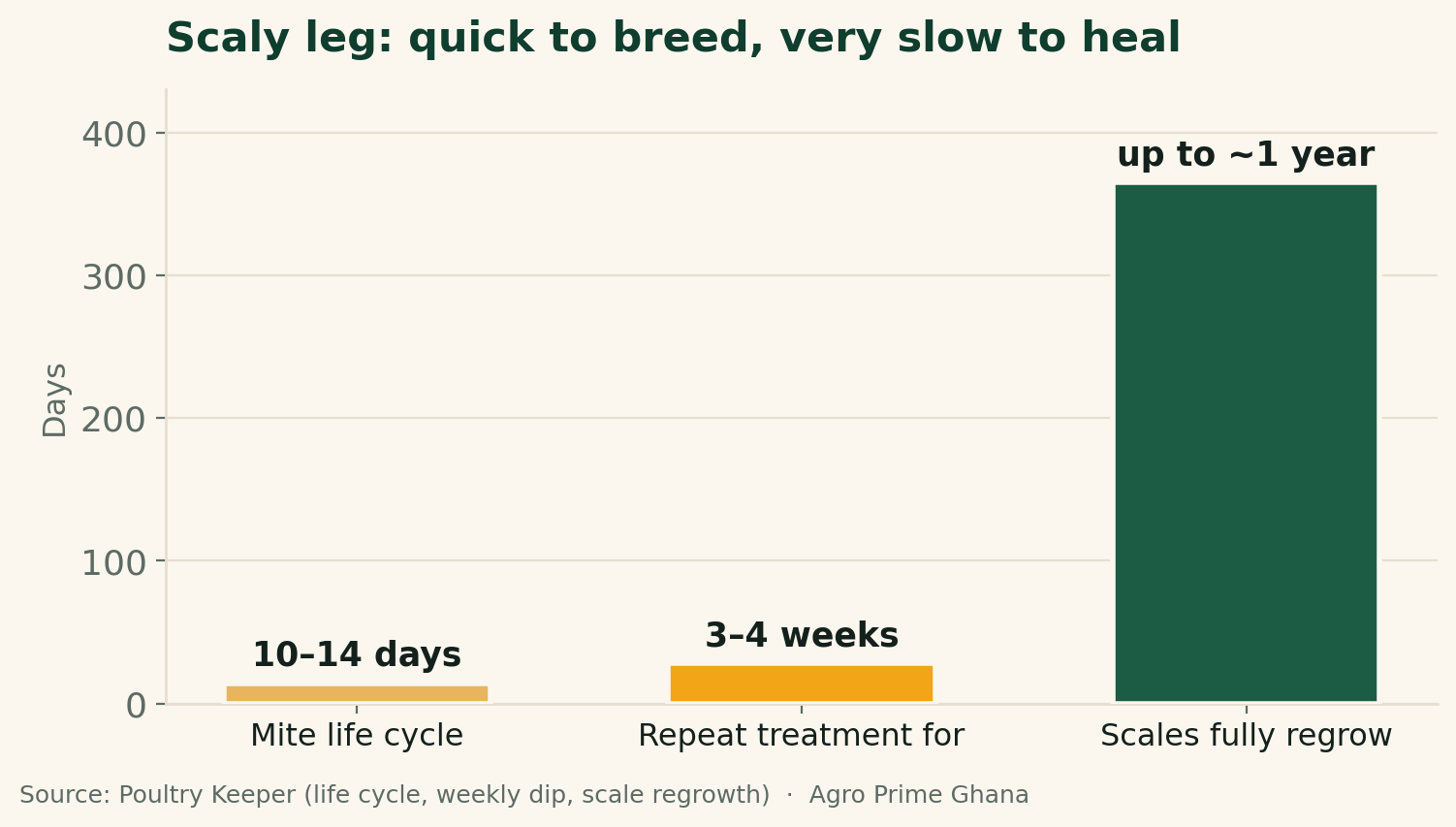
Understanding the mite explains the whole treatment strategy. The critical fact, from Poultry Keeper, is that Knemidocoptes mutans spends its entire life cycle on the bird — egg, larva, nymph and adult, all under the scales — completing that cycle in about 10 to 14 days. It does not need to leave the host to breed, and transmission is by direct contact: mites pass from an infested bird to a clean one when they roost side by side, or when a new, infested bird is brought into the flock. The MSD Veterinary Manual confirms the whole life cycle is in the skin and transmission is by contact, and notes infestations may stay latent until stress lets the population climb. Because everything happens on the bird, and slowly, scaly leg spreads far less explosively than the fast-breeding red mite — but it is persistent, and it will keep passing along a perch year after year if nothing is done.
The two practical lessons: first, since the mite lives on the bird, you treat the bird, not just the house (though clean perches help). Second, because eggs hatch over a 10–14-day cycle and treatments do not always kill every stage, you must repeat treatment over several weeks to catch mites that hatch after the first application. A single treatment is rarely enough.
Treating scaly leg
The good news is that scaly leg is very treatable, and the mainstay is simple and cheap: smother the mites. Because they live in a sealed environment under the scales, coating the legs in oil deprives them of air and kills them. The proven approaches:
- Oil or petroleum jelly. Daily application of an oil-based product — petroleum jelly (Vaseline), mineral oil, paraffin or a vegetable oil — softens the crusts and suffocates the mites underneath. Poultry Keeper recommends using Vaseline to soften the scales, with the jelly between treatments helping to suffocate the mite. This is the single most accessible treatment for any Ghanaian keeper: cheap, safe and effective if kept up.
- A weekly antiseptic dip. Poultry Keeper describes dipping the legs in surgical spirit (or a suitable leg wash) once per week for 3 to 4 weeks, with petroleum jelly applied in between. The repeated weekly cycle is what carries treatment across the mite's 10–14-day life cycle so newly hatched mites are caught.
- Ivermectin. For heavier infestations, an avian ivermectin product kills scaly leg mites (and common worms at the same time). In the UK this is a veterinary prescription product with a standard 7-day egg withdrawal period; here, use any such medicine strictly on veterinary or qualified advice and observe withdrawal periods. Deworming and ectoparasite control often overlap — our poultry deworming guide covers related worming.
- Gentle cleaning, not scrubbing. Soften and gently wash the legs, but do not forcibly pull or scrub off the crusty scales — they are attached to living tissue and pulling them causes pain and bleeding. Let them soften and moult off naturally over time.
Be patient about appearances. Even after the mites are dead, the damaged, thickened scales do not snap back to normal — Poultry Keeper notes it can take up to a year for the old scales to moult and healthy ones to regrow. So judge success by the bird's comfort and the halt in progression, not by instantly smooth legs.
Field note: treat the whole roost, not just the worst bird
Because scaly leg passes bird-to-bird along the perch, the visibly crusty cock is usually not the only carrier — others are likely in the early, easily-missed stage. When we find one clear case, we check and treat every bird that shares that roost, and we give the perches, which the birds' legs are in contact with all night, a good clean and where practical a light coat of a safe oil or an approved treatment. Treating one bird and returning it to an untreated roost just lets the mites walk straight back. Clear the whole group over the same few weeks and you actually break the cycle.
Comparing the burrowing leg and skin mites
It helps to keep the burrowing mites straight, since they are treated on the bird rather than in the house, unlike the blood-feeding surface mites.
| Mite | Where it lives | What you see | Main approach |
|---|---|---|---|
| Scaly leg mite (Knemidocoptes mutans) | Under the scales of legs and feet | Raised, crusty, thickened legs; lameness; deformed toes | Oil/petroleum jelly to smother; ivermectin; repeat weekly |
| Depluming mite (Knemidocoptes / Neocnemidocoptes gallinae) | In the skin at the base of feathers | Intense itching, feather-pulling, feather loss | On-bird acaricide/ivermectin on veterinary advice |
| Red mite / northern fowl mite | On the skin surface and in house cracks (red mite feeds at night) | Anaemia, pale combs, drop in lay, mites/eggs in crevices | Treat the house and birds; break the cycle |
The key contrast: scaly leg and depluming mites burrow and live on the bird, so you treat the bird; red mite lives largely in the house and feeds at night, so you must treat the house too. Getting this right saves you from, say, spraying the coop repeatedly for a scaly leg problem that is entirely on the bird's legs.
Prevention: quarantine, clean perches and early eyes
Since scaly leg usually walks in on a new bird and then spreads slowly along the roost, prevention is straightforward:
- Quarantine new birds. The commonest way scaly leg enters a flock is on purchased or gifted adult birds. Keep any new bird separate for a couple of weeks, inspect its legs closely, and treat before it joins the flock — a core part of general poultry biosecurity.
- Inspect legs routinely. Make glancing at the shanks a habit whenever birds are handled, and pay attention to older birds. Early cases are quick and cheap to clear.
- Keep perches and housing clean. Clean, smooth perches and good hygiene reduce contact spread and give mites fewer footholds; some keepers lightly treat perches as a precaution when a case is found.
- Cull or treat carriers. Do not let a chronically infested old bird sit untreated in the flock as a permanent mite reservoir — either treat it thoroughly or, if it is past its use, remove it.
- Support bird condition. Well-fed, unstressed birds resist a build-up better, since infestations can flare when stress lets the mite population climb.
The bottom line on scaly leg
Scaly leg is a slow, creeping mite infestation of older backyard and free-range birds — exactly the long-lived hens and cocks common on Ghanaian holdings. The mite Knemidocoptes mutans lives its whole life under the leg scales, lifting them into the rough, crusty, thickened legs that give the condition its name, and left alone it brings lameness, deformity and eventually death. It is, however, very treatable: smother the mites with oil or petroleum jelly, add a weekly antiseptic dip or vet-advised ivermectin, repeat over several weeks to catch every hatching stage, and be patient while the damaged scales slowly regrow over up to a year. Best of all, quarantining new birds and glancing at the shanks whenever a bird is in your hands keeps it out of the flock in the first place.
Frequently asked questions
What causes scaly leg in chickens?
How do I know my bird has scaly leg mites?
How do you treat scaly leg mites?
Should I scrub off the crusty scales?
How long does it take to clear scaly leg?
Is scaly leg contagious to my other birds?
Why does scaly leg mostly affect older birds?
How do I stop scaly leg getting into my flock?
Sources & further reading
- MSD Veterinary Manual — Mites of Poultry (Knemidocoptes mutans biology, older-bird and backyard prevalence, lesions, lameness and death, depluming mite, diagnosis).
- Poultry Keeper — Scaly Leg Mite (10–14 day life cycle on the bird, Vaseline and weekly surgical-spirit treatment, ivermectin and egg withdrawal, up to a year for scales to regrow).
- University of Guelph Animal Health Laboratory — Knemidocoptes mutans in backyard flocks (crusting, oil-based treatment for at least two weeks, transmission by contact).
- Agro Prime Ghana guides: poultry biosecurity and deworming poultry.
About Agro Prime Ghana
Agro Prime Ghana Limited runs a poultry hatchery and mixed agribusiness in Kasoa, supplying day-old chicks and working alongside poultry keepers across the country. These guides draw on that hands-on hatchery and farm experience, checked against current veterinary references. This article is general educational information, not a substitute for diagnosis and treatment by a qualified veterinary or extension officer — if a bird is badly affected or lame, get it seen. Need chicks, feed advice or farm support? Book a visit or message us on WhatsApp (+233 24 915 1503).