A good layer that was steady on the nest suddenly slows down, then stops laying altogether. She stands upright like a little penguin, her belly feels heavy and doughy, her vent feathers are soiled, and she is slowly losing condition even though she looks almost swollen. Then one morning you find it in the nest box: not an egg, but a strange rubbery, layered, cheesy mass shaped a little like an egg — a lash egg. That mass is a cast of pus and dead tissue from an infected oviduct, and it is the clearest sign of salpingitis, one of the most common and under-recognised killers of laying hens. This guide explains what salpingitis and lash eggs are, why they happen, and what a Ghanaian layer keeper can realistically do about them.
Written by the Agro Prime Ghana poultry team and reviewed against current veterinary references (Merck/MSD Veterinary Manual and peer-reviewed poultry research). Last updated September 2026.
Key takeaways
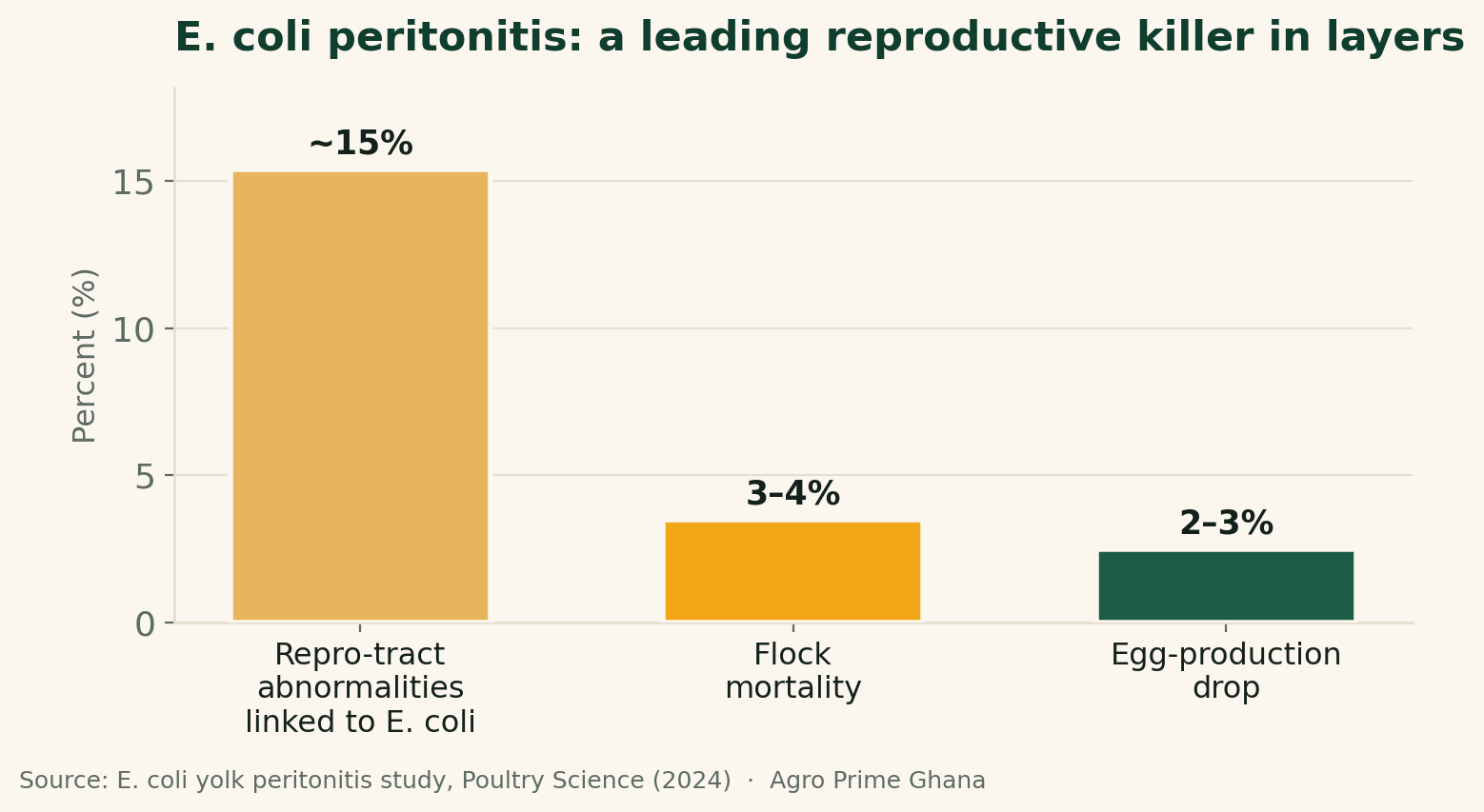
Salpingitis is inflammation and infection of the oviduct (the tube that builds the egg), usually caused by bacteria — most often Escherichia coli (E. coli), sometimes with Mycoplasma, Salmonella or others. It is one of the most common causes of death in commercial layers and breeders, and easy to miss because the hen simply stops laying and slowly wastes. A lash egg — a rubbery, layered mass of pus and tissue instead of a real egg — is a hallmark sign. Infection usually climbs up from the vent (an ascending infection) or arrives from the airways, and once yolk and bacteria reach the abdomen you get egg (yolk) peritonitis, which is frequently fatal. In one study, E. coli yolk peritonitis was linked to about 15% of reproductive-tract abnormalities in commercial layers, with roughly 3–4% mortality and a 2–3% drop in egg production. Medical treatment usually disappoints, so the game is prevention: clean nests, sound bodyweight and lighting management, good hygiene and biosecurity.
What salpingitis actually is
To understand salpingitis, picture the hen's egg factory. The oviduct is a long, folded tube where a released yolk is wrapped in albumen, membranes and finally the shell over roughly a day before being laid. Salpingitis is inflammation of that tube, nearly always driven by bacterial infection. When it becomes infected, egg formation is disrupted, the tube fills with inflammatory material, and instead of clean eggs the hen may lay abnormal ones — or eventually nothing but pus. The bacteria most often responsible is Escherichia coli, with Salmonella, Mycoplasma gallisepticum, Pasteurella multocida and Gallibacterium anatis also implicated. The reason it matters so much is scale: salpingitis and the egg peritonitis it leads to are among the most common causes of mortality in commercial layer and breeder flocks. It is not exotic — it is a routine, ongoing drain that most keepers never name because they never see inside the bird.
What a lash egg really is
The lash egg is the part of the disease keepers actually see, and it causes real confusion, so be precise. A lash egg is not an egg and has nothing to do with diet, calcium or "a stuck egg." It is a solid or rubbery, often layered mass — sometimes described as looking like cheese, cooked egg, or coagulated pus wrapped in tissue — that the inflamed oviduct forms and expels. When the oviduct is infected it pours out exudate, pus and shed lining; as this sits in the tube it gets wrapped in successive layers just as an egg would, producing an egg-shaped cast of infection. Finding one in the nest strongly signals that the hen that produced it has salpingitis. Lash eggs vary — some soft and cheesy, some firm and layered, some streaked with yolk-coloured or bloody material — so the key is not the exact appearance but recognising that this waxy, rubbery, non-egg object means an infected oviduct, and a hen that is seriously unwell even if still walking around.
How the infection gets in
Bacteria reach the oviduct by two main routes, both important for prevention. The first is the ascending infection: bacteria travel up from the vent (cloaca) into the oviduct, helped by the hen's own biology — the hormonal activity of laying, particularly oestrogen, relaxes and opens the tract and can facilitate movement of bacteria from the cloaca into the reproductive system. Dirty nest boxes, vent pecking, prolapse or vent damage all raise the bacterial load right at the doorway, which is why hygiene at the back end matters so much. The second route is descending or systemic: E. coli that is inhaled or spreads from a respiratory or air-sac infection travels through the body and settles in the oviduct and abdomen. This is why the pattern differs across the laying cycle — reviews of colibacillosis in layers note that at the peak of production infection tends to be of respiratory origin, while in late lay it is more often of vent origin. Either way, once bacteria establish in the oviduct, the stage is set for the most dangerous complication of all.
From salpingitis to egg peritonitis — the deadly step
The reason salpingitis kills is what happens next. In a healthy hen, each yolk released by the ovary is caught by the oviduct and turned into an egg. But in an inflamed, damaged or blocked oviduct, yolks can end up loose in the body cavity — and the Merck/MSD Veterinary Manual explains why that is so dangerous: yolk material is "an excellent bacterial growth medium." Add E. coli — which can move in reverse from the oviduct into the abdomen — and the belly becomes a warm incubator for infection. The result is egg (yolk) peritonitis: inflammation of the abdominal cavity, with the fibrin and caseous, "cooked-looking" material the manual describes forming among the organs. This is the doughy, heavy abdomen you feel in a sick hen, and it is frequently fatal. The manual notes it can be the major cause of death before or after peak production, and — critically — that it is diagnosed at necropsy and that antimicrobial treatment is usually ineffective, partly because of how extensive the disease is by the time it is found.
Field note: the "penguin" hen and the doughy belly
The posture is the tell we watch for. A hen carrying fluid and infection in her abdomen shifts her weight back and stands more upright — an almost penguin-like stance — because the heavy belly changes her balance. Pick her up and the abdomen feels full, doughy or firm rather than soft and light, and she is often thinner over the breast than her weight suggests, because much of that "weight" is fluid and infection, not muscle. On the farm, a good layer that suddenly stops laying, stands upright and has a heavy lower belly is a bird we isolate and examine rather than wait on, because by the time these signs are obvious the disease inside is already advanced.
Recognising salpingitis in your flock
Because the disease is inside the bird, you read it from behaviour and body condition. Watch for a hen that stops or sharply reduces laying, or lays abnormal eggs — shell-less, thin-shelled or misshapen — followed by lethargy, a hunched or upright "penguin" posture, a swollen, doughy or firm abdomen, soiled feathers below the vent, and sometimes laboured breathing as the enlarged abdomen presses on the air sacs. Individually these are easy to blame on something else — a broody hen, a pause in lay, a heat-stressed bird — but together, in a hen that has quietly dropped out of production with a heavy belly, they point to salpingitis and its complications. Finding a lash egg confirms it. In a flock, a steady trickle of hens dying "for no obvious reason" around and after peak lay, some with swollen abdomens at post-mortem, is the classic signature — and a strong reason to have a few birds opened by someone who knows what an infected oviduct and a yolk-peritonitis abdomen look like.
Why laying hens are so vulnerable
It is no accident that this strikes productive layers and breeders rather than broilers or growers. A modern laying hen is under enormous reproductive load — releasing a yolk almost every day for many months — and each cycle opens and relaxes the tract, giving bacteria repeated chances to climb in. High-producing strains, over-conditioned birds, and pullets that come into lay before their bodies are ready are all at greater risk. Merck's prevention guidance centres on this: managing bodyweight and uniformity, controlling how fast the ovary and follicles develop, and avoiding early light stimulation of underweight pullets, per the strain's bodyweight and lighting guidelines. Pushing a flock into heavy lay too soon or in poor condition sets it up for reproductive-tract disease. This is one of the clearest places where getting the layer feeding and management programme right — correct bodyweight at point of lay, the right lighting, steady nutrition — is not just about egg numbers but about keeping birds alive through the cycle.
| Feature | Salpingitis / lash egg | Normal egg-laying pause or broodiness |
|---|---|---|
| What is passed | Rubbery, layered mass of pus/tissue (lash egg), or abnormal eggs | Nothing, or normal eggs; hen simply sits |
| Abdomen | Swollen, doughy or firm; bird stands upright | Soft, light, normal posture |
| Body condition | Declining; wasting under the "weight" | Maintained; bird stays bright |
| Recovery | Rarely recovers fully; often progresses to death | Returns to lay normally |
Treatment: manage expectations honestly
Here the honest truth matters more than false hope. Once salpingitis is established, and especially once egg peritonitis has set in, medical treatment is usually disappointing. The Merck Veterinary Manual states plainly that antimicrobial treatment of egg peritonitis is usually ineffective, largely because the disease is so extensive by the time it is recognised. A valuable individual pet hen can sometimes be helped with early antibiotics, anti-inflammatories, supportive care and, in some cases, surgery or hormonal implants to stop ovulation — but these are neither practical nor economic for a commercial or serious backyard flock in Ghana. For most keepers, the realistic response to a hen with confirmed salpingitis and a heavy, doughy abdomen is humane culling rather than prolonged, futile treatment, combined with a hard look at management to protect the rest. Antibiotics scattered across a flock to control reproductive disease are rarely the answer and carry residue and resistance risks; the durable solution is prevention, not treatment.
Prevention: where the disease is actually won
Because treatment fails so often, salpingitis is a disease you beat before it starts. The measures that genuinely reduce it are management measures, and most cost little:
- Bring pullets into lay in the right condition. Follow the strain's bodyweight and lighting programme, and do not light-stimulate underweight pullets into early lay — this is Merck's headline prevention point. A well-grown, uniform flock resists reproductive disease far better.
- Keep nests and litter clean and dry. Dirty nest boxes and fouled floors load the vent area with the very bacteria that climb the oviduct. Clean, dry nesting and good litter management directly cut the ascending-infection risk.
- Protect the airways. Because peak-lay salpingitis is often of respiratory origin, good house ventilation that keeps air fresh and ammonia low reduces the respiratory route into the oviduct.
- Guard water and feed hygiene. Clean, sanitary drinking water limits the E. coli load, and nutrition should keep hens neither over-conditioned nor deficient under a heavy laying load.
- Practise steady biosecurity and control Mycoplasma. Keeping infectious pressure low — the basics of poultry biosecurity, plus controlling Mycoplasma where it is a problem — reduces the bacterial challenge salpingitis feeds on.
- Cull promptly. Remove hens showing the penguin stance and doughy abdomen so they do not linger, suffer and add infection pressure to the house.
Field note: clean nests earn their keep
The cheapest, most overlooked defence against salpingitis on a layer farm is the state of the nest boxes. A hen's vent spends real time pressed against whatever is in the nest, so caked, wet, dropping-fouled nesting material sits a heavy bacterial load right where an ascending infection begins. On the farm we keep nest litter dry and topped up, clean or replace it before it mats, and try to head off floor eggs and vent pecking, since a torn or dirty vent is an open door. It is dull, unglamorous work, but a few minutes on the nests each week does more to keep reproductive infection down than any bottle of medicine will once a hen is already sick.
The economics: a quiet, steady loss
Salpingitis rarely announces itself as an "outbreak," which is exactly why its cost is so easily overlooked. Instead of a dramatic die-off, it takes hens one and two at a time — a bird that stops laying weeks before she dies, eating feed and occupying a nest while producing nothing, then a carcass worth little and unsafe to eat. Across a cycle those quiet losses add up: the research behind the chart above links E. coli yolk peritonitis to a meaningful share of reproductive-tract disease and to measurable mortality and lost egg output. Every hen lost also represents the full cost of rearing her to point of lay — thrown away just as she should be paying it back — and because treatment rarely works, none of it is recoverable. The case for spending on the unglamorous basics — correct pullet management, clean nests, good ventilation, sound water hygiene — is strong: it is far cheaper to prevent reproductive-tract disease than to keep replacing the hens it silently removes.
The bottom line on salpingitis
Salpingitis is the hidden reproductive killer of laying flocks: a bacterial infection of the oviduct, usually driven by E. coli, that stops hens laying, casts out rubbery lash eggs in place of real ones, and slides into the frequently fatal egg peritonitis that leaves a hen upright with a heavy, doughy belly. It hits productive layers and breeders hardest, often around and after peak lay. Do not expect medicine to fix it — by the time you see it, treatment usually fails. Win it instead on management: bring pullets into lay well-grown and on the right lighting, keep nests and litter clean, keep the air fresh and water sanitary, hold the line on biosecurity, and cull affected hens promptly. Get those basics right and you turn a steady, invisible drain on your flock into a rare and manageable problem.
Frequently asked questions
What is a lash egg and does it mean my hen is sick?
What causes salpingitis in laying hens?
What are the signs of salpingitis and egg peritonitis?
Can salpingitis be treated?
Is salpingitis contagious to the rest of my flock?
Why does it strike around peak lay?
How do I prevent salpingitis in my layers?
Is a lash egg or an affected hen safe to eat?
Sources & further reading
- Merck/MSD Veterinary Manual — Egg Peritonitis in Poultry (E. coli cause, yolk as a growth medium, caseous abdominal lesions, diagnosis at necropsy, ineffective treatment, prevention through bodyweight and lighting management).
- The Poultry Site — Colibacillosis in Layers: an Overview (salpingitis as a common cause of layer mortality; respiratory-origin peak-lay vs vent-origin late-lay patterns).
- Peer-reviewed research on E. coli yolk peritonitis in laying hens (Poultry Science, 2024) — reported ~15% of reproductive-tract abnormalities linked to E. coli yolk peritonitis, with ~3–4% mortality and a 2–3% reduction in egg production.
- Agro Prime Ghana guides: layer feeding guide, poultry house ventilation, and poultry biosecurity.
About Agro Prime Ghana
Agro Prime Ghana Limited runs a poultry hatchery and mixed agribusiness in Kasoa, supplying day-old chicks and supporting layer keepers nationwide. These guides combine hands-on hatchery and farm experience with current veterinary references. This article is general educational information, not a substitute for diagnosis by a qualified veterinary or extension officer — if hens are dying or passing lash eggs, get birds examined. Need chicks, layer advice or farm support? Book a visit or message us on WhatsApp (+233 24 915 1503).